2020 AMC 10A Solutions

Scroll down to view professional video solutions and written solutions from LIVE by Po-Shen Loh, print PDF solutions, view answer key, or take the full timed exam.

All problems are used with permission of the Mathematical Association of America (MAA).

1.

What value of xx satisfies x−34=512−13?x- \frac{3}{4} = \frac{5}{12} - \frac{1}{3}? Express your answer as a common fraction.
−23\displaystyle -\frac{2}{3}
736\displaystyle \frac{7}{36}
712\displaystyle \frac{7}{12}
23\displaystyle \frac{2}{3}
56\displaystyle \frac{5}{6}
Concepts:fractionlinear equation
Small hint:
First simplify the right side using denominator 1212
Big hint:
After finding the right side, add 34\frac34 to both sides
Video solution:
Solution video thumbnail
Play video

Click to load, then click again to play

Written solution:
The right side is 512−13=512−412=112\dfrac{5}{12}-\dfrac13=\dfrac{5}{12}-\dfrac4{12}=\dfrac1{12}. Thus x=34+112=912+112=56x=\dfrac34+\dfrac1{12}=\dfrac9{12}+\dfrac1{12}=\dfrac56. Thus, E is the correct answer.

2.

The numbers 3,3, 5,5, 7,7, a,a, and bb have an average (arithmetic mean) of 15.15. What is the average of aa and b?b?
00
1515
3030
4545
6060
Concepts:mean
Difficulty rating: 560
Small hint:
Convert the average of five numbers into a total sum
Big hint:
Subtract the known three numbers before averaging aa and bb
Video solution:
Solution video thumbnail
Play video

Click to load, then click again to play

Written solution:
The five numbers have total sum 5⋅15=755\cdot15=75. Since 3+5+7=153+5+7=15, we have a+b=75−15=60a+b=75-15=60, so the average of aa and bb is 3030. Thus, C is the correct answer.

3.

Assuming a≠3,a\neq3, b≠4,b\neq4, and c≠5,c\neq5, what is the value in simplest form of the following expression? a−35−c⋅b−43−a⋅c−54−b\frac{a-3}{5-c} \cdot \frac{b-4}{3-a} \cdot \frac{c-5}{4-b}
−1-1
11
abc60\displaystyle \frac{abc}{60}
1abc−160\displaystyle \frac{1}{abc} - \frac{1}{60}
160−1abc\displaystyle \frac{1}{60} - \frac{1}{abc}
Difficulty rating: 770
Small hint:
Each denominator is the negative of a matching numerator factor
Big hint:
Count the number of negative signs after cancellation
Video solution:
Solution video thumbnail
Play video

Click to load, then click again to play

Written solution:
Rewrite the denominator factors as 5−c=−(c−5)5-c=-(c-5), 3−a=−(a−3)3-a=-(a-3), and 4−b=−(b−4)4-b=-(b-4). The expression becomes (a−3)(b−4)(c−5)−(a−3)(b−4)(c−5)=−1\dfrac{(a-3)(b-4)(c-5)}{-(a-3)(b-4)(c-5)}=-1. Thus, A is the correct answer.

4.

A driver travels for 22 hours at 6060 miles per hour, during which her car gets 3030 miles per gallon of gasoline. She is paid $0.50\$0.50 per mile, and her only expense is gasoline at $2.00\$2.00 per gallon. What is her net rate of pay, in dollars per hour, after this expense? Give your answer as a whole number of dollars per hour.
2020
2222
2424
2525
2626
Difficulty rating: 1020
Small hint:
Find the total miles driven in two hours
Big hint:
Subtract gasoline cost before dividing by the number of hours
Video solution:
Solution video thumbnail
Play video

Click to load, then click again to play

Written solution:
The driver travels 2⋅60=1202\cdot60=120 miles, so she is paid 120⋅$0.50=$60120\cdot \$0.50=\$60. The trip uses 12030=4\frac{120}{30}=4 gallons of gasoline, costing 4⋅$2=$84\cdot\$2=\$8. Her net pay is 60−8=5260-8=52 dollars over 22 hours, or 2626 dollars per hour. Thus, E is the correct answer.

5.

What is the sum of all real numbers xx for which ∣x2−12x+34∣=2?|x^2-12x+34|=2?
1212
1515
1818
2121
2525
Difficulty rating: 1020
Small hint:
Split the absolute-value equation into two quadratic equations
Big hint:
Remember to count the double root only once in the sum of real numbers
Video solution:
Solution video thumbnail
Play video

Click to load, then click again to play

Written solution:
The equation means x2−12x+34=2x^2-12x+34=2 or x2−12x+34=−2x^2-12x+34=-2. The first gives x2−12x+32=0x^2-12x+32=0, with roots 44 and 88. The second gives (x−6)2=0(x-6)^2=0, with root 66. The sum of all real solutions is 4+8+6=184+8+6=18. Thus, C is the correct answer.

6.

How many 44-digit positive integers (that is, integers between 10001000 and 9999,9999, inclusive) having only even digits are divisible by 5?5?
8080
100100
125125
200200
500500
Difficulty rating: 1090
Small hint:
The last digit must be compatible with both evenness and divisibility by 55
Big hint:
Choose the thousands, hundreds, and tens digits independently after fixing the last digit
Video solution:
Solution video thumbnail
Play video

Click to load, then click again to play

Written solution:
The last digit must be 00, because the number is divisible by 55 and all digits are even. The thousands digit can be 2,4,6,2,4,6, or 88, and each of the hundreds and tens digits has 55 choices. Thus there are 4⋅5⋅5=1004\cdot5\cdot5=100 such integers. Thus, B is the correct answer.

7.

The 2525 integers from −10-10 to 14,14, inclusive, can be arranged to form a 55-by-55 square in which the sum of the numbers in each row, the sum of the numbers in each column, and the sum of the numbers along each of the main diagonals are all the same. What is the value of this common sum?
22
55
1010
2525
5050
Difficulty rating: 1040
Small hint:
The five row sums together equal the sum of all 2525 integers
Big hint:
Compute the arithmetic-sequence sum from −10-10 through 1414
Video solution:
Solution video thumbnail
Play video

Click to load, then click again to play

Written solution:
The sum of the integers from −10-10 to 1414 is 25⋅−10+142=5025\cdot\dfrac{-10+14}{2}=50. If every row has common sum SS, then the five row sums add to 5050, so 5S=505S=50 and S=10S=10. Thus, C is the correct answer.

8.

What is the value of 1+2+3−4+5+6+7−8+⋯+197+198+199−200? \begin{aligned} &1+2+3-4+5+6+7-8\\ &\quad+\cdots\\ &\quad+197+198+199-200? \end{aligned}
9,8009{,}800
9,9009{,}900
10,00010{,}000
10,10010{,}100
10,20010{,}200
Difficulty rating: 1060
Small hint:
Group the expression into blocks of four terms
Big hint:
Find a formula for the jjth block and sum over 5050 blocks
Video solution:
Solution video thumbnail
Play video

Click to load, then click again to play

Written solution:
Group the terms in blocks of four: (1+2+3−4)(1+2+3-4) +(5+6+7−8)+(5+6+7-8) +⋯+\cdots +(197+198+199−200)+(197+198+199-200). The jjth block is (4j−3)+(4j−2)(4j-3)+(4j-2) +(4j−1)−4j=8j−6+(4j-1)-4j=8j-6.
There are 5050 blocks, so the sum is ∑j=150(8j−6)=8⋅50⋅512\sum_{j=1}^{50}(8j-6)=8\cdot\dfrac{50\cdot51}{2} −6⋅50=9900-6\cdot50=9900. Thus, B is the correct answer.

9.

A single bench section at a school event can hold either 77 adults or 1111 children. When NN bench sections are connected end to end, an equal number of adults and children seated together will occupy all the bench space. What is the least possible positive integer value of N?N?
99
1818
2727
3636
7777
Difficulty rating: 1070
Small hint:
Let the equal number of adults and children be PP
Big hint:
The number of bench sections is P7+P11\frac{P}{7}+\frac{P}{11}
Video solution:
Solution video thumbnail
Play video

Click to load, then click again to play

Written solution:
If the equal number of adults and children is PP, then the adults use P7\frac{P}{7} bench sections and the children use P11\frac{P}{11} bench sections. Thus N=P(17+111)=18P77N=P\left(\dfrac17+\dfrac1{11}\right)=\dfrac{18P}{77}.
The least positive integer occurs when P=77P=77, giving N=18N=18. Thus, B is the correct answer.

10.

Seven cubes, whose volumes are 1,1, 8,8, 27,27, 64,64, 125,125, 216,216, and 343343 cubic units, are stacked vertically to form a tower in which the volumes of the cubes decrease from bottom to top. Except for the bottom cube, the bottom face of each cube lies completely on top of the cube below it. What is the total surface area of the tower (including the bottom) in square units?
644644
658658
664664
720720
749749
Difficulty rating: 1380
Small hint:
Start with the surface areas of all seven separate cubes
Big hint:
Each contact hides two faces with the side length of the smaller cube
Video solution:
Solution video thumbnail
Play video

Click to load, then click again to play

Written solution:
The cube side lengths are 1,2,3,4,5,6,71,2,3,4,5,6,7, stacked from largest on bottom to smallest on top. The sum of the surface areas of the separate cubes is 6(12+22+⋯+72)6(1^2+2^2+\cdots+7^2) =6⋅140=840=6\cdot140=840.
Each contact hides two square faces, with areas 12,22,…,621^2,2^2,\ldots,6^2. Subtracting these hidden faces gives 840840 −2(12+22+⋯+62)-2(1^2+2^2+\cdots+6^2) =840−182=658=840-182=658. Thus, B is the correct answer.

11.

What is the median of the following list of 40404040 numbers? 1,2,3,…,2020,12,22,32,…,20202 \begin{aligned} &1,2,3,\ldots,2020,\\ &1^2,2^2,3^2,\ldots,2020^2 \end{aligned} Express your answer as a decimal.
1974.51974.5
1975.51975.5
1976.51976.5
1977.51977.5
1978.51978.5
Difficulty rating: 1460
Small hint:
With 40404040 numbers the median averages the 20202020th and 20212021st smallest
Big hint:
Squares up to 20202020 come from 121^2 through 442;44^2; count how many list entries are at most a given integer
Video solution:
Solution video thumbnail
Play video

Click to load, then click again to play

Written solution:
The median is the average of the 20202020th and 20212021st smallest values.
The perfect squares that are at most 20202020 are 12,…,4421^2, \ldots, 44^2 (since 442=193644^2 = 1936 and 452=202545^2 = 2025), so there are 4444 of them.
Among the list, the numbers ≤1976\le 1976 are the 19761976 integers 1,…,19761, \ldots, 1976 together with those 4444 squares, totaling 1976+44=2020.1976 + 44 = 2020.
Thus the 20202020th value is 19761976 and the 20212021st value is 1977,1977, making the median 1976+19772=1976.5.\dfrac{1976 + 1977}{2} = 1976.5.
Thus, the correct answer is C.

12.

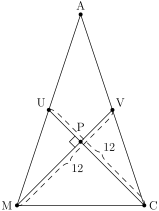
Triangle AMCAMC is isosceles with AM=AC.AM = AC. Medians MV‾\overline{MV} and CU‾\overline{CU} are perpendicular to each other, and MV=CU=12.MV=CU=12. What is the area of △AMC?\triangle AMC?
4848
7272
9696
144144
192192
Difficulty rating: 1660
Small hint:
Put the centroid at the origin and align the perpendicular medians with the axes
Big hint:
The centroid divides each median in a 2:12:1 ratio
Video solution:
Solution video thumbnail
Play video

Click to load, then click again to play

Written solution:
Let the centroid be the origin. Since a centroid divides each median in a 2:12:1 ratio, we may place median MVMV horizontally with M=(8,0)M=(8,0) and V=(−4,0)V=(-4,0), and median CUCU vertically with C=(0,8)C=(0,8) and U=(0,−4)U=(0,-4).
Because UU is the midpoint of AMAM, we get A=2U−M=(−8,−8)A=2U-M=(-8,-8). The area of △AMC\triangle AMC is 12∣(16,8)×(8,16)∣\dfrac12 |(16,8)\times(8,16)| =12(256−64)=96=\dfrac12(256-64)=96. Thus, C is the correct answer.

13.

A frog sitting at the point (1,2)(1, 2) begins a sequence of jumps, where each jump is parallel to one of the coordinate axes and has length 1,1, and the direction of each jump (up, down, right, or left) is chosen independently at random. The sequence ends when the frog reaches a side of the square with vertices (0,0),(0, 0), (0,4),(0, 4), (4,4),(4, 4), and (4,0).(4, 0). What is the probability that the sequence of jumps ends on a vertical side of the square? Express your answer as a common fraction.
12\displaystyle \frac{1}{2}
58\displaystyle \frac{5}{8}
23\displaystyle \frac{2}{3}
34\displaystyle \frac{3}{4}
78\displaystyle \frac{7}{8}
Difficulty rating: 1790
Small hint:
Let each interior lattice point store the probability of hitting a vertical side first
Big hint:
What happens to the two kinds of sides if you reflect the square across a diagonal?
Video solution:
Solution video thumbnail
Play video

Click to load, then click again to play

Written solution:
From any interior lattice point, three consecutive leftward jumps guarantee that the frog reaches a side, so it eventually stops with probability 11. Reflection across either diagonal exchanges vertical and horizontal sides. Thus a frog starting on either diagonal has probability 12\tfrac12 of finishing on a vertical side.
From (1,2),(1,2), the first jump reaches one of (0,2),(0,2), (2,2),(2,2), (1,1),(1,1), or (1,3).(1,3). The first point is on a vertical side, and the other three are on diagonals. The probability is the average 1+3⋅124=58. \frac{1+3\cdot\tfrac12}{4}=\frac58.
Thus, B is the correct answer.

14.

Real numbers xx and yy satisfy x+y=4x + y = 4 and x⋅y=−2.x \cdot y = -2. What is the value of x+x3y2+y3x2+y?x + \frac{x^3}{y^2} + \frac{y^3}{x^2} + y?
360360
400400
420420
440440
480480
Difficulty rating: 1480
Small hint:
Use power sums Sk=xk+ykS_k=x^k+y^k
Big hint:
The relation t2−4t−2=0t^2-4t-2=0 gives a recurrence for SkS_k
Video solution:
Solution video thumbnail
Play video

Click to load, then click again to play

Written solution:
Let Sk=xk+ykS_k=x^k+y^k. Since x+y=4x+y=4 and xy=−2xy=-2, the numbers xx and yy satisfy t2−4t−2=0t^2-4t-2=0, so Sk=4Sk−1+2Sk−2S_k=4S_{k-1}+2S_{k-2}.
Using S0=2S_0=2 and S1=4S_1=4, we get S2=20S_2=20, S3=88S_3=88, S4=392S_4=392, and S5=1744S_5=1744. The expression is x+y+x5+y5x2y2x+y+\dfrac{x^5+y^5}{x^2y^2} =4+17444=440=4+\dfrac{1744}{4}=440. Thus, D is the correct answer.

15.

A positive integer divisor of 12!12! is chosen at random. The probability that the divisor chosen is a perfect square can be expressed as mn,\frac{m}{n}, where mm and nn are relatively prime positive integers. What is m+n?m+n?
33
55
1212
1818
2323
Difficulty rating: 1420
Small hint:
Factor 12!12! into primes
Big hint:
A square divisor must choose only even prime exponents
Video solution:
Solution video thumbnail
Play video

Click to load, then click again to play

Written solution:
The prime factorization of 12!12! is 2103552711112^{10}3^5 5^2 7^1 11^1. Therefore 12!12! has (10+1)(5+1)(10+1)(5+1) ⋅(2+1)(1+1)(1+1)=792\cdot(2+1)(1+1)(1+1)=792 positive divisors.
A square divisor must use only even exponents, giving 6⋅3⋅2⋅1⋅1=366\cdot3\cdot2\cdot1\cdot1=36 square divisors. The probability is 36792=122\frac{36}{792}=\frac{1}{22}, so m+n=1+22=23m+n=1+22=23. Thus, E is the correct answer.

16.

A point is chosen at random within the square in the coordinate plane whose vertices are (0,0),(0, 0), (2020,0),(2020, 0), (2020,2020),(2020, 2020), and (0,2020).(0, 2020). The probability that the point is within dd units of a lattice point is 12.\tfrac{1}{2}. (A point (x,y)(x, y) is a lattice point if xx and yy are both integers.) What is dd to the nearest tenth?
0.30.3
0.40.4
0.50.5
0.60.6
0.70.7
Difficulty rating: 1640
Small hint:
Look at one unit square of the lattice
Big hint:
The four quarter-circles around its corners have total area πd2\pi d^2
Video solution:
Solution video thumbnail
Play video

Click to load, then click again to play

Written solution:
For d<12d\lt\dfrac12, the points within dd of lattice points occupy, in each unit square, four quarter-circles whose total area is πd2\pi d^2. The enormous square is tiled by unit squares, so the desired probability is πd2\pi d^2.
Setting πd2=12\pi d^2=\dfrac12 gives d2=12π.d^2=\dfrac{1}{2\pi}. Because 3<π<4,3\lt\pi\lt4, we have 0.352<18<d20.35^2\lt\frac18\lt d^2 and d2<16<0.452.d^2\lt\frac16\lt0.45^2. This value of dd is within the range assumed above, and it rounds to 0.4.0.4.
Thus, B is the correct answer.

17.

Define P(x)=(x−12)(x−22)⋯(x−1002). \begin{aligned} P(x)={}&(x-1^2)(x-2^2)\\ &\cdots(x-100^2). \end{aligned} How many integers nn are there such that P(n)≤0?P(n)\leq 0?
49004900
49504950
50005000
50505050
51005100
Difficulty rating: 1660
Small hint:
Make a sign chart across the square roots 12,22,…,10021^2,2^2,\ldots,100^2
Big hint:
Count integer points in every other interval, including endpoints
Video solution:
Solution video thumbnail
Play video

Click to load, then click again to play

Written solution:
The polynomial changes sign at each square 12,22,…,10021^2,2^2,\ldots,100^2, and its leading coefficient is positive. Thus P(n)≤0P(n)\le0 for integers in the intervals [12,22][1^2,2^2], [32,42][3^2,4^2], …\ldots, [992,1002][99^2,100^2].
For odd kk, the interval [k2,(k+1)2][k^2,(k+1)^2] contains (k+1)2−k2+1=2k+2(k+1)^2-k^2+1=2k+2 integers. Summing over odd k=1,3,…,99k=1,3,\ldots,99 gives 2(1+3+⋯+99)2(1+3+\cdots+99) +2⋅50=5000+100+2\cdot50=5000+100 =5100=5100. Thus, E is the correct answer.

18.

Let (a,b,c,d)(a,b,c,d) be an ordered quadruple of not necessarily distinct integers, each one of them in the set {0,1,2,3}.\{0,1,2,3\}. For how many such quadruples is it true that a⋅d−b⋅ca\cdot d-b\cdot c is odd? (For example, (0,3,1,1)(0,3,1,1) is one such quadruple, because 0⋅1−3⋅1=−30\cdot 1-3\cdot 1 = -3 is odd.)
4848
6464
9696
128128
192192
Difficulty rating: 1540
Small hint:
Only the parities of a,b,c,da,b,c,d matter
Big hint:
Exactly one of adad and bcbc must be odd. Count the parity choices for each pair of factors.
Video solution:
Solution video thumbnail
Play video

Click to load, then click again to play

Written solution:
For an ordered pair of parities there is one pattern giving an odd product, when both factors are odd. The other three give even products. Thus ad−bcad-bc is odd for 1⋅3+3⋅1=61\cdot3+3\cdot1=6 parity patterns.
Each of a,b,c,da,b,c,d has two possible values of its chosen parity in {0,1,2,3},\{0,1,2,3\}, so the count is 6⋅24=96.6\cdot2^4=96.
Thus, C is the correct answer.

19.

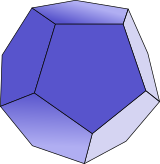
As shown in the figure below, a regular dodecahedron (the polyhedron consisting of 1212 congruent regular pentagonal faces) floats in space with two horizontal faces. Note that there is a ring of five slanted faces adjacent to the top face, and a ring of five slanted faces adjacent to the bottom face. How many ways are there to move from the top face to the bottom face via a sequence of adjacent faces so that each face is visited at most once and moves are not permitted from the bottom ring to the top ring?
125125
250250
405405
640640
810810
Difficulty rating: 2460
Small hint:
Because upward moves are forbidden, split every path into a top-ring phase and a bottom-ring phase
Big hint:
On a five-cycle, a self-avoiding walk has 1+2⋅41+2\cdot4 possible stopping paths
Video solution:
Solution video thumbnail
Play video

Click to load, then click again to play

Written solution:
After leaving the top face, choose one of the 55 top-ring faces. Because moves from the bottom ring to the top ring are forbidden, every valid path has a top-ring phase, then one move down to the bottom ring, then a bottom-ring phase.
Fix the first top-ring face. On the top ring, the path can move around the 55-cycle without revisiting a face and then stop at any point: there are 1+2⋅4=91+2\cdot4=9 possible top-ring paths. From the stopping face, there are 22 possible downward moves to the bottom ring, so the top part has 1818 choices.
Once in the bottom ring, the path can move around the bottom 55-cycle without revisiting a face and then enter the bottom face; this gives 1+2⋅4=91+2\cdot4=9 choices. The total is 5⋅18⋅9=8105\cdot18\cdot9=810. Thus, E is the correct answer.

20.

Quadrilateral ABCDABCD satisfies ∠ABC=∠ACD=90∘,\angle ABC = \angle ACD = 90^{\circ}, AC=20,AC=20, and CD=30.CD=30. Diagonals AC‾\overline{AC} and BD‾\overline{BD} intersect at point E,E, and AE=5.AE=5. What is the area of quadrilateral ABCD?ABCD?
330330
340340
350350
360360
370370
Difficulty rating: 1980
Small hint:
Put ACAC on the xx-axis and use the known point EE
Big hint:
Point BB lies both on line DEDE and on the circle with diameter ACAC
Video solution:
Solution video thumbnail
Play video

Click to load, then click again to play

Written solution:
Place A=(0,0)A=(0,0) and C=(20,0)C=(20,0). Since ∠ACD=90∘\angle ACD=90^\circ and CD=30CD=30, take D=(20,30)D=(20,30). The point EE is (5,0)(5,0), so line BDBD has equation y=2(x−5)y=2(x-5).
Because ∠ABC=90∘\angle ABC=90^\circ, point BB lies on the circle with diameter ACAC: (x−10)2+y2=100(x-10)^2+y^2=100. Intersecting with y=2(x−5)y=2(x-5) gives x=2x=2 or 1010. The convex quadrilateral uses B=(2,−6)B=(2,-6).
Then [ACD]=12⋅20⋅30=300[ACD]=\dfrac12\cdot20\cdot30=300, and [ABC]=12⋅20⋅6=60[ABC]=\dfrac12\cdot20\cdot6=60. The total area is 360360. Thus, D is the correct answer.

21.

There exists a unique strictly increasing sequence of nonnegative integers a1<a2<⋯<aka_1\lt a_2\lt\cdots\lt a_k such that 2289+1217+1=2a1+2a2+⋯+2ak.\frac{2^{289}+1}{2^{17}+1}=2^{a_1}+2^{a_2}+\cdots+2^{a_k}. What is k?k?
117117
136136
137137
273273
306306
Difficulty rating: 2180
Small hint:
Write x=217;x = 2^{17}; then the quotient is x17+1x+1=x16−x15+⋯+1\dfrac{x^{17} + 1}{x + 1} = x^{16} - x^{15} + \cdots + 1
Big hint:
Group the alternating terms into pairs xm+1−xm=217m(217−1),x^{m+1} - x^m = 2^{17m}(2^{17} - 1), each a block of 1717 ones in binary
Video solution:
Solution video thumbnail
Play video

Click to load, then click again to play

Written solution:
Let x=217.x = 2^{17}. Then 2289+1217+1\dfrac{2^{289} + 1}{2^{17} + 1} =x17+1x+1= \dfrac{x^{17} + 1}{x + 1} =x16−x15+⋯−x+1,= x^{16} - x^{15} + \cdots - x + 1, an alternating sum of the 1717 powers x0,x1,…,x16.x^0, x^1, \ldots, x^{16}.
Pair each subtracted power with the added power just above it: xm+1−xmx^{m+1} - x^m =217m(217−1)= 2^{17m}(2^{17} - 1) =217m+217m+1= 2^{17m} + 2^{17m+1} +⋯+217m+16,+ \cdots + 2^{17m+16}, a block of 1717 consecutive powers of 2.2.
There are 88 such pairs, together with the leftover +20.+2^0. The blocks occupy disjoint ranges, so the total number of powers is 8⋅17+1=137.8 \cdot 17 + 1 = 137.
Thus, the correct answer is C.

22.

For how many positive integers n≤1000n \le 1000 is⌊998n⌋+⌊999n⌋+⌊1000n⌋\left\lfloor \dfrac{998}{n} \right\rfloor+\left\lfloor \dfrac{999}{n} \right\rfloor+\left\lfloor \dfrac{1000}{n}\right \rfloornot divisible by 3?3? (Recall that ⌊x⌋\lfloor x \rfloor is the greatest integer less than or equal to x.x.)
2222
2323
2424
2525
2626
Difficulty rating: 2380
Small hint:
Let 1000=qn+r1000=qn+r
Big hint:
The sum of floors fails to be a multiple of 33 only when subtracting 11 or 22 crosses a multiple of nn
Video solution:
Solution video thumbnail
Play video

Click to load, then click again to play

Written solution:
Write 1000=qn+r1000=qn+r, where 0≤r<n0\le r\lt n. Then ⌊1000n⌋=q\left\lfloor\dfrac{1000}{n}\right\rfloor=q. The other two floors are usually also qq, except that subtracting 11 or 22 from 10001000 crosses a multiple of nn when rr is small.
For n>1n\gt1, the sum is not divisible by 33 exactly when r=0r=0 or r=1r=1. The case r=0r=0 gives divisors of 10001000, excluding 11, for 1515 values. The case r=1r=1 gives divisors of 999999, excluding 11, for (3+1)(1+1)−1=7(3+1)(1+1)-1=7 values. The total is 2222. Thus, A is the correct answer.

23.

Let TT be the triangle in the coordinate plane with vertices (0,0),(0,0), (4,0),(4,0), and (0,3).(0,3). Consider the following five isometries (rigid transformations) of the plane: rotations of 90∘,90^{\circ}, 180∘,180^{\circ}, and 270∘270^{\circ} counterclockwise around the origin, reflection across the xx-axis, and reflection across the yy-axis. How many of the 125125 sequences of three of these transformations (not necessarily distinct) will return TT to its original position? (For example, a 180∘180^{\circ} rotation, followed by a reflection across the xx-axis, followed by a reflection across the yy-axis will return TT to its original position, but a 90∘90^{\circ} rotation, followed by a reflection across the xx-axis, followed by another reflection across the xx-axis will not return TT to its original position.)
1212
1515
1717
2020
2525
Difficulty rating: 1930
Small hint:
Name the 90∘90^\circ rotation RR and the two reflections X,YX,Y
Big hint:
Once the first two transformations are fixed, the third must be the inverse of their product
Video solution:
Solution video thumbnail
Play video

Click to load, then click again to play

Written solution:
Let RR be a 90∘90^\circ rotation, so the allowed rotations are R,R2,R3R,R^2,R^3. Let XX and YY be the reflections across the coordinate axes. Once the first two transformations are chosen, the third is forced to be the inverse of their product.
Among two rotations, 66 ordered pairs have a nonidentity rotation as their product. A rotation and a reflection have an allowed axis-reflection as their product exactly when the rotation is R2R^2, giving 44 ordered pairs. Finally, the two different axis-reflections can occur in either order, giving 22 more pairs. Altogether there are 6+4+2=126+4+2=12 valid sequences. Thus, A is the correct answer.

24.

Let nn be the least positive integer greater than 10001000 for which gcd⁡(63,n+120)=21andgcd⁡(n+63,120)=60. \begin{gathered} \gcd(63,n+120)=21\\ \text{and}\\ \gcd(n+63,120)=60. \end{gathered} What is the sum of the digits of n?n?
1212
1515
1818
2121
2424
Difficulty rating: 1820
Small hint:
Translate each gcd condition into a congruence plus an exclusion
Big hint:
Solve the two congruences first, then test candidates above 10001000
Video solution:
Solution video thumbnail
Play video

Click to load, then click again to play

Written solution:
The first gcd condition gives n+120≡0(mod21)n+120\equiv0\pmod{21}, so n≡6(mod21)n\equiv6\pmod{21}, but n+120n+120 must not be divisible by 6363. The second gives n+63≡0(mod60)n+63\equiv0\pmod{60}, so n≡57(mod60)n\equiv57\pmod{60}, but n+63n+63 must not be divisible by 120120.
Solving n≡6(mod21)n\equiv6\pmod{21} and n≡57(mod60)n\equiv57\pmod{60} gives n≡237(mod420)n\equiv237\pmod{420}. The candidates above 10001000 are 1077,1497,1917,…1077,1497,1917,\ldots. The first fails the first gcd condition, the second fails the second gcd condition, and 19171917 works. The digit sum is 1818. Thus, C is the correct answer.

25.

Jason rolls three fair standard six-sided dice. Then he looks at the rolls and chooses a subset of the dice (possibly empty, possibly all three dice) to reroll. After rerolling, he wins if and only if the sum of the numbers face up on the three dice is exactly 7.7. Jason always plays to optimize his chances of winning. What is the probability that he chooses to reroll exactly two of the dice? Express your answer as a common fraction.
736\displaystyle \frac{7}{36}
524\displaystyle \frac{5}{24}
29\displaystyle \frac{2}{9}
1772\displaystyle \frac{17}{72}
14\displaystyle \frac{1}{4}
Difficulty rating: 2320
Small hint:
Compare the win chance from rerolling one die (keep two summing to at most 66) with rerolling two (keep one small die)
Big hint:
Rerolling exactly two is best when no two dice sum to 66 or less, yet the smallest die is small enough to beat rerolling all three
Video solution:
Solution video thumbnail
Play video

Click to load, then click again to play

Written solution:
Rerolling one die, keeping two dice that sum to s,s, wins with probability 16\tfrac16 when s≤6s \le 6 and 00 otherwise. Rerolling two dice, keeping a die of value v,v, wins with probability equal to the number of ways two dice sum to 7−v,7 - v, over 36;36; this is largest when vv is smallest. For v=1,2,3,v=1,2,3, these probabilities are 536,436,336,\tfrac5{36},\tfrac4{36},\tfrac3{36}, all greater than the reroll-all probability 15216=572;\tfrac{15}{216}=\tfrac{5}{72}; for v≥4,v\ge4, rerolling all is better.
Rerolling exactly two dice is strictly best precisely when the two smallest dice sum to at least 77 (so rerolling one cannot reach 77) while the smallest die is 1,2,1, 2, or 33 (so keeping it beats rerolling all three).
Sort the roll as u≤v≤w.u\le v\le w. If u=1,u=1, the only possibility is (1,6,6),(1,6,6), with 33 orderings. If u=2,u=2, the possibilities (2,5,5),(2,5,6),(2,6,6)(2,5,5),(2,5,6),(2,6,6) have 3+6+3=123+6+3=12 orderings. If u=3,u=3, choose v,wv,w with repetition from {4,5,6};\{4,5,6\}; the six resulting triples have 3+6+6+3+6+3=273+6+6+3+6+3=27 orderings. Thus there are 3+12+27=423+12+27=42 qualifying ordered rolls out of 216,216, a probability of 42216=736.\dfrac{42}{216} = \dfrac{7}{36}.
Thus, the correct answer is A.
LIVE by Po-Shen Loh
Programs

LIVE Classes

Self-Paced Classes

Stars

Scholarship

About Us

Who Is Po-Shen Loh?

Email Contact

Newsletter

Jobs

Become a Star

For a more Thought Full world.

© 2026 Expii, Inc.Terms of UsePrivacy PolicyCOPPA Privacy Policy