
2020 AMC 10A Problems
Scroll down and press Start to try the exam! Or, go to the printable PDF, answer key, or professional video solutions and written solutions curated by LIVE by Po-Shen Loh.
All problems are used with official legal permission of the Mathematical Association of America (MAA).
Or jump straight to a single problem with its solution and video: 1 · 2 · 3 · 4 · 5 · 6 · 7 · 8 · 9 · 10 · 11 · 12 · 13 · 14 · 15 · 16 · 17 · 18 · 19 · 20 · 21 · 22 · 23 · 24 · 25
Want to learn professionally through interactive video classes?
Timed
1:15:00
1.
What value of satisfies
Answer: E
Small Hint:
First simplify the right side using denominator
Big Hint:
After finding the right side, add to both sides
Video solution:

Click to load, then click again to play
Written solution:
The right side is . Thus . Thus, E is the correct answer.
2.
The numbers and have an average (arithmetic mean) of What is the average of and
Answer: C
Small Hint:
Convert the average of five numbers into a total sum
Big Hint:
Subtract the known three numbers before averaging and
Video solution:
Click to load, then click again to play
Written solution:
The five numbers have total sum . Since , we have , so the average of and is . Thus, C is the correct answer.
3.
Assuming and what is the value in simplest form of the following expression?
Answer: A
Small Hint:
Each denominator is the negative of a matching numerator factor
Big Hint:
Count the number of negative signs after cancellation
Video solution:
Click to load, then click again to play
Written solution:
Rewrite the denominator factors as , , and . The expression becomes . Thus, A is the correct answer.
4.
A driver travels for hours at miles per hour, during which her car gets miles per gallon of gasoline. She is paid per mile, and her only expense is gasoline at per gallon. What is her net rate of pay, in dollars per hour, after this expense?
Small Hint:
Find the total miles driven in two hours
Big Hint:
Subtract gasoline cost before dividing by the number of hours
Video solution:
Click to load, then click again to play
Written solution:
The driver travels miles, so she is paid . The trip uses gallons of gasoline, costing . Her net pay is dollars over hours, or dollars per hour. Thus, E is the correct answer.
5.
What is the sum of all real numbers for which
Answer: C
Small Hint:
Split the absolute-value equation into two quadratic equations
Big Hint:
Remember to count the double root only once in the sum of real numbers
Video solution:
Click to load, then click again to play
Written solution:
The equation means or . The first gives , with roots and . The second gives , with root . The sum of all real solutions is . Thus, C is the correct answer.
6.
How many -digit positive integers (that is, integers between and inclusive) having only even digits are divisible by
Answer: B
Small Hint:
The last digit must be compatible with both evenness and divisibility by
Big Hint:
Choose the thousands, hundreds, and tens digits independently after fixing the last digit
Video solution:
Click to load, then click again to play
Written solution:
The last digit must be , because the number is divisible by and all digits are even. The thousands digit can be or , and each of the hundreds and tens digits has choices. Thus there are such integers. Thus, B is the correct answer.
7.
The integers from to inclusive, can be arranged to form a -by- square in which the sum of the numbers in each row, the sum of the numbers in each column, and the sum of the numbers along each of the main diagonals are all the same. What is the value of this common sum?
Answer: C
Small Hint:
The five row sums together equal the sum of all integers
Big Hint:
Compute the arithmetic-sequence sum from through
Video solution:
Click to load, then click again to play
Written solution:
The sum of the integers from to is . If every row has common sum , then the five row sums add to , so and . Thus, C is the correct answer.
8.
What is the value of
Answer: B
Small Hint:
Group the expression into blocks of four terms
Big Hint:
Find a formula for the th block and sum over blocks
Video solution:
Click to load, then click again to play
Written solution:
Group the terms in blocks of four: . The th block is .
There are blocks, so the sum is . Thus, B is the correct answer.
9.
A single bench section at a school event can hold either adults or children. When bench sections are connected end to end, an equal number of adults and children seated together will occupy all the bench space. What is the least possible positive integer value of
Answer: B
Small Hint:
Let the equal number of adults and children be
Big Hint:
The number of bench sections is
Video solution:
Click to load, then click again to play
Written solution:
If the equal number of adults and children is , then the adults use bench sections and the children use bench sections. Thus .
The least positive integer occurs when , giving . Thus, B is the correct answer.
10.
Seven cubes, whose volumes are and cubic units, are stacked vertically to form a tower in which the volumes of the cubes decrease from bottom to top. Except for the bottom cube, the bottom face of each cube lies completely on top of the cube below it. What is the total surface area of the tower (including the bottom) in square units?
Answer: B
Small Hint:
Start with the surface areas of all seven separate cubes
Big Hint:
Each contact hides two faces with the side length of the smaller cube
Video solution:
Click to load, then click again to play
Written solution:
The cube side lengths are , stacked from largest on bottom to smallest on top. The sum of the surface areas of the separate cubes is .
Each contact hides two square faces, with areas . Subtracting these hidden faces gives . Thus, B is the correct answer.
11.
What is the median of the following list of numbers?
Answer: C
Small Hint:
Near the median, count ordinary integers and square numbers separately
Big Hint:
Use
Video solution:
Click to load, then click again to play
Written solution:
For a number near the median, the sorted list includes all ordinary integers up to that number and all squares up to that number. Since and , there are squares not exceeding any number from through .
At , there are list entries at most . At , there are entries at most , so the th entry is , and the next is . The median is . Thus, C is the correct answer.
12.
Triangle is isosceles with Medians and are perpendicular to each other, and What is the area of
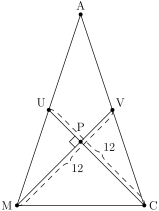
Answer: C
Small Hint:
Put the centroid at the origin and align the perpendicular medians with the axes
Big Hint:
The centroid divides each median in a ratio
Video solution:
Click to load, then click again to play
Written solution:
Let the centroid be the origin. Since a centroid divides each median in a ratio, we may place median horizontally with and , and median vertically with and .
Because is the midpoint of , we get . The area of is . Thus, C is the correct answer.
13.
A frog sitting at the point begins a sequence of jumps, where each jump is parallel to one of the coordinate axes and has length and the direction of each jump (up, down, right, or left) is chosen independently at random. The sequence ends when the frog reaches a side of the square with vertices and What is the probability that the sequence of jumps ends on a vertical side of the square?
Answer: B
Small Hint:
Let each interior lattice point store the probability of hitting a vertical side first
Big Hint:
Use symmetry to reduce the random-walk equations to four unknowns
Video solution:
Click to load, then click again to play
Written solution:
Let be the probability of eventually hitting a vertical side first from point . By symmetry, set , , , and .
The averaging equations are , , , and . Solving gives , which is the desired probability from . Thus, B is the correct answer.
14.
Real numbers and satisfy and What is the value of
Answer: D
Small Hint:
Use power sums
Big Hint:
The relation gives a recurrence for
Video solution:
Click to load, then click again to play
Written solution:
Let . Since and , the numbers and satisfy , so .
Using and , we get , , , and . The expression is . Thus, D is the correct answer.
15.
A positive integer divisor of is chosen at random. The probability that the divisor chosen is a perfect square can be expressed as where and are relatively prime positive integers. What is
Answer: E
Small Hint:
Factor into primes
Big Hint:
A square divisor must choose only even prime exponents
Video solution:
Click to load, then click again to play
Written solution:
The prime factorization of is . Therefore has positive divisors.
A square divisor must use only even exponents, giving square divisors. The probability is , so . Thus, E is the correct answer.
16.
A point is chosen at random within the square in the coordinate plane whose vertices are and The probability that the point is within units of a lattice point is (A point is a lattice point if and are both integers.) What is to the nearest tenth?
Answer: B
Small Hint:
Look at one unit square of the lattice
Big Hint:
The four quarter-circles around its corners have total area
Video solution:
Click to load, then click again to play
Written solution:
For , the points within of lattice points occupy, in each unit square, four quarter-circles whose total area is . The enormous square is tiled by unit squares, so the desired probability is .
Setting gives , which rounds to . Thus, B is the correct answer.
17.
Define How many integers are there such that
Answer: E
Small Hint:
Make a sign chart across the square roots
Big Hint:
Count integer points in every other interval, including endpoints
Video solution:
Click to load, then click again to play
Written solution:
The polynomial changes sign at each square , and its leading coefficient is positive. Thus for integers in the intervals , , , .
For odd , the interval contains integers. Summing over odd gives . Thus, E is the correct answer.
18.
Let be an ordered quadruple of not necessarily distinct integers, each one of them in the set For how many such quadruples is it true that is odd? (For example, is one such quadruple, because is odd.)
Answer: C
Small Hint:
Only the parities of matter
Big Hint:
Count invertible matrices over the two-element field
Video solution:
Click to load, then click again to play
Written solution:
Only parity matters. Modulo , the condition is that is , meaning the matrix is invertible over .
There are invertible matrices over . Each parity pattern lifts to choices from , so there are quadruples. Thus, C is the correct answer.
19.
As shown in the figure below, a regular dodecahedron (the polyhedron consisting of congruent regular pentagonal faces) floats in space with two horizontal faces. Note that there is a ring of five slanted faces adjacent to the top face, and a ring of five slanted faces adjacent to the bottom face. How many ways are there to move from the top face to the bottom face via a sequence of adjacent faces so that each face is visited at most once and moves are not permitted from the bottom ring to the top ring?
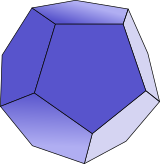
Answer: E
Small Hint:
Because upward moves are forbidden, split every path into a top-ring phase and a bottom-ring phase
Big Hint:
On a five-cycle, a self-avoiding walk has possible stopping paths
Video solution:
Click to load, then click again to play
Written solution:
After leaving the top face, choose one of the top-ring faces. Because moves from the bottom ring to the top ring are forbidden, every valid path has a top-ring phase, then one move down to the bottom ring, then a bottom-ring phase.
Fix the first top-ring face. On the top ring, the path can move around the -cycle without revisiting a face and then stop at any point: there are possible top-ring paths. From the stopping face, there are possible downward moves to the bottom ring, so the top part has choices.
Once in the bottom ring, the path can move around the bottom -cycle without revisiting a face and then enter the bottom face; this gives choices. The total is . Thus, E is the correct answer.
20.
Quadrilateral satisfies and Diagonals and intersect at point and What is the area of quadrilateral
Answer: D
Small Hint:
Put on the -axis and use the known point
Big Hint:
Point lies both on line and on the circle with diameter
Video solution:
Click to load, then click again to play
Written solution:
Place and . Since and , take . The point is , so line has equation .
Because , point lies on the circle with diameter : . Intersecting with gives or . The convex quadrilateral uses .
Then , and . The total area is . Thus, D is the correct answer.
21.
There exists a unique strictly increasing sequence of nonnegative integers such that What is
Answer: C
Small Hint:
Set and divide by
Big Hint:
Pair positive and negative powers to create blocks of binary ones
Video solution:
Click to load, then click again to play
Written solution:
Let . Then .
Pair consecutive terms: , , , , and then the final . Each pair is , contributing ones in binary. There are such pairs plus the final , so . Thus, C is the correct answer.
22.
For how many positive integers isnot divisible by (Recall that is the greatest integer less than or equal to )
Answer: A
Small Hint:
Let
Big Hint:
The sum of floors fails to be a multiple of only when subtracting or crosses a multiple of
Video solution:
Click to load, then click again to play
Written solution:
Write , where . Then . The other two floors are usually also , except that subtracting or from crosses a multiple of when is small.
For , the sum is not divisible by exactly when or . The case gives divisors of , excluding , for values. The case gives divisors of , excluding , for values. The total is . Thus, A is the correct answer.
23.
Let be the triangle in the coordinate plane with vertices and Consider the following five isometries (rigid transformations) of the plane: rotations of and counterclockwise around the origin, reflection across the -axis, and reflection across the -axis. How many of the sequences of three of these transformations (not necessarily distinct) will return to its original position? (For example, a rotation, followed by a reflection across the -axis, followed by a reflection across the -axis will return to its original position, but a rotation, followed by a reflection across the -axis, followed by another reflection across the -axis will not return to its original position.)
Answer: A
Small Hint:
Name the rotation and the two reflections
Big Hint:
Once the first two transformations are fixed, the third must be the inverse of their product
Video solution:
Click to load, then click again to play
Written solution:
Let be a rotation, so the allowed rotations are . Let and be the reflections across the coordinate axes. Once the first two transformations are chosen, the third is forced to be the inverse of their product.
Among two rotations, ordered pairs have a nonidentity rotation as their product. A rotation and a reflection have an allowed axis-reflection as their product exactly when the rotation is , giving ordered pairs. Finally, the two different axis-reflections can occur in either order, giving more pairs. Altogether there are valid sequences. Thus, A is the correct answer.
24.
Let be the least positive integer greater than for which What is the sum of the digits of
Answer: C
Small Hint:
Translate each gcd condition into a congruence plus an exclusion
Big Hint:
Solve the two congruences first, then test candidates above
Video solution:
Click to load, then click again to play
Written solution:
The first gcd condition gives , so , but must not be divisible by . The second gives , so , but must not be divisible by .
Solving and gives . The candidates above are . The first fails the first gcd condition, the second fails the second gcd condition, and works. The digit sum is . Thus, C is the correct answer.
25.
Jason rolls three fair standard six-sided dice. Then he looks at the rolls and chooses a subset of the dice (possibly empty, possibly all three dice) to reroll. After rerolling, he wins if and only if the sum of the numbers face up on the three dice is exactly Jason always plays to optimize his chances of winning. What is the probability that he chooses to reroll exactly two of the dice?
Answer: A
Small Hint:
Compare the best chance from rerolling or dice
Big Hint:
Rerolling two dice is optimal only for certain sorted initial rolls with large two-smallest sum
Video solution:
Click to load, then click again to play
Written solution:
For any initial roll, Jason compares the best probabilities from rerolling or dice. Rerolling all three dice has probability . Rerolling one die has probability whenever some pair of kept dice has sum at most .
If he rerolls exactly two dice, he keeps one die. Keeping a die showing gives probabilities out of , respectively. This can be optimal only when the two smallest dice sum at least and the smallest die is or .
The sorted rolls satisfying this are , , and . Counting permutations gives rolls out of , so the probability is . Thus, A is the correct answer.