
2018 AMC 10B Solutions
Scroll down to view professionally curated solutions from LIVE by Po-Shen Loh, print PDF solutions, view answer key, or take the full timed exam.
All problems are used with official legal permission of the Mathematical Association of America (MAA).
1.
Kate bakes a -inch by -inch pan of cornbread. The cornbread is cut into pieces that measure inches by inches. How many pieces of cornbread does the pan contain?
Small Hint:
The pan and each piece are rectangles; compare their areas
Big Hint:
Divide the total area by the area of one piece
Solution:
The whole pan has area square inches. Each piece is square inches. So the number of pieces is Thus, A is the correct answer.
2.
Sam drove miles in minutes. His average speed during the first minutes was mph (miles per hour), and his average speed during the second minutes was mph. What was his average speed, in mph, during the last minutes?
Small Hint:
Distance = rate time, and each -minute leg is half an hour
Big Hint:
Subtract the distance covered in the first hour from to get the last leg’s distance
Solution:
Each leg is half an hour. In the first, Sam drove miles; in the second, miles. That’s miles so far. That leaves miles for the last half hour, which is a speed of mph. Therefore, the answer is D.
3.
In the expression each blank is to be filled in with one of the digits or with each digit being used once. How many different values can be obtained?
Small Hint:
Neither multiplication nor the final addition depends on order, so only the way the four digits are split into two pairs matters
Big Hint:
List the three ways to split into two pairs
Solution:
Order inside a product doesn’t matter, and neither does the order we add the two products. So all that matters is how the four digits split into two pairs. There are three splits: and That’s different values. Thus, B is the correct answer.
4.
A three-dimensional rectangular box with dimensions and has faces whose surface areas are and square units. What is
Small Hint:
The three distinct face areas are the pairwise products equal to
Big Hint:
Multiplying all three gives take the square root, then divide by each face area
Solution:
The three distinct face areas are the pairwise products in some order. Multiply all three: so Now divide by each face area. We get and so Therefore, the answer is B.
5.
How many subsets of contain at least one prime number?
Small Hint:
Count the subsets with no prime and subtract from the total number of subsets
Big Hint:
The non-prime elements are any subset of just those contains no prime
Solution:
Count the complement. The set has subsets total. A subset avoids every prime exactly when it sticks to the non-primes and there are of those. So subsets contain at least one prime. Thus, D is the correct answer.
6.
A box contains chips, numbered and Chips are drawn randomly one at a time without replacement until the sum of the values drawn exceeds What is the probability that draws are required?
Small Hint:
A third draw is needed exactly when the first two chips still sum to at most
Big Hint:
Which pairs of distinct chips sum to or less? Count them among all ordered first-two-draw outcomes
Solution:
We need a third draw exactly when the first two chips still sum to or less. The only such unordered pairs are and Each can be drawn in either order, giving favorable ordered prefixes.
Imagine that a complete random ordering of all five chips is chosen in advance. Then all ordered first-two-chip prefixes are equally likely, even when the actual process would stop after the first chip. Thus the probability is Therefore, the answer is D.
7.
In the figure below, congruent semicircles are drawn along a diameter of a large semicircle, with their diameters covering the diameter of the large semicircle with no overlap. Let be the combined area of the small semicircles and be the area of the region inside the large semicircle but outside the small semicircles. The ratio is What is

Small Hint:
If each small semicircle has radius the large semicircle has radius
Big Hint:
Show then set this equal to
Solution:
Let each small semicircle have radius The diameters cover the big diameter, so the large radius is Then and the large semicircle has area so the leftover region is This gives Set and Thus, D is the correct answer.
8.
Sara makes a staircase out of toothpicks as shown:

This is a -step staircase and uses toothpicks. How many steps would be in a staircase that used toothpicks?
Small Hint:
Count the toothpicks in an -step staircase; the vertical ones number
Big Hint:
With equal horizontal and vertical counts the total is solve
Solution:
In an -step staircase the vertical toothpicks number and there are just as many horizontal ones. That’s a total of Check: gives as it should. Now solve This factors as so Therefore, the answer is C.
9.
The faces of each of standard dice are labeled with the integers from to Let be the probability that when all dice are rolled, the sum of the numbers on the top faces is What other sum occurs with the same probability
Small Hint:
Replacing each die value by pairs up equally likely outcomes
Big Hint:
This replacement sends a total of to a total of
Solution:
Replace each die’s value by This pairs up outcomes one-to-one and keeps their probabilities, and it sends a total of to So the sums and are equally likely. The partner of is Thus, D is the correct answer.
10.
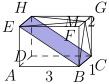
In the rectangular parallelepiped shown, and Point is the midpoint of What is the volume of the rectangular pyramid with base and apex
Small Hint:
Place at the origin with the edges along the axes; find the rectangle and its area
Big Hint:
Volume
Solution:
Put at the origin with edges along the axes: so The base is a rectangle with and hence area Its plane is and sits at distance from it. The volume is Therefore, the answer is E.
11.
Which of the following expressions is never a prime number when is a prime number?
Small Hint:
Test the expressions modulo for a prime
Big Hint:
For the correct choice, also check separately, then show it is a multiple of for all other primes
Solution:
Look at When it’s For any other prime, isn’t divisible by so and Either way it’s a multiple of bigger than hence composite. So it’s never prime. Thus, C is the correct answer.
12.
Line segment is a diameter of a circle with Point not equal to or lies on the circle. As point moves around the circle, the centroid (center of mass) of traces out a closed curve missing two points. To the nearest positive integer, what is the area of the region bounded by this curve?
Small Hint:
The centroid of is and is twice the center
Big Hint:
As moves on a circle of radius the centroid moves on a circle of one third the radius
Solution:
Put the center at the origin, so and while runs over the circle of radius Then so the centroid is As circles, traces a circle of radius (minus the two points where or ). Its area is Therefore, the answer is C.
13.
How many of the first numbers in the sequence are divisible by
Small Hint:
The -th term is which is divisible by when
Big Hint:
so exactly when
Solution:
The -th term is which divides iff Notice So exactly when meaning that is Among the values number Thus, C is the correct answer.
14.
A list of positive integers has a unique mode, which occurs exactly times. What is the least number of distinct values that can occur in the list?
Small Hint:
Every value other than the mode can appear at most times, to keep the mode unique
Big Hint:
With distinct values the list holds at most entries; make this at least
Solution:
The mode shows up times. To keep the number of distinct values small, let every other value repeat as much as the rules allow, which is times each (any more would tie the mode). With distinct values the list holds at most entries. We need so giving Therefore, the answer is D.
15.
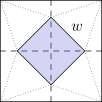
A closed box with a square base is to be wrapped with a square sheet of wrapping paper. The box is centered on the wrapping paper with the vertices of the base lying on the midlines of the square sheet of paper, as shown in the figure on the left. The four corners of the wrapping paper are to be folded up over the sides and brought together to meet at the center of the top of the box, point in the figure on the right. The box has base length and height What is the area of the sheet of wrapping paper?
Small Hint:
If the sheet has side its center-to-corner distance is
Big Hint:
Folding a corner to the top center covers, in a straight line, half the base, then the side of height then the other half of the top
Solution:
Let the sheet have side The base sits as a square of side turned so the center is from each base edge. A corner of the sheet lies from the center. Folding that corner up to the top center traces a straight line: out to the base edge, then up the side, then across the top. So Then and the area is Thus, A is the correct answer.
16.
Let be a strictly increasing sequence of positive integers such that
What is the remainder when is divided by
Small Hint:
because is a product of three consecutive integers
Big Hint:
So the sum of cubes is congruent to reduce that modulo
Solution:
For any integer is a product of three consecutive integers, so it’s divisible by That means Summing, Now and powers of mod alternate The exponent is even, so The remainder is Therefore, the answer is E.
17.
In rectangle and Points and lie on points and lie on points and lie on and points and lie on so that and the convex octagon is equilateral. The length of a side of this octagon can be expressed in the form where and are integers and is not divisible by the square of any prime. What is
Small Hint:
The four cut corners are congruent right triangles with legs (on the sides of length ) and (on the sides of length )
Big Hint:
The equal sides give the first equality gives then substitute and square
Solution:
Let be the octagon’s side length and let The right triangles and have the same hypotenuse and a leg of length so they are congruent; write Because and the vertical sides of the rectangle both have length it follows that The right triangles at and are then congruent, so Since and each of these equal lengths is Thus all four cut corners have legs and
The equal octagon sides give The first equality gives Substituting and squaring gives so the root with is
The side length is so Thus, B is the correct answer.
18.
Three young brother-sister pairs from different families need to take a trip in a van. These six children will occupy the second and third rows in the van, each of which has three seats. To avoid disruptions, siblings may not sit right next to each other in the same row, and no child may sit directly in front of his or her sibling. How many seating arrangements are possible for this trip?
Small Hint:
Show that each row must contain exactly one child from each family
Big Hint:
The third row’s families must differ from the second row’s in every column (a derangement), and each pair’s two children can be swapped between their seats
Solution:
Suppose some family put both children in one row. They’d have to take the non-adjacent seats and which forces the middle family’s two children into the same column. Not allowed. So each row holds exactly one child from each family. The second row is a permutation of the three families, ways. The third row needs a different family in every column, a derangement of the second row’s order, and there are of those. Finally, each pair can swap its two children between their seats, ways. The total is Therefore, the answer is D.
19.
Joey and Chloe and their daughter Zoe all have the same birthday. Joey is year older than Chloe, and Zoe is exactly year old today. Today is the first of the birthdays on which Chloe’s age will be an integral multiple of Zoe’s age. What will be the sum of the two digits of Joey’s age the next time his age is a multiple of Zoe’s age?
Small Hint:
Let Chloe be today. In years her age is a multiple of Zoe’s iff divides
Big Hint:
Exactly such birthdays means has divisors; find the two-digit value, then repeat the divisor idea for Joey
Solution:
Let Chloe be today; Zoe is In years their age ratio is which is an integer exactly when divides Thus has exactly positive divisors.
A number with divisors has the form or The only two-digit possibility is so Chloe is and Joey is
Joey’s age is a multiple of Zoe’s age exactly when divides The next time is when Joey is Its digit sum is Thus, E is the correct answer.
20.
A function is defined recursively by and
for all integers What is
Small Hint:
Look for a particular solution of the form subtracting it leaves
Big Hint:
That homogeneous recursion is periodic with period reduce modulo
Solution:
Notice solves the recurrence on its own, so write Then satisfies the homogeneous version With and it cycles with period : Since we get so Therefore, the answer is B.
21.
Mary chose an even -digit number She wrote down all the divisors of in increasing order from left to right: At some moment Mary wrote as a divisor of What is the smallest possible value of the next divisor written to the right of
Small Hint:
and is an even -digit multiple of
Big Hint:
For a candidate next divisor must be a multiple of find the smallest keeping that under
Solution:
Let be the next divisor after If then is a multiple of impossible for a four-digit number. Thus
Since this gcd is at least It also divides so and hence
This bound is attained: for both and are divisors. The lower bound shows there is no divisor between them. Thus the smallest possible next divisor is and C is the correct answer.
22.
Real numbers and are chosen independently and uniformly at random from the interval Which of the following numbers is closest to the probability that and are the side lengths of an obtuse triangle?
Small Hint:
A triangle with sides needs since is the longest side it is obtuse when
Big Hint:
In the unit square this region is a quarter disk with the triangle below removed
Solution:
The three lengths make a triangle iff Since is the longest side, that triangle is obtuse iff So in the unit square we want the region inside the quarter circle but above the line That’s the quarter disk with the right triangle under the chord removed: The closest choice is Therefore, the answer is C.
23.
How many ordered pairs of positive integers satisfy the equation
where denotes the greatest common divisor of and and denotes their least common multiple?
Small Hint:
Use let and
Big Hint:
The equation becomes also must divide
Solution:
Recall Let and The equation becomes
The positive factor pairs give and The negative factor pairs make either or negative, so they are impossible. Also must divide and only passes.
Write and Then and so or Hence the two ordered pairs are and and B is the correct answer.
24.
Let be a regular hexagon with side length Denote by and the midpoints of sides and respectively. What is the area of the convex hexagon whose interior is the intersection of the interiors of and
Small Hint:
is equilateral with side is equilateral with side
Big Hint:
Centered at the hexagon’s center the two triangles are concentric and rotated the overlap is minus its three protruding corner triangles
Solution:
The triangle is equilateral with side so its area is
The triangles and are concentric and rotated from each other. At each vertex of the sides of cut off a -- triangle whose hypotenuse is the half-side segment Its legs are and so each corner has area
Removing the three corners gives Therefore, the answer is C.
25.
Let denote the greatest integer less than or equal to How many real numbers satisfy the equation
Small Hint:
Writing the equation is so
Big Hint:
On each interval there is a solution exactly when
Solution:
Let The equation reads and since this forces so On each interval the quantity increases from and approaches, but does not reach, It hits exactly once precisely when That holds for the integers which is solutions. Thus, C is the correct answer.