
2002 AMC 10A Solutions
Scroll down to view professionally curated solutions from LIVE by Po-Shen Loh, print PDF solutions, view answer key, or take the full timed exam.
All problems are used with official legal permission of the Mathematical Association of America (MAA).
1.
The ratio is closest to which of the following numbers?
Small Hint:
Factor out of the numerator
Big Hint:
The denominator equals
Solution:
Factoring gives which is closest to
Thus, the correct answer is D.
2.
For the nonzero numbers and define Find
Small Hint:
Substitute
Big Hint:
Add over a common denominator
Solution:
Over a denominator of this is
Thus, the correct answer is C.
3.
According to the standard convention for exponentiation, If the order in which the exponentiations are performed is changed, how many other values are possible?
Small Hint:
List the five ways to parenthesize a tower of four ’s
Big Hint:
Every grouping evaluates to either or
Solution:
There are five ways to parenthesize the tower. Three of them, and all equal The other two both give the standard value
So exactly one other value, is possible.
Thus, the correct answer is B.
4.
For how many positive integers does there exist at least one positive integer such that
infinitely many
Small Hint:
Try a very small positive value of
Big Hint:
See whether the resulting inequality places any upper bound on
Solution:
Take Then becomes which holds for every positive integer
So every positive integer works, giving infinitely many.
Thus, the correct answer is E.
5.
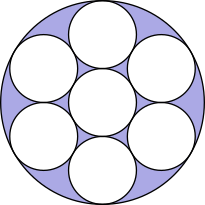
Each of the small circles in the figure has radius one. The innermost circle is tangent to the six circles that surround it, and each of those circles is tangent to the large circle and to its small-circle neighbors. Find the area of the shaded region.
Small Hint:
The large radius spans the center circle plus two more radii
Big Hint:
Subtract the seven unit circles from the large circle
Solution:
The center of a surrounding circle is from the center (two radii), and adding its own radius gives a large radius of
The large circle has area and the seven unit circles have total area so the shaded region is
Thus, the correct answer is C.
6.
Cindy was asked by her teacher to subtract from a certain number and then divide the result by Instead, she subtracted and then divided the result by giving an answer of What would her answer have been had she worked the problem correctly?
Small Hint:
Recover the original number from Cindy’s incorrect steps
Big Hint:
Solve
Solution:
Let be the number. Cindy computed so and
The correct computation is
Thus, the correct answer is A.
7.
If an arc of on circle has the same length as an arc of on circle then the ratio of the area of circle to the area of circle is
Small Hint:
Arc length is
Big Hint:
Equal arc lengths give the ratio
Solution:
Equal arc lengths give so and
The ratio of areas is
Thus, the correct answer is A.
8.
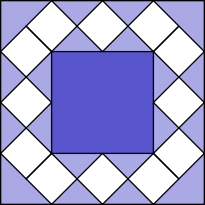
Betsy designed a flag using blue triangles, small white squares, and a red center square, as shown. Let be the total area of the blue triangles, the total area of the white squares, and the area of the red square. Which of the following is correct?
Small Hint:
Cut the whole flag into congruent right triangles
Big Hint:
Count how many of those congruent triangles fill each color
Solution:
Divide the flag into congruent right triangles by drawing the grid lines and diagonals. Counting gives triangles in the blue region, in the white region, and in the red region.
Hence
Thus, the correct answer is A.
9.
Suppose and are three numbers for which and The average of the three numbers and is
not uniquely determined
Small Hint:
Add the two equations together
Big Hint:
The sum collapses to a multiple of
Solution:
Adding the equations,
So and the average is
Thus, the correct answer is B.
10.
11.
Jamal wants to store computer files on floppy disks, each of which has a capacity of megabytes (mb). Three of his files require mb of memory each, more require mb each, and the remaining require mb each. No file can be split between floppy disks. What is the minimal number of floppy disks that will hold all the files?
Small Hint:
A mb file leaves room for only one mb file on its disk
Big Hint:
Account for the wasted space on the three mb disks, then build a packing that reaches the bound
Solution:
The files need mb. On any disk holding a mb file, only one mb file fits alongside it (since ), leaving at least mb wasted. Across the three such disks that is at least mb, so the effective demand is at least mb, requiring at least disks.
This is achievable: disks each hold one file and one file, disks each hold two files, and disks each hold three files.
Thus, the correct answer is B.
12.
Mr. Earl E. Bird leaves his house for work at exactly A.M. every morning. When he averages miles per hour, he arrives at his workplace three minutes late. When he averages miles per hour, he arrives three minutes early. At what average speed, in miles per hour, should Mr. Bird drive to arrive at his workplace precisely on time?
Small Hint:
Let be the on-time travel time in hours; three minutes is hours
Big Hint:
The distance is the same both ways:
Solution:
Let hours be the on-time travel time. Since minutes is hours, Then so
The distance is miles, so the required speed is mph.
Thus, the correct answer is B.
13.
The sides of a triangle have lengths of and Find the length of the shortest altitude.
Small Hint:
Check whether is a right triangle
Big Hint:
The shortest altitude is drawn to the longest side
Solution:
Since the triangle is right with legs and and area
The shortest altitude falls to the longest side and equals
Thus, the correct answer is B.
14.
Both roots of the quadratic equation are prime numbers. The number of possible values of is
more than four
Small Hint:
The roots sum to and multiply to
Big Hint:
An odd sum of two primes forces one of them to be
Solution:
If the roots are primes and then and Because is odd, one prime must be making the other which is prime.
So is the only possible value.
Thus, the correct answer is B.
15.
The digits and are used to form four two-digit prime numbers, with each digit used exactly once. What is the sum of these four primes?
Small Hint:
A two-digit prime cannot end in or
Big Hint:
Those four digits must therefore be the tens digits
Solution:
A two-digit prime cannot end in or so these four are the tens digits and and are the units digits.
The sum is One valid set is
Thus, the correct answer is E.
16.
If then is
Small Hint:
Set every expression equal to a single value
Big Hint:
Write in terms of and add them
Solution:
Let the common value be Then so
Since we get so and Then
Thus, the correct answer is B.
17.
Sarah pours four ounces of coffee into an eight-ounce cup and four ounces of cream into a second cup of the same size. She then transfers half the coffee from the first cup to the second and, after stirring thoroughly, transfers half the liquid in the second cup back to the first. What fraction of the liquid in the first cup is now cream?
Small Hint:
Track ounces of coffee and cream after each transfer
Big Hint:
The second cup is uniformly mixed before the second transfer
Solution:
After transferring oz of coffee, cup has oz coffee and cup has oz coffee plus oz cream, a total of oz.
Transferring back half of cup (that is oz, consisting of oz coffee and oz cream) leaves cup with oz coffee and oz cream. The fraction that is cream is
Thus, the correct answer is D.
18.
A cube is formed by gluing together standard cubical dice. (On a standard die, the sum of the numbers on any pair of opposite faces is ) The smallest possible sum of all the numbers showing on the surface of the cube is
Small Hint:
Classify the dice as corner, edge, face-center, and interior dice
Big Hint:
Minimize each die’s showing faces: corners show edges show face-centers show
Solution:
The corner dice show faces each, minimized at contributing The edge dice show faces, minimized at contributing
The face-center dice show face, minimized at contributing and the hidden interior die contributes The total is
Thus, the correct answer is D.
19.
Spot’s doghouse has a regular hexagonal base that measures one yard on each side. He is tethered to a vertex with a two-yard rope. What is the area, in square yards, of the region outside the doghouse that Spot can reach?
Small Hint:
The interior angle of a regular hexagon is so Spot sweeps at radius
Big Hint:
Around each adjacent vertex the leftover yard of rope sweeps a sector
Solution:
At the tether vertex the hexagon blocks its interior angle, leaving a sector of radius area
Wrapping around each of the two adjacent vertices, yard of rope remains and sweeps a sector: The total is
Thus, the correct answer is E.
20.
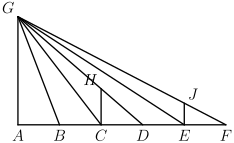
Points and lie, in that order, on dividing it into five segments, each of length Point is not on line Point lies on and point lies on The line segments and are parallel. Find
Small Hint:
gives in terms of
Big Hint:
gives in terms of
Solution:
Since so giving
Since so giving
Therefore
Thus, the correct answer is D.
21.
The mean, median, unique mode, and range of a collection of eight integers are all equal to The largest integer that can be an element of this collection is
Small Hint:
The eight integers sum to and a range of ties the largest and smallest together
Big Hint:
Test the largest candidate values while keeping both the median and unique mode equal to
Solution:
The sum is The collection has mean, median, unique mode, and range all equal to so is attainable.
If the largest were at least the range condition would make the smallest at least A mean of would then force all eight integers to equal contradicting the range.
If the largest were the range forces the smallest to be so all eight integers are at least The other seven then sum to forcing every one of them to equal But then the median and mode would be not a contradiction.
Thus, the correct answer is D.
22.
A set of tiles numbered through is modified repeatedly by the following operation: remove all tiles numbered with a perfect square, and renumber the remaining tiles consecutively starting with How many times must the operation be performed to reduce the number of tiles in the set to one?
Small Hint:
Removing the perfect squares from tiles leaves tiles
Big Hint:
Two operations take tiles down to
Solution:
Starting from tiles, one operation removes the perfect squares, leaving The next operation removes perfect squares, leaving
So every two operations reduce to Going from down to takes operations.
Thus, the correct answer is C.
23.
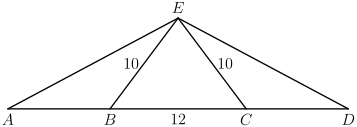
Points and lie on a line, in that order, with and Point is not on the line, and The perimeter of is twice the perimeter of Find
Small Hint:
Let be the midpoint of then and
Big Hint:
With and use the perimeter condition and the Pythagorean theorem
Solution:
Let be the midpoint of Since and By symmetry write and
The perimeter condition gives so Also
Substituting which simplifies to so and
Thus, the correct answer is D.
24.
Tina randomly selects two distinct numbers from the set and Sergio randomly selects a number from the set The probability that Sergio’s number is larger than the sum of the two numbers chosen by Tina is
Small Hint:
List the ten possible sums Tina can make and how often each occurs
Big Hint:
For a sum Sergio’s number exceeds it with probability
Solution:
Tina’s equally likely pairs give sums and For a sum Sergio’s number exceeds it with probability
Averaging the winning probability over the ten pairs, the total is
Thus, the correct answer is A.
25.
In trapezoid with bases and we have and The area of is
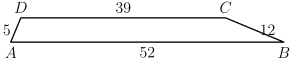
Small Hint:
Extend the legs and until they meet at a point
Big Hint:
with ratio
Solution:
Extend and to meet at Since with ratio From we get and similarly
Then so is a right angle. The area of is
Thus, the correct answer is C.