
2024 AIME II Problems
Scroll down and press Start to try the exam! Or, go to the printable PDF, answer key, or professional solutions curated by LIVE by Po-Shen Loh.
All problems are used with official legal permission of the Mathematical Association of America (MAA).
Or jump straight to a single problem with its solution: 1 · 2 · 3 · 4 · 5 · 6 · 7 · 8 · 9 · 10 · 11 · 12 · 13 · 14 · 15
Want to learn professionally through interactive video classes?
Timed
3:00:00
1.
Among the residents of Aimeville, there are who own a diamond ring, who own a set of golf clubs, and who own a garden spade. In addition, each of the residents owns a bag of candy hearts. There are residents who own exactly two of these things, and residents who own exactly three of these things. Find the number of residents of Aimeville who own all four of these things.
Answer: 73
Small Hint:
Every resident owns the candy hearts, so add all four ownership counts and compare with
Big Hint:
Counting once per item owned, residents with exactly or items are counted or extra times
Solution:
Adding the four ownership counts gives item ownerships among the residents. Since everyone owns a bag of candy hearts, every resident owns at least one item, and a resident owning exactly items is counted times beyond the first.
If residents own all four things, the extra counts total so giving
2.
A list of positive integers has the following properties:
• The sum of the items in the list is
• The unique mode of the list is
• The median of the list is a positive integer that does not appear in the list itself.
Find the sum of the squares of all the items in the list.
Answer: 236
Small Hint:
An odd-length list has its median as a member, so the list has evenly many items. The mode appears at least twice.
Big Hint:
Try four items with the median must be a whole number, so is odd
Solution:
The median is an integer that is not in the list, so the list cannot have odd length (then the median would be a member). The unique mode appears at least twice. Two items sum to not so try four items together with where and are distinct (a repeat would tie the mode) and The median must be an integer, so is odd, and forces Thus and the list has median which indeed does not appear.
No longer list works. With exactly two s, six items would need four distinct other values summing to namely or but both give median eight or more items are impossible because six distinct positive values already sum to at least With three s the remaining items sum to and every option either puts at the median or ties the mode. Four s already sum to more than
The sum of squares is
3.
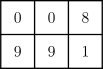
Find the number of ways to place a digit in each cell of a grid so that the sum of the two numbers formed by reading left to right is and the sum of the three numbers formed by reading top to bottom is The grid below is an example of such an arrangement because and
Answer: 45
Small Hint:
In the row sum each column’s two digits must add to exactly with no carrying anywhere
Big Hint:
If the top row’s digits sum to the bottom row’s digits sum to the column condition pins down
Solution:
Let the top row hold digits and the bottom row In the sum of the two row numbers, the units digits satisfy and since in fact with no carry. Repeating the argument in the tens and hundreds places gives and
The three column numbers add to Writing the bottom digits sum to so and
Conversely, any digits with determine the bottom row by and both conditions hold. The number of solutions of in nonnegative digits is
4.
Let and be positive real numbers that satisfy the following system of equations:
Then the value of is where and are relatively prime positive integers. Find
Answer: 33
Small Hint:
Set to turn the system into three linear equations
Big Hint:
Add all three equations to find then combine it with each equation to solve for one at a time
Solution:
Let The equations become Adding all three gives Since we get so and similarly and
Therefore so and
5.
Let be a convex equilateral hexagon in which all pairs of opposite sides are parallel. The triangle whose sides are extensions of segments and has side lengths and Find the side length of the hexagon.
Answer: 80
Small Hint:
Each corner triangle between the hexagon and the big triangle has all three sides parallel to the big triangle’s sides, so it is similar to the big triangle
Big Hint:
Writing the side containing as plus two corner pieces leads to
Solution:
Let be the hexagon’s side length, and let the triangle formed by lines have sides of lengths along those three lines, respectively. The corner triangle cut off at the vertex where lines and meet has third side and since all three of its sides are parallel to sides of the big triangle. So it is similar to the big triangle with ratio and its side along line has length Likewise the corner at contains and cuts off from the -side.
The -side therefore decomposes as corner piece, corner piece: and dividing by gives symmetric in the three sides.
Hence
6.
Alice chooses a set of positive integers. Then Bob lists all finite nonempty sets of positive integers with the property that the maximum element of belongs to Bob’s list has sets. Find the sum of the elements of
Answer: 55
Small Hint:
Group Bob’s sets by their maximum: if the maximum is the rest of the set is any subset of
Big Hint:
So the list has sets; binary representations are unique, so write in base
Solution:
For a fixed the sets with maximum element consist of together with an arbitrary subset of so there are of them, and every set on Bob’s list is counted exactly once by its maximum. Hence
Since and binary representations are unique, The sum of the elements of is
7.
Let be the greatest four-digit integer with the property that whenever one of its digits is changed to the resulting number is divisible by Let and be the quotient and remainder, respectively, when is divided by Find
Answer: 699
Small Hint:
Changing a digit to subtracts times a power of so for digits
Big Hint:
Let each digit is then determined mod and consistency of with its own digits forces a single value of
Solution:
Write with digits Changing the thousands digit to produces so and similarly for the other digits. Since and
Let Using and the inverses the digits satisfy But also substituting gives so and
Then and taking the largest digit in each class gives (the class has no larger digit), Indeed are all multiples of Finally and
8.
Torus is the surface produced by revolving a circle with radius around an axis in the plane of the circle that is a distance from the center of the circle (so like a donut).
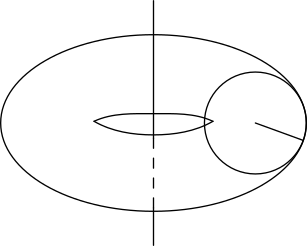
Let be a sphere with a radius When rests on the inside of it is internally tangent to along a circle with radius and when rests on the outside of it is externally tangent to along a circle with radius The difference can be written as where and are relatively prime positive integers. Find
Answer: 127
Small Hint:
Slice with a plane through the axis: the tube is a circle of radius centered from the axis, and the sphere’s center lies on the axis
Big Hint:
Tangency puts the tube’s center at distance or from the sphere’s center; scale the tube center’s distance from the axis by or
Solution:
By symmetry the axis of the torus passes through the center of the sphere. Work in a plane through the axis: there the torus appears as a circle of radius (the tube) whose center sits at distance from the axis, and the sphere appears as a circle of radius centered at The two surfaces are tangent along the circle swept by the tangency point of these cross-sections, which lies on the ray from through the tube’s center. For internal tangency the tube’s center is at distance from for external tangency,
The tangency point lies at distance from along that ray, so it is the tube center scaled by (resp. ) from and its distance from the axis is the same multiple of the tube center’s distance
Then which is in lowest terms, so
9.
There is a collection of indistinguishable white chips and indistinguishable black chips. Find the number of ways to place some of these chips in a grid such that:
• each cell contains at most one chip
• all chips in the same row and all chips in the same column have the same color, and
• any additional chip placed on the grid would violate one or more of the previous two conditions.
Answer: 902
Small Hint:
A maximal placement has no empty row or column: a chip matching the column’s color could always be added inside an empty row
Big Hint:
So every row and column carries a color, chips fill exactly the cells where the two colors agree, and rows and columns must use the same set of colors
Solution:
In a valid placement, each nonempty row has a single color, and likewise each column. If some row were empty, choose any cell of it: a chip of the color of that cell’s column (either color if the column is also empty) could legally be added, contradicting the third condition. So every row and every column is nonempty, and we may speak of its color.
A chip at a cell forces its row and column colors to agree; conversely, if a row and a column share a color but their common cell is empty, a chip of that color could be added. Hence chips occupy exactly the cells whose row color equals the column color. For every row to be nonempty, each row’s color must appear among the column colors, and vice versa — the rows and the columns use the same set of colors. Any such coloring conversely yields a valid maximal placement (at most cells hold chips of each color, so the supply suffices), and distinct colorings give distinct placements.
Counting the colorings: all rows and columns white, all black, or both colors used by the rows and by the columns:
10.
Let have incenter circumcenter inradius and circumradius Suppose that Find
Answer: 468
Small Hint:
The right angle gives and Euler’s formula turns this into
Big Hint:
Combine with and
Solution:
Since the Pythagorean theorem in triangle gives and Euler’s formula yields Combining with gives so
Then so while Hence the semiperimeter is
Equating the two area formulas
11.
Find the number of triples of nonnegative integers satisfying and
Answer: 601
Small Hint:
With the given sum equals
Big Hint:
Expand using the condition says exactly that this product vanishes
Solution:
The left side is the symmetric sum where and So the condition is Now expand using The condition holds exactly when this product is that is, when at least one of equals
If then giving triples, and likewise for and A triple counted more than once has two variables equal to which forces the third to be as well; the triple is counted three times, so the total is
12.
Let and be points in the coordinate plane. Let be the family of segments of unit length lying in the first quadrant with on the -axis and on the -axis. There is a unique point on distinct from and that does not belong to any segment from other than Then where and are relatively prime positive integers. Find
Answer: 23
Small Hint:
The segment from to lies on is the member
Big Hint:
Setting the -derivative of to zero at gives intersect that with
Solution:
The members of are the segments from to for lying on the lines the segment is the member with For a point of with let so the point lies on the member for angle exactly when Note at both endpoints of and If then is negative on one side of and the intermediate value theorem produces another zero on that side — the point is covered by another segment. So must satisfy Because both and are strictly convex on this interval, is strictly convex; thus for that point is the strict global minimum of so no other segment contains it.
Now and gives i.e. Intersecting with gives so and an interior point of
Therefore and
13.
Let be a th root of unity. Find the remainder when is divided by
Answer: 321
Small Hint:
Factor and use over all th roots of unity
Big Hint:
makes easy to compute; the whole product becomes
Solution:
Since each factor of the product splits, and as runs from to runs over all th roots of unity. Because for any we get Hence the product equals
Since we get and by conjugation So the product is whose remainder upon division by is
14.
Let be an integer. Call a positive integer -eautiful if it has exactly two digits when expressed in base and these two digits sum to For example, is -eautiful because and Find the least integer for which there are more than ten -eautiful integers.
Answer: 211
Small Hint:
Write with digit sum then so must divide
Big Hint:
Each for which is divisible by gives one mod there are such residues, where counts the distinct primes of
Solution:
A two-digit number in base is with and and the condition says where Then so Note Conversely, for any with and divisible by setting and gives and hence exactly one -eautiful integer So the count equals the number of with
Let Since and are coprime, each prime power dividing must divide or so by the Chinese remainder theorem there are solutions modulo where is the number of distinct prime factors of Among the representatives only falls outside our range (and qualifies), so the count is
We need i.e. The smallest positive integer with four distinct prime factors is so the least base is (which has -eautiful integers).
15.
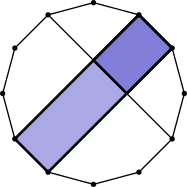
Find the number of rectangles that can be formed inside a fixed regular dodecagon (-gon) where each side of the rectangle lies on either a side or a diagonal of the dodecagon. The diagram below shows three of those rectangles.
Answer: 315
Small Hint:
Every side and diagonal points in one of directions, multiples of a rectangle uses two chords from each of two perpendicular directions
Big Hint:
Record each parallel chord’s distance from center and half-length: the corners fit iff each pair’s larger distance is at most the half-length of the other pair’s farther chord
Solution:
Put the vertices at angles on a unit circle. The chord joining vertices and has direction so chords come in directions spaced apart, and a rectangle uses two chords from each of two perpendicular directions. The six perpendicular direction pairs split into two kinds, three of each, by rotation. When is even, a family of parallel chords has members, at distances from the center with half-lengths respectively; when is odd, a family has members, at distances with half-lengths
A corner is the intersection of one chord from each direction, and its offset along a chord equals the other chord’s distance from the center. Since half-lengths shrink as distance grows, the four corners lie on all four chord segments exactly when, writing for the larger distances of the two chosen pairs, each is at most the half-length of the other pair’s farther chord. For the -chord families: pairs with (there are ) have half-length bound and pairs with (there are ) have bound the valid combinations give rectangles. For the -chord families: there are pairs with and the valid combinations are both orders of and and giving
Each kind of direction pair occurs three times, so the total is