
2016 AIME II Solutions
Scroll down to view professionally curated solutions from LIVE by Po-Shen Loh, print PDF solutions, view answer key, or take the full timed exam.
All problems are used with official legal permission of the Mathematical Association of America (MAA).
1.
Initially Alex, Betty, and Charlie had a total of peanuts. Charlie had the most peanuts, and Alex had the least. The three numbers of peanuts that each person had form a geometric progression. Alex eats of his peanuts, Betty eats of her peanuts, and Charlie eats of his peanuts. Now the three numbers of peanuts that each person has form an arithmetic progression. Find the number of peanuts Alex had initially.
Small Hint:
After everyone eats, peanuts remain in arithmetic progression, so the middle amount is
Big Hint:
Betty began with Write the starting amounts as and use the total
Solution:
After the eating, peanuts remain, and the three amounts form an arithmetic progression, so the middle amount, Betty’s, is Hence Betty started with peanuts.
The starting amounts form a geometric progression, so they are and with (Charlie had the most and Alex the least). Then which simplifies to with roots and since we take
So Alex initially had peanuts. (Check: after eating, the amounts increase by each.)
2.
There is a chance of rain on Saturday and a chance of rain on Sunday. However, it is twice as likely to rain on Sunday if it rains on Saturday than if it does not rain on Saturday. The probability that it rains at least one day this weekend is where and are relatively prime positive integers. Find
Small Hint:
Let be the chance of Sunday rain when Saturday is dry; then it is when Saturday is rainy. Use the overall
Big Hint:
Once is known, the chance of a completely dry weekend is
Solution:
Let be the probability that it rains on Sunday given a dry Saturday; given a rainy Saturday it is The overall Sunday chance gives so and
The weekend is completely dry exactly when Saturday is dry and then Sunday is dry: So the probability of rain on at least one day is which is in lowest terms, and
3.
Let and be real numbers satisfying the system Find the value of
Small Hint:
Undo each outer logarithm: the equations become
Big Hint:
Set etc., and add all three equations: has exactly one solution
Solution:
Exponentiating each equation gives and similarly for the others, so Write so that
Adding the three equations gives where The left side is strictly increasing in and works since so and
Then and so
4.
An rectangular box is built from unit cubes. Each unit cube is colored red, green, or yellow. Each of the layers of size parallel to the -faces of the box contains exactly red cubes, exactly green cubes, and some yellow cubes. Each of the layers of size parallel to the -faces of the box contains exactly green cubes, exactly yellow cubes, and some red cubes. Find the smallest possible volume of the box.
Small Hint:
Count each color over the whole box using both layer directions; for instance green gives
Big Hint:
The counts force and so the volume is with dividing both and
Solution:
Each layer has exactly red and green cubes, hence exactly yellow; each layer has exactly green and yellow, hence exactly red. Counting green cubes in the whole box both ways gives so Counting yellow both ways gives so Counting red both ways gives and so
Thus and are positive integers, so divides and the volume is smallest when volume with
This is achievable: color every layer with three identical rows RRRGGGGYYYYY. Then each layer has red, green, and yellow cubes, and each layer has red, green, and yellow cubes. So the smallest possible volume is
5.
Triangle has a right angle at Its side lengths are pairwise relatively prime positive integers, and its perimeter is Let be the foot of the altitude to and for let be the foot of the altitude to in The sum Find
Small Hint:
Each new altitude creates a triangle similar to the one before, so the lengths form a geometric series
Big Hint:
With legs hypotenuse the series sums to Factor to simplify.
Solution:
Let and The altitude gives and with ratio Each later altitude repeats this construction in a triangle scaled by so the segments form a geometric series and
Since we get so that is Squaring and using gives hence
Because the side lengths are pairwise relatively prime, and so and indeed Then (and checks).
6.
For polynomial define Then where and are relatively prime positive integers. Find
Small Hint:
The coefficients of are all positive, and is a product of such polynomials
Big Hint:
So is just
Solution:
Every substituted power is odd, so Since has only nonnegative coefficients, so does each factor and hence so does the product The coefficient of in is so
Therefore and
7.
Squares and have a common center and The area of is and the area of is a smaller positive integer. Square is constructed so that each of its vertices lies on a side of and each vertex of lies on a side of Find the difference between the largest and smallest possible integer values for the area of
Small Hint:
A square with vertices on the sides of a square of side tilted by has side with
Big Hint:
The same relation ties to so the areas form a geometric progression: the area of is where is the area of
Solution:
If a square of side has its vertices on the sides of a concentric square of side and is tilted by angle each side of the outer square is split into pieces and so This applies to (side ) in (side ) with some angle Since square (side ) makes the same angle with so also
Hence so the three areas form a geometric progression: the area of equals where is the area of As ranges over the factor takes every value in so takes every value in ( is excluded because is smaller than ). For to be an integer, must divide which forces to divide
The multiples of in run from to and each is attained by an appropriate with the area of then a positive integer less than The difference is
8.
Find the number of sets of three distinct positive integers with the property that the product of and is equal to the product of and
Small Hint:
The product is First count ordered triples by distributing each prime.
Big Hint:
A value that appears twice must have its square divide the product, so it is or Remove those triples and divide by
Solution:
Count ordered triples with Each of the six primes appears once and can go to any of the three values: ways. The two factors of can be split among the three values in ways. That gives ordered triples.
If two of the three values were equal, their common value would be such that divides so or This produces the triples with values and each in orders, for ordered triples in all (all three equal is impossible). The remaining ordered triples have distinct entries, and each set is counted times.
So the number of sets is
9.
The sequences of positive integers and are an increasing arithmetic sequence and an increasing geometric sequence, respectively. Let There is an integer such that and Find
Small Hint:
Write and with integers and turn the two given values into equations
Big Hint:
Show and then must be multiples of with only six pairs remain to test
Solution:
Write and with integers and Since we have and the two conditions read
Subtracting, The product of three consecutive integers is divisible by so divides hence divides Then forces to divide so divides The bounds and leave only
Testing each against and only gives a consistent value, Then
10.
Triangle is inscribed in circle Points and are on side with Rays and meet again at and (other than ), respectively. If and then where and are relatively prime positive integers. Find
Small Hint:
Extend past to with Then so lie on a circle.
Big Hint:
Chase angles through both circles to get so
Solution:
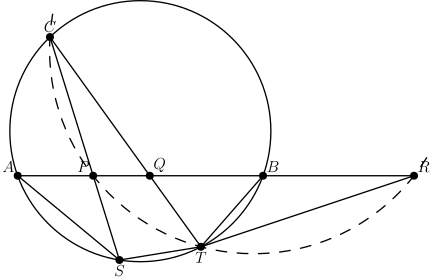
By Power of a Point at in Extend beyond to the point with so that and By the converse of Power of a Point, and are concyclic.
In circle and in (both subtend arc ). Also is cyclic, so the exterior angle of the quadrilateral at equals the opposite interior angle: Hence
Therefore so and
11.
For positive integers and define to be -nice if there exists a positive integer such that has exactly positive divisors. Find the number of positive integers less than that are neither -nice nor -nice.
Small Hint:
If then has divisors, which is more than a multiple of
Big Hint:
Every works too (take ). Count residues mod and mod below by inclusion-exclusion.
Solution:
If then has positive divisors, and each factor is so the product is too. Conversely, if then gives with exactly divisors. So is -nice exactly when
Among there are integers (namely ) and integers (namely ). Since there are integers (namely ). By inclusion-exclusion, of them are -nice or -nice.
Hence positive integers less than are neither.
12.
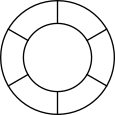
The figure below shows a ring made of six small sections which you are to paint on a wall. You have four paint colors available and will paint each of the six sections a solid color. Find the number of ways you can choose to paint the sections if no two adjacent sections can be painted with the same color.
Small Hint:
A row of sections with adjacent colors different can be painted in ways; split these by whether the two end colors match
Big Hint:
If counts ring colorings, then starting from
Solution:
Let be the number of valid paintings of a ring of sections. Cutting a ring open between two adjacent sections shows that ring paintings correspond exactly to rows of sections with adjacent colors different and the two end colors different. A row of sections with adjacent colors different can be painted in ways, and the rows whose end colors match correspond, by merging the two end sections into one, to ring paintings of sections. Hence
Three mutually adjacent sections give so then and finally
13.
Beatrix is going to place six rooks on a chessboard where both the rows and columns are labeled to the rooks are placed so that no two rooks are in the same row or the same column. The value of a square is the sum of its row number and column number. The score of an arrangement of rooks is the least value of any occupied square. The average score over all valid configurations is where and are relatively prime positive integers. Find
Small Hint:
Sum the scores by counting the arrangements with score at least the total is
Big Hint:
Score bans the squares with row + column place rooks row by row, e.g.
Solution:
There are arrangements, and every score lies between and Let be the number of arrangements with score at least Since each score satisfies the total of all scores is
Score means no rook occupies a square with row + column Place the rooks row by row. For only is banned: For row has allowed columns, then row has (column and the used column are excluded): Similarly and (all rooks on the anti-diagonal).
The total is so the average is and
14.
Equilateral has side length Points and lie outside the plane of and are on opposite sides of the plane. Furthermore, and and the planes of and form a dihedral angle (the angle between the two planes). There is a point whose distance from each of and is Find
Small Hint:
and all lie on the line through the center of perpendicular to its plane, and is the midpoint of
Big Hint:
Since so Combine with the tangent addition formula at the midpoint of
Solution:
Since and both and lie on the line through the center of perpendicular to its plane, on opposite sides. Any point equidistant from also lies on that line, so is on it, and makes the midpoint of with Let be the midpoint of and then and Since and the dihedral angle is write and so
Right triangles and give and so Since point lies on the circle with diameter so and is the foot of the altitude from to the hypotenuse Thus which gives
By the tangent addition formula, so Then so
15.
For let and Let be positive real numbers such that and The maximum possible value of where and are relatively prime positive integers. Find
Small Hint:
Use to turn the condition into
Big Hint:
Since Cauchy-Schwarz makes this an equality case, forcing proportional to
Solution:
Since we have Doubling the given equation and rearranging, so
Now so By the Cauchy-Schwarz inequality,
Equality holds, so is proportional to forcing The only, hence maximum, possible value of is and