
2015 AIME I Solutions
Scroll down to view professionally curated solutions from LIVE by Po-Shen Loh, print PDF solutions, view answer key, or take the full timed exam.
All problems are used with official legal permission of the Mathematical Association of America (MAA).
1.
The expressions and are obtained by writing multiplication and addition operators in an alternating pattern between successive integers. Find the positive difference between integers and
Small Hint:
Compute by pairing each product in with the product in that shares its even factor
Big Hint:
Each pair contributes and the leftover terms are and
Solution:
Subtract term by term: Each parenthesized difference has the form for
Therefore
2.
The nine delegates to the Economic Cooperation Conference include officials from Mexico, officials from Canada, and officials from the United States. During the opening session, three of the delegates fall asleep. Assuming that the three sleepers were determined randomly, the probability that exactly two of the sleepers are from the same country is where and are relatively prime positive integers. Find
Small Hint:
All sleeper triples are equally likely; count the favorable ones by which country supplies the pair
Big Hint:
Exactly two from a country of size means choices for the pair times choices for the third sleeper
Solution:
There are equally likely sets of three sleepers. Exactly two sleepers come from the same country when one country supplies exactly two of them and the third sleeper comes from a different country: ways with the pair from the United States, with the pair from Canada, and with the pair from Mexico.
The probability is already in lowest terms, so
3.
There is a prime number such that is the cube of a positive integer. Find
Small Hint:
Write and factor
Big Hint:
is always odd, so the factor must come entirely from primality then forces
Solution:
Write so Since is odd, is odd, and is odd as well. Therefore all four factors of must divide write which gives For to be prime we need so
Then which is indeed prime, and
4.
Point lies on line segment with and Points and lie on the same side of line forming equilateral triangles and Let be the midpoint of and be the midpoint of The area of is Find
Small Hint:
Put at the origin with and and write and using equilateral-triangle altitudes
Big Hint:
Compute the midpoints and and the three distances triangle turns out equilateral
Solution:
Place and Each equilateral triangle has its apex above the midpoint of its base at height times the side, so and The midpoints are and
Now and so is equilateral with side Its area is so
5.
In a drawer Sandy has pairs of socks, each pair a different color. On Monday Sandy selects two individual socks at random from the socks in the drawer. On Tuesday Sandy selects of the remaining socks at random and on Wednesday two of the remaining socks at random. The probability that Wednesday is the first day Sandy selects matching socks is where and are relatively prime positive integers. Find
Small Hint:
Splitting the socks into a sequence of daily pairs is symmetric: any reordering of the days is equally likely
Big Hint:
So compute instead the probability of a match on Monday and then no match on Tuesday or Wednesday, tracking how many complete pairs remain each day
Solution:
Imagine dealing all ten socks out two per day for five days; every assignment of unordered pairs to days is equally likely, and permuting the days does not change this distribution. Swapping Monday and Wednesday therefore shows that the desired probability (mismatch, mismatch, match) equals the probability of a match on Monday followed by mismatches on Tuesday and Wednesday.
That pattern is easy to compute in order. Monday matches with probability (the second sock must be the first sock’s mate). The remaining socks then form complete pairs, so Tuesday mismatches with probability Tuesday’s mismatch breaks two pairs, leaving complete pairs among the remaining socks, so Wednesday mismatches with probability
The probability is so
6.
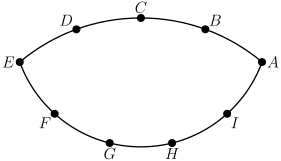
Points and are equally spaced on a minor arc of a circle. Points and are equally spaced on a minor arc of a second circle with center as shown in the figure below. The angle exceeds by Find the degree measure of
Small Hint:
Let be the common central angle at in the second circle; then is simultaneously an inscribed angle of the first circle
Big Hint:
Express every arc of both circles in terms of the condition pins down
Solution:
Let the common central angle of the second circle, so Since also lies on the first circle, is an inscribed angle there, so the arc not containing measures and each of the four equal arcs measures
Angle subtends the arc not containing which is so Angle subtends the second circle’s arc not containing which is so The given condition reads so
Finally, subtends the first circle’s arc giving and subtends the second circle’s arc giving Hence
7.
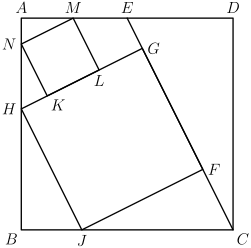
In the diagram below, is a square. Point is the midpoint of Points and lie on and and lie on and respectively, so that is a square. Points and lie on and and lie on and respectively, so that is a square. The area of is Find the area of
Small Hint:
Every right triangle cut off by the tilted squares ( ) is similar to with legs in ratio
Big Hint:
Write to get ’s side from then gives ’s side in exactly the same way
Solution:
Let so the big square has side and The right triangles and are all similar, with legs in ratio Let be the side of In the hypotenuse is so and in the longer leg is so the hypotenuse is Then so
Next, The identical decomposition along for the square of side gives Dividing the two equations,
The areas are therefore in ratio so the area of is
8.
For positive integer let denote the sum of the digits of Find the smallest positive integer satisfying
Small Hint:
Each carry in an addition lowers the digit sum by so where counts the carries
Big Hint:
Exactly two carries must occur, and the hundreds place always carries, so try each choice of the second carrying place and minimize the hundreds digit
Solution:
Each carry in an addition replaces in one place by in the next, lowering the digit sum by Hence where is the number of carries, and forces For a three-digit candidate with digits summing to since we have so the hundreds place always carries (), and exactly one of the units and tens places carries.
If the units carry and the tens do not, the tens computation must stay below so then forcing If the tens carry and the units do not, then gives so and works:
Indeed and with so the smallest such is
9.
Let be the set of all ordered triples of integers with Each ordered triple in generates a sequence according to the rule for Find the number of such sequences for which for some
Small Hint:
If two consecutive terms are ever equal, the sequence hits two steps later; if they differ by it hits within four steps
Big Hint:
Count triples whose consecutive entries are equal or differ by correcting for overlaps, then check what happens when a difference of meets a
Solution:
If then and if then so Hence every triple of one of the forms produces a These forms contain triples, but triples fitting two forms are counted twice: the of the form the in each of the six families (matching signs), and the in each of and That leaves triples.
A few other triples also work: if then and so These triples include and which were already counted, so they add new ones, for
No other triple reaches if both consecutive differences are at least and then and so inductively the terms grow forever and no factor ever vanishes. If instead with then and and the same growth takes over. The count is
10.
Let be a third-degree polynomial with real coefficients satisfying Find
Small Hint:
Each of and is a cubic, so each has exactly three of as roots
Big Hint:
The two cubics differ by a constant, so the two root triples have equal sums and equal pairwise-product sums; only one split works
Solution:
Each of and is a cubic, so each vanishes at exactly three of Writing them as and the two cubics differ by the constant so their and coefficients agree: the root triples have equal sums and equal sums of pairwise products. The only partition of into two triples of equal sum is and (each summing to ), and indeed both have pairwise-product sum
Replacing by if necessary (which does not change ), we have Setting gives so and Thus
11.
Triangle has positive integer side lengths with Let be the intersection of the bisectors of and Suppose Find the smallest possible perimeter of
Small Hint:
Let be the midpoint of right triangles at give and
Big Hint:
Since is half of the double-angle formula relates to integrality and leave only a few cases to test
Solution:
Let be the midpoint of by symmetry and are collinear with With and right triangles and give and Since bisects the double-angle formula yields so
Writing this becomes We need so while forces Testing only makes an integer, namely
The triangle with sides satisfies all the conditions, and its perimeter is
12.
Consider all -element subsets of the set From each such subset choose the least element. The arithmetic mean of all of these least elements is where and are relatively prime positive integers. Find
Small Hint:
Exactly of the subsets have least element
Big Hint:
Interpret as counting -element subsets of a -element set by their second-smallest element
Solution:
A -element subset has least element exactly when it contains together with larger elements, so of the subsets have least element The mean is therefore
The numerator counts something concrete: to build a -element subset of whose second-smallest element is choose its smallest element from ( ways) and its top elements from Summing over produces every -element subset exactly once, so
Hence the mean is which is in lowest terms, and
13.
With all angles measured in degrees, the product where and are integers greater than Find
Small Hint:
Let and be the products of the sines of the odd and even degree angles up to pair with
Big Hint:
Then doubling every factor turns the product into again, leaving only a power of
Solution:
Let and so the desired product is Then and multiplying this by itself in reverse order, using gives
Multiply by and use since and turns the second half into as well.
Because it follows that so Since is prime, the only representation with is and
14.
For each integer let be the area of the region in the coordinate plane defined by the inequalities and where is the greatest integer not exceeding Find the number of values of with for which is an integer.
Small Hint:
Over with the strip is a trapezoid of area — an integer exactly when is even
Big Hint:
So integrality of persists while is even and alternates while is odd; track the blocks according to
Solution:
On the strip we have so the region above it is a trapezoid under with area an integer when is even, a half-integer when is odd. Hence as grows by the integrality of is unchanged while is even and flips at every step while is odd.
Consider the block of values Starting from the statuses of cycle with period integer for and non-integer for (an odd block flips the status an odd number of times, an even block preserves it). Counting integer values of inside each block: for the block alternates, beginning and ending with non-integers, giving for every value is a non-integer, giving for it alternates, beginning and ending with integers, giving for all values are integers.
For covering the four blocks contribute integers, totaling Then the block contributes integers for the block contributes none, and for the alternation over begins with an integer at and gives more. The total is
15.
A block of wood has the shape of a right circular cylinder with radius and height and its entire surface has been painted blue. Points and are chosen on the edge of one of the circular faces of the cylinder so that arc on that face measures The block is then sliced in half along the plane that passes through point point and the center of the cylinder, revealing a flat, unpainted face on each half. The area of one of these unpainted faces is where and are integers and is not divisible by the square of any prime. Find
Small Hint:
Project the cut face straight down onto the circular face containing and the image is the disk minus two circular segments
Big Hint:
With the cylinder’s center, the face center, and the midpoint of the tilt satisfies divide the projected area by
Solution:
Stand the block on the face containing and and let be the center of that face, the midpoint of and the center of the cylinder. The cutting plane meets the bottom face in chord and, by symmetry through meets the top face in the reflected chord, so the cut face projects vertically onto the region between chord and its mirror image through (shaded below). Each circular segment cut off has area so has area
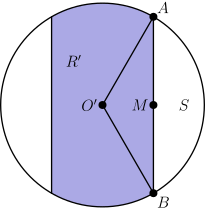
Since triangle gives and so The cut face is planar and tilted from the horizontal only in the direction of at the angle with Undoing the projection therefore multiplies areas by so the unpainted face has area Thus