
2014 AIME II Solutions
Scroll down to view professionally curated solutions from LIVE by Po-Shen Loh, print PDF solutions, view answer key, or take the full timed exam.
All problems are used with official legal permission of the Mathematical Association of America (MAA).
1.
Abe can paint the room in hours, Bea can paint percent faster than Abe, and Coe can paint twice as fast as Abe. Abe begins to paint the room and works alone for the first hour and a half. Then Bea joins Abe, and they work together until half the room is painted. Then Coe joins Abe and Bea, and they work together until the entire room is painted. Find the number of minutes after Abe begins for the three of them to finish painting the room.
Small Hint:
Work in rooms per minute: Abe’s rate is so Bea’s is and Coe’s is
Big Hint:
After minutes alone, of the room is done. Divide each remaining portion of the room by the combined rate of the painters working then.
Solution:
Abe paints of the room per minute, so Bea paints per minute and Coe paints per minute. In the first minutes Abe paints of the room.
Abe and Bea together paint per minute, and they must bring the total from up to which takes minutes. All three together paint per minute, so the remaining half of the room takes minutes.
The total time is minutes.
2.
Arnold is studying the prevalence of three health risk factors, denoted by and within a population of men. For each of the three factors, the probability that a randomly selected man in the population has only this risk factor (and none of the others) is For any two of the three factors, the probability that a randomly selected man has exactly these two risk factors (but not the third) is The probability that a randomly selected man has all three risk factors, given that he has and is The probability that a man has none of the three risk factors given that he does not have risk factor is where and are relatively prime positive integers. Find
Small Hint:
Take a population of and fill in a Venn diagram: each exactly-one region holds men and each exactly-two region holds
Big Hint:
If men have all three factors, then Then count the men outside and the men with no factor at all.
Solution:
Take a population of men and fill in a Venn diagram. Each of the three exactly-one regions contains men, and each of the three exactly-two regions contains If men have all three factors, then the men with both and number so the given conditional probability says giving
The union of the three sets therefore contains men, leaving with no risk factor. The men with risk factor number so men do not have
The desired probability is which is in lowest terms, so
3.
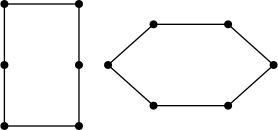
A rectangle has sides of length and A hinge is installed at each vertex of the rectangle and at the midpoint of each side of length The sides of length can be pressed toward each other keeping those two sides parallel so the rectangle becomes a convex hexagon as shown. When the figure is a hexagon with the sides of length parallel and separated by a distance of the hexagon has the same area as the original rectangle. Find
Small Hint:
Each half of a -side is a hinged bar of length whose vertical extent in the hexagon is the Pythagorean theorem gives its horizontal reach
Big Hint:
Cut the hexagon along the line through the two midpoint hinges into two congruent trapezoids and set the total area equal to
Solution:
In the hexagon, each side of length has folded at its midpoint into two bars of length The two sides of length are apart, so each bar spans a vertical distance of and hence a horizontal distance of
The line through the two midpoint hinges splits the hexagon into two congruent trapezoids with parallel sides and and height so the hexagon has area
Setting this equal to the rectangle’s area gives so and
4.
The repeating decimals and satisfy where and are (not necessarily distinct) digits. Find the three-digit number
Small Hint:
Write the decimals as and then clear denominators using and
Big Hint:
Reducing the equation modulo forces then a short linear equation pins down the digits
Solution:
Writing and for the two- and three-digit numbers, the decimals equal and Since and the common denominator is and multiplying the equation by it gives
Modulo since and this forces to be divisible by so Then and dividing the equation by gives Since this is which requires and
Thus and the three-digit number is
5.
Real numbers and are roots of and and are roots of Find the sum of all possible values of
Small Hint:
Neither cubic has an term, so the third roots are and Equate the coefficients of in the two cubics.
Big Hint:
Comparing constant terms and substituting yields finish each case using
Solution:
Both cubics have zero coefficient, so their roots sum to the third root of is and the third root of is The coefficient of is in both, so which simplifies to
The constant terms give and so i.e. Substituting reduces this to so or
If then and so the roots are and If then so the roots are and The requested sum is
6.
Charles has two six-sided dice. One of the dice is fair, and the other die is biased so that it comes up six with probability and each of the other five sides has probability Charles chooses one of the two dice at random and rolls it three times. Given that the first two rolls are both sixes, the probability that the third roll will also be a six is where and are relatively prime positive integers. Find
Small Hint:
The answer is the probability of three sixes divided by the probability of two sixes, each averaged over the two equally likely dice
Big Hint:
Two sixes in a row make the biased die much more likely: weight each die by its chance of producing the observed two sixes before predicting the third roll
Solution:
The desired conditional probability is since each die is chosen with probability and the fair die shows a six with probability
The numerator is and the denominator is so the probability is
Since and share no factor,
7.
Let Find the sum of all positive integers for which
Small Hint:
Since the product of the telescopes: even contribute and odd contribute its reciprocal
Big Hint:
For even the product is for odd it is The sum of logs is when the product is or
Solution:
Since and we have The sum of the logarithms is the log of the product which telescopes: consecutive factors and leave only boundary terms.
For even the product is and for odd it is The absolute value of the log equals exactly when the product is or
For even gives for odd gives The requested sum is
8.
Circle with radius has diameter Circle is internally tangent to circle at Circle is internally tangent to circle externally tangent to circle and tangent to The radius of circle is three times the radius of circle and can be written in the form where and are positive integers. Find
Small Hint:
Let be the radius of circle and drop its center to a foot on express and with the Pythagorean theorem
Big Hint:
gives isolating one radical and squaring twice leaves a quadratic in
Solution:
Let also name the circles’ centers, let be the radius of circle so circle has radius and let be the foot of on Tangency gives and while lies on with
Right triangles and give and Since is on the opposite side of from we have so
Moving to the left and squaring gives i.e. squaring again yields so The radius of circle is and
9.
Ten chairs are arranged in a circle. Find the number of subsets of this set of chairs that contain at least three adjacent chairs.
Small Hint:
Count subsets other than the full set by locating an empty chair followed clockwise by three chairs of the subset
Big Hint:
Each such empty-full-full-full pattern leaves choices for the remaining chairs; subtract the double-counted subsets containing two separate runs of three or more
Solution:
The full set of chairs qualifies; count the others by locating each maximal run of at least three adjacent chosen chairs at its clockwise start. Any such subset contains a block of four consecutive chairs that is empty-chosen-chosen-chosen. There are positions for this block, and the remaining chairs are free, giving
This counts once for each maximal run of length at least Two such runs require at least chosen chairs plus two gaps, so three runs are impossible, and subsets with exactly two runs are counted twice. To have two runs, place two disjoint empty-chosen-chosen-chosen blocks: ways (the second block fits in positions among the remaining chairs), with the last chairs free, for subsets.
The total is
10.
Let be a complex number with Let be the polygon in the complex plane whose vertices are and every such that Then the area enclosed by can be written in the form where is an integer. Find the remainder when is divided by
Small Hint:
Clear denominators in to get
Big Hint:
Multiplying by gives so the vertices are times the cube roots of unity: an equilateral triangle with circumradius
Solution:
Multiplying by gives i.e. Multiplying by yields so or where is a primitive cube root of unity (and both indeed satisfy the original equation).
Thus is the equilateral triangle with vertices inscribed in the circle of radius Its area is so
The remainder when is divided by is
11.
In and Let be the midpoint of segment Point lies on side such that Extend segment through to point such that Then where and are relatively prime positive integers, and is a positive integer. Find
Small Hint:
Place at the origin and on the positive -axis; then and the law of sines gives
Big Hint:
Perpendicular slopes locate on the -axis, and is a linear equation in the -coordinate of
Solution:
Since place with on the positive -axis, so The law of sines gives and
The slope of is so line has slope Descending from by to the -axis moves us left by so with
For the condition reads which is linear in Then so
12.
Suppose that the angles of satisfy Two sides of the triangle have lengths and There is a positive integer so that the maximum possible length for the remaining side of is Find
Small Hint:
Write and combine by sum-to-product; the whole condition factors
Big Hint:
One angle must equal The remaining side is longest when that angle lies between the sides of lengths and
Solution:
Using and together with so that the condition becomes
For an angle of a triangle, lies strictly between and so exactly when Hence one angle of the triangle is
The remaining side is longest when the angle sits between the sides of lengths and (if were opposite one of them, the remaining side would be shorter than that side). By the law of cosines its length is so
13.
Ten adults enter a room, remove their shoes, and toss their shoes into a pile. Later, a child randomly pairs each left shoe with a right shoe without regard to which shoes belong together. The probability that for every positive integer no collection of pairs made by the child contains the shoes from exactly of the adults is where and are relatively prime positive integers. Find
Small Hint:
Pairing left shoe with right shoe defines a random permutation; a collection of pairs using exactly adults’ shoes is a union of cycles
Big Hint:
The condition says every cycle of has length at least count -cycles and products of two -cycles
Solution:
The child’s pairing matches left shoe with right shoe for a uniformly random permutation of A collection of pairs uses left and right shoes, so it involves exactly adults precisely when those adults’ indices are closed under — that is, when the collection is a union of cycles of The condition therefore says has no cycle of length less than
The cycle lengths must partition into parts of size at least either one -cycle or two -cycles. There are ten-cycles, and permutations that are products of two -cycles.
The probability is so
14.
In and Let and be points on line such that and Point is the midpoint of segment and point is on ray such that Then where and are relatively prime positive integers. Find
Small Hint:
Extend ray to the circumcircle: it meets it at the midpoint of arc whose projection onto line is exactly
Big Hint:
Since is the midpoint of is the midpoint of Find from triangle with the law of sines.
Solution:
Let ray meet the circumcircle of again at Since bisects angle the point is the midpoint of arc so lies on the perpendicular bisector of and projects onto line at The projections of the collinear points onto line are and projection preserves ratios along a line; since is the midpoint of point is the midpoint of
Here and (both subtend arc ), so Also (both subtend arc ). The law of sines in gives
Therefore so and
15.
For any integer let be the smallest prime which does not divide Define the integer function to be the product of all primes less than if and if Let be the sequence defined by and for Find the smallest positive integer such that
Small Hint:
Compute through and factor each; compare the set of primes appearing in with the binary digits of
Big Hint:
The recursion is binary counting: dividing by clears the trailing prime “ones” and multiplying by carries a into the next bit
Solution:
List the primes in order as Every is squarefree, so it is described by the set of primes dividing it, and we claim this set encodes in binary: if with then
Indeed, suppose and let be the smallest index with Then and is exactly the product of the primes for the trailing -bits (with when ). So removes the trailing ones and inserts — precisely adding in binary. Since corresponds to induction proves the claim.
Now which corresponds to binary digits at positions Hence