
2014 AIME I Problems
Scroll down and press Start to try the exam! Or, go to the printable PDF, answer key, or professional solutions curated by LIVE by Po-Shen Loh.
All problems are used with official legal permission of the Mathematical Association of America (MAA).
Or jump straight to a single problem with its solution: 1 · 2 · 3 · 4 · 5 · 6 · 7 · 8 · 9 · 10 · 11 · 12 · 13 · 14 · 15
Want to learn professionally through interactive video classes?
Timed
3:00:00
1.
The eyelets for the lace of a sneaker all lie on a rectangle, four equally spaced on each of the longer sides. The rectangle has a width of mm and a length of mm. There is one eyelet at each vertex of the rectangle. The lace itself must pass between the vertex eyelets along a width side of the rectangle and then crisscross between successive eyelets until it reaches the two eyelets at the other width side of the rectangle as shown. After passing through these final eyelets, each of the ends of the lace must extend at least mm farther to allow a knot to be tied. Find the minimum length of the lace in millimeters.
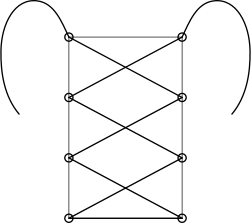
Answer: 790
Small Hint:
The eyelets divide each mm side into three equal gaps, and the shortest lace uses straight segments only
Big Hint:
Six crisscross segments each measure add one width and two mm ends
Solution:
The four eyelets on each mm side are equally spaced with one at each vertex, so consecutive eyelets on a side are mm apart. The lace consists of one segment across the mm width, six crisscross pieces (after the width crossing, each of the two strands makes three crossings to reach the top), and two free ends of at least mm each. The lace is shortest when every piece is a straight segment.
Each crisscross piece spans the full width and rises one gap, so its length is
The minimum length is
2.
An urn contains green balls and blue balls. A second urn contains green balls and blue balls. A single ball is drawn at random from each urn. The probability that both balls are of the same color is Find
Answer: 144
Small Hint:
Add the probabilities of green-green and blue-blue draws
Big Hint:
Solve for
Solution:
Both balls are green with probability and both are blue with probability The condition is
Clearing denominators, so giving
3.
Find the number of rational numbers such that when is written as a fraction in lowest terms, the numerator and the denominator have a sum of
Answer: 200
Small Hint:
Write in lowest terms; then with
Big Hint:
so count that are coprime to
Solution:
Write in lowest terms with since we need Because the fraction is in lowest terms exactly when is coprime to
There are integers in coprime to and they pair up as (note is not coprime to ), so exactly of them are less than The answer is
4.
Jon and Steve ride their bicycles on a path that parallels two side-by-side train tracks running in the east/west direction. Jon rides east at miles per hour, and Steve rides west at miles per hour. Two trains of equal length, traveling in opposite directions at constant but different speeds, each pass the two riders. Each train takes exactly minute to go past Jon. The westbound train takes times as long as the eastbound train to go past Steve. The length of each train is miles, where and are relatively prime positive integers. Find
Answer: 49
Small Hint:
Passing Jon in one minute forces both train speeds: with in miles
Big Hint:
Passing Steve, the westbound time is times the eastbound:
Solution:
Let the eastbound and westbound trains have speeds and miles per hour and common length miles. A train passes a rider in time divided by their relative speed. Passing Jon (riding east at ) in hour gives so and
Relative to Steve (riding west at ), the speeds are and and the westbound train takes times as long: so Substituting, so and
Since the answer is
5.
Let the set consist of the twelve vertices of a regular -gon. A subset of is called communal if there is a circle such that all points of are inside the circle, and all points of not in are outside of the circle. How many communal subsets are there? (Note that the empty set is a communal subset.)
Answer: 134
Small Hint:
A subset can be cut off by a circle exactly when its vertices are consecutive on the -gon
Big Hint:
For each size from to there are runs of consecutive vertices; don’t forget the empty set and all of
Solution:
A subset is communal exactly when its vertices are consecutive around the -gon. Indeed, a separating circle meets the circumcircle of the -gon in at most two points, so the vertices inside it form a contiguous arc. Conversely, any run of consecutive vertices can be separated from the remaining vertices by a line, and a sufficiently large circle on the proper side of that line contains exactly that run.
For each size with there are runs of consecutive vertices (one starting at each vertex), giving subsets, and the empty set and all of are also communal. The total is
6.
The graphs and have -intercepts of and respectively, and each graph has two positive integer -intercepts. Find
Answer: 36
Small Hint:
Set to get and the -intercepts are then roots of and
Big Hint:
The positive integer roots multiply to and and both pairs must have the same sum
Solution:
Setting gives and Expanding, the first graph is whose roots are positive integers with sum and product Similarly the second is with integer roots of sum and product
The first pair of roots is or so or the second pair is or so or The only common value is so which indeed gives -intercepts and
7.
Let and be complex numbers such that and Let The maximum possible value of can be written as where and are relatively prime positive integers. Find (Note that for denotes the measure of the angle that the ray from to makes with the positive real axis in the complex plane.)
Answer: 100
Small Hint:
lies on the circle of radius centered at
Big Hint:
The argument is extremal when the ray from the origin is tangent to that circle, so the sine of the angle with the real axis is
Solution:
Since and can be any complex number of modulus the point ranges over the circle of radius centered at
Because is unchanged when shifts by we want the largest angle that a ray from the origin to this circle makes with the real axis. The extreme rays are tangent to the circle, where
Then so
8.
The positive integers and both end in the same sequence of four digits when written in base where digit is not zero. Find the three-digit number
Answer: 937
Small Hint:
The condition says i.e.
Big Hint:
and are coprime, so and each divide one of them; only one of the four cases has nonzero leading digit
Solution:
The condition is that is, Since consecutive integers are coprime, divides one of and divides one of them. This gives four cases modulo (which is mod and mod ), and (which is mod and mod ).
The last four digits must have which rules out and So — for instance — and
9.
Let be the three real roots of the equation Find
Answer: 2
Small Hint:
Since the cubic factors as times a quadratic
Big Hint:
The quadratic has one negative root and one large positive root, so the middle root is
Solution:
Write so the equation is It factors as as expanding confirms. So one root is and the other two are with product and sum
Since the middle root is and Therefore
10.
A disk with radius is externally tangent to a disk with radius Let be the point where the disks are tangent, be the center of the smaller disk, and be the center of the larger disk. While the larger disk remains fixed, the smaller disk is allowed to roll along the outside of the larger disk until the smaller disk has turned through an angle of That is, if the center of the smaller disk has moved to the point and the point on the smaller disk that began at has now moved to point then is parallel to Then where and are relatively prime positive integers. Find
Answer: 58
Small Hint:
Rolling outside a radius- circle, the disk turns in the ground frame for each its center sweeps about so the center sweeps
Big Hint:
After one full turn the disk regains its original orientation, so place at the origin and compute
Solution:
Place at the origin with so When a circle of radius rolls without slipping outside a fixed circle of radius and its center sweeps an angle about the rolling contact turns the disk through relative to the line of centers, and the revolution of that line adds more, so the disk turns in the ground frame. Turning through therefore means so
Having turned through a full the disk is back in its original orientation, so the vector from its center to the marked point is unchanged: (In particular is parallel to as the problem states.)
The ray is the positive -axis, so and
11.
A token starts at the point of an -coordinate grid and then makes a sequence of six moves. Each move is unit in a direction parallel to one of the coordinate axes. Each move is selected randomly from the four possible directions and independently of the other moves. The probability that the token ends at a point on the graph of is where and are relatively prime positive integers. Find
Answer: 391
Small Hint:
Track and each move changes each of and by independently and uniformly
Big Hint:
The token ends on when or each with probability add these and subtract the overlap
Solution:
Work in the diagonal coordinates and Each of the four moves changes by and by and the four moves realize all four sign combinations equally often — so and perform independent six-step walks. The token ends on exactly when that is, when or
Each of and requires three s and three s, with probability By independence and inclusion-exclusion, the probability is
Thus
12.
Let and let and be randomly chosen (not necessarily distinct) functions from to The probability that the range of and the range of are disjoint is where and are relatively prime positive integers. Find
Answer: 453
Small Hint:
If the range of has elements, exactly functions have range disjoint from it
Big Hint:
Count functions by range size: with size with size with size with size
Solution:
Condition on the range of If it has elements, then the range of is disjoint from it exactly when maps into the remaining elements, which happens for of the functions
Count functions by range size: constant functions; with range size with range size (there are surjections from four elements onto three); and bijections. The number of favorable pairs is
The probability is and since is a power of while is odd, this is in lowest terms. Thus
13.
On square points and lie on sides and respectively, so that and Segments and intersect at a point and the areas of the quadrilaterals and are in the ratio Find the area of square
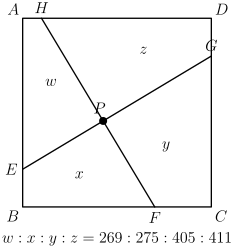
Answer: 850
Small Hint:
Since segment passes through the center of the square; treat the trapezoid the same way to locate
Big Hint:
With side and rise of the length gives and the ratio for pins down the product
Solution:
Place with The regions and together form the trapezoid of area since this is half of forcing i.e. passes through the center. Likewise and form the trapezoid of area so Perpendicularity of the directions and gives Writing we get and gives
Intersecting lines and (and simplifying with ) yields and the shoelace formula on then gives Setting this equal to leaves so
Now and so and are the roots of which are and Since the area is
14.
Let be the largest real solution to the equation There are positive integers and such that Find
Answer: 263
Small Hint:
Add to both sides, splitting one unit to each fraction: each becomes Then substitute
Big Hint:
Symmetric pairs combine to a quadratic in
Solution:
Add to both sides, giving one unit to each fraction: since the equation becomes Besides we can divide by and substitute which pairs the fractions symmetrically:
Besides dividing by gives With clearing denominators gives i.e. so
The largest solution is which exceeds the other candidates and Therefore
15.
In and Circle intersects at and at and and at and Given that and length where and are relatively prime positive integers, and is a positive integer not divisible by the square of any prime. Find
Answer: 41
Small Hint:
is inscribed in so is a diameter and
Big Hint:
Express the distances from and to line as multiples of using the angles of cyclic quadrilateral then compare with coordinates
Solution:
Since angle is right, and as is inscribed in the chord is a diameter. Hence From triangle is an isosceles right triangle, so and from and we get and On the order is (both and lie on the arc opposite and exceeds so is farther from ).
Line is the line so the distances from and to it follow from the angles of cyclic quadrilateral At and so the distance from is At so the distance from is
Now place so line and Setting the two distance formulas read and which give and Then becomes so and Therefore