2012 AIME II Solutions
Scroll down to view professionally curated solutions from LIVE by Po-Shen Loh, print PDF solutions, view answer key, or take the full timed exam.
All problems are used with official legal permission of the Mathematical Association of America (MAA).
1.
Find the number of ordered pairs of positive integer solutions to the equation
Small Hint:
Divide the equation by to get
Big Hint:
Modulo the equation forces count the values that keep positive
Solution:
Dividing by gives Reducing modulo we need so Write with then so
This is positive exactly when that is So all work, giving ordered pairs.
2.
Two geometric sequences and have the same common ratio, with and Find
Small Hint:
With common ratio the condition says
Big Hint:
You only need because
Solution:
Let be the shared common ratio. Then and so gives
Therefore
3.
At a certain university, the division of mathematical sciences consists of the departments of mathematics, statistics, and computer science. There are two male and two female professors in each department. A committee of six professors is to contain three men and three women and must also contain two professors from each of the three departments. Find the number of possible committees that can be formed subject to these requirements.
Small Hint:
Each department contributes exactly two members; classify by how the three men are spread across the departments
Big Hint:
Either every department sends one man and one woman, or one department sends two men, another sends two women, and the third sends one of each
Solution:
Each department contributes exactly two committee members. If every department sends one man and one woman, there are choices per department, for committees.
Otherwise some department sends two men. To keep three of each gender, another department must then send its two women, and the remaining department sends one man and one woman. There are ways to pick the all-male department, ways to pick the all-female department, and choices in the mixed department (the two-man and two-woman selections are forced), for committees.
The total is
4.
Ana, Bob, and Cao bike at constant rates of meters per second, meters per second, and meters per second, respectively. They all begin biking at the same time from the northeast corner of a rectangular field whose longer side runs due west. Ana starts biking along the edge of the field, initially heading west, Bob starts biking along the edge of the field, initially heading south, and Cao bikes in a straight line across the field to a point on the south edge of the field. Cao arrives at point at the same time that Ana and Bob arrive at for the first time. The ratio of the field’s length to the field’s width to the distance from point to the southeast corner of the field can be represented as where and are positive integers with and relatively prime. Find
Small Hint:
Let the field be by and let be the distance from to the southeast corner; set the three riders’ travel times equal
Big Hint:
Equating Bob’s and Cao’s times gives which factors into two linear factors
Solution:
Let the field have length (west) and width (south) with and let be the distance from to the southeast corner. Ana rides around the perimeter a distance Bob rides and Cao rides all in the same time:
The first equality gives Squaring the second, which simplifies to factoring as
The root gives which is impossible, so and then The ratio is and
5.
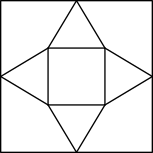
In the accompanying figure, the outer square has side length A second square of side length is constructed inside with the same center as and with sides parallel to those of From each midpoint of a side of segments are drawn to the two closest vertices of The result is a four-pointed starlike figure inscribed in The star figure is cut out and then folded to form a pyramid with base Find the volume of this pyramid.
Small Hint:
The four triangular points fold up along the sides of and their tips meet at the apex above the center of
Big Hint:
The slant from the midpoint of a side of to the star tip has length use a right triangle through the center to get the height
Solution:
Folding the star along the sides of lifts the four triangular points so that their tips (the midpoints of the sides of ) meet at a single apex Let be the center of and the midpoint of one of its sides. In the flat figure, the distance from to the tip of its triangle is and this becomes the slant after folding.
Triangle has a right angle at with so the height is The volume is
6.
Let be the complex number with and such that the distance between and is maximized, and let Find
Small Hint:
Factor the distance as so you need the point on the circle of radius farthest from
Big Hint:
The farthest point lies in exactly the opposite direction: now square once more
Solution:
The distance is As runs over the circle with the square attains every point of the circle (the condition merely selects one of the two square roots). The point of that circle farthest from is diametrically opposite in direction:
Squaring, so
7.
Let be the increasing sequence of positive integers whose binary representation has exactly ones. Let be the th number in Find the remainder when is divided by
Small Hint:
There are members of below so has binary digits
Big Hint:
Fix the leading binary digits one at a time, counting members with each prefix, until the position pins down every remaining bit
Solution:
There are members of below and below so has binary digits, and exactly members below exceed it. The members whose binary representations begin are the largest ones, so begins with and is the th smallest of them.
Among these, begin the next begin and the next begin Since the number is the largest member beginning namely in binary.
Its value is so the remainder upon division by is
8.
The complex numbers and satisfy the system
Find the smallest possible value of
Small Hint:
Multiply the two equations: the cross terms become the constants and leaving an equation in the single unknown
Big Hint:
The quadratic in needs find it by setting with integers and
Solution:
Multiplying the two equations gives so Setting yields
By the quadratic formula, Writing requires and which gives Hence or with or
The smaller value is attained: satisfies both equations with So the smallest possible value of is
9.
Let and be real numbers such that and The value of can be expressed in the form where and are relatively prime positive integers. Find
Small Hint:
is just the product of the two given ratios
Big Hint:
Square both given equations and add, using to find then apply
Solution:
From the double-angle formula,
Squaring the given equations, and Adding, so and Then and so
The requested value is and
10.
Find the number of positive integers less than for which there exists a positive real number such that
Note: is the greatest integer less than or equal to
Small Hint:
Fix as runs from to the product sweeps through the integers from to
Big Hint:
Each contributes exactly values of sum over all whose values stay below
Solution:
Fix For the product ranges over and every integer in that interval is achieved by (which indeed has floor ). So each contributes exactly values of namely
For the largest value is so all values through qualify, while already starts at The count is
11.
Let and for define The value of that satisfies can be expressed in the form where and are relatively prime positive integers. Find
Small Hint:
Write as a single fraction and compute and by hand — a pattern appears
Big Hint:
so setting gives a quadratic with a double root
Solution:
Combining fractions, Composing once, and composing again gives
So the iteration is periodic with period Since we have and the equation becomes that is or
The unique solution is so
12.
For a positive integer define the positive integer to be -safe if differs in absolute value by more than from all multiples of For example, the set of -safe numbers is Find the number of positive integers less than or equal to which are simultaneously -safe, -safe, and -safe.
Small Hint:
is -safe exactly when
Big Hint:
Since count the safe residues in each block of consecutive integers, then adjust near the cutoff
Solution:
Being -safe depends only on it requires That allows residues modulo residues modulo and residues modulo Since the Chinese remainder theorem gives exactly safe residues modulo so each block of consecutive integers contains safe numbers.
The integers through form ten such blocks, containing safe numbers. It remains to discard the safe numbers among Their residues modulo run so only and are -safe; both are also -safe (residues and ) and -safe (residues and ).
Therefore the count is
13.
Equilateral has side length There are four distinct triangles and each congruent to with Find
Small Hint:
Each is or rotated about so track the four angles
Big Hint:
With the four angles are and the last two cosines add up to
Solution:
Write and Since each triangle is congruent to we have so and are the two intersections of the circle of radius about with the circle of radius about they are mirror images across line so with and on opposite sides of Each is the image of its rotated about Measuring signed angles from ray with at the rays sit at and the rays at so the four angles are and
Since the law of cosines gives Using the four angles’ cosines sum to so
Applying the law of cosines in triangle (with ) gives so Therefore the sum equals
14.
In a group of nine people each person shakes hands with exactly two of the other people from the group. Let be the number of ways this handshaking can occur. Consider two handshaking arrangements different if and only if at least two people who shake hands under one arrangement do not shake hands under the other arrangement. Find the remainder when is divided by
Small Hint:
Everyone shaking exactly two hands splits the nine people into cycles of length at least
Big Hint:
A cycle on chosen people can be formed in ways; sum over the partitions and
Solution:
An arrangement in which everyone shakes exactly two hands is a disjoint union of cycles of length at least covering all nine people. The possible cycle-length partitions of are and On given people, the number of distinct cycles is
For split into three unordered triples in ways, one cycle each: For For For a single -cycle:
In total so the remainder modulo is
15.
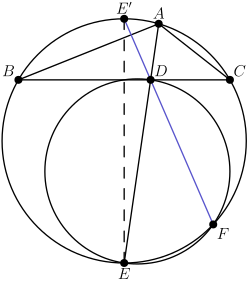
Triangle is inscribed in circle with and The bisector of angle meets side at and circle at a second point Let be the circle with diameter Circles and meet at and a second point Then where and are relatively prime positive integers. Find
Small Hint:
Let be diametrically opposite on angles in semicircles give so lies on line
Big Hint:
Place and then have clean coordinates, and comes from intersecting line with
Solution:
Let be the point of diametrically opposite Since is a diameter of the angle and since is a diameter of also Both and are perpendicular to so lies on line the point is the second intersection of line with
Set and then The bisector gives so Since is the midpoint of arc not containing both and lie on the vertical line through the center which satisfies with Thus and
The direction from to is proportional to and the point lies on when so gives Then so