
2012 AIME I Solutions
Scroll down to view professionally curated solutions from LIVE by Po-Shen Loh, print PDF solutions, view answer key, or take the full timed exam.
All problems are used with official legal permission of the Mathematical Association of America (MAA).
1.
Find the number of positive integers with three not necessarily distinct digits, with and such that both and are multiples of
Small Hint:
Divisibility by depends only on the last two digits, so must divide both and
Big Hint:
Subtracting shows is divisible by with and even, so both lie in or both in then forces the parity of
Solution:
An integer is a multiple of exactly when its last two digits form a multiple of so we need and to be divisible by In particular and are even, and subtracting the two conditions shows is divisible by The even nonzero digits split by remainder mod into and so and must both come from the same one of these sets: ordered pairs from each.
If then requires odd ( choices), and the condition on holds automatically since If then must be even ( choices).
The count is
2.
The terms of an arithmetic sequence add to The first term of the sequence is increased by the second term is increased by the third term is increased by and in general, the th term is increased by the th odd positive integer. The terms of the new sequence add to Find the sum of the first, last, and middle terms of the original sequence.
Small Hint:
If the sequence has terms, the amounts added total
Big Hint:
In an arithmetic sequence the middle term equals the average of all the terms, and the first and last terms add to twice that average
Solution:
If the sequence has terms, the amounts added are the first odd numbers, whose sum is Thus so
The average of the terms is which equals the middle (sixth) term of the arithmetic sequence. The first and last terms also average to so they add to
The requested sum is
3.
Nine people sit down for dinner where there are three choices of meals. Three people order the beef meal, three order the chicken meal, and three order the fish meal. The waiter serves the nine meals in random order. Find the number of ways in which the waiter could serve the meal types to the nine people so that exactly one person receives the type of meal ordered by that person.
Small Hint:
Pick the one correctly served person ( ways), then count servings of the remaining eight people with no matches
Big Hint:
Follow the two leftover meals of the correct person’s type: they go into one other group or into both, and almost everything else is then forced
Solution:
Choose the one person served correctly ( ways); by symmetry say they ordered beef. The remaining meals — beef, chicken, and fish — must go to the other people ( beef, chicken, and fish orderers) with nobody matched. Track where the leftover beef meals go: to chicken or fish orderers.
If both go to the same group, say to two of the three chicken orderers ( ways counting both groups), then the third chicken orderer must receive fish, the three fish orderers must take the three chicken meals, and the two beef orderers take the remaining fish: everything is forced. If one goes to a chicken orderer and one to a fish orderer ( ways), the other two chicken orderers must take fish and the other two fish orderers must take chicken, leaving one chicken and one fish meal to split between the two beef orderers ( ways).
The total is
4.
Butch and Sundance need to get out of Dodge. To travel as quickly as possible, each alternates walking and riding their only horse, Sparky, as follows. Butch begins by walking while Sundance rides. When Sundance reaches the first of the hitching posts that are conveniently located at one-mile intervals along their route, he ties Sparky to the post and begins walking. When Butch reaches Sparky, he rides until he passes Sundance, then leaves Sparky at the next hitching post and resumes walking, and they continue in this manner. Sparky, Butch, and Sundance walk at and miles per hour, respectively. The first time Butch and Sundance meet at a milepost, they are miles from Dodge, and they have been traveling for minutes. Find
Small Hint:
Each mile of the route is ridden by exactly one of the two men, so if Butch walks of the miles, he rides and Sundance rides
Big Hint:
A mile takes minutes walked by Butch, walked by Sundance, and ridden. Setting their travel times equal gives
Solution:
Walking a mile takes Sparky minutes, Butch and Sundance The horse advances along the same route as the men and is ridden over each mile by exactly one of them, so if Butch walks of the miles and rides the other then Sundance rides those miles and walks the remaining
When they meet at a milepost they have been traveling for the same amount of time, so which simplifies to Since the handoffs happen at mileposts, and are integers, and the smallest positive solution is
Then minutes, so
5.
Let be the set of all binary integers that can be written using exactly zeros and ones where leading zeros are allowed. If all possible subtractions are performed in which one element of is subtracted from another, find the number of times the answer is obtained.
Small Hint:
Count pairs and that are both in Adding turns a trailing block into
Big Hint:
The number of ones is unchanged only when ends in the other eleven digits are shared and contain seven ones and four zeros
Solution:
We must count pairs of elements of differing by say and Adding to a binary number turns its trailing block (a zero followed by ones) into changing the number of ones by Both numbers have exactly eight ones precisely when ends in ends in and the two numbers agree everywhere else.
The shared first eleven digits then consist of the remaining seven ones and four zeros, and since leading zeros are allowed, every arrangement gives a valid pair: Each pair produces the answer exactly once, so the count is
6.
The complex numbers and satisfy and the imaginary part of is for relatively prime positive integers and with Find
Small Hint:
Substituting one equation into the other gives so is a nd root of unity
Big Hint:
Write and reduce the fraction in the angle to lowest terms
Solution:
Because the specified imaginary part is positive, so Substituting, and hence Conversely, any nd root of unity works with since then
Hence for some integer and the imaginary part of is The sine specified in the problem is positive, so we may take Since is prime, is already in lowest terms, matching the required form with Thus
7.
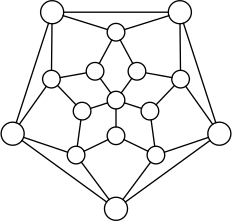
At each of the sixteen circles in the network below stands a student. A total of coins are distributed among the sixteen students. All at once, all students give away all their coins by passing an equal number of coins to each of their neighbors in the network. After the trade, all students have the same number of coins as they started with. Find the number of coins the student standing at the center circle had originally.
Small Hint:
Group the circles into rings (center, inner five, middle five, outer five) and track the total number of coins in each ring
Big Hint:
A student with neighbors sends each neighbor of their coins, so the four ring totals satisfy a small linear system
Solution:
Group the sixteen circles into rings: the center, the inner ring of five, the middle ring of five, and the outer ring of five, holding and coins in total, respectively. The center has neighbors (the inner ring); each inner student has (the center and two middle students); each middle student has (two inner and two outer); each outer student has (two middle and two outer). A student with neighbors sends of their coins to each neighbor.
Summing the trades over each ring (for example, the outer ring receives a quarter of each middle student’s coins twice over, which totals ) gives
The first equation gives the second then gives and the last gives The total is so the center student had coins.
8.
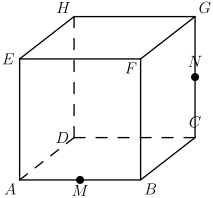
Cube labeled as shown below, has edge length and is cut by a plane passing through vertex and the midpoints and of and respectively. The plane divides the cube into two solids. The volume of the larger of the two solids can be written in the form where and are relatively prime positive integers. Find
Small Hint:
Extend the cutting plane to meet line beyond at since and point is the midpoint of
Big Hint:
The smaller piece is pyramid minus pyramid which is similar to it with ratio
Solution:
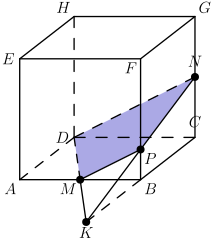
Extend the cutting plane. In the bottom face, line meets line extended beyond at a point since and segment is a midline of triangle so is the midpoint of and The plane also cuts edge at a point and the piece of the cube cut off past the plane is the pyramid with the small pyramid sliced away.
Pyramid has base a right triangle with legs and and its apex is at distance from the plane of that base, so its volume is Pyramid is similar to with ratio so its volume is
The smaller piece therefore has volume and the larger piece has volume giving
9.
Let and be positive real numbers that satisfy The value of can be expressed in the form where and are relatively prime positive integers. Find
Small Hint:
Set so each logarithm becomes a ratio of linear expressions in the exponents
Big Hint:
Equal ratios also equal their mediant: Compare that with the third ratio to pin down
Solution:
Write Then and so the condition is
From the first two, and equal ratios also equal their mediant Comparing with the third expression gives The common value is nonzero, so and thus giving Then yields that is,
Therefore so
10.
Let be the set of all perfect squares whose rightmost three digits in base are Let be the set of all numbers of the form where is in In other words, is the set of numbers that result when the last three digits of each number in are truncated. Find the remainder when the tenth smallest element of is divided by
Small Hint:
is divisible by handle the prime powers and separately
Big Hint:
must divide one of the two factors, and is divisible by these combine to
Solution:
A square ends in exactly when is divisible by Modulo forces to be divisible by Modulo the factors differ by so divides at most one of them, and hence must divide a single factor: Because is a multiple of the two conditions combine to
So consists of the numbers whose square roots in increasing order are The tenth smallest element of is
The corresponding element of is whose remainder upon division by is
11.
A frog begins at and makes a sequence of jumps according to the following rule: from the frog jumps to which may be any of the points or There are points with that can be reached by a sequence of such jumps. Find the remainder when is divided by
Small Hint:
Each jump changes by or and changes by or
Big Hint:
Points with and need and of equal parity, and all of them are reachable. Note
Solution:
Each jump changes by or and changes by Starting from every reachable point therefore has and for integers and moreover must be an integer, so and have the same parity. Since the condition becomes and
Conversely, every such point is reachable. Repeating a jump that changes in the desired direction first reaches some point on every line Two-jump combinations translate by or Two of the former plus one of the latter give the shift while three of the former plus two of the latter give so along a fixed line they move by or The initially reached value of has the same parity as so these shifts reach every pair of equal parity.
Counting: even ( values) pairs with even ( values), and odd ( values) with odd ( values), so The remainder is
12.
Let be a right triangle with right angle at Let and be points on with between and such that and trisect If then can be written as where and are relatively prime positive integers, and is a positive integer not divisible by the square of any prime. Find
Small Hint:
In triangle ray bisects angle which measures so
Big Hint:
Take and the Law of Cosines gives and a second application gives
Solution:
The trisectors make In triangle ray bisects angle which measures so the angle bisector theorem gives Scale the triangle so that and
By the Law of Cosines in triangle so Applying the Law of Cosines again in the same triangle, which gives
Then so and
13.
Three concentric circles have radii and An equilateral triangle with one vertex on each circle has side length The largest possible area of the triangle can be written as where and are positive integers, and are relatively prime, and is not divisible by the square of any prime. Find
Small Hint:
Say Rotate the plane by about so that lands on and follow the center
Big Hint:
If is the image of triangle has sides and and the largest triangle comes from
Solution:
Let be the common center and label the triangle with Rotate the plane by about so that maps to and let be the image of Then triangle is equilateral, so and the image of has length
Triangle has sides so In the configuration giving the largest triangle, lies inside and so by the Law of Cosines (If lies outside the triangle, the triangle fits in a half-disk of radius so its altitude is at most and which is smaller.)
The area is so
14.
Complex numbers and are the zeros of a polynomial and The points corresponding to and in the complex plane are the vertices of a right triangle with hypotenuse Find
Small Hint:
There is no term, so if the right angle is at then
Big Hint:
The hypotenuse midpoint is equidistant from all three vertices; also
Solution:
Since has no term, Say the right angle is at then the hypotenuse joins and so and The midpoint of the hypotenuse is the circumcenter of the right triangle, so Since this gives
By the parallelogram law, and so
Therefore
15.
There are mathematicians seated around a circular table with seats numbered in clockwise order. After a break they again sit around the table. The mathematicians note that there is a positive integer such that
for each the mathematician who was seated in seat before the break is seated in seat after the break (where seat is seat );
for every pair of mathematicians, the number of mathematicians sitting between them after the break, counting in both the clockwise and the counterclockwise directions, is different from either of the number of mathematicians sitting between them before the break.
Find the number of possible values of with
Small Hint:
Condition means the seats are pairwise distinct mod i.e.
Big Hint:
Condition forces and to be coprime to as well, and among three consecutive integers there are multiples of both and
Solution:
Condition requires the seats to be pairwise distinct modulo which happens if and only if For condition the two mathematicians from seats and have gap counts before the break determined by and after the break by so the requirement is for all Equivalently, and for every nonzero residue which holds exactly when and are also relatively prime to
So is possible if and only if some satisfies Any three consecutive integers include a multiple of and a multiple of so no works when Conversely, if then works, since has only the prime factors and
The valid with are those congruent to namely for and there are of them.