
2010 AIME II Solutions
Scroll down to view professionally curated solutions from LIVE by Po-Shen Loh, print PDF solutions, view answer key, or take the full timed exam.
All problems are used with official legal permission of the Mathematical Association of America (MAA).
1.
Let be the greatest integer multiple of all of whose digits are even and no two of whose digits are the same. Find the remainder when is divided by
Small Hint:
Since the digit sum must be divisible by and the last two digits must form a multiple of
Big Hint:
Distinct even digits come from so the digit sum is even and hence must be Use the largest such digits.
Solution:
Since the number must be divisible by both and Its digits are distinct members of whose total is so cannot use all five. The digit sum must be a multiple of and being even it must be the only such digit sets are and
The largest number formed from is which ends in a multiple of So and the remainder upon division by is
2.
A point is chosen at random in the interior of a unit square Let denote the distance from to the closest side of The probability that is equal to where and are relatively prime positive integers. Find
Small Hint:
The set of points at distance at least from every side is a concentric square of side
Big Hint:
The favorable region lies inside the square of side and outside the square of side subtract areas
Solution:
The points with form a concentric square of side So puts inside the concentric square of side and keeps outside the open concentric square of side
Since the unit square has area the probability is the area between those two squares: Thus
3.
Let be the product of all factors (not necessarily distinct) where and are integers satisfying Find the greatest positive integer such that divides
Small Hint:
The difference takes each value occurring exactly times
Big Hint:
Add times the exponent of in over even
Solution:
For each value the pairs show that occurs exactly times, so The exponent of in is therefore where is the exponent of in
Only even contribute: give give gives and gives The total is so
4.
Dave arrives at an airport which has twelve gates arranged in a straight line with exactly feet between adjacent gates. His departure gate is assigned at random. After waiting at that gate, Dave is told the departure gate has been changed to a different gate, again at random. Let the probability that Dave walks feet or less to the new gate be a fraction where and are relatively prime positive integers. Find
Small Hint:
Walking feet or less means the gate numbers differ by at most count ordered pairs of distinct gates
Big Hint:
Gates near the ends have fewer close neighbors: the counts are
Solution:
Number the gates through All ordered pairs of distinct (old, new) gates are equally likely, and Dave walks feet or less exactly when the gate numbers differ by at most
A gate has qualifying new gates: gates and have each, gates and have gates and have gates and have and gates through have each. The total is
The probability is so
5.
Positive numbers and satisfy and Find
Small Hint:
Let then and the second condition says
Big Hint:
Use
Solution:
Let and Taking logs of gives Since the second condition is
Squaring the sum, so the requested value is
6.
Find the smallest positive integer with the property that the polynomial can be written as a product of two nonconstant polynomials with integer coefficients.
Small Hint:
Try splitting into two quadratics matching coefficients gives and
Big Hint:
Look for factor pairs of whose sum is a perfect square, and also compare with the case of a linear factor, whose root must divide
Solution:
If there is a linear factor, then some integer is a root, so and forcing to be divisible by and The smallest value is at
Otherwise the polynomial splits into two quadratics, which we may take monic; since the coefficient vanishes, they have the form Matching coefficients gives and The factor pairs of with square sum are (sum so ) and (sum so ), giving or
The smallest positive value overall is indeed
7.
Let where and are real. There exists a complex number such that the three roots of are and where Find
Small Hint:
The sum of the roots, must be real; this determines the imaginary part of
Big Hint:
Real coefficients force the two non-real roots to be conjugates, and
Solution:
Write with and real. The sum of the roots is which is real, so and The roots are then and Because the coefficients are real, the two non-real roots must be conjugates, so giving The roots are and
Now so and
8.
Let be the number of ordered pairs of nonempty sets and that have the following properties:
•
•
• the number of elements of is not an element of
• the number of elements of is not an element of
Find
Small Hint:
If then and the conditions force and
Big Hint:
For each choose the remaining elements of from the unassigned numbers. The case fails because would have to lie in both sets.
Solution:
Let so with Since every element lies in exactly one set, means and means If then would have to belong to both sets, which is impossible, so
For each other the elements and are already placed, and the remaining elements of can be chosen from the other numbers in ways, with taking the rest. Hence
9.
Let be a regular hexagon. Let and be the midpoints of sides and respectively. The segments and bound a smaller regular hexagon. Let the ratio of the area of the smaller hexagon to the area of be expressed as a fraction where and are relatively prime positive integers. Find
Small Hint:
Place the center at the origin; by symmetry the smaller hexagon is regular and concentric, so it suffices to find the distance from the center to one of its vertices
Big Hint:
One vertex of the small hexagon is the intersection of lines and with circumradius it is
Solution:
Center the hexagon at the origin with circumradius and Then and Rotation by permutes the six segments, so the smaller hexagon is regular and concentric, and the area ratio is the square of the ratio of distances from the center to a vertex.
One vertex is the intersection of and Line is and line is Substituting gives so and
That vertex has squared distance from the center, while is at distance The ratio of areas is and
10.
Find the number of second-degree polynomials with integer coefficients and integer zeros for which
Small Hint:
Write so count choices of and the unordered root pair
Big Hint:
When split the four primes among and check that all four sign patterns of work. Treat separately.
Solution:
Write with integer roots and such a polynomial is determined by and the unordered pair The condition says Since is squarefree, each of the four primes goes entirely to one of
First suppose Choosing which of the four primes divide the roots ( ways) and splitting those primes between the two roots ( unordered ways) gives choices of magnitudes. For each, the four sign patterns of are distinct and each forces the sign of giving polynomials.
If squarefreeness forces so the options are roots or with or roots with adding more. In total
11.
Define a T-grid to be a matrix which satisfies the following two properties:
Exactly five of the entries are ’s, and the remaining four entries are ’s.
Among the eight rows, columns, and long diagonals (the long diagonals are and ), no more than one of the eight has all three entries equal.
Find the number of distinct T-grids.
Small Hint:
There are placements of the ’s; subtract those where two or more of the eight lines are constant
Big Hint:
Two constant lines must be either a row/column of ’s with a parallel line of ’s, or two crossing lines of ’s, which use exactly five ’s
Solution:
There are matrices satisfying we subtract those with two or more constant lines. Two lines of ’s are impossible (they would need at least zeros), and a line of ’s and a line of ’s cannot cross, so they must be parallel rows or parallel columns; likewise two lines of ’s cannot be parallel ( ones), so they must cross, using exactly ones.
Case a line of ’s and a parallel line of ’s. There are choices for the all- row or column, for the parallel all- line, and ways to fill the remaining parallel line with two ’s and one matrices. Every perpendicular line then contains both a and a so no third constant line appears and nothing is double-counted.
Case two crossing lines of ’s and ’s elsewhere. The pair can be a row and a column (), a row or column with a diagonal (), or the two diagonals (), for matrices; one checks the four remaining ’s never form a constant line. So
12.
Two noncongruent integer-sided isosceles triangles have the same perimeter and the same area. The ratio of the lengths of the bases of the two triangles is Find the minimum possible value of their common perimeter.
Small Hint:
Write the bases as and equal areas mean the altitudes are and Express each leg with the Pythagorean theorem.
Big Hint:
Setting the perimeters equal and squaring twice gives then demand that both legs, and be integers
Solution:
Since the integer bases are in ratio they are and for a positive integer Equal areas make the corresponding altitudes inversely proportional to the bases, say and The legs are then and and equal perimeters give
Moving to the left and squaring yields squaring again and simplifying leaves so The legs become and
For all sides to be integers, must divide Taking gives the triangles and each with perimeter and area The minimum common perimeter is
13.
The cards in a deck are numbered Alex, Blair, Corey, and Dylan each picks a card from the deck without replacement and with each card being equally likely to be picked. The two persons with lower numbered cards form a team, and the two persons with higher numbered cards form another team. Let be the probability that Alex and Dylan are on the same team, given that Alex picks one of the cards and and Dylan picks the other of these two cards. The minimum value of for which can be written as where and are relatively prime positive integers. Find
Small Hint:
Given that Alex and Dylan hold and they are teammates exactly when Blair and Corey both draw below or both draw above
Big Hint:
reduces to so or
Solution:
Condition on Alex and Dylan holding and Blair and Corey then draw of the remaining cards, and Alex and Dylan are teammates exactly when both of those cards are below (Alex and Dylan are the high team) or both are above (the low team). There are cards below and cards above, so
The numerator is so becomes that is, Since is an integer, so or
The parabola is smallest at the admissible points closest to which is indeed at least Thus
14.
In right triangle with the right angle at and Point on has the properties that and The ratio can be represented in the form where and are positive integers and is not divisible by the square of any prime. Find
Small Hint:
Since the right angle is at is a diameter of the circumcircle. Extend to meet the circle again at
Big Hint:
The angle condition forces so the power of the point gives while
Solution:
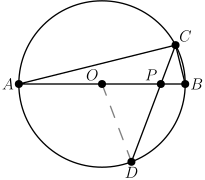
Because the right angle is at segment is a diameter of the circumcircle; let be its center, so the radius is Let and extend to meet the circle again at The central angle over arc is while vertical angles give So and make equal angles with line and triangle is isosceles with
By the power of the point so and are the roots of namely Since we have with so and the triangle inequality gives Hence
Therefore and
15.
In triangle and Points and lie on with and Points and lie on with and Let be the other point of intersection of the circumcircles of and Ray meets at The ratio can be written in the form where and are relatively prime positive integers. Find
Small Hint:
Use the angle bisector theorem to compute the short segments and between the midpoints and the bisector feet
Big Hint:
The cyclic quadrilaterals and make triangles and similar, and the law of sines turns into
Solution:
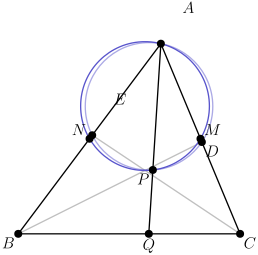
By the angle bisector theorem, and so lies on and lies on with
Since is cyclic, and since is cyclic, Hence triangles and are similar, so By the law of sines in triangles and whose angles and are supplementary,
Comparing the areas of triangles and which share the cevian which is in lowest terms since and Thus