
2010 AIME I Solutions
Scroll down to view professionally curated solutions from LIVE by Po-Shen Loh, print PDF solutions, view answer key, or take the full timed exam.
All problems are used with official legal permission of the Mathematical Association of America (MAA).
1.
Maya lists all the positive divisors of She then randomly selects two distinct divisors from this list. Let be the probability that exactly one of the selected divisors is a perfect square. The probability can be expressed in the form where and are relatively prime positive integers. Find
Small Hint:
Factor it has divisors
Big Hint:
A divisor is a perfect square exactly when all four exponents are even, so of the divisors are squares. Count pairs using one square and one non-square.
Solution:
Since it has positive divisors. A divisor is a perfect square exactly when each of its four exponents is or giving perfect squares and non-squares.
The probability of picking one of each is so
2.
Find the remainder when is divided by
Small Hint:
Every factor from the third one on ends in at least three s, so it is
Big Hint:
Count how many factors are and check whether that count is odd or even; only remains to compute
Solution:
Work modulo Every factor from the third one on ends in at least three s, so each is There are factors in all, hence of them are
The product is therefore so the remainder is
3.
Suppose that and The quantity can be expressed as a rational number where and are relatively prime positive integers. Find
Small Hint:
Substitute into and take th roots of both sides
Big Hint:
The equation becomes so which gives
Solution:
Substituting into gives Taking th roots (the quantities here are positive), so dividing by yields that is,
Then and Since the answer is
4.
Jackie and Phil have two fair coins and a third coin that comes up heads with probability Jackie flips the three coins, and then Phil flips the three coins. Let be the probability that Jackie gets the same number of heads as Phil, where and are relatively prime positive integers. Find
Small Hint:
Compute the probability that one player flips heads; all four have denominator
Big Hint:
The two players are independent and identical, so the probability they match is the sum of the squares of those four probabilities
Solution:
Let be the probability that one player flips heads. Splitting according to the two fair coins and the biased coin,
Jackie’s and Phil’s flips are independent with the same distribution, so the probability that their head counts agree is Thus
5.
Positive integers and satisfy and Find the number of possible values of
Small Hint:
Factor:
Big Hint:
Equality forces so then find the range of allowed by and
Solution:
Factoring, since and Equality holds, so that is, and Then gives
The condition means so and means so Every in this range works, via
The count is
6.
Let be a quadratic polynomial with real coefficients satisfying for all real numbers and suppose Find
Small Hint:
Complete the square: both bounding quadratics equal and with common vertex
Big Hint:
is nonnegative everywhere and zero at so it is use to find
Solution:
Completing the square, the condition reads At both bounds equal so The quadratic is nonnegative for all and vanishes at so is a double root: for some constant
From we get Then
7.
Define an ordered triple of sets to be minimally intersecting if and For example, is a minimally intersecting triple. Let be the number of minimally intersecting ordered triples of sets for which each set is a subset of Find the remainder when is divided by
Note: represents the number of elements in the set
Small Hint:
The three pairwise intersections are single elements which must be distinct since the triple intersection is empty
Big Hint:
After placing in ways, each remaining element may go into exactly one of the three sets or into none
Solution:
Write and Since the elements are distinct, and they can be chosen in ways.
Each of the remaining elements must not create any further pairwise intersections, so it can belong to exactly one of or to none of them: choices each, for assignments.
Hence and the remainder upon division by is
8.
For a real number let denote the greatest integer less than or equal to Let denote the region in the coordinate plane consisting of points such that The region is completely contained in a disk of radius (a disk is the union of a circle and its interior). The minimum value of can be written as where and are integers and is not divisible by the square of any prime. Find
Small Hint:
must be one of the integer pairs with squares summing to so is a union of unit squares
Big Hint:
is symmetric about so the best disk is centered there; find the square corner farthest from that center
Solution:
Since and are integers whose squares sum to the pair is one of the pairs So is the union of the unit squares whose lower-left corners are these points.
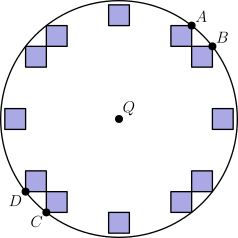
Let be the closure of Any closed disk containing also contains so the two sets have the same minimum enclosing radius. The map permutes the closed unit squares in so is symmetric under rotation about If its opposite point also lies in Every disk containing both endpoints of has radius at least Thus no enclosing disk can have radius smaller than the greatest distance from to
That greatest distance is attained at square corners such as and and checking the corners of all twelve closed squares gives The disk centered at with this radius contains every square, so it attains the lower bound.
Hence the minimum radius is and
9.
Let be a real solution of the system of equations The greatest possible value of can be written in the form where and are relatively prime positive integers. Find
Small Hint:
Add to each equation and set so
Big Hint:
Multiplying the three gives which is really a quadratic in note
Solution:
Adding to each equation gives and Let Multiplying the three equations yields so i.e. whose roots are and Each root is achievable: the cube roots of then really do have product
Adding the original equations, which is maximized by the larger root Thus
10.
Let be the number of ways to write in the form where the ’s are integers, and An example of such a representation is Find
Small Hint:
Split each coefficient into digits: with
Big Hint:
The are the digits of a number and the of a number and the condition is exactly count the possible
Solution:
Write each coefficient as with digits every integer splits this way uniquely. Setting and (read as base- numbers), the condition becomes
Conversely, any nonnegative integers with satisfy and so each has at most four digits; those digits recover the and hence the So representations correspond exactly to choices of with and
11.
Let be the region consisting of the set of points in the coordinate plane that satisfy both and When is revolved around the line whose equation is the volume of the resulting solid is where and are positive integers, and are relatively prime, and is not divisible by the square of any prime. Find
Small Hint:
The region is a triangle with one side on the axis of revolution find its three vertices
Big Hint:
Revolving gives two cones sharing a base: total volume where is the distance from the off-axis vertex to the line
Solution:
The condition means for and for Intersecting with the half-plane leaves the triangle with vertices and on the line and apex
Side lies on the axis of revolution, and the foot of the perpendicular from to the line, namely lies between and So the solid is two cones sharing a base of radius with heights summing to and its volume is Here
The volume is so
12.
Let be an integer and let Find the smallest value of such that for every partition of into two subsets, at least one of the subsets contains integers and (not necessarily distinct) such that
Note: a partition of is a pair of sets such that and
Small Hint:
Try two-subset partitions that keep small numbers and their pairwise products apart, such as separating from
Big Hint:
For the upper bound, follow the powers of once and are forced into different subsets, place and and one more power creates a contradiction
Solution:
First, works. Suppose were partitioned into and with neither containing a product, and say Then must lie in so must lie in and then must lie in Now consider if then puts a product in if then puts one in Either way we reach a contradiction.
For the partition and avoids products: two elements of multiply to something in any product involving an element of is at least and two elements of multiply to at least
Hence the smallest such is
13.
Rectangle and a semicircle with diameter are coplanar and have nonoverlapping interiors. Let denote the region enclosed by the semicircle and the rectangle. Line meets the semicircle, segment and segment at distinct points and respectively. Line divides region into two regions with areas in the ratio Suppose that and Then can be represented as where and are positive integers and is not divisible by the square of any prime. Find
Small Hint:
With the center satisfies so triangle is equilateral and sector is one third of the semicircle
Big Hint:
Since splits the rectangle in ratio as well, the two small triangles that cuts off on either side of must have equal areas
Solution:
Here so the semicircle has center (the midpoint of ) and radius Since triangle is equilateral, so and sector is exactly one third of the semicircle. Likewise, if is the foot of the perpendicular from to then makes rectangle one third of rectangle
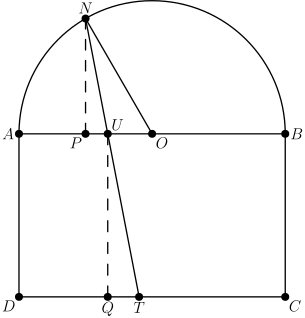
The part of on the -side of equals (sector ) (rectangle ) Since this must be one third of we need Let be the foot of the perpendicular from to In the -- triangle and so and Triangles and are similar right triangles (vertical angles at ), so the latter because both triangles have height over bases and
Setting the two triangle areas equal gives so and
14.
For each positive integer let Find the largest value of for which
Note: is the greatest integer less than or equal to
Small Hint:
Each term never decreases as grows, so is nondecreasing; compute as a baseline
Big Hint:
For slightly above count the with and the with to see exactly when reaches
Solution:
Each term is nondecreasing in so is nondecreasing and we just locate where it passes For the products run from to giving for for and for so
For since and the terms are for for and for For now so ten terms equal and
By monotonicity, the largest valid is
15.
In with and let be a point on such that the incircles of and have equal radii. Let and be positive relatively prime integers such that Find
Small Hint:
Writing the area as we have Thus equal inradii mean the two triangles’ areas and perimeters are in the same ratio, and both ratios equal
Big Hint:
Set the perimeter condition gives and Stewart’s theorem on cevian gives a second expression for
Solution:
Let Triangles and share the altitude from so Since the inradius of a triangle is its area divided by its semiperimeter, equal inradii force as well. From we get and since the perimeter equation simplifies to so and forces
Stewart’s theorem on cevian gives so Setting this equal to and clearing denominators yields which simplifies to
The roots are and and only exceeds (then ). Hence