
2008 AIME II Solutions
Scroll down to view professionally curated solutions from LIVE by Po-Shen Loh, print PDF solutions, view answer key, or take the full timed exam.
All problems are used with official legal permission of the Mathematical Association of America (MAA).
1.
Let where the additions and subtractions alternate in pairs. Find the remainder when is divided by
Small Hint:
Pair each positive square with the negative square two below it, and factor with
Big Hint:
Group four consecutive terms at a time; the block ending in simplifies to
Solution:
Group the terms four at a time. For the block ending at is using the difference of squares with twice.
Summing over to so the remainder when is divided by is
2.
Rudolph bikes at a constant rate and stops for a five-minute break at the end of every mile. Jennifer bikes at a constant rate which is three-quarters the rate that Rudolph bikes, but Jennifer takes a five-minute break at the end of every two miles. Jennifer and Rudolph begin biking at the same time and arrive at the -mile mark at exactly the same time. How many minutes has it taken them?
Small Hint:
Neither rider takes a break upon arriving, so Rudolph takes breaks and Jennifer takes
Big Hint:
With Rudolph’s rate miles per minute, equate and
Solution:
Let Rudolph bike at miles per minute. He rests after each of miles through so his total time is minutes. Jennifer bikes at miles per minute and rests after each of miles so her total time is minutes.
Setting the times equal gives so and The common time is minutes.
3.
A block of cheese in the shape of a rectangular solid measures cm by cm by cm. Ten slices are cut from the cheese. Each slice has a width of cm and is cut parallel to one face of the cheese. The individual slices are not necessarily parallel to each other. What is the maximum possible volume in cubic cm of the remaining block of cheese after ten slices have been cut off?
Small Hint:
Each slice shortens one of the three dimensions by cm, so the remaining block has dimensions summing to
Big Hint:
A product of positive numbers with a fixed sum is largest when the numbers are all equal
Solution:
Every slice is cm wide and parallel to a face, so after each cut the remaining cheese is still a rectangular block, with one dimension shortened by If the ten slices shorten the three dimensions by and with the remaining block measures and these dimensions sum to
By the AM-GM inequality, a product of positive numbers with fixed sum is greatest when all three are equal to which is achieved by taking slice from the cm dimension, from the cm dimension, and from the cm dimension. The maximum volume is cubic cm.
4.
There exist unique nonnegative integers and unique integers with each either or such that Find
Small Hint:
Start by writing in base
Big Hint:
Replace each digit using so that every coefficient becomes or
Solution:
In base that is, To convert the digits into coefficients use The two adjacent digits collapse neatly: and
Therefore which has distinct exponents and coefficients as required. The sum of the exponents is
5.
In trapezoid with let and Let and and be the midpoints of and respectively. Find the length
Small Hint:
Extend the legs and to meet at since the angle at is right
Big Hint:
The median to the hypotenuse of a right triangle is half the hypotenuse, and are collinear
Solution:
Extend legs and until they meet at a point Since triangle has a right angle at Because triangle is the image of triangle under a homothety centered at so the midpoint of maps to the midpoint of in particular and are collinear.
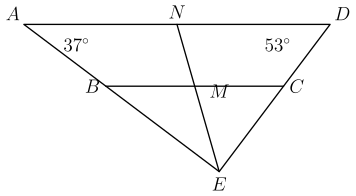
The median to the hypotenuse of a right triangle is half the hypotenuse, so and Therefore
6.
The sequence is defined by
The sequence is defined by
Find
Small Hint:
Divide the recurrence by to see that the ratio increases by exactly at each step
Big Hint:
The ratios give and form the quotient
Solution:
Dividing the recurrence by gives so the consecutive-term ratio increases by exactly each step. For the first ratio is so and The same computation applies to whose first ratio is so and
Therefore
7.
Let and be the three roots of the equation Find
Small Hint:
There is no term, so and each of is the negative of a root
Big Hint:
When the identity applies; Vieta gives the product of the roots from the constant term
Solution:
The cubic has no term, so by Vieta’s formulas. Hence and and the desired sum is
Whenever the identity gives By Vieta’s formulas, so and the answer is
8.
Let Find the smallest positive integer such that is an integer.
Small Hint:
Apply the product-to-sum identity to turn each term into a difference of two sine terms
Big Hint:
The sum telescopes to which is an integer exactly when is a multiple of
Solution:
By the product-to-sum identity, Summing over to the terms telescope, leaving
A sine is an integer only when it is or that is, when its argument is a multiple of So we need to be a multiple of i.e. is divisible by where and is prime.
Since and are coprime, must divide one of them, so For the product is not divisible by For the product is divisible by The smallest such is
9.
A particle is located on the coordinate plane at Define a move for the particle as a counterclockwise rotation of radians about the origin followed by a translation of units in the positive -direction. Given that the particle’s position after moves is find the greatest integer less than or equal to
Small Hint:
In the complex plane a move sends to where
Big Hint:
After iterating, group the resulting geometric sum into blocks of using
Solution:
Identify the plane with the complex plane, so a move sends to with Starting from and iterating,
Since and we get In the geometric sum, every block of consecutive powers adds to so the terms reduce to Therefore
Thus and the greatest integer less than or equal to this is
10.
The diagram below shows a rectangular array of points, each of which is unit away from its nearest neighbors.

Define a growing path to be a sequence of distinct points of the array with the property that the distance between consecutive points of the sequence is strictly increasing. Let be the maximum possible number of points in a growing path, and let be the number of growing paths consisting of exactly points. Find
Small Hint:
The squared distance between two array points is with not both zero, which takes only distinct values
Big Hint:
Build maximal paths backwards from the longest step: the last two points must be opposite corners, and nearly every earlier point is then forced
Solution:
The squared distance between two points of the array is where and are the coordinate differences, each in and not both zero. The possible values are — only values — so a growing path has at most points, and a path with points must use all nine distances in increasing order. Label its points so that and
Since is realized only by opposite corners, there are ordered choices of Next, leaves choices for the two neighbors of symmetric across the main diagonal. From there the distances force uniquely (for the alternative corner choice fails because the point needed next for would coincide with or ). Finally must be at distance from and of its neighbors are unused. One of the resulting paths is shown below.
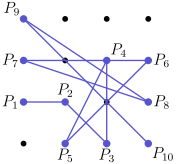
Hence and so
11.
In triangle and Circle has radius and is tangent to and Circle is externally tangent to circle and is tangent to and No point of circle lies outside of The radius of circle can be expressed in the form where and are positive integers and is the product of distinct primes. Find
Small Hint:
Place both centers lie on angle bisectors, and
Big Hint:
The centers are and set the distance between them equal to
Solution:
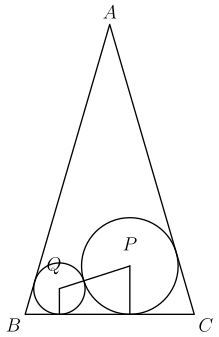
Place and the altitude from has length so Then and A circle of radius tangent to and to a slanted side has its center on the bisector from that base vertex, at height and horizontal distance from the vertex. Thus and where is the radius of circle
External tangency means Since this becomes i.e. which simplifies to so
The root would make circle extend outside the triangle, so Here and giving
12.
There are two distinguishable flagpoles, and there are flags, of which are identical blue flags, and are identical green flags. Let be the number of distinguishable arrangements using all of the flags in which each flagpole has at least one flag and no two green flags on either pole are adjacent. Find the remainder when is divided by
Small Hint:
On a pole with blue and green flags, the greens must occupy distinct gaps among the gaps determined by the blues: ways
Big Hint:
Sum over using Vandermonde’s identity, then subtract the arrangements that leave a pole empty
Solution:
Suppose the first pole gets blue and green flags, the second the remaining blue and green. On a pole with blue flags, the green flags must occupy distinct gaps among the gaps around the blues, in ways. Temporarily ignoring the requirement that each pole be nonempty, the total is where the inner sum collapses by Vandermonde’s identity, since
The arrangements that leave a pole empty put all flags on one pole, in ways for each choice of pole. Hence and the remainder when is divided by is
13.
A regular hexagon with center at the origin in the complex plane has opposite pairs of sides one unit apart. One pair of sides is parallel to the imaginary axis. Let be the region outside the hexagon, and let Then the area of has the form where and are positive integers. Find
Small Hint:
Writing the half-plane maps exactly onto the disk of radius centered at
Big Hint:
is the union of six unit disks centered at the sixth roots of unity; by symmetry find the area inside one wedge as a sector plus two triangles
Solution:
The hexagon’s sides lie at distance from the origin, with one side on the line so is the union of the six half-planes obtained by rotating by multiples of If then is equivalent to i.e. So each half-plane maps onto an open unit disk, and is the union of six unit disks centered at the sixth roots of unity.
Cut the plane into six wedges by the rays at angles by symmetry, within each wedge coincides with the disk whose center lies in that wedge. The rays at meet the circle at so the piece of in that wedge consists of two triangles with vertices at the center and one of these points — each isosceles with two sides and apex angle area — together with the sector of the disk between them, area
Each wedge therefore contributes and the total area is Thus and
14.
Let and be positive real numbers with Let be the maximum possible value of for which the system of equations has a solution satisfying and Then can be expressed as a fraction where and are relatively prime positive integers. Find
Small Hint:
The equal quantities are squared distances: with in an rectangle, triangle is equilateral
Big Hint:
With equal sides force which increases in while caps at
Solution:
Draw the rectangle with vertices and let on and on Then and so the system says exactly that triangle is equilateral, with the constraints keeping and on those two sides.
Let so and Since and the corner angle at is we get so and Setting gives which is increasing in The requirement gives while forces
The maximum is therefore at where attained with and Hence and
15.
Find the largest integer satisfying the following conditions: can be expressed as the difference of two consecutive cubes; is a perfect square.
Small Hint:
Condition says which rearranges to
Big Hint:
The two factors are coprime, and working modulo shows must be a perfect square; then yields a difference of squares equal to
Solution:
Condition says for some integer Multiplying by and rearranging, i.e. The factors on the left are consecutive odd numbers, hence coprime, so one of them is a perfect square and the other is times a square. If then would be a perfect square, which is impossible. Hence with odd.
Writing gives Condition says so The two factors have the same parity, so both are even: the pairs give of which the odd values yield (so ) and (so ).
For indeed (here as required), and So the largest such is