
2006 AIME II Solutions
Scroll down to view professionally curated solutions from LIVE by Po-Shen Loh, print PDF solutions, view answer key, or take the full timed exam.
All problems are used with official legal permission of the Mathematical Association of America (MAA).
1.
In convex hexagon all six sides are congruent, and are right angles, and and are congruent. The area of the hexagonal region is Find
Small Hint:
Each of angles measures Draw diagonals and
Big Hint:
These diagonals cut the hexagon into two right isosceles triangles and a rectangle with side lengths and
Solution:
The angles of a hexagon sum to so each of the four congruent angles measures degrees. Let The diagonals and cut off the right isosceles triangles and each with legs and hypotenuse and the angles guarantee that the remaining piece is a rectangle with sides and
Hence the area is so and
2.
The lengths of the sides of a triangle with positive area are and where is a positive integer. Find the number of possible values for
Small Hint:
The three lengths must satisfy the triangle inequality; two of the three conditions bound from both sides.
Big Hint:
so
Solution:
The triangle inequality requires and that is The remaining inequality, is automatic because and
So which for integers means That gives possible values of
3.
Let be the product of the first positive odd integers. Find the largest integer such that is divisible by
Small Hint:
Count how many of are divisible by then by by and by
Big Hint:
Each divisibility layer adds one more factor of per surviving term, so is the sum of the four counts.
Solution:
so is the total number of factors of among the odd numbers up to The odd multiples of are and there are of them. The odd multiples of are of them. The odd multiples of are of them. The only odd multiple of at most is itself, and there are no multiples of
Each layer contributes one additional factor of so
4.
Let be a permutation of for which and An example of such a permutation is Find the number of such permutations.
Small Hint:
is less than all eleven other terms, so
Big Hint:
Once you choose which five of the remaining numbers fill the first five slots, the order of both halves is forced.
Solution:
The term is smaller than every other term of the permutation, so Now choose which five of the remaining numbers occupy positions through they must appear in decreasing order, so their arrangement is forced, and the other six numbers must fill positions through in increasing order, which is also forced.
Every choice of the five numbers gives exactly one valid permutation, so the count is
5.
When rolling a certain unfair six-sided die with faces numbered and the probability of obtaining face is greater than the probability of obtaining the face opposite face is less than the probability of obtaining each of the other faces is and the sum of the numbers on each pair of opposite faces is When two such dice are rolled, the probability of obtaining a sum of is Given that the probability of obtaining face is where and are relatively prime positive integers, find
Small Hint:
Write the probability of face as so the opposite face has probability
Big Hint:
A sum of always comes from a pair of opposite faces:
Solution:
Let the probability of face be so the face opposite has probability (the six probabilities must sum to ). Since opposite faces sum to a total of occurs exactly when the two dice show a pair of opposite faces. Of the six ordered pairs that sum to four use only ordinary faces, and two pair with its opposite. Thus
Since this gives so The probability of face is and
6.
Square has sides of length Points and are on and respectively, so that is equilateral. A square with vertex has sides that are parallel to those of and a vertex on The length of a side of this smaller square is where and are positive integers and is not divisible by the square of any prime. Find
Small Hint:
If the equilateral condition gives so
Big Hint:
With at the origin, line is and the small square’s far corner must lie on it.
Solution:
Place By the symmetry of the equilateral triangle across diagonal we have Let so Then and and setting them equal gives so (taking the root less than ).
Thus and line is If the smaller square has side its vertex opposite is which must lie on line
So and
7.
Find the number of ordered pairs of positive integers such that and neither nor has a zero digit.
Small Hint:
Count the bad pairs instead. If ends in then so does giving with
Big Hint:
If neither number ends in a zero digit can only be a middle digit — and then the other number’s tens digit is
Solution:
There are pairs in all (); count the forbidden ones. If has units digit so does and writing gives with that is forbidden pairs.
Now suppose both units digits are nonzero. Then a number in the pair has a zero digit exactly when it is a three-digit number of the form with (a one- or two-digit number with nonzero units digit has no zero digit). If then has tens digit so is not also of that form. Hence the forbidden pairs here are those where exactly one of equals pairs.
The total number of forbidden pairs is so the answer is
8.
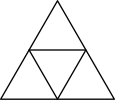
There is an unlimited supply of congruent equilateral triangles made of colored paper. Each triangle is a solid color with the same color on both sides of the paper. A large equilateral triangle is constructed from four of these paper triangles as shown. Two large triangles are considered distinguishable if it is not possible to place one on the other, using translations, rotations, and/or reflections, so that their corresponding small triangles are of the same color. Given that there are six different colors of triangles from which to choose, how many distinguishable large equilateral triangles can be constructed?
Small Hint:
Rotations and reflections can permute the three corner triangles arbitrarily, so only the center color and the multiset of corner colors matter.
Big Hint:
Count the multisets of three corner colors from six: all alike, exactly two alike, all different. Then multiply by the choices for the center.
Solution:
The rotations and reflections of the large triangle realize every permutation of the three corner triangles while fixing the center triangle. So two large triangles are indistinguishable exactly when they have the same center color and the same multiset of three corner colors.
Count the multisets of corner colors from six colors: all three the same ( ways), exactly two the same ( ways, choosing the repeated color and then the different one), or all three different ( ways). That is multisets.
With independent choices for the center color, the total is
9.
Circles and have their centers at and and have radii and respectively. Line is a common internal tangent to and and has a positive slope, and line is a common internal tangent to and and has a negative slope. Given that lines and intersect at and that where and are positive integers and is not divisible by the square of any prime, find
Small Hint:
A common internal tangent crosses the segment joining the centers at the point that divides it in the ratio of the radii.
Big Hint:
is and is set them equal and rationalize.
Solution:
A common internal tangent meets the segment between the centers at the point dividing it in the ratio of the radii. For and that point is at distance from If makes angle with the -axis, then so and is For and the point is at distance from here so the slope is and is
Setting the two expressions equal and multiplying by gives so and
Thus
10.
Seven teams play a soccer tournament in which each team plays every other team exactly once. No ties occur, each team has a chance of winning each game it plays, and the outcomes of the games are independent. In each game, the winner is awarded point and the loser gets points. The total points are accumulated to decide the ranks of the teams. In the first game of the tournament, team beats team The probability that team finishes with more points than team is where and are relatively prime positive integers. Find
Small Hint:
starts one point ahead and never plays again, so finishes ahead exactly when wins at least as many of its remaining games as does.
Big Hint:
The chance the remaining win counts are equal is by symmetry the other outcomes split evenly between the teams.
Solution:
Teams and each have games left, none against each other, so all outcomes are equally likely. Since already leads by one point, finishes with more points exactly when wins at least as many remaining games as does.
The number of outcomes with equal win counts is By symmetry, the other outcomes split evenly between winning more and winning more.
So the probability is and
11.
A sequence is defined as follows: and, for all positive integers Given that and find the remainder when is divided by
Small Hint:
Compute the first several partial sums and compare them with the sequence itself to spot a pattern.
Big Hint:
Induction using the recurrence shows
Solution:
Let We claim which holds for since If it holds for then by the recurrence, completing the induction.
Therefore whose remainder upon division by is
12.
Equilateral is inscribed in a circle of radius Extend through to point so that and extend through to point so that Through draw a line parallel to and through draw a line parallel to Let be the intersection of and Let be the point on the circle that is collinear with and and distinct from Given that the area of can be expressed in the form where and are positive integers, and are relatively prime, and is not divisible by the square of any prime, find
Small Hint:
is a parallelogram, so find and by the law of cosines.
Big Hint:
Inscribed angles show with ratio where
Solution:
By construction is a parallelogram with and Hence and by the law of cosines,
Since lies on the circle, inscribed angles give (both subtend arc ) and (both subtend arc ); and because So with ratio The side of an equilateral triangle inscribed in a circle of radius is
Therefore and
13.
How many integers less than can be written as the sum of consecutive positive odd integers for exactly values of
Small Hint:
A sum of consecutive odd numbers is a difference of squares: it equals
Big Hint:
So count factorizations with of equal parity: exactly five occur when (odd case) or (even case) has or divisors.
Solution:
The sum of the th through th positive odd integers is Writing and the representations of correspond exactly to the factorizations with and of the same parity (then ). So we need to have exactly such factorizations.
If is odd, every divisor pair works, so needs or divisors, i.e. or with distinct odd primes. Below and are impossible, gives and and gives five odd values.
If is even, both factors must be even, so and the factorizations correspond to divisor pairs of with no parity restriction; we need with or divisors. With divisors: With divisors (): That is even values, for a total of
14.
Let be the sum of the reciprocals of the nonzero digits of the integers from to inclusive. Find the smallest positive integer for which is an integer.
Small Hint:
Pad with leading zeros: among the integers below every digit appears equally often — each nonzero digit times.
Big Hint:
so you need to be divisible by — check which factors of the power of cannot supply.
Solution:
Write the integers from to as -digit strings with leading zeros. Each of the digit positions takes each digit value equally often, so each nonzero digit appears times. Adding the digit of itself,
Since the sum is an integer exactly when is divisible by Now and for the factor supplies leaving the condition that be divisible by (a power of has no factors of or ). For the products are not multiples of
The smallest solution is therefore
15.
Given that and are real numbers that satisfy and that where and are positive integers, and is not divisible by the square of any prime, find
Small Hint:
Interpret as a leg of a right triangle with hypotenuse and other leg
Big Hint:
Build a triangle with sides whose altitudes are Then with area use Heron.
Solution:
Each radical is the leg of a right triangle with hypotenuse and other leg So the first equation says: in a triangle with the altitude from has length and its foot splits into the two radical lengths. The other equations say the altitudes to sides and are and
If is the area of this triangle, then gives and likewise and These are proportional to and so the triangle is acute and the altitude feet do land inside the sides. Heron’s formula with gives so and
Then so