
2006 AIME I Solutions
Scroll down to view professionally curated solutions from LIVE by Po-Shen Loh, print PDF solutions, view answer key, or take the full timed exam.
All problems are used with official legal permission of the Mathematical Association of America (MAA).
1.
In quadrilateral is a right angle, diagonal is perpendicular to and Find the perimeter of
Small Hint:
Diagonal splits the quadrilateral into two right triangles that share
Big Hint:
Apply the Pythagorean theorem twice:
Solution:
Triangle is right-angled at so Triangle is right-angled at so giving
The perimeter is
2.
Let set be a -element subset of and let be the sum of the elements of Find the number of possible values of
Small Hint:
Find the smallest and largest possible sums, then show every value between them occurs
Big Hint:
If the sum is not maximal, some element of has replacing by raises the sum by exactly
Solution:
The smallest possible sum is and the largest is
Every integer in between also occurs. Suppose has sum and let be the smallest element of with If were then would be a block of consecutive integers ending at namely whose sum exceeds So and replacing by produces a -element subset with sum
Hence takes every value from to for possible values.
3.
Find the least positive integer such that when its leftmost digit is deleted, the resulting integer is of the original integer.
Small Hint:
If the leftmost digit sits in the place and remains after deleting it, then
Big Hint:
forces to be divisible by so and
Solution:
Let be the leftmost digit and the integer that remains after deleting it, so the original integer is for some positive integer The condition says so
Since is divisible by but is not, the digit must be a multiple of so Then giving which requires The smallest case is
The least such integer is and indeed
4.
Let be the number of consecutive ’s at the right end of the decimal representation of the product Find the remainder when is divided by
Small Hint:
Count factors of the integer appears as a factor in exactly of the factorials
Big Hint:
Sum over all multiples of then add the same sum over multiples of for their second factor of
Solution:
Factors of are plentiful, so is the exponent of in the product. Each integer with appears as a factor in exactly of the factorials, namely
Every multiple of contributes one factor of per appearance, and every multiple of contributes one more. Over the appearances total and over they total
Hence and the remainder upon division by is
5.
The number can be written as where and are positive integers. Find
Small Hint:
Square and match the coefficients of and
Big Hint:
so you never need individually
Solution:
Squaring gives Matching coefficients yields that is along with
Then so As a check, and as required.
Therefore
6.
Let be the set of real numbers that can be represented as repeating decimals of the form where are distinct digits. Find the sum of the elements of
Small Hint:
and there are elements to add
Big Hint:
By symmetry each digit through appears exactly times in each of the three positions
Solution:
Each element equals and there are ordered triples of distinct digits. By symmetry, each digit through appears in each of the three positions exactly times.
The numerators therefore total so the sum of the elements is
7.
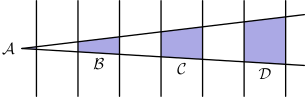
An angle is drawn on a set of equally spaced parallel lines as shown. The ratio of the area of shaded region to the area of shaded region is Find the ratio of the area of shaded region to the area of shaded region
Small Hint:
With unit spacing, every region is a difference of similar triangles, so areas scale as squares of distances from the vertex
Big Hint:
If is the vertex’s distance to the first line, then determines
Solution:
Take the spacing between consecutive lines as the unit, and let be the distance from the vertex of the angle to the first line. The triangle cut off by the th line is similar to triangle with ratio so its area is proportional to and the strip between lines and has area proportional to
Regions and are the strips beginning at lines and with areas proportional to and The given ratio yields so and
Since has area proportional to the requested ratio is
8.
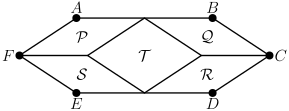
Hexagon is divided into five rhombuses, and as shown. Rhombuses and are congruent, and each has area Let be the area of rhombus Given that is a positive integer, find the number of possible values for
Small Hint:
All five rhombuses share the same side length, and the three angles meeting along add to
Big Hint:
If each congruent rhombus has area then find which positive integers this can equal
Solution:
Since shares a side with each of the other rhombuses, all five have the same side length Let be the vertex of on and let be the angle of at Then each congruent rhombus has area The angles of and at lie along the line and by symmetry ’s angle there also equals so ’s angle is Hence
As ranges over the value takes every value in so takes every value in Since the possible positive integer values are there are of them.
9.
The sequence is geometric with and common ratio where and are positive integers. Given that find the number of possible ordered pairs
Small Hint:
Combine the logs: the product of the twelve terms is which must equal
Big Hint:
Write and count nonnegative solutions of parity forces odd
Solution:
The sum of the logarithms is so which gives
Thus and are powers of write and with integers and Since is even and is odd, must be odd, say for Then exactly when
Each gives one pair, so there are ordered pairs
10.
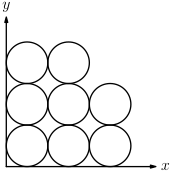
Eight circles of diameter are packed in the first quadrant of the coordinate plane as shown. Let region be the union of the eight circular regions. Line with slope divides into two regions of equal area. Line ’s equation can be expressed in the form where and are positive integers whose greatest common divisor is Find
Small Hint:
Any line through the point where two congruent circles touch splits that pair’s area evenly
Big Hint:
The line through and has slope and leaves two whole circles on each side
Solution:
The circles have radius and centers at and The pair of circles tangent at is symmetric about so any line through bisects that pair’s area; similarly for the pair tangent at The line has slope
Line misses the remaining four circles entirely, and exactly two of them lie on each side of it, so it divides into two regions of equal area. Sliding a slope- line strictly shifts area from one side to the other, so must be this line.
Its equation is that is, With the answer is
11.
A collection of cubes consists of one cube with edge-length for each integer A tower is to be built using all cubes according to the rules:
• Any cube may be the bottom cube in the tower.
• The cube immediately on top of a cube with edge-length must have edge-length at most
Let be the number of different towers that can be constructed. What is the remainder when is divided by
Small Hint:
Build towers of the cubes by inserting the largest cube into a legal tower of the smaller ones
Big Hint:
For cube can go on the bottom, on cube or on cube — the count triples at each step
Solution:
Let be the number of legal towers using the cubes of edge-lengths Given a legal tower of cubes, cube can be inserted in exactly three places: at the bottom, immediately on top of cube or immediately on top of cube (anywhere else it would rest on a cube of edge-length at most violating the rule). Each insertion stays legal, because the cube that ends up on top of cube has edge-length at most Conversely, deleting cube from a legal tower of cubes leaves a legal tower: the cube that was above it, of edge-length at most lands on a cube of edge-length at least
Hence for Since (either of the two cubes may be on top), we get and the remainder is
12.
Find the sum of the values of such that where is measured in degrees and
Small Hint:
Product-to-sum: so the equation reads
Big Hint:
so one of must vanish
Solution:
By the product-to-sum identity, so the right side is Setting and the equation becomes and since it holds exactly when or
For in degrees: gives gives gives and gives no solutions in the interval.
The sum is
13.
For each even positive integer let denote the greatest power of that divides For example, and For each positive integer let Find the greatest integer less than such that is a perfect square.
Small Hint:
sums over exactly of these numbers have
Big Hint:
so must be odd and must be a perfect square
Solution:
is the sum of over the even numbers Among these numbers, exactly are divisible by but not (so have ) for each and the single number has Hence
If is even, then is odd and the exponent is odd, so has an odd number of factors of and cannot be a perfect square. If is odd, then is already a perfect square, so is a perfect square exactly when is.
For odd the number is even, and the greatest even perfect square at most is Thus the greatest valid is
14.
A tripod has three legs each of length feet. When the tripod is set up, the angle between any pair of legs is equal to the angle between any other pair, and the top of the tripod is feet from the ground. In setting up the tripod, the lower foot of one leg breaks off. Let be the height in feet of the top of the tripod from the ground when the broken tripod is set up. Then can be written in the form where and are positive integers and is not divisible by the square of any prime. Find (The notation denotes the greatest integer that is less than or equal to )
Small Hint:
Set coordinates: top at and feet from the origin; the broken leg now ends of the way from top to old foot
Big Hint:
By symmetry is a 2D distance in the -plane: from to the line through the broken tip and the midpoint of the other two feet
Solution:
Place the top at Each leg has length so each foot is from the origin: The broken leg has length so its tip is and the tripod now stands on the plane with equal to the distance from to that plane.
The plane contains which is parallel to the -axis and passes through the midpoint so its distance from can be measured in the -plane: it is the distance from to the line through and whose equation is Therefore
Here and is squarefree. Since we get
15.
Given that a sequence satisfies and for all integers find the minimum possible value of
Small Hint:
Square the recurrence: Summing over telescopes into a formula for
Big Hint:
Each is a multiple of with the parity of so choose with square as close as possible to
Solution:
Squaring the recurrence gives Summing for to telescopes: so with
Induction shows each is a multiple of whose parity matches that of so is an odd multiple of To minimize take the odd multiple of whose square is nearest that is with giving (the neighbors and give and ).
This value is attained: take for and thereafter alternate for even and for odd then and the sum is So the minimum is