
2003 AIME I Problems
Scroll down and press Start to try the exam! Or, go to the printable PDF, answer key, or professional solutions curated by LIVE by Po-Shen Loh.
All problems are used with official legal permission of the Mathematical Association of America (MAA).
Or jump straight to a single problem with its solution: 1 · 2 · 3 · 4 · 5 · 6 · 7 · 8 · 9 · 10 · 11 · 12 · 13 · 14 · 15
Want to learn professionally through interactive video classes?
Timed
3:00:00
1.
Given that where and are positive integers and is as large as possible, find
Answer: 839
Small Hint:
Compute the inner factorials: so the expression is
Big Hint:
Write and note that would make too large
Solution:
Since and the expression is
If were or more, then which exceeds So the largest possible value of is achieved with and
2.
One hundred concentric circles with radii are drawn in a plane. The interior of the circle of radius is colored red, and each region bounded by consecutive circles is colored either red or green, with no two adjacent regions the same color. The ratio of the total area of the green regions to the area of the circle of radius can be expressed as where and are relatively prime positive integers. Find
Answer: 301
Small Hint:
The colors alternate, so the green regions are the annuli between radii and and and so on
Big Hint:
By difference of squares, the green areas total
Solution:
The regions alternate red, green, red, green, from the center outward, so the green regions are the annuli between radii and between and and so on up to the annulus between and Their total area is which is
The desired ratio is so
3.
Let the set Susan makes a list as follows: for each two-element subset of she writes on her list the greater of the set’s two elements. Find the sum of the numbers on the list.
Answer: 484
Small Hint:
Each element is written on the list once for every smaller element in the set
Big Hint:
Sort the set as and multiply each element by the count of smaller elements
Solution:
An element is the greater element of a two-element subset exactly once for each smaller element of the set, so contributes to the sum once per element below it. Sorting the set as the sum of the list is
4.
Given that and that find
Answer: 12
Small Hint:
Add the logarithms: the first equation gives
Big Hint:
Square and use to evaluate it
Solution:
The first equation says so Then
Taking logarithms, so and
5.
Consider the set of points that are inside or within one unit of a rectangular parallelepiped (box) that measures by by units. Given that the volume of this set is where and are positive integers, and and are relatively prime, find
Answer: 505
Small Hint:
The region is the box plus slabs over each face, quarter-cylinders along each edge, and sphere octants at each corner
Big Hint:
The twelve quarter-cylinders form three full cylinders with heights and the eight octants form one unit sphere
Solution:
The region consists of the box itself, six slabs of thickness projecting outward from the faces, quarter-cylinders of radius along the twelve edges, and eighth-spheres of radius at the eight corners. The box has volume and the slabs total
The four quarter-cylinders along edges parallel to each dimension combine into a full cylinder, so the cylinders total The eight octants combine into one unit sphere of volume
The total volume is so
6.
The sum of the areas of all triangles whose vertices are also vertices of a by by cube is where and are integers. Find
Answer: 348
Small Hint:
Each side is a cube edge, a face diagonal of length or a space diagonal of length classify the triangles
Big Hint:
The three types are edge-edge-face diagonal, three face diagonals, and edge-face diagonal-space diagonal; there are and of them
Solution:
Every side of such a triangle is a cube edge, a face diagonal of length or a space diagonal of length Only three shapes occur. A triangle of two adjacent edges and a face diagonal is right with area there are per face, or A triangle of three face diagonals is equilateral with area each is determined by the three vertices adjacent to one of the cube vertices, so there are A triangle of an edge, a face diagonal, and a space diagonal is right with legs and so its area is each of the space diagonals forms one with each of the vertices off that diagonal, so there are (Indeed )
The total area is so
7.
Point is on with and Point is not on so that and and are integers. Let be the sum of all possible perimeters of Find
Answer: 380
Small Hint:
The foot of the perpendicular from to is the midpoint of which is units from
Big Hint:
With and the two right triangles give factor it
Solution:
Let and and let be the foot of the perpendicular from to Since point is the midpoint of so and The right triangles and share leg so that is
The factorizations give and The last is rejected: would put on Each valid pair gives a triangle with perimeter
Therefore
8.
In an increasing sequence of four positive integers, the first three terms form an arithmetic progression, the last three terms form a geometric progression, and the first and fourth terms differ by Find the sum of the four terms.
Answer: 129
Small Hint:
Write the terms as and
Big Hint:
The geometric condition becomes so and must have the same sign
Solution:
Write the terms as and where and are positive integers. The geometric condition on the last three terms says Expanding both sides and simplifying, that is
Since the factors and must have the same sign, forcing so or For we get which has no integer solution. For we get so
The sequence is (indeed has ratio ), and the sum is
9.
An integer between and inclusive, is called balanced if the sum of its two leftmost digits equals the sum of its two rightmost digits. How many balanced integers are there?
Answer: 615
Small Hint:
Group by the common digit-pair sum count leftmost pairs (first digit nonzero) and rightmost pairs separately
Big Hint:
For the counts are and for both equal Sum the products.
Solution:
Group the balanced integers by the common sum of each digit pair, where For the leftmost pair (first digit at least ) can be formed in ways and the rightmost pair in ways. For both digits of each pair must be at least giving ways for each pair.
The total count is
10.
Triangle is isosceles with and Point is in the interior of the triangle so that and Find the number of degrees in
Answer: 83
Small Hint:
The base angles are In triangle the Law of Sines with gives
Big Hint:
Apply the Law of Cosines in triangle using the fact that the cosine of equals to show
Solution:
Assume In triangle the angles at and are and so and the Law of Sines gives
Also whose cosine is The Law of Cosines in triangle then gives
So making triangle isosceles with The answer is
11.
An angle is chosen at random from the interval Let be the probability that the numbers and are not the lengths of the sides of a triangle. Given that where is the number of degrees in and and are positive integers with find
Answer: 92
Small Hint:
For the largest of the three numbers is so only one triangle inequality can fail
Big Hint:
rearranges via double angles to
Solution:
Replacing by swaps and so the failure probability on matches that on and it suffices to consider There so the three numbers fail to form a triangle exactly when
Since and this says i.e. Because tangent increases on this range, that happens exactly for
Therefore so and with and the answer is
12.
In convex quadrilateral and The perimeter of is Find (The notation means the greatest integer that is less than or equal to )
Answer: 777
Small Hint:
Compute by the Law of Cosines in triangles and and set the results equal
Big Hint:
Because dividing by leaves and
Solution:
Let and Applying the Law of Cosines to diagonal in triangles and
Rearranging gives and since we may divide by
Then so
13.
Let be the number of positive integers that are less than or equal to and whose base- representation has more ’s than ’s. Find the remainder when is divided by
Answer: 155
Small Hint:
Every such integer has at most binary digits; for -digit numbers, count by the number of ’s using row of Pascal’s triangle
Big Hint:
Rows through contribute numbers by symmetry; then discard the qualifying integers from to
Solution:
Since every integer in question has at most binary digits. A -digit binary number starts with and choosing more ’s among the remaining digits gives numbers with ones; the ’s outnumber the ’s exactly when So the count over all numbers up to is the total of the entries on or to the right of the center of rows through of Pascal’s triangle.
Those rows sum to and the central entries sum to so by symmetry the count is
The integers from to all exceed so each has the prefix plus at least one more hence at least six ’s among eleven digits — all were counted. Therefore whose remainder upon division by is
14.
The decimal representation of where and are relatively prime positive integers and contains the digits and consecutively, and in that order. Find the smallest value of for which this is possible.
Answer: 127
Small Hint:
Show it suffices for to appear immediately after the decimal point, so
Big Hint:
Use the neighboring fractions each adjacent pair has cross-difference which bounds the denominators between them
Solution:
It suffices to make appear immediately after the decimal point: if with a block of digits, then is a fraction between and whose reduced denominator is at most So we need the smallest admitting an with that is
The fraction lies in this interval because It remains to prove that no smaller denominator works. We use the following elementary fact: if and then because both parenthesized quantities are positive integers.
Now and Therefore every fraction strictly between and has denominator at least while every fraction strictly between and has denominator at least Since our target interval lies inside and contains no fraction in it has denominator below
The smallest possible value of is
15.
In and Let be the midpoint of and let be the point on such that bisects angle Let be the point on such that Suppose that meets at The ratio can be written in the form where and are relatively prime positive integers. Find
Answer: 289
Small Hint:
Extend past to hit ray at In triangle is both an altitude and an angle bisector, so
Big Hint:
Take on with then by similar triangles
Solution:
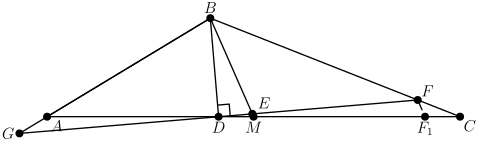
Write Extend beyond to meet ray beyond at In triangle segment is both an angle bisector and an altitude, so The bisector also gives so Menelaus’ theorem for line crossing triangle says so
Now let be the point on with Since lies on we have so triangles and are similar and The bisector ratio gives so Also so and
Therefore and