
1995 AIME Solutions
Scroll down to view professionally curated solutions from LIVE by Po-Shen Loh, print PDF solutions, view answer key, or take the full timed exam.
All problems are used with official legal permission of the Mathematical Association of America (MAA).
1.
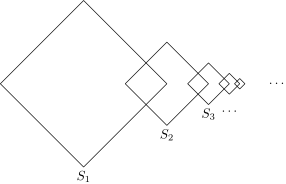
Square is For the lengths of the sides of square are half the lengths of the sides of square two adjacent sides of square are perpendicular bisectors of two adjacent sides of square and the other two sides of square are the perpendicular bisectors of two adjacent sides of square The total area enclosed by at least one of can be written in the form where and are relatively prime positive integers. Find
Small Hint:
Each square has one fourth the area of the preceding square
Big Hint:
Adjacent squares overlap in one fourth of the smaller square, and nonadjacent interiors do not overlap
Solution:
The sum of the five square areas is The perpendicular-bisector placement makes the overlap of each adjacent pair one fourth of the smaller square. These four overlaps are disjoint and have total area Thus the union has area and
2.
Find the last three digits of the product of the positive roots of
Small Hint:
Set so
Big Hint:
Compare exponents of , then use the sum of the two values of
Solution:
Put so The equation becomes and hence The two values of have sum so the product of the corresponding positive roots is Since its last three digits are The requested AIME answer is
3.
Starting at an object moves in the coordinate plane via a sequence of steps, each of length one. Each step is left, right, up, or down, all four equally likely. Let be the probability that the object reaches in six or fewer steps. Given that can be written in the form where and are relatively prime positive integers, find
Small Hint:
The target can first be reached only after or steps
Big Hint:
From the six-step paths ending at the target, subtract those that already arrived at step
Solution:
There are four-step paths to There are six-step paths ending there: the extra opposite pair is either left-right or down-up. Of these, first reach the target at step and then make a two-step return. Therefore Thus
4.
Circles of radius and are externally tangent to each other and are internally tangent to a circle of radius The circle of radius has a chord that is a common external tangent of the other two circles. Find the square of the length of this chord.
Small Hint:
The three circle centers are collinear because their pairwise distances are and
Big Hint:
Use signed distances from the two smaller centers to the common tangent to find its distance from the large center
Solution:
Put the radius- circle at the origin and the smaller centers at and Write the common external tangent as where is a unit normal. Its signed distances from the two centers differ by so and Using the distance from gives Thus the chord lies units from the large center, and its squared length is
5.
For certain real values of and the equation has four non-real roots. The product of two of these roots is and the sum of the other two roots is where Find
Small Hint:
Because the polynomial has real coefficients, its non-real roots occur in conjugate pairs
Big Hint:
Group the six pairwise products into the products within the two groups and the four cross-products
Solution:
Let the first two roots be and Since is not real, they are not conjugates, so the other roots are and Hence and By Vieta’s formulas,
6.
Let How many positive integer divisors of are less than but do not divide
Small Hint:
Pair each divisor of with
Big Hint:
Among the divisors below , subtract those that already divide
Solution:
The number has divisors. Pairing with leaves only unpaired, so divisors lie below The number has divisors, of which are below Therefore the requested count is
7.
Given that and where and are positive integers with and relatively prime, find
Small Hint:
Set and express in terms of
Big Hint:
Both given products become half of a perfect square in
Solution:
Let Since The feasible sign gives Therefore Thus
8.
For how many ordered pairs of positive integers with are both and integers?
Small Hint:
Write and reduce modulo
Big Hint:
The quotient must have the form ; count the possible positive values of
Solution:
Write Modulo we have so is divisible by exactly when Since write with The bound becomes Only contribute, giving
9.
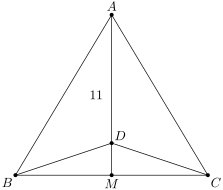
Triangle is isosceles, with and altitude Suppose that there is a point on with and Then the perimeter of may be written in the form where and are integers. Find
Small Hint:
Let and let half the apex angle be
Big Hint:
Use and the triple-angle formula for tangent
Solution:
Let and so Because symmetry gives while Hence Put Then so and Thus and making the perimeter Therefore
10.
What is the largest positive integer that is not the sum of a positive integral multiple of and a positive composite integer?
Small Hint:
For each residue modulo , find the smallest positive composite integer in that residue
Big Hint:
Once one number in a residue class is representable, every number larger in that class is representable
Solution:
A number in residue class is representable once it exceeds the first positive composite in that class by a positive multiple of Composite residues themselves supply that first value. For the remaining residues, suitable first composites are The largest entry is and and are all prime. Hence is not representable, while every larger integer is.
11.
A right rectangular prism (i.e., a rectangular parallelepiped) has sides of integral length with A plane parallel to one of the faces of cuts into two prisms, one of which is similar to and both of which have nonzero volume. Given that for how many ordered triples does such a plane exist?
Small Hint:
Sort the three side lengths of the smaller prism and compare them in order with and
Big Hint:
The two unchanged dimensions force
Solution:
Let the similar smaller prism have sorted sides It shares two side lengths with and all three of its sorted sides are smaller than the corresponding sides of The only possible matching is and Similarity then gives so Conversely every factor pair gives a nondegenerate cut. Since its square has divisors. Excluding the central pair and taking one divisor from each remaining pair gives
12.
Pyramid has square base congruent edges and and Let be the measure of the dihedral angle formed by faces and Given that where and are integers, find
Small Hint:
Place the square’s vertices at and the apex at
Big Hint:
Find from then take the supplement of the angle between suitable face normals
Solution:
Take adjacent base vertices and From Normals to the two faces may be taken as and Their acute angle has cosine The interior dihedral angle is its supplement, so Thus
13.
Let be the integer closest to Find
Small Hint:
Count the integers for which
Big Hint:
The number of occurrences of simplifies to
Solution:
For the number of positive integers for which is For these account for values, and their contribution to the requested sum is The remaining values have contributing The total is
14.
In a circle of radius two chords of length intersect at a point whose distance from the center is The two chords divide the interior of the circle into four regions. Two of these regions are bordered by segments of unequal lengths, and the area of either of them can be expressed uniquely in the form where and are positive integers and is not divisible by the square of any prime. Find
Small Hint:
Each chord is from the center, so determine the two possible line directions through the intersection point
Big Hint:
The unequal chord segments have lengths and and their endpoints subtend at the center
Solution:
Put the center at and the intersection at A length- chord is from so a line through containing such a chord makes angle or with Solving along either line gives segment lengths and
For either region bordered by unequal segments, the two arc endpoints subtend at Its area is the sector minus plus Hence
15.
Let be the probability that, in the process of repeatedly flipping a fair coin, one will encounter a run of heads before one encounters a run of tails. Given that can be written in the form where and are relatively prime positive integers, find
Small Hint:
Use states for and consecutive heads and one separate state for a single trailing tail
Big Hint:
Express every head-run state’s success probability in terms of the trailing-tail state
Solution:
Let be the success probability with consecutive heads and no trailing tail, and let be the probability after one tail. Then Working backward gives Since we get and Therefore so