
1994 AIME Solutions
Scroll down to view professionally curated solutions from LIVE by Po-Shen Loh, print PDF solutions, view answer key, or take the full timed exam.
All problems are used with official legal permission of the Mathematical Association of America (MAA).
1.
The increasing sequence consists of those positive multiples of that are one less than a perfect square. What is the remainder when the th term of the sequence is divided by
Small Hint:
A number is divisible by exactly when is not divisible by
Big Hint:
Index the eligible values of in pairs, then reduce the required square modulo
Solution:
The terms are for integers not divisible by In each block of three consecutive ’s there are two eligible values. The th corresponds to Since
2.
A circle with diameter of length is internally tangent at to a circle of radius Square is constructed with and on the larger circle, tangent at to the smaller circle, and the smaller circle outside The length of can be written in the form where and are integers. Find
Small Hint:
Place the large circle at the origin and put and on a diameter
Big Hint:
If the square’s side is , its chord side lies at distance from the large circle’s center
Solution:
Put the large circle at the origin with and Let the square’s side be Because the smaller circle is outside the square, lies on and the parallel chord lies on A chord of the radius- circle then gives Squaring yields so Thus
3.
The function has the property that, for each real number If what is the remainder when is divided by
Small Hint:
First use to find
Big Hint:
Eliminate alternating terms by deriving a recurrence from to
Solution:
First Subtracting through two steps gives Therefore The requested remainder is
4.
Find the positive integer for which (For real is the greatest integer not exceeding )
Small Hint:
Group integers having the same value of
Big Hint:
Compute the sum through , after which every new term initially contributes
Solution:
For the summand is Thus the sum through is The remaining is so we include more integers beginning with Hence
5.
Given a positive integer let be the product of the nonzero digits of (If has only one digit, then is equal to that digit.) Let What is the largest prime factor of
Small Hint:
Write every number from through using three digits and let a zero digit contribute a factor of
Big Hint:
The sum factors by digit position; remember to remove the contribution of
Solution:
For one digit position, the sum of its effective factors is where the first represents digit Thus the sum over through is Removing the artificial contribution from gives Since the largest prime factor is
6.
The graphs of the equations are drawn in the coordinate plane for These lines cut part of the plane into equilateral triangles of side How many such triangles are formed?
Small Hint:
Index one line from each family by in
Big Hint:
A smallest triangular cell occurs precisely when or
Solution:
A unit triangular cell is determined by indices satisfying For the plus sign, There are ordered pairs with sum so this orientation contributes By symmetry the other orientation also contributes for a total of
7.
For certain ordered pairs of real numbers, the system of equations has at least one solution, and each solution is an ordered pair of integers. How many such ordered pairs are there?
Small Hint:
List all integer points on
Big Hint:
Count both chords through two non-antipodal lattice points and tangents at one lattice point
Solution:
The circle has the lattice points obtained from and A secant satisfying the condition is determined by any two non-antipodal lattice points. This gives lines; antipodal pairs are excluded because their line passes through the origin and cannot have equation There are also tangents, one at each lattice point. Each line has a unique normalization so the total is
8.
The points and are the vertices of an equilateral triangle. Find the value of
Small Hint:
The vector is a rotation of through or
Big Hint:
Use the second coordinate of the rotation first, then compute the first coordinate
Solution:
For a rotation, so The first coordinate is then The opposite orientation changes both signs and leaves the product unchanged. Hence
9.
A solitaire game is played as follows. Six distinct pairs of matched tiles are placed in a bag. The player randomly draws tiles one at a time from the bag and retains them, except that matching tiles are put aside as soon as they appear in the player’s hand. The game ends if the player ever holds three tiles, no two of which match; otherwise the drawing continues until the bag is empty. The probability that the bag will be emptied is where and are relatively prime positive integers. Find
Small Hint:
Track the number of unseen pairs and the number of unmatched tiles currently held
Big Hint:
From state , the next tile either matches one of the held tiles or opens one of the unseen pairs
Solution:
Let be the chance of success with unseen pairs and unmatched tiles held. Among remaining tiles, close an open pair and open a new pair; the latter move fails when Thus omitting the second term when with Evaluating this three-state recursion gives for Hence and
10.
In triangle angle is a right angle and the altitude from meets at The lengths of the sides of are integers, and where and are relatively prime positive integers. Find
Small Hint:
Use similarity to write
Big Hint:
Express in lowest terms and use the prime factorization of
Solution:
Write in lowest terms, with and Similarity gives Hence is divisible by writing gives The possibility cannot be a leg of a nondegenerate integer right triangle, so Writing the other leg of the primitive triple as we have giving and Therefore
11.
Ninety-four bricks, each measuring are to be stacked one on top of another to form a tower bricks tall. Each brick can be oriented so it contributes or to the total height of the tower. How many different tower heights can be achieved using all of the bricks?
Small Hint:
Start with all bricks contributing inches and count possible increments
Big Hint:
If bricks contribute inches, the remaining increments form a parity interval as the number of -inch bricks varies
Solution:
If bricks use height and use height the total is where and For fixed the value runs by twos from to The even- intervals cover every even from through as well as missing only and The odd- intervals cover every odd from through as well as and missing only and Thus there are distinct heights.
12.
A fenced, rectangular field measures meters by meters. An agricultural researcher has meters of fence that can be used for internal fencing to partition the field into congruent, square test plots. The entire field must be partitioned, and the sides of the squares must be parallel to the edges of the field. What is the largest number of square test plots into which the field can be partitioned using all or some of the meters of fence?
Small Hint:
If there are rows and columns, equality of square side lengths forces
Big Hint:
Write and , then calculate only the internal fence length
Solution:
Let the grid have rows and columns, so each square has side The internal vertical and horizontal fences have total length Requiring this to be at most gives With the number of plots is
13.
The equation has complex roots where the bar denotes complex conjugation. Find the value of
Small Hint:
Set where
Big Hint:
Express in terms of and sum over the five conjugate pairs
Solution:
Let so and Since Summing one value for each of the five conjugate pairs gives minus times the sum of all ten roots of which is The requested value is
14.
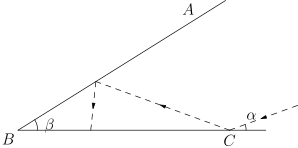
A beam of light strikes at point with angle of incidence and reflects with an equal angle of reflection as shown. The light beam continues its path, reflecting off line segments and according to the rule: angle of incidence equals angle of reflection. Given that and determine the number of times the light beam will bounce off the two line segments. Include the first reflection at in your count.
Small Hint:
Unfold each reflection by reflecting the next copy of the two-segment angle instead of reflecting the beam
Big Hint:
After reflections beyond the first one, the relevant boundary ray has turned through
Solution:
Unfold the path at each bounce, so the beam becomes one straight line crossing successive reflected copies of the angle at After reflections beyond the initial reflection at the next boundary ray makes angle with the original one. Using the crossing remains on the finite segments exactly while Therefore so there are further reflections. Including the first reflection at gives
15.
Given a point on a triangular piece of paper consider the creases that are formed in the paper when and are folded onto Let us call a fold point of if these creases, which number three unless is one of the vertices, do not intersect. Suppose that and Then the area of the set of all fold points of can be written in the form where and are positive integers and is not divisible by the square of any prime. What is
Small Hint:
Two fold creases meet at the circumcenter of the triangle formed by and the corresponding two vertices
Big Hint:
The fold-point locus is the intersection of the disks with diameters and
Solution:
The creases for two vertices meet at the circumcenter of the triangle formed with This intersection lies off the paper exactly when the angle at is obtuse, so the fold-point locus is the intersection of the three diameter disks for and The disk contains the entire right triangle, leaving the intersection of the and disks.
Here The two relevant radii are and and their lens consists of circular segments with central angles and Its area is Thus equals