
1990 AIME Solutions
Scroll down to view professionally curated solutions from LIVE by Po-Shen Loh, print PDF solutions, view answer key, or take the full timed exam.
All problems are used with official legal permission of the Mathematical Association of America (MAA).
1.
The increasing sequence consists of all positive integers that are neither the square nor the cube of a positive integer. Find the th term of this sequence.
Small Hint:
Count squares and cubes up to a candidate endpoint by inclusion-exclusion
Big Hint:
Numbers that are both squares and cubes are sixth powers
Solution:
Through there are squares, cubes, and sixth powers counted in both groups. Thus the number of allowed terms at most is But is excluded, while is neither a square nor a cube. Therefore the th term is
2.
Find the value of
Small Hint:
Express as squares of conjugate radical expressions
Big Hint:
After taking the powers, expand the difference of the two cubes symmetrically
Solution:
Since and the expression is Using with and gives
3.
Let be a regular -gon and be a regular -gon such that each interior angle of is as large as each interior angle of What is the largest possible value of
Small Hint:
Use for the interior angle of a regular -gon
Big Hint:
After simplifying, set and use the positivity of
Solution:
The angle condition gives which simplifies to Put Then In particular, is a positive divisor of and maximizing means taking the least possible The choice gives and the positive integer which also satisfies Hence the largest possible is
4.
Find the positive solution to
Small Hint:
Set so the three denominators differ only by constants
Big Hint:
Combine the first two fractions before clearing denominators
Solution:
Set Combining the first two fractions and clearing the nonzero denominators gives an equality between and Expanding and canceling yields Thus so The positive solution is
5.
Let be the smallest positive integer that is a multiple of and has exactly positive integral divisors, including and itself. Find
Small Hint:
Factor into possible products of numbers one greater than prime exponents
Big Hint:
The exponent pattern can include the required factors and while assigning the largest exponents to the smallest primes
Solution:
The multiplicative partitions of give exponent patterns and A number divisible by needs both primes and so the one-prime pattern is impossible. The smallest candidates from the two-prime patterns are and respectively. The smallest three-prime candidate is It has divisors, and each two-prime candidate is larger because and Therefore
6.
A biologist wants to calculate the number of fish in a lake. On May she catches a random sample of fish, tags them, and releases them. On September she catches a random sample of fish and finds that of them are tagged. To calculate the number of fish in the lake on May she assumes that of these fish are no longer in the lake on September (because of death and emigrations), that of the fish were not in the lake May (because of births and immigrations), and that the number of untagged fish and tagged fish in the September sample are representative of the total population. What does the biologist calculate for the number of fish in the lake on May
Small Hint:
First determine how many of the original tagged fish remain in September
Big Hint:
Use the sample’s tagged fraction to estimate the September population, then identify the that were present in May
Solution:
Of the tagged fish, remain in September, so tagged fish remain. The sample estimates that tagged fish form of the September population, making that population Of those fish, were present in May, so surviving May fish remain. These are of the May population. Thus the estimated May population is
7.
A triangle has vertices and The equation of the bisector of can be written in the form Find
Small Hint:
Find the unit vectors from toward and
Big Hint:
The internal angle-bisector direction is the sum of the two unit vectors
Solution:
We have with length and with length The sum of their unit vectors is so the angle bisector has direction A normal vector is Through its equation is or Hence
8.
In a shooting match, eight clay targets are arranged in two hanging columns of three targets each and one column of two targets. A marksman is to break all the targets according to the following rules:
The marksman first chooses a column from which a target is to be broken.
The marksman must then break the lowest remaining target in the chosen column.
If the rules are followed, in how many different orders can the eight targets be broken?
Small Hint:
Within each column, the bottom-to-top order is forced
Big Hint:
Encode an order only by the sequence of chosen columns, with multiplicities and
Solution:
Once the chosen column is known at each shot, the target within that column is forced. Thus every valid order corresponds to an arrangement of three symbols from the first column, three from the second, and two from the third. The number of such arrangements is
9.
A fair coin is to be tossed times. Let in lowest terms, be the probability that heads never occur on consecutive tosses. Find
Small Hint:
Count valid length- toss strings according to whether they end in tails or heads
Big Hint:
The resulting recurrence is Fibonacci-like, with initial counts and
Solution:
Let be the number of length- toss strings with no consecutive heads. A valid string ending in tails is obtained by appending to any valid length- string, while one ending in heads is obtained by appending to any valid length- string. Hence with and This gives The probability is so
10.
The sets and are both sets of complex roots of unity. The set is also a set of complex roots of unity. How many distinct elements are in
Small Hint:
Write the roots as exponentials whose arguments are multiples of and
Big Hint:
The sums of those arguments generate all multiples of
Solution:
The arguments of products in are Since the residues generate every residue modulo Thus is precisely the set of th roots of unity. Equivalently, its order is
11.
Someone observed that Find the largest positive integer for which can be expressed as the product of consecutive positive integers.
Small Hint:
Compare with products of consecutive integers beginning at and at
Big Hint:
The product beginning at equals
Solution:
The consecutive integers beginning at have product while those beginning at have product For the latter product equals so works. For every the product beginning at is below the product beginning at is above and the product strictly increases with its initial term. Hence no works, and the largest possible value is
12.
A regular -gon is inscribed in a circle of radius The sum of the lengths of all sides and diagonals of the -gon can be written in the form where and are positive integers. Find
Small Hint:
Group the chords by the number of vertex steps where is or
Big Hint:
For there are chords of length while there are diameters
Solution:
For equal to and there are chords of length and there are diameters of length The five chord lengths are Their sum is Therefore the total is Hence and so
13.
Let be the set of powers where is an integer with Given that has digits and that its first (leftmost) digit is how many elements of have as their leftmost digit?
Small Hint:
Compare the number of digits of with that of
Big Hint:
A multiplication by produces a leading exactly when the digit count does not increase
Solution:
For the number begins with exactly when it has the same number of digits as Indeed, if has digits and multiplication by creates no new digit, then so its leading digit is If multiplication does create a new digit, then so its leading digit is at most
Starting from the one-digit number the digit count reaches after multiplications. Thus it increases on steps and stays unchanged on steps. Since does not begin with exactly elements of do.
14.
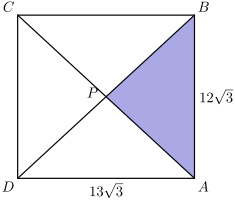
The rectangle below has dimensions and Diagonals and intersect at If triangle is cut out and removed, edges and are joined, and the figure is then creased along segments and we obtain a triangular pyramid, all four of whose faces are isosceles triangles. Find the volume of this pyramid.
Small Hint:
After and are joined, vertices and become one vertex; determine all six edge lengths of the tetrahedron
Big Hint:
Place and the joined vertex in one coordinate plane, then locate from its equal distances to the other vertices
Solution:
After folding, and become one vertex Each half-diagonal of the rectangle has length Thus while and
Place and These coordinates give the required lengths from to and Because is equidistant from and write Equating and gives Then yields so
The base triangle has area Therefore the pyramid’s volume is
15.
Find if the real numbers and satisfy the equations
Small Hint:
Let and derive a recurrence using and
Big Hint:
Use and to solve for the two recurrence coefficients before computing
Solution:
Let and Since and each satisfy Using and gives Solving yields and Therefore