
1989 AIME Solutions
Scroll down to view professionally curated solutions from LIVE by Po-Shen Loh, print PDF solutions, view answer key, or take the full timed exam.
All problems are used with official legal permission of the Mathematical Association of America (MAA).
1.
Compute
Small Hint:
Pair the outer factors and the inner factors
Big Hint:
The two paired products are consecutive even integers
Solution:
We have and These products lie one below and one above so their product is After the final is added, the radicand is Its positive square root is
2.
Ten points are marked on a circle. How many distinct convex polygons of three or more sides can be drawn using some (or all) of the ten points as vertices?
Small Hint:
Each choice of at least three marked points determines one convex polygon
Big Hint:
Count all subsets and remove those of sizes and
Solution:
Every subset of at least three points determines exactly one convex polygon. There are subsets in all. Of these, and have fewer than three points. Therefore the required number is
3.
Suppose is a positive integer and is a single digit in base Find if
Small Hint:
Convert the repeating three-digit block into a fraction with denominator
Big Hint:
Use the integrality of to determine which digit makes divisible by
Solution:
The repeating decimal is Thus Since the only way can be divisible by is so and
4.
If are consecutive positive integers such that is a perfect square and is a perfect cube, what is the smallest possible value of
Small Hint:
Express both sums in terms of the middle integer
Big Hint:
Compare the prime exponents in and modulo and modulo
Solution:
The two sums are and If then being a square and being a cube impose conditions on every exponent. For the smallest exponent in that is odd and divisible by is For the smallest exponent that is even and congruent to is Every other prime exponent can be Thus the least possible value is
5.
When a certain biased coin is flipped five times, the probability of getting heads exactly once is not equal to and is the same as that of getting heads exactly twice. Let in lowest terms, be the probability that the coin comes up heads in exactly out of flips. Find
Small Hint:
Let be the probability of heads and equate the two binomial probabilities
Big Hint:
Cancel the nonzero common factors before solving for
Solution:
Let be the probability of heads. The condition gives The stated nonzero condition permits cancellation, yielding so The probability of exactly three heads is Therefore
6.
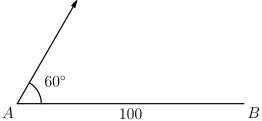
Two skaters, Allie and Billie, are at points and respectively, on a flat, frozen lake. The distance between and is meters. Allie leaves and skates at a speed of meters per second on a straight line that makes a angle with At the same time Allie leaves Billie leaves at a speed of meters per second and follows the straight path that produces the earliest possible meeting of the two skaters, given their speeds. How many meters does Allie skate before meeting Billie?
Small Hint:
After seconds, Allie is meters from and Billie can be meters from
Big Hint:
Apply the Law of Cosines to the triangle and select the smaller positive time
Solution:
Suppose the skaters meet after seconds. Their distances from and are and and the included angle at is The Law of Cosines gives Hence whose roots are and The earliest meeting occurs at so Allie skates meters.
7.
If the integer is added to each of the numbers and one obtains the squares of three consecutive terms of an arithmetic series. Find
Small Hint:
Write the three arithmetic-sequence terms as and
Big Hint:
Subtract adjacent square equations, then subtract those two resulting equations
Solution:
Let the three terms be and Subtracting the square equations gives and Their difference is so Negating all three terms does not change their squares, so take Then giving Therefore
8.
Assume that are real numbers such that
Find the value of
Small Hint:
Let
Big Hint:
Because is quadratic in its second finite differences are constant
Solution:
Define This is a quadratic polynomial in and the equations say and Its first two differences are and so the constant second difference is The next first difference is therefore giving
9.
One of Euler’s conjectures was disproved in the s by three American mathematicians when they showed there was a positive integer such that Find the value of
Small Hint:
Estimate the fifth root to narrow the possible integer values of
Big Hint:
Evaluate the fifth powers by repeated squaring and multiplication, then compare their sum with the nearby candidate
Solution:
Direct integer arithmetic gives Their sum is Repeated multiplication also gives so the positive integer is
10.
Let be the three sides of a triangle, and let be the angles opposite them. If find
Small Hint:
Simplify using
Big Hint:
Use the Law of Sines for the resulting sine factors and the Law of Cosines for
Solution:
First, Hence the desired ratio is where the Law of Sines was used in the final equality. By the Law of Cosines, Therefore the ratio is
11.
A sample of integers is given, each between and inclusive, with repetitions allowed. The sample has a unique mode (most frequent value). Let be the difference between the mode and the arithmetic mean of the sample. What is the largest possible value of (For real is the greatest integer less than or equal to )
Small Hint:
By symmetry, place the mode at the low endpoint and push every other entry as high as the frequency restriction allows
Big Hint:
If the mode occurs times, every other value may occur at most times; optimize separately over
Solution:
By reflecting every value to it suffices to maximize the mean minus the mode. For a fixed modal frequency the extremal sample has copies of then fills the largest available integers with at most copies each.
Put where The nonmodal entries are copies of each of followed by copies of For and this formula gives floors and respectively. If there are at most nonmodal terms, so even the weaker bound suffices. Thus the maximum occurs at
The extremal sample contains four ’s and three copies of every integer from through Put Since Therefore the largest possible floor is
12.
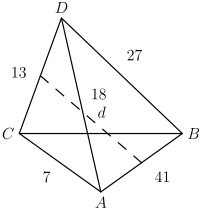
Let be a tetrahedron with and as shown in the figure. Let be the distance between the midpoints of edges and Find
Small Hint:
Represent the vertices by vectors and write the vector between the two midpoints
Big Hint:
Expand in terms of the six edge lengths
Solution:
Let the vertex names also denote their position vectors. The vector between the midpoints is Expanding squared lengths gives Therefore so
13.
Let be a subset of such that no two members of differ by or What is the largest number of elements can have?
Small Hint:
Within any eleven consecutive integers, the forbidden-difference graph is an -cycle
Big Hint:
For a matching construction, look for five allowable residue classes modulo
Solution:
On any eleven consecutive integers, join two numbers when their difference is or Because this graph is an -cycle, whose largest independent set has size Similarly, any ten consecutive integers induce a path on ten vertices and contribute at most Since this gives
This bound is attained by taking every integer whose residue modulo is or No two selected residues differ by or modulo and each of these five residues occurs times from through Thus the maximum is
14.
Given a positive integer it can be shown that every complex number of the form where and are integers, can be uniquely expressed in the base using the integers as digits. That is, the equation
is true for a unique choice of nonnegative integer and digits chosen from the set with We write
to denote the base expansion of There are only finitely many integers that have four-digit expansions
Find the sum of all such
Small Hint:
Compute the second and third powers of and set the imaginary part of the expansion equal to zero
Big Hint:
The digit bounds leave only two possible triples ; then let range over all digits
Solution:
Let Then and
The imaginary part of is Thus With and the only possibilities are
The corresponding real parts are and respectively. As ranges from through the required sum is
15.
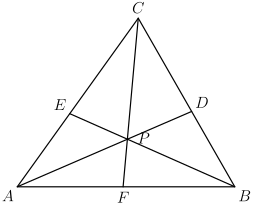
Point is inside triangle Line segments and are drawn with on on and on (see the figure). Given that and find the area of triangle
Small Hint:
Use the two known cevian ratios to find the barycentric weights of and at
Big Hint:
Place at the origin; the resulting vector relation determines the angle between and
Solution:
Since the barycentric weight of at is Since the weight of is so the weight of is also Along this means hence and
Place at the origin and denote the position vectors and by the same letters. The barycentric relation is Thus Using and so Therefore Expanding the cross product gives Consequently,