
1988 AIME Solutions
Scroll down to view professionally curated solutions from LIVE by Po-Shen Loh, print PDF solutions, view answer key, or take the full timed exam.
All problems are used with official legal permission of the Mathematical Association of America (MAA).
1.
One commercially available ten-button lock may be opened by depressing—in any order—the correct five buttons. One sample has as its combination. Suppose that these locks are redesigned so that sets of as many as nine buttons or as few as one button could serve as combinations. How many additional combinations would this allow?
Small Hint:
Count all nonempty proper subsets of the ten buttons
Big Hint:
Subtract the five-button combinations that the original design already allowed
Solution:
The redesigned lock permits every nonempty subset except the full set, giving combinations. The original lock permits Thus the number of additional combinations is
2.
For any positive integer let denote the square of the sum of the digits of For let Find
Small Hint:
Compute the first several iterates until a value repeats
Big Hint:
After the transient values, the sequence alternates between two numbers
Solution:
The iterates begin followed by Thus from the fourth iterate onward, even indices give and odd indices give Since is even,
3.
Find if
Small Hint:
Set and rewrite every base- logarithm in base
Big Hint:
Solve the resulting linear equation for
Solution:
Put Since the equation becomes Hence so Therefore
4.
Suppose that for Suppose further that
What is the smallest possible value of
Small Hint:
Let be the sum of the positive terms and the sum of the absolute values of the negative terms
Big Hint:
The left side minus the final absolute value equals
Solution:
Let be the sum of the positive and the sum of the absolute values of the negative Then so both and are at least Because every each sign requires at least terms, giving Equality is attainable with ten terms equal to and ten equal to so the minimum is
5.
Let in lowest terms, be the probability that a randomly chosen positive divisor of is an integer multiple of Find
Small Hint:
Write every divisor as
Big Hint:
Count exponent pairs with and and reduce the resulting probability
Solution:
Every divisor is with and so there are divisors. A multiple of requires and giving divisors. The probability is and
6.
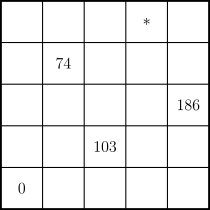
It is possible to place positive integers into the vacant twenty-one squares of the square shown below so that the numbers in each row and column form arithmetic sequences. Find the number that must occupy the vacant square marked by the asterisk
Small Hint:
Index the rows and columns from through
Big Hint:
A grid whose rows and columns are arithmetic has the form
Solution:
Index rows and columns from to The row and column conditions give the general entry The four shown values yield Solving gives and The asterisk is at so its value is
7.
In triangle and the altitude from divides into segments of length and What is the area of triangle
Small Hint:
Let the altitude have length and place its foot at the origin
Big Hint:
Use cross product over dot product to express the tangent of the angle between the two side vectors
Solution:
Let the altitude length be From vectors to the endpoints of may be taken as and Therefore Thus whose positive root is Since the area is
8.
The function defined on the set of ordered pairs of positive integers, satisfies the following properties:
Calculate
Small Hint:
Apply the third property to when
Big Hint:
Compare the resulting subtraction rule with the same rule for
Solution:
For the third property applied to gives The least common multiple obeys the identical relation, because Hence the quotient is unchanged by each subtraction step of the Euclidean algorithm. On the diagonal it equals so Therefore
9.
Find the smallest positive integer whose cube ends in
Small Hint:
The units digit forces the number to have the form
Big Hint:
Reduce first modulo
Solution:
Write the number as Expanding the required congruence modulo and dividing by gives Reducing first modulo gives substituting then gives Thus and the smallest candidate is It is even, so its cube is also and indeed
10.
A convex polyhedron has for its faces squares, regular hexagons, and regular octagons. At each vertex of the polyhedron one square, one hexagon, and one octagon meet. How many segments joining vertices of the polyhedron lie in the interior of the polyhedron rather than along an edge or a face?
Small Hint:
Double-count face-vertex and face-edge incidences to find and
Big Hint:
Count all vertex pairs, then subtract pairs lying together on a face, correcting the double count of edges
Solution:
The total number of face-vertex incidences is Three faces meet at each vertex, so The same sum counts each edge twice, so
There are vertex pairs. Summing pairs on faces gives Every edge was counted twice in this sum and every other same-face pair once, so the number of distinct boundary pairs is Hence joining segments lie in the interior.
11.
Let be complex numbers. A line in the complex plane is called a mean line for the points if contains points (complex numbers) such that
For the numbers and there is a unique mean line with -intercept Find the slope of this mean line.
Small Hint:
Average the equation
Big Hint:
A mean line is exactly a line through the centroid of the given points
Solution:
The condition says that the average of the equals the average of the Since all lie on their average lies on conversely, any line through the average works by taking all equal to that point. The centroid satisfies The line through this point and has slope
12.
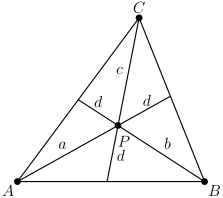
Let be an interior point of triangle and extend lines from the vertices through to the opposite sides. Let and denote the lengths of the segments indicated in the figure. Find the product if and
Small Hint:
Express the three barycentric coordinates of using the ratios
Big Hint:
Use and expand symmetrically
Solution:
Along the cevian from the barycentric coordinate at is and similarly at the other vertices. Since the three coordinates sum to and Put and Clearing denominators gives Therefore so
13.
Find if and are integers such that is a factor of
Small Hint:
Modulo powers satisfy
Big Hint:
Set both coefficients of the linear remainder equal to zero and use Cassini’s identity
Solution:
Modulo the relation gives Hence the remainder is Both coefficients must vanish. The determinant of the coefficient matrix is by Cassini’s identity. Cramer’s rule then gives
14.
Let be the graph of and denote by the reflection of in the line Let the equation of be written in the form
Find the product
Small Hint:
Find the reflection matrix for the line spanned by
Big Hint:
Because reflection is its own inverse, substitute the reflected coordinates into
Solution:
Reflection in the line spanned by has matrix Thus a point on came from and on Substituting gives or Hence and
15.
In an office at various times during the day, the boss gives the secretary a letter to type, each time putting the letter on top of the pile in the secretary’s in-box. When there is time, the secretary takes the top letter off the pile and types it. There are nine letters to be typed during the day, and the boss delivers them in the order
While leaving for lunch, the secretary tells a colleague that letter has already been typed, but says nothing else about the morning’s typing. The colleague wonders which of the nine letters remain to be typed after lunch and in what order they will be typed. Based upon the above information, how many such after-lunch typing orders are possible? (That there are no letters left to be typed is one of the possibilities.)
Small Hint:
After has been typed, any remaining letters among must later be typed in decreasing order
Big Hint:
Separate the cases according to whether was typed before lunch or remains to be inserted into the later order
Solution:
Any subset of can remain in the stack after has been typed, and those remaining letters must later be typed in decreasing order. If was already typed, choosing that subset gives possible orders.
If remains, choose of the seven smaller letters and insert into any of the positions in their decreasing order. This gives Every such order can be realized by suitable morning choices, so the total is