
1987 AIME Solutions
Scroll down to view professionally curated solutions from LIVE by Po-Shen Loh, print PDF solutions, view answer key, or take the full timed exam.
All problems are used with official legal permission of the Mathematical Association of America (MAA).
1.
An ordered pair of nonnegative integers is called “simple” if adding in base requires no carrying. Find the number of simple ordered pairs that sum to
Small Hint:
Treat the four decimal places independently
Big Hint:
A target digit can be split into an ordered pair of digits in ways without carrying
Solution:
For a target digit there are ordered pairs of nonnegative digits with sum The four digits therefore give choices independently. The answer is
2.
What is the largest possible distance between two points, one on the sphere of radius centered at and the other on the sphere of radius centered at
Small Hint:
First find the distance between the two centers
Big Hint:
The maximum occurs along the line of centers, on the two outward sides
Solution:
The squared distance between the centers is so they are apart. By the triangle inequality, the greatest point-to-point distance is obtained on the line of centers and equals
3.
A proper divisor of a natural number is a positive integral divisor other than and the number itself. A natural number greater than is called “nice” if it equals the product of its distinct proper divisors. What is the sum of the first ten nice numbers?
Small Hint:
Express the product of all positive divisors in terms of the number and its divisor count
Big Hint:
The nice numbers are exactly those having four positive divisors
Solution:
If has positive divisors, their product is Removing and leaves product which equals exactly when Thus nice numbers are precisely and for distinct primes. The first ten are whose sum is
4.
Find the area of the region enclosed by the graph of
Small Hint:
Solve for and determine where its right-hand side is nonnegative
Big Hint:
The boundary is a kite whose vertices occur at the breakpoints of the absolute values
Solution:
We need This forces At the boundary values are respectively Hence the region is a kite with perpendicular diagonals and so its area is
5.
Find if and are integers such that
Small Hint:
Move a suitable multiple of to create a product
Big Hint:
Factor and use that
Solution:
Rearranging gives where The positive divisors of congruent to are If then but which is not a square. If then and Finally, gives not a square. Therefore
6.
Rectangle is divided into four parts of equal area by five segments as shown, where and Find (in cm) if cm and cm.
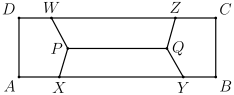
Small Hint:
Call the common boundary length and the rectangle width
Big Hint:
Equal areas above and below place halfway up the rectangle
Solution:
Put and let the four equal boundary lengths be Writing and the left boundary condition gives Substituting into the right condition gives so
The upper and lower central regions are trapezoids with the same bases and Since their areas are equal, lies halfway up the -cm rectangle. Each central region therefore has area This is one quarter of the rectangle, so Combining with yields
7.
Let denote the least common multiple of positive integers Find the number of ordered triples for which and
Small Hint:
Treat the exponents of and independently
Big Hint:
For each prime, translate every least common multiple into a condition on pairwise maxima
Solution:
For the exponent of all three pairwise maxima equal Thus at least two exponents are there is one all- triple and triples with exactly two ’s, for choices.
For the exponent of the first pair has maximum while the other two have maximum The exponent of must be and the exponents of and lie in with maximum giving choices. Independence gives
8.
What is the largest positive integer for which there is a unique integer such that
Small Hint:
Solve both inequalities for
Big Hint:
Study the integers in the open interval
Solution:
The inequalities are equivalent to This interval has length At it is containing only For its length exceeds so it contains at least two integers. Thus the largest possible is
9.
Triangle has a right angle at and contains a point for which and Find
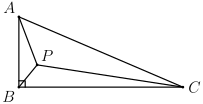
Small Hint:
The three equal angles around are each
Big Hint:
Use vectors from and translate the right angle at into a dot product
Solution:
Let and be the vectors from to and put Their pairwise angles are so and Since
Expanding gives so
10.
Al walks down an escalator that is moving up and counts steps. Bob walks up and counts steps. If Al’s walking speed is three times Bob’s, how many steps are visible at a given time? Assume this is constant.
Small Hint:
Let Bob’s speed be the escalator’s upward speed be and the visible count be
Big Hint:
Write as net speed times travel time for each person
Solution:
Bob’s time is so or Al’s time is so or Equating gives hence and
11.
Find the largest possible for which is expressible as the sum of consecutive positive integers.
Small Hint:
Write the sum as
Big Hint:
The only possible lengths divide ; then enforce a positive first term
Solution:
If the first term is then Thus is or The largest viable even choice is for which and The next candidates, and force a nonpositive first term, as do all larger choices. Hence
12.
Let be the smallest integer whose cube root has the form where is a positive integer and Find
Small Hint:
For fixed the smallest possible integer is
Big Hint:
Compare with
Solution:
For a given the closest integer cube-root candidate above is We need or This fails at and holds at The right-hand side is increasing for positive so every smaller fails; every larger has a larger least candidate Hence the smallest occurs with
13.
A given sequence of distinct real numbers can be put in ascending order by means of one or more “bubble passes.” A bubble pass through a given sequence consists of comparing the second term with the first term, and exchanging them if and only if the second term is smaller, then comparing the third term with the second term and exchanging them if and only if the third term is smaller, and so on in order, through comparing the last term, with its current predecessor and exchanging them if and only if the last term is smaller.
The example below shows how the sequence is transformed into the sequence by one bubble pass. The numbers compared at each step are underlined.
Suppose that and that the terms of the initial sequence are distinct from one another and are in random order. Let in lowest terms, be the probability that the number that begins as will end up, after one bubble pass, in the th place. Find
Small Hint:
After the comparison reaching position that position holds the maximum of the first original terms
Big Hint:
Characterize the relative ranks of and among the first terms
Solution:
For to move right to position it must exceed every other term among It stops at position exactly when Thus among the first terms, must be greatest and second greatest. These two ordered rank assignments have probability Therefore
14.
Compute
Small Hint:
Use Sophie Germain’s identity with
Big Hint:
If rewrite as
Solution:
Let Sophie Germain’s identity gives The numerator therefore supplies while the denominator supplies Everything cancels except
15.
Squares are inscribed in right triangle as shown. Find if and
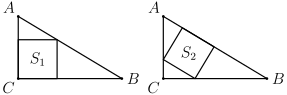
Small Hint:
Let the legs be and and use the first square to relate to
Big Hint:
For the second square, use the altitude to the hypotenuse and similar cross-sections
Solution:
Put and let the hypotenuse be Since has side the standard leg-aligned-square relation gives so Hence
The altitude to the hypotenuse is If the side of is similarity gives Substitution simplifies this to Therefore Since this becomes Thus and gives