
1985 AIME Solutions
Scroll down to view professionally curated solutions from LIVE by Po-Shen Loh, print PDF solutions, view answer key, or take the full timed exam.
All problems are used with official legal permission of the Mathematical Association of America (MAA).
1.
Let and for let Calculate the product
Small Hint:
Multiply consecutive terms using the recurrence
Big Hint:
Group the requested product as
Solution:
The recurrence gives Therefore
2.
When a right triangle is rotated about one leg, the volume of the cone produced is When the triangle is rotated about the other leg, the volume of the cone produced is What is the length (in cm) of the hypotenuse of the triangle?
Small Hint:
Write the two cone volumes in terms of the triangle’s legs and
Big Hint:
Dividing the volume equations gives the ratio of the two legs
Solution:
Let the legs be and In a suitable order, Their ratio gives so write and The first equation becomes hence The legs are and so the hypotenuse is
3.
Find if and are positive integers which satisfy where
Small Hint:
Expand and set its imaginary part equal to
Big Hint:
The resulting equation shows that the positive integer divides
Solution:
Expanding and using that is real gives Since is prime, or The latter would require which is impossible. Thus and so The real part is
4.
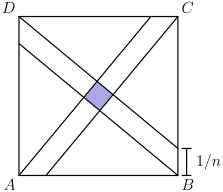
A small square is constructed inside a square of area by dividing each side of the unit square into equal parts, and then connecting the vertices to the division points closest to the opposite vertices, as shown. Find the value of if the area of the small square (shaded in the figure) is exactly
Small Hint:
Place the unit square on a coordinate plane and write equations for two parallel construction lines
Big Hint:
The distance between the parallel lines is the side length of the small square
Solution:
Put the outer square at One pair of construction lines has equations The other pair is perpendicular to this pair, and the two pairs have the same separation. Thus the inner square has side length and area Hence or Its positive root is
5.
A sequence of integers is chosen so that for each What is the sum of the first terms of this sequence if the sum of the first terms is and the sum of the first terms is
Small Hint:
Write the first six terms in terms of and
Big Hint:
The sequence repeats every six terms, and each six-term block has sum
Solution:
Put and The first six terms are after which the sequence repeats; these six terms sum to Since and the given equations are Thus Since the requested sum is
6.
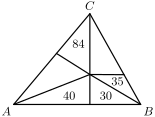
As shown in the figure, triangle is divided into six smaller triangles by lines drawn from the vertices through a common interior point. The areas of four of these triangles are as indicated. Find the area of triangle
Small Hint:
Call the upper-right unlabeled area and the upper-left unlabeled area
Big Hint:
Use equal-altitude area ratios along the sides, together with Ceva’s theorem
Solution:
Let the unlabeled upper-right and upper-left areas be and respectively. The three side-division ratios and Ceva’s theorem give so
The cevian from meets The ratio of the two segments of is Computing the same ratio from the two large triangles with vertex gives so Solving with yields and Therefore
7.
Assume that and are positive integers such that and Determine
Small Hint:
Parametrize the solutions of and
Big Hint:
Factor the resulting difference
Solution:
Comparing prime exponents, write for positive integers Then Since is prime, the factors are and giving and Thus and
8.
The sum of the following seven numbers is exactly It is desired to replace each by an integer approximation so that the sum of the ’s is also and so that the maximum of the “errors” is as small as possible. For this minimum what is
Small Hint:
Starting from seven ’s, the integer sum must be reduced by
Big Hint:
To minimize the worst error, round the two smallest ’s down to
Solution:
Choose and The sum is and the largest error is
If then must all equal and can only be or Their sum would therefore be at least a contradiction. Thus the minimum is and
9.
In a circle, parallel chords of lengths and determine central angles of and radians, respectively, where If which is a positive rational number, is expressed as a fraction in lowest terms, what is the sum of its numerator and denominator?
Small Hint:
A chord subtending angle has length
Big Hint:
Let and then eliminate the common radius
Solution:
Put and The chord data give The addition formula yields Also so Substituting gives Hence and the requested sum is
10.
How many of the first positive integers can be expressed in the form where is a real number, and denotes the greatest integer less than or equal to
Small Hint:
Substitute and separate into its integer and fractional parts
Big Hint:
Determine the values of for
Solution:
Let where is an integer and The expression is Checking the breakpoints shows that the fractional-part contribution takes exactly the values and Thus precisely six residue classes modulo are attainable. Among the first positive integers, this gives
11.
An ellipse has foci at and in the -plane and is tangent to the -axis. What is the length of its major axis?
Small Hint:
At tangency, the constant sum of distances is the minimum such sum for a point on the -axis
Big Hint:
Reflect one focus across the -axis to turn the broken path into a straight segment
Solution:
Reflect across the -axis to For a point on the -axis, the sum of its distances to the original foci equals the length of a broken path from through to Its minimum is the straight-line distance Tangency means that the ellipse’s constant distance sum equals this minimum. That sum is the major-axis length, so the answer is
12.
Let and be the vertices of a regular tetrahedron, each of whose edges measures meter. A bug, starting from vertex observes the following rule: at each vertex it chooses one of the three edges meeting at that vertex, each edge being equally likely to be chosen, and crawls along that edge to the vertex at its opposite end. Let be the probability that the bug is at vertex when it has crawled exactly meters. Find the value of
Small Hint:
Let be the probability of being at after steps
Big Hint:
From any vertex other than the probability of moving to is
Solution:
Let be the probability that the bug is at after steps. It cannot stay at while from any other vertex it moves to with probability Hence Solving this recurrence gives Thus so
13.
The numbers in the sequence are of the form where For each let be the greatest common divisor of and Find the maximum value of as ranges through the positive integers.
Small Hint:
A common divisor of consecutive terms also divides their difference
Big Hint:
Combine and to show that the gcd divides a fixed prime
Solution:
A common divisor divides It therefore also divides Since is prime, Equality occurs at because and Hence the maximum is
14.
In a tournament each player played exactly one game against each of the other players. In each game the winner was awarded point, the loser got points, and each of the two players earned point if the game was a tie. After the completion of the tournament, it was found that exactly half of the points earned by each player were earned against the ten players with the least number of points. (In particular, each of the ten lowest-scoring players earned half of her or his points against the other nine of the ten.) What was the total number of players in the tournament?
Small Hint:
Sum the scores of the ten lowest-scoring players and count their internal games
Big Hint:
Let be the number of other players and double-count points from games across the two groups
Solution:
The games among the ten lowest players contribute total points. These are half of those ten players’ combined score, so their combined score is Hence they earned points in games against the other players.
The other players therefore earned points against the lowest ten. By the condition, this is half their combined score, which is Thus giving If the lowest ten average points while the other six average only impossible for the latter group to rank above them. Hence and the total number of players is
15.
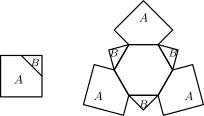
Three squares are each cut into two pieces and as shown in the first figure below, by joining the midpoints of two adjacent sides. These six pieces are then attached to a regular hexagon, as shown in the second figure, so as to fold into a polyhedron. What is the volume (in ) of this polyhedron?
Small Hint:
Recognize each as a square face with one corner cut off and each as that corner triangle
Big Hint:
A plane through six edge midpoints of a cube cuts a regular hexagon and divides the cube into two congruent parts
Solution:
Consider a cube and the plane through the midpoints of the six edges that join opposite groups of three vertices. In coordinates this is the plane Its cross-section is a regular hexagon with side the same as the cut edge joining adjacent side midpoints.
On three faces of the cube, the plane leaves a square with a corner triangle removed, exactly piece On the other three faces, it leaves the complementary right-isosceles corner triangle, exactly piece Thus the pictured net is one of the two pieces into which this plane cuts the cube. Central symmetry interchanges the two pieces, so each has half the cube’s volume: