
1983 AIME Solutions
Scroll down to view professionally curated solutions from LIVE by Po-Shen Loh, print PDF solutions, view answer key, or take the full timed exam.
All problems are used with official legal permission of the Mathematical Association of America (MAA).
1.
Let and all exceed and let be a positive number such that Find
Small Hint:
Rewrite each given logarithm with base
Big Hint:
Expand as a sum of three logarithms
Solution:
Taking reciprocals of the given logarithms gives Therefore Taking the reciprocal yields
2.
Let where Determine the minimum value taken by for in the interval
Small Hint:
Determine the sign of each expression inside an absolute value on the given interval
Big Hint:
On simplify to a decreasing linear function
Solution:
Since we have Hence This is minimized at the right endpoint where its value is
3.
What is the product of the real roots of the equation
Small Hint:
The expression outside the radical is less than the radicand
Big Hint:
Set and solve
Solution:
Set so The equation becomes or Thus and so the real roots satisfy By Vieta’s formulas, their product is
4.
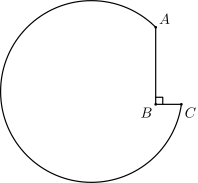
A machine-shop cutting tool has the shape of a notched circle, as shown. The radius of the circle is cm, the length of is cm, and that of is cm. The angle is a right angle. Find the square of the distance (in centimeters) from to the center of the circle.
Small Hint:
Put and
Big Hint:
The center lies on the perpendicular bisector of at distance from its midpoint
Solution:
Put and The midpoint of is and If is the center, then A vector perpendicular to is which already has length Thus the two possible centers are The pictured notched circle has its center on the side opposite the notch, so Therefore
5.
Suppose that the sum of the squares of two complex numbers and is and the sum of the cubes is What is the largest real value that can have?
Small Hint:
Let and
Big Hint:
Use to eliminate from
Solution:
Let and From we get Also, Hence Each root gives a possible pair of complex roots of so the largest real possible value of is
6.
Let Determine the remainder on dividing by
Small Hint:
Write and
Big Hint:
Modulo only the constant and linear terms of each binomial expansion survive
Solution:
Modulo every binomial term containing vanishes. Since is odd, and Their sum is congruent to
7.
Twenty-five of King Arthur’s knights are seated at their customary round table. Three of them are chosen, with all choices of three equally likely, and are sent off to slay a troublesome dragon. Let be the probability that at least two of the three had been sitting next to each other. If is written as a fraction in lowest terms, what is the sum of the numerator and denominator?
Small Hint:
Count the complementary selections in which no two chosen knights are adjacent
Big Hint:
Split into selections containing a fixed knight and selections not containing that knight
Solution:
There are selections. Fix one seat. If it is not selected, choosing three nonadjacent seats among the remaining seats is equivalent to choosing three nonconsecutive positions from a row of giving If the fixed seat is selected, its two neighbors are forbidden, and the other two selected seats must be nonconsecutive among the remaining row of giving
Thus the number with no adjacent selected seats is Therefore and the requested sum is
8.
What is the largest -digit prime factor of the integer
Small Hint:
For a prime compare the exponent of in with twice its exponent in
Big Hint:
Primes from through cancel; primes from through do not
Solution:
For a prime we have so If this is If it is Hence no prime greater than divides the binomial coefficient, while every prime between and does. The largest such prime is
9.
Find the minimum value of for
Small Hint:
Set which is positive on the given interval
Big Hint:
Apply AM-GM to and verify that equality is attainable
Solution:
Let The expression becomes with equality when or The continuous function tends to as tends to and equals at Thus it takes the value somewhere in so the lower bound is attained.
10.
The numbers and have something in common: each is a four-digit number beginning with that has exactly two identical digits. How many such numbers are there?
Small Hint:
Separate the case where the repeated digit is from the case where it is not
Big Hint:
In each case, choose the repeated digit’s positions before choosing the remaining distinct digit
Solution:
If is the repeated digit, exactly one of the last three positions contains There are choices for that position, choices for the next digit, and for the last digit, since those two digits must differ from each other and from This gives numbers.
If a digit other than is repeated, there are choices for that digit, ways to choose its two positions among the last three, and choices for the remaining digit. This gives another numbers. The total is
11.
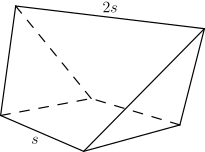
The solid shown has a square base of side length The upper edge is parallel to the base and has length All other edges have length Given that what is the volume of the solid?
Small Hint:
Find the height by projecting either endpoint of the upper edge onto the base
Big Hint:
At a fraction of the height, the cross-section is a rectangle with sides and
Solution:
Each endpoint of the upper edge is joined to the endpoints of one side of the square base. Its distance to that side’s midpoint is therefore The projection of each upper endpoint lies beyond that midpoint, because the two projected endpoints are apart while the two opposite-side midpoints are apart. Thus the height satisfies so
At a fraction of the height above the base, the cross-section is a rectangle whose dimensions are and Its area is By Cavalieri’s principle, the volume is the volume of a prism minus the volume of a pyramid: Substituting gives
12.
Diameter of a circle has length a -digit integer (base ten). Reversing the digits gives the length of the perpendicular chord The distance from their intersection point to the center is a positive rational number. Determine the length of
Small Hint:
Write the diameter as and the chord as
Big Hint:
The squared distance from the center to the chord is one fourth the difference of their squares
Solution:
Let the diameter be and the chord be Since a perpendicular from the center bisects a chord, For to be rational, must be a square. Thus it equals so Because and are digits with the left side is at most so or If the factors are and giving and If the factor pairs of either have different parity or give Hence the diameter is
13.
For and each of its nonempty subsets a unique alternating sum is defined as follows: Arrange the numbers in the subset in decreasing order and then, beginning with the largest, alternately add and subtract successive numbers. (For example, the alternating sum for is and for it is simply ) Find the sum of all such alternating sums for
Small Hint:
Add the contribution of each number separately over all subsets
Big Hint:
The sign of depends only on whether the subset contains an even or odd number of elements greater than
Solution:
Fix Once is included, the smaller elements may be chosen arbitrarily, contributing a factor of If exactly of the larger elements are chosen, the sign of is Therefore the coefficient of in the total is This is for and for Hence the total is
14.
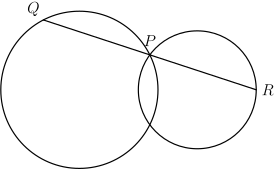
In the adjoining figure, two circles of radii and are drawn with their centers units apart. At one of the points of intersection, a line is drawn in such a way that the chords and have equal length. Find the square of the length of
Small Hint:
Put the centers at and and find the coordinates of
Big Hint:
If and subtract the two equal-radius equations
Solution:
Put the center of the radius- circle at and the other center at Subtracting the two circle equations gives where the positive -coordinate selects the pictured intersection.
Let the common chord length be and let be the unit vector from toward Then and Comparing with in the first circle and with in the second gives Adding shows that so Subtracting the two dot-product equations gives Therefore
15.
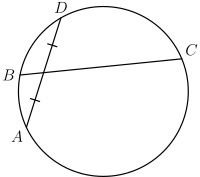
The adjoining figure shows two intersecting chords in a circle, with on minor arc Suppose that the radius of the circle is that and that is bisected by Suppose further that is the only chord starting at which is bisected by It follows that the sine of the minor arc is a rational number. If this fraction is expressed as a fraction in lowest terms, what is the product
Small Hint:
The midpoints of all chords from lie on the circle with diameter joining to the center
Big Hint:
Uniqueness makes tangent to that midpoint circle at the midpoint of
Solution:
Let be the midpoint of Put and let the circle’s center be Then The midpoints of all chords starting at form the circle with center and radius Because is the only such chord bisected by the line that line is tangent to the midpoint circle at
Hence a unit direction vector for may be taken as perpendicular to Write and where Then and intersecting chords give Substituting the line into the original circle also gives Therefore so Its roots are and but Thus and
Choose and for the endpoint on minor arc Then The sine of the central angle subtending minor arc is the absolute determinant of these radius vectors divided by namely Hence