
Soluciones del 2009 AMC 8
Desplázate hacia abajo para ver las soluciones preparadas profesionalmente de LIVE by Po-Shen Loh, imprime las soluciones en PDF, consulta la clave de respuestas, o haz el examen cronometrado completo.
Todos los problemas se usan con el permiso legal oficial de la Mathematical Association of America (MAA).
1.
Bridget compró una bolsa de manzanas en la tienda de comestibles. Le dio la mitad de las manzanas a Ann. Luego le dio a Cassie manzanas, quedándose con manzanas para ella. ¿Cuántas manzanas compró Bridget?
Bridget bought a bag of apples at the grocery store. She gave half of the apples to Ann. Then she gave Cassie apples, keeping apples for herself. How many apples did Bridget buy?
Pista pequeña:
Trabaja hacia atrás desde las manzanas que Bridget se quedó y le dio a Cassie
Work backward from the apples Bridget kept and gave to Cassie.
Pista grande:
Esas manzanas eran la mitad que no le dio a Ann
Those apples were the half not given to Ann.
Solución:
Podemos trabajar hacia atrás, empezando con las manzanas que Bridget se quedó para ella. Sumando las manzanas que le dio a Cassie, ahora tiene manzanas.
Por último, multiplicamos este valor por ya que le dio la mitad de sus manzanas iniciales a Ann. así que Bridget empezó con manzanas.
Por lo tanto, E es la respuesta correcta.
We can work backwards, starting with the apples that Bridget kept for herself. Adding the apples that she gave Cassie, she now has apples.
Finally, we multiply this value by since she gave half of her initial apples to Ann. so Bridget started off with apples.
Thus, E is the correct answer.
2.
En promedio, por cada autos deportivos que se venden en el concesionario local, se venden sedanes. El concesionario predice que venderá autos deportivos el próximo mes. ¿Cuántos sedanes espera vender?
On average, for every sports cars sold at the local car dealership, sedans are sold. The dealership predicts that it will sell sports cars next month. How many sedans does it expect to sell?
Pista pequeña:
Usa la razón de autos deportivos a sedanes
Use the ratio sports cars to sedans.
Pista grande:
Pasar de a autos deportivos multiplica por
Going from to sports cars multiplies by
Solución:
Planteamos la proporción Al multiplicar en cruz obtenemos y, por tanto,
Por lo tanto, D es la respuesta correcta.
Set up the proportion Cross-multiplying gives and hence
Thus, D is the correct answer.
3.
La gráfica muestra la velocidad constante a la que Suzanna anda en bicicleta. Si anda en total media hora a la misma velocidad, ¿cuántas millas habrá recorrido?
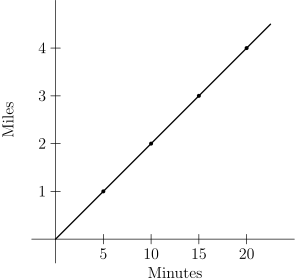
The graph shows the constant rate at which Suzanna rides her bike. If she rides a total of half an hour at the same speed, how many miles will she have ridden?
Pista pequeña:
Lee un punto claro de la gráfica
Read one clear point from the graph.
Pista grande:
Si minutos dan millas, entonces minutos es el doble de tiempo
If minutes gives miles, then minutes is twice as long.
Solución:
En la gráfica, podemos ver que Suzanna recorre millas en minutos. Esto significa que en minutos, habrá recorrido millas.
Por lo tanto, C es la respuesta correcta.
From the graph, we can see that Suzanna rides miles in minutes. This means that in minutes, she will have ridden miles.
Thus, C is the correct answer.
4.
Las cinco piezas que se muestran abajo pueden acomodarse para formar cuatro de las cinco figuras de abajo. ¿Qué figura no se puede formar?
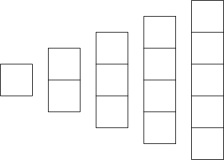
The five pieces shown below can be arranged to form four of the five figures below. Which figure cannot be formed?


Pista pequeña:
Busca una característica en las cinco piezas que deba aparecer en la figura final
Look for a feature in the five pieces that must appear in the final figure.
Pista grande:
La pieza larga de cuadrados debe caber como un segmento continuo en algún lugar
The long -square piece must fit as an unbroken segment somewhere.
Solución:
Observa que la opción B no tiene ningún segmento que mida bloques de largo. Esto significa que es imposible acomodar la pieza de bloques de largo dentro de la figura.
Por lo tanto, B es la respuesta correcta.
Note that option B does not have any segments in it that are blocks long. This means that it is impossible to arrange the block long piece to fit within the figure.
Thus, B is the correct answer.
5.
Una sucesión de números empieza con y El cuarto número de la sucesión es la suma de los tres números anteriores de la sucesión, es decir De la misma manera, cada número después del cuarto es la suma de los tres números anteriores. ¿Cuál es el octavo número de la sucesión?
A sequence of numbers starts with and The fourth number of the sequence is the sum of the previous three numbers in the sequence: In the same way, every number after the fourth is the sum of the previous three numbers. What is the eighth number in the sequence?
Pista pequeña:
Genera la sucesión un término a la vez
Generate the sequence one term at a time.
Pista grande:
Cada término nuevo es la suma de los tres términos anteriores
Each new term is the sum of the previous three terms.
Solución:
La sucesión empieza con
Los siguientes términos son y
Por lo tanto, D es la respuesta correcta.
The sequence begins
The next terms are and
Thus, D is the correct answer.
6.
La piscina vacía de Steve puede contener galones de agua cuando está llena. Se llenará con mangueras, cada una de las cuales suministra galones de agua por minuto. ¿Cuántas horas tomará llenar la piscina de Steve?
Steve’s empty swimming pool will hold gallons of water when full. It will be filled by hoses, each of which supplies gallons of water per minute. How many hours will it take to fill Steve’s pool?
Pista pequeña:
Primero halla la velocidad de llenado combinada de las cuatro mangueras
First find the combined filling rate of the four hoses.
Pista grande:
Convierte los minutos a horas después de hallar el número total de minutos
Convert minutes to hours after finding the total number of minutes.
Solución:
Las mangueras juntas suministran galones de agua por minuto.
Para llenar galones, las mangueras tardarán minutos.
minutos equivalen a horas.
Por lo tanto, A es la respuesta correcta.
The hoses together fill the pool with gallons of water per minute.
To fill gallons, it will take the hoses minutes to fill the pool.
minutes is the same as hours.
Thus, A is the correct answer.
7.
El terreno triangular se ubica entre Aspen Road, Brown Road y una vía férrea. Main Street va de este a oeste, y la vía férrea va de norte a sur. Los números del diagrama indican distancias en millas. El ancho de la vía férrea se puede ignorar. ¿Cuántas millas cuadradas tiene el terreno ?
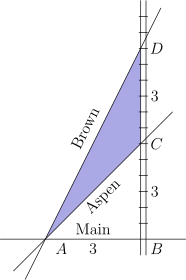
The triangular plot of land lies between Aspen Road, Brown Road and a railroad. Main Street runs east and west, and the railroad runs north and south. The numbers in the diagram indicate distances in miles. The width of the railroad track can be ignored. How many square miles are in the plot of land
Pista pequeña:
Usa como base del triángulo
Use as a base for triangle
Pista grande:
La distancia perpendicular de a la vía férrea está dada por
The perpendicular distance from to the railroad is shown by
Solución:
La base de es que es La altura también es
Por consiguiente, el área de es
Por lo tanto, C es la respuesta correcta.
The base of is which is The altitude is as well.
Therefore, the area of is
Thus, C is the correct answer.
8.
El largo de un rectángulo se aumenta en y el ancho se disminuye en ¿Qué porcentaje del área anterior es el área nueva?
The length of a rectangle is increased by and the width is decreased by What percent of the old area is the new area?
Pista pequeña:
Multiplica los factores de escala del largo y del ancho
Multiply the scale factors for length and width.
Pista grande:
El área nueva es veces el área anterior
The new area is times the old area.
Solución:
Sean y el largo y el ancho anteriores, así que el área anterior es
El largo nuevo es y el ancho nuevo es Así, el área nueva es
Esto muestra que el área nueva es el del área anterior.
Por lo tanto, B es la respuesta correcta.
Let the old length and width be and so the old area is
The new length is and the new width is Thus the new area is
This shows that the new area is of the old area.
Thus, B is the correct answer.
9.
Construye un cuadrado sobre un lado de un triángulo equilátero. Sobre un lado no adyacente del cuadrado, construye un pentágono regular, como se muestra. Sobre un lado no adyacente del pentágono, construye un hexágono regular. Continúa construyendo polígonos regulares de la misma manera, hasta construir un octágono. ¿Cuántos lados tiene el polígono resultante?
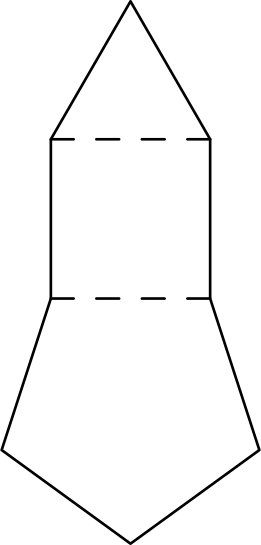
Construct a square on one side of an equilateral triangle. On one non-adjacent side of the square, construct a regular pentagon, as shown. On a non-adjacent side of the pentagon, construct a regular hexagon. Continue to construct regular polygons in the same way, until you construct an octagon. How many sides does the resulting polygon have?
Pista pequeña:
Cuenta solo los lados exteriores de cada polígono
Count only the outside sides of each polygon.
Pista grande:
Los polígonos del medio comparten dos lados; los dos polígonos de los extremos comparten un lado cada uno
Middle polygons share two sides; the two end polygons share one side each.
Solución:
El triángulo y el octágono están en los extremos de la cadena, así que cada uno pierde un lado por un borde compartido. El cuadrado, el pentágono, el hexágono y el heptágono están en el medio, así que cada uno pierde dos lados por bordes compartidos.
El polígono resultante tiene lados.
Por lo tanto, B es la respuesta correcta.
The triangle and octagon are at the ends of the chain, so each loses one side to a shared edge. The square, pentagon, hexagon, and heptagon are in the middle, so each loses two sides to shared edges.
The resulting polygon has sides.
Thus, B is the correct answer.
10.
En un tablero de damas compuesto por cuadrados unitarios, ¿cuál es la probabilidad de que un cuadrado unitario elegido al azar no toque el borde exterior del tablero?

On a checkerboard composed of unit squares, what is the probability that a randomly chosen unit square does not touch the outer edge of the board?
Pista pequeña:
Solo los cuadrados estrictamente dentro del borde no tocan la orilla
Only the squares strictly inside the border do not touch the edge.
Pista grande:
Un tablero de tiene un interior de
An board has a interior.
Solución:
Hay cuadrados en el interior.
Esto significa que la probabilidad de elegir uno de estos cuadrados es
Por lo tanto, D es la respuesta correcta.
There are squares on the interior.
This means that the probability of choosing one of these squares is
Thus, D is the correct answer.
11.
La librería de la Escuela Secundaria Amaco vende lápices que cuestan un número entero de centavos. Algunos estudiantes de séptimo grado compraron cada uno un lápiz, pagando en total dólares. Algunos de los estudiantes de sexto grado compraron cada uno un lápiz, y pagaron en total dólares. ¿Cuántos alumnos más de sexto grado que de séptimo grado compraron un lápiz?
The Amaco Middle School bookstore sells pencils costing a whole number of cents. Some seventh graders each bought a pencil, paying a total of dollars. Some of the sixth graders each bought a pencil, and they paid a total of dollars. How many more sixth graders than seventh graders bought a pencil?
Pista pequeña:
El precio del lápiz debe dividir ambos costos totales en centavos
The pencil price must divide both total costs in cents.
Pista grande:
Usa el hecho de que a lo sumo estudiantes de sexto grado compraron lápices para descartar un precio de centavo
Use the fact that at most sixth graders bought pencils to rule out a -cent price.
Solución:
El número de estudiantes de séptimo grado que compraron un lápiz es dividido entre el precio de un lápiz. De igual manera, el número de estudiantes de sexto grado que compraron un lápiz es dividido entre el precio de un lápiz.
Esto significa que el precio de un lápiz divide tanto a como a Al factorizar en primos obtenemos y Los únicos números positivos que dividen tanto a como a son y
Si el precio del lápiz fuera centavo, eso significaría que estudiantes de sexto grado compraron lápices, lo cual no es posible. Por lo tanto, el precio de un lápiz es centavos.
Esto significa que estudiantes de séptimo grado compraron un lápiz, y estudiantes de sexto grado compraron un lápiz. Por lo tanto, estudiantes de sexto grado más que de séptimo grado compraron lápices.
Por lo tanto, D es la respuesta correcta.
The number of seventh graders that bought a pencil is divided by the price of a pencil. Similarly, the number of sixth graders that bought a pencil is divided by the price of a pencil.
This means that the price of a pencil divides both and Prime factorizing, we get and The only numbers that divide both and are and
If cent was the price of the pencil, that means sixth graders bought pencils, which is not possible. Therefore, the price of a pencil is cents.
This means that seventh graders bought a pencil, and sixth graders bought a pencil. Therefore, more sixth graders than seventh graders bought pencils.
Thus, D is the correct answer.
12.
Se hace girar una vez cada una de las dos ruletas mostradas, y cada una se detiene en uno de los sectores numerados. ¿Cuál es la probabilidad de que la suma de los números de los dos sectores sea un número primo?
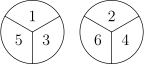
The two spinners shown are spun once and each lands on one of the numbered sectors. What is the probability that the sum of the numbers in the two sectors is prime?
Pista pequeña:
Haz una tabla de de las sumas posibles
Make a table of possible sums.
Pista grande:
Entre los resultados posibles, solo las sumas de no son primas
Only sums of are not prime among the possible outcomes.
Solución:
Podemos hallar la suma de los dos números en cada resultado posible.
Solo hay resultados en los que la suma no es prima (las dos ocasiones en que la suma es ). Por lo tanto, la probabilidad de que la suma sea prima es
Por lo tanto, D es la respuesta correcta.
We can find the sum of the two numbers in every possible outcome.
There are only outcomes where the sum is not prime (the two instances when the sum is ). Therefore, the probability that the sum is prime is
Thus, D is the correct answer.
13.
Un entero de tres dígitos contiene una vez cada uno de los dígitos y ¿Cuál es la probabilidad de que el entero sea divisible por ?
A three-digit integer contains one of each of the digits and What is the probability that the integer is divisible by
Pista pequeña:
Un número es divisible por exactamente cuando su último dígito es o
A number is divisible by exactly when its last digit is or
Pista grande:
Con los dígitos y cada dígito tiene la misma probabilidad de quedar al final
With digits and each digit is equally likely to be last.
Solución:
El número tiene la misma probabilidad de terminar en o
Es divisible por solo si el último dígito es lo cual ocurre con probabilidad
Por lo tanto, B es la respuesta correcta.
The number is equally likely to end in or
It is divisible by only if the last digit is which happens with probability
Thus, B is the correct answer.
14.
Austin y Temple están a millas de distancia a lo largo de la Interestatal Bonnie condujo de Austin a la casa de su hija en Temple, con un promedio de millas por hora. Después de dejarle el auto a su hija, Bonnie tomó un autobús de regreso a Austin por la misma ruta, a una velocidad promedio de millas por hora. ¿Cuál fue la velocidad promedio del viaje de ida y vuelta, en millas por hora?
Austin and Temple are miles apart along Interstate Bonnie drove from Austin to her daughter’s house in Temple, averaging miles per hour. Leaving the car with her daughter, Bonnie rode a bus back to Austin along the same route and averaged miles per hour on the return trip. What was the average speed for the round trip, in miles per hour?
Pista pequeña:
La velocidad promedio es la distancia total dividida entre el tiempo total
Average speed is total distance divided by total time.
Pista grande:
Los dos viajes de millas toman cantidades de tiempo diferentes
The two -mile trips take different amounts of time.
Solución:
El viaje de Austin a Temple tomó horas. El viaje de Temple a Austin tomó horas. Esto significa que el tiempo total del viaje de ida y vuelta fue horas.
La distancia total del viaje de ida y vuelta fue millas. Por lo tanto, la velocidad promedio del viaje de ida y vuelta fue millas por hora.
Por lo tanto, B es la respuesta correcta.
The trip from Austin to Temple took hours. The trip from Temple to Austin took hours. This means that the total time for the round trip was hours.
The total distance of the round trip was miles. Therefore, the average speed for the round trip was miles per hour.
Thus, B is the correct answer.
15.
Una receta que hace porciones de chocolate caliente requiere cuadros de chocolate, taza de azúcar, taza de agua y tazas de leche. Jordan tiene cuadros de chocolate, tazas de azúcar, mucha agua y tazas de leche. Si mantiene la misma proporción de ingredientes, ¿cuál es el mayor número de porciones de chocolate caliente que puede hacer?
A recipe that makes servings of hot chocolate requires squares of chocolate, cup sugar, cup water and cups milk. Jordan has squares of chocolate, cups of sugar, lots of water, and cups of milk. If she maintains the same ratio of ingredients, what is the greatest number of servings of hot chocolate she can make?
Pista pequeña:
Compara para cuántas tandas de la receta alcanza cada ingrediente
Compare how many recipe batches each ingredient can support.
Pista grande:
El ingrediente que alcanza para menos tandas limita el número de porciones
The ingredient that supports the fewest batches limits the servings.
Solución:
Necesitamos hallar qué ingrediente es el factor limitante.
Jordan tiene chocolate suficiente para tandas, azúcar suficiente para tandas, y leche suficiente para tandas.
La leche es el factor limitante, así que Jordan puede hacer porciones.
Por lo tanto, D es la respuesta correcta.
We need to find which ingredient is the limiting factor.
Jordan has enough chocolate for batches, enough sugar for batches, and enough milk for batches.
The milk is limiting, so Jordan can make servings.
Thus, D is the correct answer.
16.
¿Cuántos enteros positivos de dígitos tienen dígitos cuyo producto es igual a ?
How many -digit positive integers have digits whose product equals
Pista pequeña:
Enumera las ternas no ordenadas de dígitos cuyo producto es
List the unordered triples of digits whose product is
Pista grande:
Las ternas con tres dígitos distintos tienen permutaciones, mientras que tiene
Triplets with three distinct digits have permutations, while has
Solución:
Las únicas ternas de enteros menores que cuyo producto es son
Las ternas con números distintos se pueden reordenar para formar enteros positivos de dígitos distintos. La otra terna se puede acomodar para formar enteros positivos de dígitos distintos.
Esto deja un total de enteros.
Por lo tanto, D es la respuesta correcta.
The only triples of integers less than that multiply to are
The triples with distinct numbers can be rearranged to form distinct -digit positive integers. The other triple can be arranged to form distinct -digit positive integers.
This leaves a total of integers.
Thus, D is the correct answer.
17.
Los enteros positivos y son los dos enteros positivos más pequeños para los que el producto de y es un cuadrado y el producto de y es un cubo. ¿Cuál es la suma de y ?
The positive integers and are the two smallest positive integers for which the product of and is a square and the product of and is a cube. What is the sum of and
Pista pequeña:
Factoriza en primos
Factor into primes.
Pista grande:
Haz los exponentes pares para un cuadrado y múltiplos de para un cubo
Make exponents even for a square and multiples of for a cube.
Solución:
Para que un número sea un cuadrado perfecto, cada exponente de la factorización en primos debe ser par. Para que sea un cubo, los exponentes deben ser divisibles entre
Podemos factorizar como Para que sea un cuadrado perfecto y sea mínimo, debe aportar un factor de y un factor de Por lo tanto, podemos tomar
Para que sea un cubo, debe tener un factor de y dos factores de Por lo tanto, podemos tomar de modo que
Por lo tanto, B es la respuesta correcta.
For a number to be a perfect square, every exponent in the prime factorization must be even. For it to be a cube, the exponents must be divisible by
We can factor to get For to be a perfect square and to be minimized, must have one factor of and one factor of Therefore, we can let
For to be a cube, must have one factor of and two factors of Therefore, we can let suggesting
Thus, B is the correct answer.
18.
El diagrama representa un piso de pies por pies que está embaldosado con baldosas sombreadas de pie cuadrado y baldosas no sombreadas. Observa que las esquinas tienen baldosas no sombreadas. Si un piso de pies por pies se embaldosa de la misma manera, ¿cuántas baldosas no sombreadas se necesitarán?
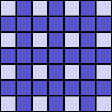
The diagram represents a -foot-by--foot floor that is tiled with -square-foot shaded tiles and unshaded tiles. Notice that the corners have unshaded tiles. If a -foot-by--foot floor is to be tiled in the same manner, how many unshaded tiles will be needed?
Pista pequeña:
Busca el patrón en las baldosas no sombreadas del piso de
Look for the pattern in the unshaded tiles of the floor.
Pista grande:
Para un lado de longitud impar el número de baldosas no sombreadas sigue
For an odd side length the unshaded tile count follows
Solución:
En el ejemplo de hay filas que contienen baldosas no sombreadas, para baldosas no sombreadas.
Para un piso de con el mismo patrón, habrá de esas filas con baldosas no sombreadas cada una.
Así, el número de baldosas no sombreadas es
Por lo tanto, C es la respuesta correcta.
In the example, there are rows that contain unshaded tiles, for unshaded tiles.
For a floor with the same pattern, there will be such rows with unshaded tiles each.
Thus the number of unshaded tiles is
Thus, C is the correct answer.
19.
Dos ángulos de un triángulo isósceles miden y ¿Cuál es la suma de los tres valores posibles de ?
Two angles of an isosceles triangle measure and What is the sum of the three possible values of
Pista pequeña:
El ángulo conocido de y el ángulo de pueden ubicarse de tres maneras en un triángulo isósceles
There are three ways the known angle and the angle can sit in an isosceles triangle.
Pista grande:
Considera si son los ángulos iguales, o si uno es el ángulo del vértice
Consider whether they are the equal angles, or whether one is the vertex angle.
Solución:
Todas las posibilidades siguientes se muestran abajo.
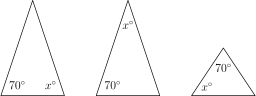
En el primer caso, obtenemos por las propiedades del triángulo isósceles.
En el segundo caso, tenemos de donde
En el tercer caso, tenemos de donde
La suma de estos valores da
Por lo tanto, D es la respuesta correcta.
All the following possibilities are shown below.
In the first scenario, we get by the properties of the isosceles triangle.
In the second scenario, we get that from which we get that
From the third scenario, we get that from which we get that
The sum of these values yields
Thus, D is the correct answer.
20.
¿Cuántos triángulos no congruentes tienen vértices en tres de los ocho puntos del arreglo que se muestra abajo?

How many non-congruent triangles have vertices at three of the eight points in the array shown below?
Pista pequeña:
Usa la simetría para evitar contar cada triángulo por separado
Use symmetry to avoid counting every triangle separately.
Pista grande:
Clasifica los triángulos por sus longitudes de lado después de elegir vértices del arreglo de dos filas
Classify triangles by their side lengths after choosing vertices from the two-row array.
Solución:
Por simetría, basta con enumerar un representante de cada forma de triángulo posible.
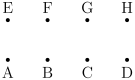
Una lista completa de triángulos representantes no congruentes es y
Cualquier otro triángulo formado con los ocho puntos es congruente con uno de estos triángulos.
Por lo tanto, D es la respuesta correcta.
By symmetry, it is enough to list one representative of each possible triangle shape.
One complete list of non-congruent possibilities is and
Every other triangle formed from the eight points is congruent to one of these triangles.
Thus, D is the correct answer.
21.
Andy y Bethany tienen un arreglo rectangular de números con filas y columnas. Andy suma los números de cada fila. El promedio de sus sumas es Bethany suma los números de cada columna. El promedio de sus sumas es ¿Cuál es el valor de ?
Andy and Bethany have a rectangular array of numbers with rows and columns. Andy adds the numbers in each row. The average of his sums is Bethany adds the numbers in each column. The average of her sums is What is the value of
Pista pequeña:
Sea la suma de todas las entradas del arreglo
Let be the sum of all entries in the array.
Pista grande:
Andy tiene una suma de fila promedio de mientras que Bethany tiene una suma de columna promedio de
Andy has average row sum while Bethany has average column sum
Solución:
Sea la suma de todos los números del arreglo.
Las sumas de fila de Andy también suman así que su promedio es Las sumas de columna de Bethany también suman así que su promedio es
Así,
Por lo tanto, D es la respuesta correcta.
Let be the sum of all numbers in the array.
Andy’s row sums also add to so their average is Bethany’s column sums also add to so their average is
Therefore
Thus, D is the correct answer.
22.
¿Cuántos números enteros entre y no contienen el dígito ?
How many whole numbers between and do not contain the digit
Pista pequeña:
Cuenta según el número de dígitos, o rellena los números con ceros a la izquierda
Count by number of digits, or pad numbers with leading zeroes.
Pista grande:
Para tres dígitos rellenados, cada posición tiene opciones si se prohíbe el dígito pero excluye
For three padded digits, each position has choices if digit is forbidden, but exclude
Solución:
Podemos separar en casos según el número de dígitos.
Hay números de un dígito excluyendo el
Hay números de dos dígitos que carecen del dígito
Hay números de tres dígitos que no incluyen el
Esto da un total de números que no contienen el dígito
Por lo tanto, D es la respuesta correcta.
We can case on the number of digits.
There are one digit numbers excluding
There are two digit numbers that lack the digit
There are three digit numbers that do not include
This yields a total of numbers that do not contain the digit
Thus, D is the correct answer.
23.
En el último día de clases, la señora Wonderful les dio gomitas a su clase. Le dio a cada niño tantas gomitas como niños había en la clase. Le dio a cada niña tantas gomitas como niñas había en la clase. Trajo gomitas, y cuando terminó, le sobraron seis gomitas. Había dos niños más que niñas en su clase. ¿Cuántos estudiantes había en su clase?
On the last day of school, Mrs. Wonderful gave jelly beans to her class. She gave each boy as many jelly beans as there were boys in the class. She gave each girl as many jelly beans as there were girls in the class. She brought jelly beans, and when she finished, she had six jelly beans left. There were two more boys than girls in her class. How many students were in her class?
Pista pequeña:
Sea el número de niñas, así que el número de niños es
Let the number of girls be so the number of boys is
Pista grande:
El total de gomitas repartidas es
The total jelly beans given out is
Solución:
Sea el número de niños de la clase y el número de niñas. Del problema, obtenemos que
Si cada niño recibe gomitas, entonces la señora Wonderful repartirá un total de gomitas a todos los niños. De igual manera, repartirá gomitas a todas las niñas.
Por lo tanto, Como no puede ser negativo, obtenemos que Esto significa que así que
Por lo tanto, B es la respuesta correcta.
Let be the number of boys in the class and be the number of girls. From the problem, we get that
If each boy gets jelly beans, then Mrs. Wonderful will give out a total of jelly beans to all the boys. Similarly, she will give out jelly beans to all the girls.
Therefore, Since cannot be negative, we get that This means that so
Thus, B is the correct answer.
24.
Las letras y representan dígitos distintos. Si y ¿qué dígito representa ?
The letters and all represent different digits. If and what digit does represent?
Pista pequeña:
Usa primero la columna de las unidades de la suma
Use the ones column of the addition first.
Pista grande:
La resta obliga a una relación de préstamo que involucra a
The subtraction forces a borrowing relation involving
Solución:
De la columna de las unidades de la suma, termina en así que
En la resta ahora tenemos La columna de las unidades requiere un préstamo, así que lo que da
Entonces así que En la suma, así que
Por lo tanto, E es la respuesta correcta.
From the ones column of the addition, ends in so
In the subtraction we now have The ones column requires a borrow, so giving
Then so In the addition, so
Thus, E is the correct answer.
25.
Un cubo de un pie cúbico se corta en cuatro piezas mediante tres cortes paralelos a la cara superior del cubo. El primer corte está a pie de la cara superior. El segundo corte está pie debajo del primer corte, y el tercer corte está pie debajo del segundo corte. De arriba hacia abajo las piezas se etiquetan y Luego las piezas se pegan una tras otra en el orden para formar un sólido largo como se muestra. ¿Cuál es el área superficial total de este sólido en pies cuadrados?
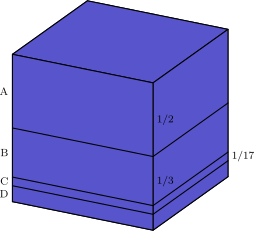
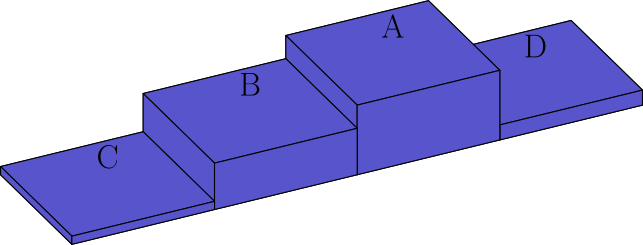
A one-cubic-foot cube is cut into four pieces by three cuts parallel to the top face of the cube. The first cut is foot from the top face. The second cut is foot below the first cut, and the third cut is foot below the second cut. From the top to the bottom the pieces are labeled and The pieces are then glued together end to end in the order to make a long solid as shown. What is the total surface area of this solid in square feet?
Pista pequeña:
Piensa en el área superficial mirando desde las seis direcciones
Think of surface area by looking from the six directions.
Pista grande:
Las cuatro piezas se apilan de nuevo en un cubo unitario cuando se ven desde cualquiera de los lados
The four pieces stack back to a unit cube when viewed from either side.
Solución:
Observa el sólido desde las seis direcciones coordenadas.
Visto desde cualquiera de los extremos, las caras verticales expuestas tienen una altura total igual al grosor de la pieza es decir, pie. Por lo tanto, cada vista desde un extremo tiene un área de pie cuadrado.
Desde cada lado, las cuatro piezas se apilan en la vista lateral del cubo unitario original, así que cada vista lateral tiene un área de pie cuadrado.
Desde arriba y desde abajo, cada vista muestra cuatro caras de por así que cada una tiene un área de pies cuadrados.
El área superficial total es pies cuadrados.
Por lo tanto, E es la respuesta correcta.
Look at the solid from the six coordinate directions.
Viewed from either end, the exposed vertical faces have total height equal to the thickness of piece namely foot. Thus each end view has area square foot.
From each side, the four pieces stack to the side view of the original unit cube, so each side view has area square foot.
From the top and bottom, each view shows four -by- faces, so each has area square feet.
The total surface area is square feet.
Thus, E is the correct answer.