
Soluciones del 2003 AMC 8
Desplázate hacia abajo para ver las soluciones preparadas profesionalmente de LIVE by Po-Shen Loh, imprime las soluciones en PDF, consulta la clave de respuestas, o haz el examen cronometrado completo.
Todos los problemas se usan con el permiso legal oficial de la Mathematical Association of America (MAA).
1.
Jamie contó el número de aristas de un cubo, Jimmy contó el número de vértices y Judy contó el número de caras. Luego sumaron los tres números. ¿Cuál fue la suma resultante?
Jamie counted the number of edges of a cube, Jimmy counted the number of corners, and Judy counted the number of faces. They then added the three numbers. What was the resulting sum?
Pista pequeña:
Un cubo tiene un número fijo de aristas, vértices y caras
A cube has a fixed number of edges, corners, and faces.
Pista grande:
Suma las cantidades de aristas, vértices y caras
Add the counts for edges, corners, and faces.
Solución:
Un cubo tiene aristas, vértices y caras. Al sumarlos se obtiene
Por lo tanto, E es la respuesta correcta.
A cube has edges, corners, and faces. Adding these together yields
Thus, E is the correct answer.
2.
¿Cuál de los siguientes números tiene el menor factor primo?
Which of the following numbers has the smallest prime factor?
Pista pequeña:
Busca un número con factor primo
Look for a number with prime factor
Pista grande:
Entre las opciones, solo uno es par
Among the choices, only one is even.
Solución:
Observa que el menor número primo es Esto significa que cualquier número par sería nuestra respuesta.
Por lo tanto, C es la respuesta correcta.
Note that the smallest prime number is This means that any even number would be our answer.
Thus, C is the correct answer.
3.
Una hamburguesa en Ricky C’s pesa gramos, de los cuales gramos son relleno. ¿Qué porcentaje de la hamburguesa no es relleno?
A burger at Ricky C’s weighs grams, of which grams are filler. What percent of the burger is not filler?
Pista pequeña:
Primero halla cuántos gramos no son relleno
First find how many grams are not filler.
Pista grande:
Compara los gramos que no son relleno con
Compare the non-filler grams to
Solución:
Obtenemos que gramos no son relleno. Por lo tanto, el porcentaje es
Por lo tanto, D es la respuesta correcta.
We get that grams are not filler. The percentage is therefore
Thus, D is the correct answer.
4.
Un grupo de niños que iban en bicicletas y triciclos pasó por la casa de Billy Bob. Billy Bob contó niños y ruedas. ¿Cuántos triciclos había?
A group of children riding on bicycles and tricycles rode past Billy Bob’s house. Billy Bob counted children and wheels. How many tricycles were there?
Pista pequeña:
Si los niños tuvieran bicicletas, cuenta las ruedas
If all children had bicycles, count the wheels.
Pista grande:
Cada triciclo agrega una rueda en comparación con una bicicleta
Each tricycle adds one wheel compared with a bicycle.
Solución:
Sea el número de bicicletas y el número de triciclos. Entonces podemos plantear el siguiente sistema de ecuaciones: Al multiplicar la primera ecuación por y restar el resultado de la segunda ecuación, obtenemos
Por lo tanto, C es la respuesta correcta.
Let be the number of bicycles and be the number of tricycles. Then we can set up the following system of equations: Multiplying the first equation by and subtracting from the second equation, we get
Thus, C is the correct answer.
5.
Si el de un número es ¿cuánto es el del mismo número?
If of a number is what is of the same number?
Pista pequeña:
El es un quinto
is one fifth.
Pista grande:
Usa el como paso intermedio de a
Use as a stepping stone from to
Solución:
Como el del número es el del número es
Por lo tanto, el del mismo número es
Por lo tanto, B es la respuesta correcta.
Since of the number is of the number is
Therefore of the same number is
Thus, B is the correct answer.
6.
Dadas las áreas de los tres cuadrados en la figura, ¿cuál es el área del triángulo interior?
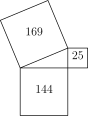
Given the areas of the three squares in the figure, what is the area of the interior triangle?
Pista pequeña:
Las áreas de los cuadrados dan las longitudes de los lados de los tres cuadrados
The square areas give the side lengths of the three squares.
Pista grande:
Las longitudes de los lados forman un triángulo rectángulo
The side lengths form a right triangle.
Solución:
Las longitudes de los lados de los cuadrados son y Estas longitudes forman una terna pitagórica.
Por lo tanto, el triángulo interior es rectángulo, y su área es
Por lo tanto, B es la respuesta correcta.
The side lengths of the squares are and These lengths form a Pythagorean triple.
Therefore, the interior triangle is right. Its area is
Thus, B is the correct answer.
7.
Blake y Jenny hicieron cada uno cuatro pruebas de puntos. Blake promedió en las cuatro pruebas. Jenny obtuvo puntos más que Blake en la primera prueba, puntos menos que él en la segunda prueba, y puntos más en la tercera y la cuarta pruebas. ¿Cuál es la diferencia entre el promedio de Jenny y el promedio de Blake en estas cuatro pruebas?
Blake and Jenny each took four -point tests. Blake averaged on the four tests. Jenny scored points higher than Blake on the first test, points lower than him on the second test, and points higher on both the third and fourth tests. What is the difference between Jenny’s average and Blake’s average on these four tests?
Pista pequeña:
Suma las cuatro diferencias entre las puntuaciones de Jenny y las de Blake
Add Jenny’s four score differences from Blake’s.
Pista grande:
Divide la diferencia total entre para comparar los promedios
Divide the total difference by to compare averages.
Solución:
La diferencia total de puntos entre los dos es El promedio de esta diferencia es
Por lo tanto, A es la respuesta correcta.
The total point difference between the two is The average of this difference is
Thus, A is the correct answer.
8.
Los problemas y usan los datos que se encuentran en el párrafo y las figuras adjuntas.
Venta de repostería
Cuatro amigos, Art, Roger, Paul y Trisha, hornean galletas, y todas las galletas tienen el mismo grosor. Las formas de las galletas difieren, como se muestra.
• Las galletas de Art son trapecios:
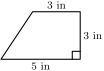
• Las galletas de Roger son rectángulos:

• Las galletas de Paul son paralelogramos:
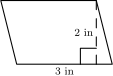
• Las galletas de Trisha son triángulos:

Cada amigo usa la misma cantidad de masa, y Art hace exactamente galletas.
¿Quién obtiene la menor cantidad de galletas de una tanda de masa para galletas?
Problems and use the data found in the accompanying paragraph and figures.
Bake Sale
Four friends, Art, Roger, Paul and Trisha, bake cookies, and all cookies have the same thickness. The shapes of the cookies differ, as shown.
• Art’s cookies are trapezoids:
• Roger’s cookies are rectangles:
• Paul’s cookies are parallelograms:
• Trisha’s cookies are triangles:
Each friend uses the same amount of dough, and Art makes exactly cookies.
Who gets the fewest cookies from one batch of cookie dough?
Art
Paul
Roger
Trisha
Hay un empate en la menor cantidad.
There is a tie for fewest.
Pista pequeña:
La misma masa y grosor significa que una mayor área de galleta da menos galletas
Same dough and thickness means larger cookie area gives fewer cookies.
Pista grande:
Compara las áreas de las cuatro formas de galleta
Compare the areas of the four cookie shapes.
Solución:
Como todas las galletas tienen el mismo grosor y usan la misma cantidad de masa, la forma de galleta más grande produce la menor cantidad de galletas.
El trapecio de Art tiene área El rectángulo de Roger tiene área El paralelogramo de Paul tiene área y el triángulo de Trisha tiene área
Art tiene el área de galleta más grande, así que Art obtiene la menor cantidad de galletas de una tanda.
Por lo tanto, A es la respuesta correcta.
Since the cookies all have the same thickness and use the same amount of dough, the largest cookie shape produces the fewest cookies.
Art’s trapezoid has area Roger’s rectangle has area Paul’s parallelogram has area and Trisha’s triangle has area
Art has the largest cookie area, so Art gets the fewest cookies from one batch.
Thus, A is the correct answer.
9.
Las galletas de Art se venden a ¢ cada una. Para ganar la misma cantidad de una sola tanda, ¿cuánto debería costar una de las galletas de Roger?
Art’s cookies sell for ¢ each. To earn the same amount from a single batch, how much should one of Roger’s cookies cost?
¢
¢
¢
¢
¢
Pista pequeña:
Primero halla el dinero total que Art gana de una tanda
First find the total money Art earns from a batch.
Pista grande:
Usa el número de galletas de Roger que salen de la misma cantidad de masa
Use the number of Roger’s cookies from the shared dough amount.
Solución:
Art hace galletas que se venden a centavos cada una, así que una tanda gana centavos.
La tanda tiene pulgadas cuadradas de área de masa, y cada galleta de Roger tiene área Así, Roger hace galletas.
Para ganar centavos con galletas, cada galleta de Roger debería costar centavos.
Por lo tanto, C es la respuesta correcta.
Art makes cookies that sell for cents each, so one batch earns cents.
The batch has square inches of dough area, and each Roger cookie has area Thus Roger makes cookies.
To earn cents from cookies, each Roger cookie should cost cents.
Thus, C is the correct answer.
10.
¿Cuántas galletas habrá en una tanda de las galletas de Trisha?
How many cookies will be in one batch of Trisha’s cookies?
Pista pequeña:
El área de la galleta de Trisha es la mitad del área de la galleta de Art
Trisha’s cookie area is half of Art’s cookie area.
Pista grande:
La misma cantidad de masa significa que galletas de la mitad de tamaño producen el doble
Same dough amount means half-size cookies make twice as many.
Solución:
El área de la galleta de Art es pulgadas cuadradas, así que toda la tanda tiene área pulgadas cuadradas.
La galleta triangular de Trisha tiene área pulgadas cuadradas.
Por lo tanto, Trisha puede hacer galletas por tanda.
Por lo tanto, E es la respuesta correcta.
Art’s cookie area is square inches, so the whole batch has area square inches.
Trisha’s triangular cookie has area square inches.
Therefore Trisha can make cookies per batch.
Thus, E is the correct answer.
11.
El negocio va un poco lento en Lou’s Fine Shoes, así que Lou decide hacer una rebaja. El viernes, Lou aumenta todos los precios del jueves en un Durante el fin de semana, Lou anuncia la rebaja: «Diez por ciento de descuento sobre el precio de lista. La rebaja empieza el lunes.» ¿Cuánto cuesta el lunes un par de zapatos que costaba el jueves?
Business is a little slow at Lou’s Fine Shoes, so Lou decides to have a sale. On Friday, Lou increases all of Thursday’s prices by Over the weekend, Lou advertises the sale: “Ten percent off the listed price. Sale starts Monday.” How much does a pair of shoes cost on Monday that cost on Thursday?
Pista pequeña:
El descuento del lunes se aplica sobre el precio aumentado del viernes
The Monday discount is taken from Friday’s increased price.
Pista grande:
Multiplica el precio original por luego por
Multiply the original price by then by
Solución:
El viernes, los zapatos suben así que el precio de lista pasa a ser dólares.
El lunes, el descuento del se aplica sobre lo que da dólares.
Por lo tanto, B es la respuesta correcta.
On Friday, the shoes are marked up by so the listed price becomes dollars.
On Monday, the discount is taken from giving dollars.
Thus, B is the correct answer.
12.
Cuando se lanza un dado justo de seis caras sobre una mesa, no se puede ver la cara inferior. ¿Cuál es la probabilidad de que el producto de los números en las cinco caras que se pueden ver sea divisible por ?
When a fair six-sided die is tossed on a table top, the bottom face cannot be seen. What is the probability that the product of the numbers on the five faces that can be seen is divisible by
Pista pequeña:
Revisa el único caso en que la cara con el número está oculta
Check the only case where the face numbered is hidden.
Pista grande:
Si el está oculto, las caras visibles aún incluyen y
If is hidden, the visible faces still include and
Solución:
Si la cara con el número es visible, entonces el producto visible es divisible por
Si la cara con el número está en el fondo, entonces las caras visibles incluyen tanto como así que su producto sigue siendo divisible por
Todo lanzamiento posible funciona, así que la probabilidad es
Por lo tanto, E es la respuesta correcta.
If the face numbered is visible, then the visible product is divisible by
If the face numbered is on the bottom, then the visible faces include both and so their product is still divisible by
Every possible toss works, so the probability is
Thus, E is the correct answer.
13.
Catorce cubos blancos se juntan para formar la figura de la derecha. Toda la superficie de la figura, incluida la parte inferior, se pinta de rojo. Luego la figura se separa en cubos individuales. ¿Cuántos de los cubos individuales tienen exactamente cuatro caras rojas?

Fourteen white cubes are put together to form the figure on the right. The complete surface of the figure, including the bottom, is painted red. The figure is then separated into individual cubes. How many of the individual cubes have exactly four red faces?
Pista pequeña:
Un cubo tiene cuatro caras pintadas exactamente cuando toca a otros dos cubos
A cube has four painted faces exactly when it touches two other cubes.
Pista grande:
Separa los cubos superiores, los cubos de las esquinas inferiores y los cubos restantes
Separate the top cubes, bottom corner cubes, and remaining cubes.
Solución:
Un cubo tiene exactamente cuatro caras pintadas justamente cuando está unido a exactamente otros dos cubos.
Los cubos superiores tocan solo a otro cubo, así que tienen caras pintadas. Los cubos de las esquinas inferiores tocan a otros tres cubos, así que tienen caras pintadas.
Los cubos restantes tocan cada uno exactamente a otros dos cubos, así que tienen exactamente cuatro caras pintadas.
Por lo tanto, B es la respuesta correcta.
A cube has exactly four painted faces exactly when it is attached to exactly two other cubes.
The top cubes touch only one other cube, so they have painted faces. The bottom corner cubes touch three other cubes, so they have painted faces.
The remaining cubes each touch exactly two other cubes, so they have exactly four painted faces.
Thus, B is the correct answer.
14.
En este problema de suma, cada letra representa un dígito diferente. Si y la letra representa un número par, ¿cuál es el único valor posible para ?
In this addition problem, each letter stands for a different digit. If and the letter represents an even number, what is the only possible value for
Pista pequeña:
Usa en la columna de las centenas
Use the hundreds column after
Pista grande:
La columna de las unidades y el hecho de que sea par determinan
The ones column and the fact that is even force
Solución:
Como ambos son obtenemos que es o Como es par, obtenemos que
Luego, obtenemos que También sabemos que no genera acarreo, ya que de lo contrario sería
Por lo tanto, es menor que y no puede ser ni Si entonces lo que da a dos letras el mismo dígito. Si entonces lo cual tampoco está permitido.
Esto hace que
Por lo tanto, D es la respuesta correcta.
Since both ’s are we get that is either or Since is even, we get that
Then, we get that We also know that doesn’t carry over, since otherwise would be
Therefore, is less than and cannot be or If then which gives two letters the same digit. If then which is also not allowed.
This makes
Thus, D is the correct answer.
15.
Una figura se construye a partir de cubos unitarios. Cada cubo comparte al menos una cara con otro cubo. ¿Cuál es el número mínimo de cubos necesarios para construir una figura con las vistas frontal y lateral mostradas?

A figure is constructed from unit cubes. Each cube shares at least one face with another cube. What is the minimum number of cubes needed to build a figure with the front and side views shown?
Pista pequeña:
Intenta satisfacer ambas vistas con solo tres cubos
Try to satisfy both views with only three cubes.
Pista grande:
Se muestra una construcción de cuatro cubos; solo necesitas descartar la de tres
A four-cube construction is shown; you only need to rule out three.
Solución:
La vista frontal requiere una forma de L con tres posiciones visibles, así que se necesitan al menos tres cubos.
Supongamos que hubiera exactamente tres cubos. Los dos cubos que aparecen uno encima del otro deben compartir una cara, por lo que tienen la misma profundidad. El tercer cubo aparece al lado del cubo inferior. Para compartir una cara con cualquiera de los dos primeros, también debe tener la misma profundidad que el cubo inferior; de lo contrario, no estaría conectado con ninguno. Por tanto, los tres cubos ocuparían una sola columna de profundidad, lo que daría una vista lateral de una sola columna en vez de la forma de L requerida.
La construcción de cuatro cubos mostrada tiene ambas vistas requeridas, así que el mínimo es

Por lo tanto, B es la respuesta correcta.
The front view requires an L-shape with three visible positions, so at least three cubes are needed.
Suppose there were exactly three cubes. The two cubes that appear one above the other must share a face, so they have the same depth. The third cube appears beside the lower one. To share a face with either of the first two cubes, it must share the lower cube’s depth as well; otherwise it would be disconnected from both. Thus all three cubes would occupy one depth column, giving a one-column side view instead of the required L-shape.
The shown four-cube construction has both required views, so the minimum is
Thus, B is the correct answer.
16.
Ali, Bonnie, Carlo y Dianna van a ir juntos en auto a un parque de diversiones cercano. El auto que usan tiene cuatro asientos: un asiento de conductor, un asiento de pasajero delantero y dos asientos traseros. Bonnie y Carlo son los únicos dos que pueden conducir el auto. ¿Cuántas disposiciones de asientos posibles hay?
Ali, Bonnie, Carlo and Dianna are going to drive together to a nearby theme park. The car they are using has four seats: one driver’s seat, one front passenger seat and two back seats. Bonnie and Carlo are the only two who can drive the car. How many possible seating arrangements are there?
Pista pequeña:
Elige primero al conductor
Choose the driver first.
Pista grande:
Después de elegir al conductor, coloca a las otras tres personas en los asientos restantes
After the driver is chosen, arrange the other three people in the remaining seats.
Solución:
Hay opciones para quién se sienta en el asiento del conductor. Hay opciones para el otro asiento delantero, y opciones para el primer asiento trasero.
La última persona debe sentarse en el último asiento, para un total de disposiciones de asientos posibles.
Por lo tanto, D es la respuesta correcta.
There are options for who sits in the driver’s seat. There are options for the other front seat, and options for the first back seat.
The last person has to sit in the last seat, for a total of possible seating arrangements.
Thus, D is the correct answer.
17.
Los seis niños que se listan a continuación provienen de dos familias de tres hermanos cada una. Cada niño tiene ojos azules o marrones y cabello negro o rubio. Los niños de la misma familia tienen al menos una de estas características en común. ¿Cuáles dos niños son los hermanos de Jim?
Nombre Color de ojos Color de cabello Benjamin Azul Negro Jim Marrón Rubio Nadeen Marrón Negro Austin Azul Rubio Tevyn Azul Negro Sue Azul Rubio
The six children listed below are from two families of three siblings each. Each child has blue or brown eyes and black or blond hair. Children from the same family have at least one of these characteristics in common. Which two children are Jim’s siblings?
Child Eye Color Hair Color Benjamin Blue Black Jim Brown Blond Nadeen Brown Black Austin Blue Blond Tevyn Blue Black Sue Blue Blond
Nadeen y Austin
Nadeen and Austin
Benjamin y Sue
Benjamin and Sue
Benjamin y Austin
Benjamin and Austin
Nadeen y Tevyn
Nadeen and Tevyn
Austin y Sue
Austin and Sue
Pista pequeña:
Cada hermano de Jim debe compartir con Jim el color de ojos o el color de cabello
Jim’s siblings must each share eye color or hair color with Jim.
Pista grande:
Los dos hermanos también deben compartir al menos una característica entre sí
The two siblings must also share at least one characteristic with each other.
Solución:
Observa que Nadeen, Austin y Sue son las únicas personas que comparten una característica con Jim. Necesitamos encontrar cuál de los es completamente diferente de los demás.
Austin y Sue tienen ambos ojos azules, lo que hace que Nadeen sea la que sobra. Por lo tanto, Austin y Sue son los hermanos de Jim.
Por lo tanto, E es la respuesta correcta.
Note that Nadeen, Austin, and Sue are the only individuals who share a characteristic with Jim. We need to find which of the are completely different from the others.
Austin and Sue both have blue eyes, which makes Nadeen the odd one out. Therefore, Austin and Sue are Jim’s siblings.
Thus, E is the correct answer.
18.
Cada uno de los veinte puntos en el grafo de abajo representa a un compañero de clase de Sarah. Los compañeros que son amigos están conectados con un segmento de recta. Para su fiesta de cumpleaños, Sarah invita solo a los siguientes: todos sus amigos y todos aquellos compañeros que son amigos de al menos uno de sus amigos. ¿Cuántos compañeros no serán invitados a la fiesta de Sarah?
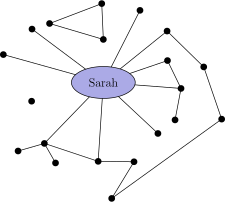
Each of the twenty dots on the graph below represents one of Sarah’s classmates. Classmates who are friends are connected with a line segment. For her birthday party, Sarah is inviting only the following: all of her friends and all of those classmates who are friends with at least one of her friends. How many classmates will not be invited to Sarah’s party?
Pista pequeña:
Sarah invita a los vértices que están a distancia o de ella
Sarah invites vertices at distance or from her.
Pista grande:
Cuenta los puntos que están a más de dos segmentos de Sarah
Count the dots not within two line segments of Sarah.
Solución:
Sarah invita a sus amigos y a los compañeros que son amigos de al menos uno de sus amigos. En términos de grafos, invita a los puntos que están a o segmentos de Sarah.
En el grafo, puntos están desconectados de la componente de Sarah, y otros puntos en la componente de Sarah están a segmentos.
Esos compañeros no serán invitados.
Por lo tanto, D es la respuesta correcta.
Sarah invites her friends and the classmates who are friends with at least one of her friends. In graph terms, she invites dots that are or line segments away from Sarah.
From the graph, dots are disconnected from Sarah’s component, and more dots in Sarah’s component are segments away.
Those classmates will not be invited.
Thus, D is the correct answer.
19.
¿Cuántos enteros entre y tienen los tres números y como factores?
How many integers between and have all three of the numbers and as factors?
Pista pequeña:
Usa el mínimo común múltiplo de y
Use the least common multiple of and
Pista grande:
Cuenta los múltiplos de ese mínimo común múltiplo entre y
Count the multiples of that LCM between and
Solución:
Si un número tiene estos tres números como factores, entonces su mínimo común múltiplo también debe dividir a
Estos números tienen las siguientes factorizaciones en primos:
A partir de estos valores, obtenemos que el mínimo común múltiplo es
Por lo tanto, los múltiplos de entre y son y
Por lo tanto, C es la respuesta correcta.
If a number has these three numbers as factors, then their least common multiple must also divide
These numbers have the following prime factorizations:
From these values, we get that the least common multiple is
Therefore, the multiples of between and are and
Thus, C is the correct answer.
20.
¿Cuál es la medida del ángulo agudo formado por las manecillas de un reloj a las a.m.?
What is the measure of the acute angle formed by the hands of a clock at a.m.?
Pista pequeña:
A las el minutero apunta al
At the minute hand points at
Pista grande:
La manecilla horaria se ha movido un tercio del camino de a
The hour hand has moved one third of the way from to
Solución:
A las la manecilla horaria estará a del camino entre y
Cada hora representa Esto significa que la manecilla horaria estará después del
A los minutos, el minutero apunta al por lo que el ángulo agudo entre las manecillas es
Por lo tanto, D es la respuesta correcta.
At the hour hand will be of the way between and
Each hour represents This means the hour hand will be past
At minutes, the minute hand points to so the acute angle between the hands is
Thus, D is the correct answer.
21.
El área del trapecio es La altura es cm, es cm, y es cm. ¿Cuánto mide en centímetros?
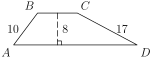
The area of trapezoid is The altitude is cm, is cm, and is cm. What is in centimeters?
Pista pequeña:
Baja perpendiculares desde y hacia la base
Drop perpendiculars from and to the base.
Pista grande:
Usa los triángulos rectángulos y
Use the and right triangles.
Solución:
Baja perpendiculares desde y hacia que la cortan en y
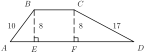
En los triángulos rectángulos izquierdo y derecho, y
Los dos triángulos laterales tienen áreas y El rectángulo central tiene área
Así, de modo que y
Por lo tanto, B es la respuesta correcta.
Drop perpendiculars from and to meeting it at and
In the left and right right triangles, and
The two side triangles have areas and The middle rectangle has area
Thus so and
Thus, B is the correct answer.
22.
Las siguientes figuras están compuestas de cuadrados y círculos. ¿Cuál figura tiene una región sombreada con el área más grande?
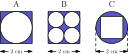
The following figures are composed of squares and circles. Which figure has a shaded region with largest area?
solo
only
solo
only
solo
only
tanto como
both and
todas son iguales
all are equal
Pista pequeña:
Las figuras y dejan la misma área sombreada
Figures and leave the same shaded area.
Pista grande:
Para compara con
For compare with
Solución:
En la figura el área sombreada es el área de un cuadrado de por menos un círculo de radio así que es
La figura está formada por cuatro copias de la figura con lados de la mitad de longitud, por lo que cada copia tiene un cuarto del área y el área sombreada total también es
En la figura el círculo tiene radio y el cuadrado inscrito tiene diagonal así que su área es El área sombreada es
Como tenemos así que la figura tiene la mayor área sombreada.
Por lo tanto, C es la respuesta correcta.
In figure the shaded area is the area of a by square minus a circle of radius so it is
Figure is made of four copies of figure with half the side length, so each copy has one-fourth the area and the total shaded area is also
In figure the circle has radius and the inscribed square has diagonal so its area is The shaded area is
Since we have so figure has the largest shaded area.
Thus, C is the correct answer.
23.
En el patrón de abajo, el gato se mueve en el sentido de las agujas del reloj por los cuatro cuadrados y el ratón se mueve en sentido contrario a las agujas del reloj por los ocho segmentos exteriores de los cuatro cuadrados.
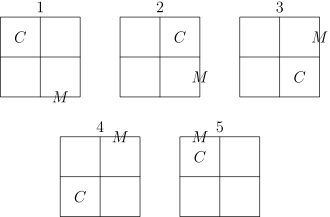
Si el patrón continúa, ¿dónde estarían el gato y el ratón después del movimiento número ?
In the pattern below, the cat moves clockwise through the four squares and the mouse moves counterclockwise through the eight exterior segments of the four squares.
If the pattern is continued, where would the cat and mouse be after the th move?


Pista pequeña:
El gato se repite cada movimientos
The cat repeats every moves.
Pista grande:
El ratón se repite cada movimientos; usa los residuos de
The mouse repeats every moves; use the remainders of
Solución:
La posición del gato se repite cada movimientos, y la posición del ratón se repite cada movimientos.
Como el gato está en la misma posición que tras el movimiento número el cuadrado inferior derecho.
Como el ratón está en la misma posición que tras el movimiento número el lado izquierdo del cuadrado inferior izquierdo.
Por lo tanto, A es la respuesta correcta.
The cat’s position repeats every moves, and the mouse’s position repeats every moves.
Since the cat is in the same position as after the rd move: the lower right square.
Since the mouse is in the same position as after the th move: the left side of the lower left square.
Thus, A is the correct answer.
24.
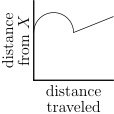
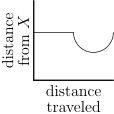
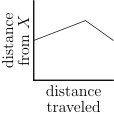
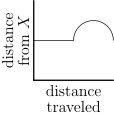
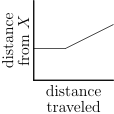
Un barco viaja del punto al punto por una trayectoria semicircular con centro en la isla Luego viaja por una trayectoria recta de a ¿Cuál de estas gráficas muestra mejor la distancia del barco a la isla mientras avanza por su recorrido?

A ship travels from point to point along a semicircular path, centered at Island Then it travels along a straight path from to Which of these graphs best shows the ship’s distance from Island as it moves along its course?
Pista pequeña:
A lo largo del semicírculo, la distancia a es constante
Along the semicircle, the distance from is constant.
Pista grande:
En el segmento recto, el barco primero se acerca a luego se aleja
On the straight segment, the ship first gets closer to then farther away.
Solución:
Todo punto del camino semicircular de a está a la misma distancia del centro así que la gráfica empieza de forma horizontal.
En el camino recto de a el barco primero se acerca a y luego se aleja de
Solo la gráfica empieza plana y luego desciende antes de subir.
Por lo tanto, B es la respuesta correcta.
Every point on the semicircular path from to is the same distance from the center so the graph starts horizontally.
On the straight path from to the ship first gets closer to and then farther away from
Only graph starts flat and then decreases before increasing.
Thus, B is the correct answer.
25.
En la figura, el área del cuadrado es Los cuatro cuadrados más pequeños tienen lados de cm de largo, ya sea paralelos a los lados del cuadrado grande o coincidiendo con ellos. En y cuando se dobla sobre el lado el punto coincide con el centro del cuadrado ¿Cuál es el área de en centímetros cuadrados?
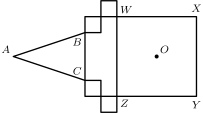
In the figure, the area of square is The four smaller squares have sides cm long, either parallel to or coinciding with the sides of the large square. In and when is folded over side point coincides with the center of square What is the area of in square centimeters?
Pista pequeña:
Sea el punto medio de
Let be the midpoint of
Pista grande:
Al doblar, la distancia de a es igual a la distancia de a
Folding makes the distance from to equal the distance from to
Solución:
El lado de mide cm, ya que
También sabemos que la distancia de a es ya que es la suma de los lados de cuadrados unitarios.
Finalmente, la distancia de a es la misma que la distancia de a que es
Ahora podemos hallar que es
Por lo tanto, el área de es
Por lo tanto, C es la respuesta correcta.
The side length of is cm, since
We also know that the distance from to is since it is the sum of the side lengths of unit squares.
Finally, the distance from to is the same as the distance from to which is
Now, we can find which is
Therefore, the area of is
Thus, C is the correct answer.