
Soluciones del 2021 AMC 12A Spring
Desplázate hacia abajo para ver las soluciones preparadas profesionalmente de LIVE by Po-Shen Loh, imprime las soluciones en PDF, consulta la clave de respuestas, o haz el examen cronometrado completo.
Todos los problemas se usan con el permiso legal oficial de la Mathematical Association of America (MAA).
1.
¿Cuál es el valor de
What is the value of
Pista pequeña:
Primero suma los exponentes: .
First add the exponents:
Pista grande:
Evalúa y por separado, luego resta.
Evaluate and separately, then subtract
Solución:
El exponente del primer término es así que el primer término es La suma entre paréntesis es Por lo tanto, el valor es
Por lo tanto, la respuesta correcta es B.
The exponent in the first term is so the first term is The parenthesized sum is Therefore the value is
Thus, the correct answer is B.
2.
¿Bajo qué condiciones es cierto que , donde y son números reales?
Under what conditions is true, where and are real numbers?
Nunca es cierto.
It is never true.
Es cierto si y solo si
It is true if and only if
Es cierto si y solo si
It is true if and only if
Es cierto si y solo si y
It is true if and only if and
Siempre es cierto.
It is always true.
Pista pequeña:
El lado izquierdo es una raíz cuadrada, así que nunca puede ser negativo; esto obliga a que .
The left side is a square root, so it can never be negative; this forces
Pista grande:
Al elevar al cuadrado se obtiene así que .
Squaring gives so
Solución:
Como nunca es negativo, la igualdad exige Al elevar ambos lados al cuadrado se obtiene lo que se simplifica a es decir,
Recíprocamente, si , entonces y si además , entonces Por tanto, las dos condiciones juntas son exactamente las necesarias.
Así, la respuesta correcta es D.
Because is never negative, equality requires Squaring both sides gives which simplifies to i.e.
Conversely, if then and if additionally then So both conditions together are exactly what is needed.
Thus, the correct answer is D.
3.
La suma de dos números naturales es Uno de los dos números es divisible entre Si se borra el dígito de las unidades de ese número, se obtiene el otro número. ¿Cuál es la diferencia de estos dos números?
The sum of two natural numbers is One of the two numbers is divisible by If the units digit of that number is erased, the other number is obtained. What is the difference of these two numbers?
Pista pequeña:
Borrar el dígito de las unidades de un múltiplo de equivale a dividirlo entre .
Erasing the units digit of a multiple of divides it by
Pista grande:
Si el número menor es el mayor es así que .
If the smaller number is the larger is so
Solución:
El número mayor termina en y borrar ese dígito lo divide entre para dar el número menor. Así que el número mayor es veces el menor. Escribiendo el número menor como la suma es lo que da
Los dos números son y cuya diferencia es
Por lo tanto, la respuesta correcta es D.
The larger number ends in and erasing that digit divides it by to give the smaller number. So the larger number is times the smaller. Writing the smaller number as the sum is giving
The two numbers are and whose difference is
Thus, the correct answer is D.
4.
Tom tiene una colección de serpientes, de las cuales son moradas y son felices. Él observa que
• todas sus serpientes felices saben sumar,
• ninguna de sus serpientes moradas sabe restar, y
• todas sus serpientes que no saben restar tampoco saben sumar.
¿Cuál de estas conclusiones se puede sacar sobre las serpientes de Tom?
Tom has a collection of snakes, of which are purple and of which are happy. He observes that
• all of his happy snakes can add,
• none of his purple snakes can subtract, and
• all of his snakes that can’t subtract also can’t add.
Which of these conclusions can be drawn about Tom’s snakes?
Las serpientes moradas saben sumar.
Purple snakes can add.
Las serpientes moradas son felices.
Purple snakes are happy.
Las serpientes que saben sumar son moradas.
Snakes that can add are purple.
Las serpientes felices no son moradas.
Happy snakes are not purple.
Las serpientes felices no saben restar.
Happy snakes can’t subtract.
Pista pequeña:
Encadena las implicaciones: morada no sabe restar no sabe sumar.
Chain the implications: purple can’t subtract can’t add
Pista grande:
Las serpientes felices saben sumar, pero las serpientes moradas no saben sumar; compara estos dos hechos.
Happy snakes can add, but purple snakes cannot add; compare these two facts
Solución:
Una serpiente morada no sabe restar, y cualquier serpiente que no sabe restar tampoco sabe sumar. Así que ninguna serpiente morada sabe sumar.
Toda serpiente feliz sabe sumar. Como las serpientes moradas no saben sumar, ninguna serpiente feliz puede ser morada; es decir, las serpientes felices no son moradas.
Por lo tanto, la respuesta correcta es D.
A purple snake cannot subtract, and any snake that cannot subtract also cannot add. So every purple snake cannot add.
Every happy snake can add. Since purple snakes cannot add, no happy snake can be purple; that is, happy snakes are not purple.
Thus, the correct answer is D.
5.
Cuando un estudiante multiplicó el número por el decimal periódico donde y son dígitos, no notó la notación y simplemente multiplicó por el decimal finito . Más tarde descubrió que su respuesta era menor que la respuesta correcta.
¿Cuál es el entero de dos dígitos ?
When a student multiplied the number by the repeating decimal where and are digits, he did not notice the notation and just multiplied by the terminating decimal Later he found that his answer was less than the correct answer.
What is the two-digit integer
Pista pequeña:
Escribe Entonces y .
Write Then and
Pista grande:
La diferencia de los dos productos es .
The difference of the two products is
Solución:
Sea el entero de dos dígitos. Entonces , mientras que el valor finito es El producto correcto menos el producto del estudiante es
Al hacer se obtiene
Por lo tanto, la respuesta correcta es E.
Let be the two-digit integer. Then while the terminating value is The correct product minus the student’s product is
Setting gives
Thus, the correct answer is E.
6.
Una baraja de cartas tiene solo cartas rojas y cartas negras. La probabilidad de que una carta elegida al azar sea roja es Cuando se añaden cartas negras a la baraja, la probabilidad de elegir una roja se vuelve ¿Cuántas cartas había originalmente en la baraja?
A deck of cards has only red cards and black cards. The probability of a randomly chosen card being red is When black cards are added to the deck, the probability of choosing red becomes How many cards were in the deck originally?
Pista pequeña:
Sea el número de cartas rojas; la baraja original tiene cartas.
Let be the number of red cards; the original deck has cards
Pista grande:
Al añadir cartas negras se mantienen rojas de un total de y esto es igual a .
Adding black cards keeps red out of and this equals
Solución:
Sea el número de cartas rojas y el total. De obtenemos Después de añadir cartas negras, así que
Sustituyendo se obtiene así que y
Por lo tanto, la respuesta correcta es C.
Let be the number of red cards and the total. From we get After adding black cards, so
Substituting gives so and
Thus, the correct answer is C.
7.
¿Cuál es el menor valor posible de para números reales y ?
What is the least possible value of for real numbers and
Pista pequeña:
Desarrolla completamente; los términos cruzados y se cancelan.
Expand fully; the cross terms and cancel
Pista grande:
La expresión es igual a un producto de dos factores, cada uno al menos .
The expression equals a product of two factors each at least
Solución:
Desarrollando, Esto se factoriza como .
Cada factor es al menos , así que el producto es al menos , con igualdad cuando .
Por lo tanto, la respuesta correcta es D.
Expanding, This factors as
Each factor is at least so the product is at least with equality when
Thus, the correct answer is D.
8.
Una sucesión de números se define por y para ¿Cuáles son las paridades (par o impar) de la terna de números donde denota par y denota impar?
A sequence of numbers is defined by and for What are the parities (evenness or oddness) of the triple of numbers where denotes even and denotes odd?
Pista pequeña:
Solo importan las paridades, así que calcula la sucesión con cada término como u usando .
Only parities matter, so compute the sequence with each term as or using
Pista grande:
La sucesión de paridades se repite con período reduce módulo .
The parity sequence repeats with period reduce modulo
Solución:
Trabajando módulo los términos tienen paridades que se repiten con período comenzando desde (en efecto, tienen las mismas paridades que ).
Como y las paridades coinciden con las de es decir,
Por lo tanto, la respuesta correcta es C.
Working modulo the terms have parities which repeat with period starting from (indeed have the same parities as ).
Since and the parities match those of namely
Thus, the correct answer is C.
9.
¿Cuál de las siguientes expresiones es equivalente a
Which of the following is equivalent to
Pista pequeña:
Multiplica todo el producto por para iniciar una cascada telescópica.
Multiply the whole product by to start a telescoping cascade
Pista grande:
Aplica repetidamente .
Repeatedly apply
Solución:
Como , multiplicar el producto por no lo cambia. Entonces y multiplicar por el siguiente factor da , y así sucesivamente. Cada paso duplica el exponente.
Después de usar los siete factores, el producto se telescopa a .
Por lo tanto, la respuesta correcta es C.
Since multiplying the product by does not change it. Then and multiplying by the next factor gives and so on. Each step doubles the exponent.
After using all seven factors, the product telescopes to
Thus, the correct answer is C.
10.
Dos conos circulares rectos con los vértices hacia abajo, como se muestra en la figura de abajo, contienen la misma cantidad de líquido. Los radios de las superficies superiores del líquido son cm y cm. En cada cono se deja caer una canica esférica de radio cm, que se hunde hasta el fondo y queda completamente sumergida sin derramar líquido. ¿Cuál es la razón entre el ascenso del nivel del líquido en el cono estrecho y el ascenso del nivel del líquido en el cono ancho?
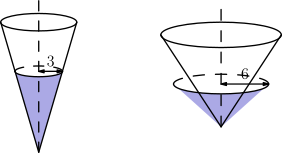
Two right circular cones with vertices facing down as shown in the figure below contain the same amount of liquid. The radii of the tops of the liquid surfaces are cm and cm. Into each cone is dropped a spherical marble of radius cm, which sinks to the bottom and is completely submerged without spilling any liquid. What is the ratio of the rise of the liquid level in the narrow cone to the rise of the liquid level in the wide cone?
Pista pequeña:
El líquido en cada cono es a su vez un cono; con volúmenes iniciales iguales, el cono estrecho (radio ) es cuatro veces más alto que el cono ancho (radio ).
The liquid in each cone is itself a cone; with equal starting volumes, the narrow cone (radius ) is four times as tall as the wide cone (radius )
Pista grande:
Añadir el mismo volumen de canica escala la altura por el mismo factor en ambos conos, así que los ascensos están en la razón de las alturas originales.
Adding the same marble volume scales the height by the same factor in both cones, so the rises are in the ratio of the original heights
Solución:
El líquido en cada cono forma un cono más pequeño semejante al recipiente. Sea el cono de líquido estrecho de radio y altura y el ancho de radio y altura Volúmenes iguales dan así que
Dejar caer la canica aumenta el volumen en la misma cantidad en cada cono, y ambos comienzan con el mismo volumen Como el volumen de un cono escala como el cubo de su altura, la nueva altura es así que cada ascenso es igual a Este factor es idéntico para los dos conos, así que los ascensos están en la razón
Por lo tanto, la respuesta correcta es E.
The liquid in each cone forms a smaller cone similar to the container. Let the narrow liquid cone have radius and height and the wide one radius and height Equal volumes give so
Dropping the marble raises the volume by the same amount in each cone, and both start with the same volume Because a cone’s volume scales as the cube of its height, the new height is so each rise equals This factor is identical for the two cones, so the rises are in the ratio
Thus, the correct answer is E.
11.
Un láser se coloca en el punto El rayo láser viaja en línea recta. Larry quiere que el rayo golpee y rebote en el eje , luego golpee y rebote en el eje , y luego golpee el punto ¿Cuál es la distancia total que recorrerá el rayo a lo largo de esta trayectoria?
A laser is placed at the point The laser beam travels in a straight line. Larry wants the beam to hit and bounce off the -axis, then hit and bounce off the -axis, then hit the point What is the total distance the beam will travel along this path?
Pista pequeña:
Un rebote en una recta significa que reflejar un extremo a través de esa recta endereza la trayectoria.
A bounce off a line means reflecting one endpoint across that line straightens the path
Pista grande:
Refleja el inicio a través del eje y el final a través del eje , luego toma la distancia en línea recta entre las imágenes.
Reflect the start across the -axis and the end across the -axis, then take the straight-line distance between the images
Solución:
Reflejar la trayectoria en cada rebote la convierte en un único segmento recto. Refleja el inicio a través del eje a y refleja el objetivo a través del eje a La distancia total recorrida es igual a la distancia en línea recta entre estas dos imágenes:
Por lo tanto, la respuesta correcta es C.
Reflecting the path at each bounce turns it into a single straight segment. Reflect the start across the -axis to and reflect the target across the -axis to The total travel distance equals the straight-line distance between these two images:
Thus, the correct answer is C.
12.
Todas las raíces del polinomio son enteros positivos, posiblemente repetidos. ¿Cuál es el valor de ?
All the roots of the polynomial are positive integers, possibly repeated. What is the value of
Pista pequeña:
Las seis raíces enteras positivas suman y multiplican encuentra el multiconjunto.
The six positive integer roots sum to and multiply to find the multiset
Pista grande:
Las raíces son es igual a por la suma de los productos de las raíces tomadas de tres en tres.
The roots are equals times the sum of products of the roots taken three at a time
Solución:
Por las fórmulas de Vieta, las seis raíces suman (el opuesto del coeficiente de ) y su producto es Por tanto, cada raíz es una potencia con Como la suma de las raíces es al menos La igualdad ocurre solo cuando cada es o así que las raíces deben ser
El polinomio es entonces Al desarrollar, El coeficiente de es
Por lo tanto, la respuesta correcta es A.
By Vieta’s formulas the six roots sum to (the negative of the coefficient) and multiply to Thus every root is a power with Since the roots have sum at least Equality holds only when every is or so the roots must be
So the polynomial is Expanding, The coefficient of is
Thus, the correct answer is A.
13.
De los siguientes números complejos ¿cuál tiene la propiedad de que tiene la mayor parte real?
Of the following complex numbers which one has the property that has the greatest real part?
Pista pequeña:
Cada opción tiene módulo así que tiene módulo solo importa el ángulo.
Every choice has modulus so has modulus only the angle matters
Pista grande:
Para un ángulo la parte real de es encuentra cuál está más cerca de un múltiplo de .
For angle the real part of is find which is closest to a multiple of
Solución:
Cada número listado tiene módulo así que tiene módulo y su parte real es donde es el argumento de Los argumentos son y
Multiplicar por da y El coseno más grande es de lo que da parte real
Por lo tanto, la respuesta correcta es B.
Each listed number has modulus so has modulus and its real part is where is the argument of The arguments are and
Multiplying by gives and The largest cosine is from giving real part
Thus, the correct answer is B.
14.
¿Cuál es el valor de
What is the value of
Pista pequeña:
Usa para simplificar cada término.
Use to simplify each term
Pista grande:
La primera suma es y la segunda es sus logaritmos son recíprocos.
The first sum is and the second is their logs are reciprocals
Solución:
Para la primera suma, así que
Para la segunda suma, independiente de así que la suma es
Como el producto es
Por lo tanto, la respuesta correcta es E.
For the first sum, so
For the second sum, independent of so the sum is
Since the product is
Thus, the correct answer is E.
15.
Un director de coro debe seleccionar un grupo de cantantes de entre sus tenores y bajos. Los únicos requisitos son que la diferencia entre el número de tenores y bajos debe ser un múltiplo de y que el grupo debe tener al menos un cantante. Sea el número de grupos que se pueden seleccionar. ¿Cuál es el residuo cuando se divide entre ?
A choir director must select a group of singers from among his tenors and basses. The only requirements are that the difference between the number of tenors and basses must be a multiple of and the group must have at least one singer. Let be the number of groups that can be selected. What is the remainder when is divided by
Pista pequeña:
Cuenta los pares con usando un filtro de raíces de la unidad con .
Count pairs with using a roots of unity filter with
Pista grande:
El conteo es luego resta por el grupo vacío.
The count is then subtract for the empty group
Solución:
Elegir tenores y bajos tiene peso Para conservar solo aplica un filtro de raíces de la unidad con
El término es El término tiene el factor Los términos y son y que se cancelan. Así que la suma es y
Este conteo incluye el grupo vacío, así que y
Por lo tanto, la respuesta correcta es D.
Choosing tenors and basses is weighted by To keep only apply a roots of unity filter with
The term is The term has factor The and terms are and which cancel. So the sum is and
This count includes the empty group, so and
Thus, the correct answer is D.
16.
En la siguiente lista de números, el entero aparece veces en la lista para
¿Cuál es la mediana de los números de esta lista?
In the following list of numbers, the integer appears times in the list for
What is the median of the numbers in this list?
Pista pequeña:
La lista tiene términos, así que la mediana promedia los términos y .
The list has terms, so the median averages the th and st
Pista grande:
Los números hasta llenan las posiciones hasta encuentra el que contiene la posición .
The numbers through fill positions up to find the containing position
Solución:
La lista tiene términos, así que la mediana es el promedio de los términos y .
El valor ocupa las posiciones hasta Como y las posiciones hasta son todas iguales a Ambas posiciones centrales caen en este bloque, así que la mediana es
Por lo tanto, la respuesta correcta es C.
The list has terms, so the median is the average of the th and st terms.
The value occupies positions up to Since and positions through all equal Both middle positions fall in this block, so the median is
Thus, the correct answer is C.
17.
El trapecio cumple y Sea la intersección de las diagonales y y sea el punto medio de Dado que la longitud se puede escribir en la forma donde y son enteros positivos y no es divisible por el cuadrado de ningún primo. ¿Cuánto vale ?
Trapezoid has and Let be the intersection of the diagonals and and let be the midpoint of Given that the length can be written in the form where and are positive integers and is not divisible by the square of any prime. What is
Pista pequeña:
Coloca en el origen con sobre un eje y sobre el otro, ya que .
Place at the origin with along one axis and along the other, since
Pista grande:
Usar obliga a que sea el punto de tipo punto medio con parámetro entonces divide de modo que .
Using forces to be the midpoint-type point with parameter then divides so that
Solución:
Coloca con sobre un eje y sobre el otro, de modo que Como escribe para algún Entonces y Igualar da así que
Así y da La diagonal corta a (el eje ) en mientras que Por lo tanto así que
Entonces así que Con y obtenemos
Por lo tanto, la respuesta correcta es D.
Place with on one axis and on the other, so that Since write for some Then and Setting gives so
Thus and gives The diagonal meets (the -axis) at while Hence so
Then so With and we get
Thus, the correct answer is D.
18.
Sea una función definida en el conjunto de los números racionales positivos con la propiedad de que para todos los números racionales positivos y Supón que también tiene la propiedad de que para todo número primo ¿Para cuál de los siguientes números se cumple ?
Let be a function defined on the set of positive rational numbers with the property that for all positive rational numbers and Suppose that also has the property that for every prime number For which of the following numbers is
Pista pequeña:
La regla hace que sea aditiva sobre los factores primos, y .
The rule makes additive over prime factors, and
Pista grande:
Para calcula (con exponentes negativos para los denominadores).
For compute (with negative exponents for denominators)
Solución:
La ecuación funcional hace que sea completamente aditiva: para tenemos donde un primo en el denominador contribuye con un exponente negativo (ya que ).
Evaluando: y Solo el último es negativo.
Por lo tanto, la respuesta correcta es E.
The functional equation makes completely additive: for we have where a prime in the denominator contributes a negative exponent (since ).
Evaluating: and Only the last is negative.
Thus, the correct answer is E.
19.
¿Cuántas soluciones tiene la ecuación en el intervalo cerrado ?
How many solutions does the equation have in the closed interval
Pista pequeña:
Reescribe el lado derecho usando .
Rewrite the right side using
Pista grande:
Senos iguales dan o cada uno tiene rango .
Equal sines give or each has range
Solución:
Escribe el lado derecho como . Senos iguales requieren o bien o bien
La primera se reduce a ; como , solo funciona, dando , con soluciones y en . La segunda se reduce a , cuya única solución en es .
Las soluciones distintas son y , para un total de .
Por lo tanto, la respuesta correcta es C.
Write the right side as Equal sines require either or
The first reduces to since only works, giving with solutions and in The second reduces to whose only solution in is
The distinct solutions are and for a total of
Thus, the correct answer is C.
20.
Supón que en una parábola con vértice y un foco existe un punto tal que y ¿Cuál es la suma de todos los valores posibles de la longitud ?
Suppose that on a parabola with vertex and a focus there exists a point such that and What is the sum of all possible values of the length
Pista pequeña:
Coloca en el origen con distancia focal entonces es igual a la distancia de a la directriz.
Put at the origin with focal distance then equals the distance from to the directrix
Pista grande:
Con usa y junto con para obtener una cuadrática en .
With use and with to get a quadratic in
Solución:
Sea , foco , y directriz , donde . Un punto en la parábola satisface y , así que . Además .
Sustituyendo : Por las fórmulas de Vieta, la suma de los dos valores posibles de es .
Por lo tanto, la respuesta correcta es B.
Let focus and directrix where A point on the parabola satisfies and so Also
Substituting By Vieta’s formulas, the sum of the two possible values of is
Thus, the correct answer is B.
21.
Las cinco soluciones de la ecuación se pueden escribir en la forma para , donde y son reales. Sea la única elipse que pasa por los puntos , , , , y . La excentricidad de se puede escribir en la forma , donde y son enteros positivos primos entre sí. ¿Cuánto vale ?
(Recuerda que la excentricidad de una elipse es la razón , donde es la longitud del eje mayor de y es la distancia entre sus dos focos.)
The five solutions to the equation may be written in the form for where and are real. Let be the unique ellipse that passes through the points and The eccentricity of can be written in the form where and are relatively prime positive integers. What is
(Recall that the eccentricity of an ellipse is the ratio where is the length of the major axis of and is the distance between its two foci.)
Pista pequeña:
Las cinco raíces son y son simétricas respecto al eje .
The five roots are and they are symmetric about the -axis
Pista grande:
Ajusta a través de los puntos, luego lee y para hallar .
Fit through the points, then read off and to find
Solución:
Las raíces son , , y , lo que da los puntos , , y . Por simetría respecto al eje , la elipse tiene la forma .
Sustituir los puntos da . Completar el cuadrado da así que (a lo largo de ) y . Entonces , así que .
Con y , obtenemos .
Por lo tanto, la respuesta correcta es A.
The roots are and giving the points and By symmetry about the -axis, the ellipse has the form
Substituting the points yields Completing the square gives so (along ) and Then so
With and we get
Thus, the correct answer is A.
22.
Supón que las raíces del polinomio son y donde los ángulos están en radianes. ¿Cuánto vale ?
Suppose that the roots of the polynomial are and where angles are in radians. What is
Pista pequeña:
Los tres cosenos son las raíces de .
The three cosines are the roots of
Pista grande:
Divide entre para que coincida con leyendo directamente.
Divide by to match reading off directly
Solución:
Sean las tres raíces Las séptimas raíces de la unidad dan Duplicar los tres ángulos solo permuta sus cosenos, así que Por tanto, es igual a
La identidad de producto a suma da así que Por consiguiente, su polinomio mónico es
Al comparar coeficientes, Por lo tanto,
Así, la respuesta correcta es D.
Let the three roots be The seventh roots of unity give Doubling the three angles merely permutes their cosines, so Hence equals
The product-to-sum identity gives so Therefore their monic polynomial is
Matching coefficients, Therefore
Thus, the correct answer is D.
23.
La rana Frieda comienza una secuencia de saltos en una cuadrícula de casillas, moviéndose una casilla en cada salto y eligiendo al azar la dirección de cada salto: arriba, abajo, izquierda o derecha. No salta en diagonal. Cuando la dirección de un salto llevaría a Frieda fuera de la cuadrícula, ella “da la vuelta” y salta al borde opuesto. Por ejemplo, si Frieda comienza en la casilla central y hace dos saltos “hacia arriba”, el primer salto la coloca en la casilla central de la fila superior, y el segundo salto hace que salte al borde opuesto, cayendo en la casilla central de la fila inferior. Supón que Frieda parte de la casilla central, hace como máximo cuatro saltos al azar, y deja de saltar si cae en una casilla de esquina. ¿Cuál es la probabilidad de que llegue a una casilla de esquina en uno de los cuatro saltos?
Frieda the frog begins a sequence of hops on a grid of squares, moving one square on each hop and choosing at random the direction of each hop: up, down, left, or right. She does not hop diagonally. When the direction of a hop would take Frieda off the grid, she “wraps around” and jumps to the opposite edge. For example, if Frieda begins in the center square and makes two hops “up,” the first hop places her in the top row middle square, and the second hop causes her to jump to the opposite edge, landing in the bottom row middle square. Suppose Frieda starts from the center square, makes at most four hops at random, and stops hopping if she lands on a corner square. What is the probability that she reaches a corner square on one of the four hops?
Pista pequeña:
Agrupa las casillas en tres estados: centro, borde-medio, y esquina (absorbente); halla las probabilidades de transición desde cada uno.
Group squares into three states: center, edge-middle, and corner (absorbing); find the transition probabilities from each
Pista grande:
Desde una casilla de borde, Frieda llega a una esquina con probabilidad regresa al centro con o se mueve a otro borde con .
From an edge square, Frieda reaches a corner with probability returns to center with or moves to another edge with
Solución:
Clasifiquemos las casillas como centro borde medio o esquina absorbente. Desde cada salto llega a una casilla . Desde una casilla , dos de los cuatro vecinos son esquinas, uno es el centro y uno es otra casilla , así que
Sea la probabilidad de llegar a una esquina en no más de saltos partiendo de una casilla de borde, y sea la probabilidad correspondiente partiendo del centro. Definimos Entonces y Por tanto, y
Partiendo del centro con cuatro saltos disponibles, la probabilidad es (el primer salto llega a un borde y deja tres saltos).
Así, la respuesta correcta es D.
Classify squares as center edge-middle or corner (absorbing). From every hop lands on an square. From an square, two of the four neighbors are corners, one is the center, and one is another square, so
Let be the probability of reaching a corner within hops starting from an edge square, and let be the corresponding probability from the center. Set Then and Thus and
Starting from the center with four hops available, the probability equals (the first hop reaches an edge, leaving three hops).
Thus, the correct answer is D.
24.
El semicírculo tiene diámetro de longitud El círculo es tangente a en un punto e interseca a en los puntos y Si y entonces el área de es donde y son enteros positivos primos entre sí y es un entero positivo no divisible por el cuadrado de ningún primo. ¿Cuánto vale ?
Semicircle has diameter of length Circle lies tangent to at a point and intersects at points and If and then the area of is where and are relatively prime positive integers and is a positive integer not divisible by the square of any prime. What is
Pista pequeña:
En el círculo lo que da el radio .
In circle which gives the radius
Pista grande:
Fija centro el eje radical de los dos círculos ubica y el área es .
Set center the radical axis of the two circles locates and the area is
Solución:
En el círculo , la cuerda subtiende el ángulo inscrito , así que , lo que da , de donde .
Coloca , , con (mitad superior). Como es tangente a en , su centro es . Restar las dos ecuaciones de los círculos da la recta , y la distancia del centro a debe ser igual a . Esto da , así que (la raíz coloca a fuera de ).
Con , la distancia de a la recta es . Así Entonces , , , y .
Por lo tanto, la respuesta correcta es D.
In circle the chord subtends the inscribed angle so giving hence
Place with (upper half). Since is tangent to at its center is Subtracting the two circle equations gives the line and the distance from the center to must equal This yields so (the root places outside ).
With the distance from to line is Thus So and
Thus, the correct answer is D.
25.
Sea el número de enteros positivos que dividen a incluyendo y Por ejemplo, y (Esta función se conoce como la función divisor.) Sea
Existe un único entero positivo tal que para todos los enteros positivos ¿Cuál es la suma de los dígitos de ?
Let denote the number of positive integers that divide including and For example, and (This function is known as the divisor function.) Let
There is a unique positive integer such that for all positive integers What is the sum of the digits of
Pista pequeña:
es multiplicativa, así que maximiza independientemente para cada primo .
is multiplicative, so maximize independently for each prime
Pista grande:
Para el mejor exponente es para es para es y para es .
For the best exponent is for it is for it is and for it is
Solución:
Como es multiplicativa, su valor se factoriza sobre las potencias primas como un producto de términos para cada potencia prima Maximizamos cada término por separado.
Si entonces Esta razón disminuye con de modo que el máximo único se encuentra comprobando cuándo cae por primera vez por debajo de . Esto da para para para y para todo primo
Por tanto, cuya suma de cifras es
Así, la respuesta correcta es E.
Since is multiplicative, its value factors over prime powers as a product of terms for each prime power We maximize each term separately.
If then This ratio decreases with so checking where it first falls below finds the unique maximum. It gives for for for and for every prime
Hence whose digit sum is
Thus, the correct answer is E.