
Soluciones del 2021 AMC 10B Fall
Desplázate hacia abajo para ver las soluciones preparadas profesionalmente de LIVE by Po-Shen Loh, imprime las soluciones en PDF, consulta la clave de respuestas, o haz el examen cronometrado completo.
Todos los problemas se usan con el permiso legal oficial de la Mathematical Association of America (MAA).
1.
¿Cuál es el valor de
What is the value of
Pista pequeña:
Cada dígito aparece una vez en cada valor posicional.
Each digit appears once in each place value
Pista grande:
La suma de los dígitos en cada columna es .
The digit sum in each column is
Solución:
Podemos sumar cada dígito por separado, lo que da
También podemos obtener la suma notando que cada dígito tiene una suma de así que la suma es igual a
Por lo tanto, la respuesta es E.
We can add each individual digit, yielding
We can also get the sum by noticing that each digit has a sum of so the sum is equal to
Thus, the answer is E .
2.
¿Cuál es el área de la figura sombreada que se muestra a continuación?
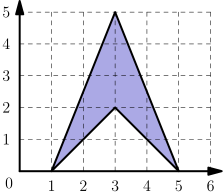
What is the area of the shaded figure shown below?
Pista pequeña:
Halla el área del triángulo grande y resta el área del triángulo pequeño.
Find the large triangle area and subtract the small triangle area
Pista grande:
Ambos triángulos tienen base .
Both triangles have base
Solución:
El área es la de un triángulo, igual a ya que restamos el área de un triángulo más pequeño al de uno más grande.
Por lo tanto, la respuesta es B.
The area is a triangle of area since we subtract the area of a smaller triangle from a larger triangle.
Thus, the answer is B .
3.
La expresión es igual a la fracción en la que y son enteros positivos cuyo máximo común divisor es ¿Cuánto vale ?
The expression is equal to the fraction in which and are positive integers whose greatest common divisor is What is
Pista pequeña:
Usa un denominador común.
Use a common denominator
Pista grande:
El numerador es .
The numerator is
Solución:
Podemos reescribirlo como
Esto se puede simplificar a
Como es coprimo con y con sabemos que es el numerador.
Por lo tanto, la respuesta es E.
We can rewrite this as
This can be simplified to
Since is coprime with both and we know is the numerator.
Thus, the answer is E .
4.
Al mediodía de cierto día, Minneapolis está grados más cálida que St. Louis. A las la temperatura en Minneapolis ha bajado grados mientras que la de St. Louis ha subido grados, momento en el cual las temperaturas de las dos ciudades difieren en grados. ¿Cuál es el producto de todos los valores posibles de ?
At noon on a certain day, Minneapolis is degrees warmer than St. Louis. At the temperature in Minneapolis has fallen by degrees while the temperature in St. Louis has risen by degrees, at which time the temperatures in the two cities differ by degrees. What is the product of all possible values of
Pista pequeña:
Después de los cambios de temperatura, la diferencia es .
After the temperature changes, the difference is
Pista grande:
Resuelve .
Solve
Solución:
Sea la diferencia de temperatura al mediodía. A las la nueva diferencia es
Entonces las temperaturas difieren en grados, así que Por lo tanto o y el producto de todos los valores posibles es
Por lo tanto, la respuesta es C.
Let be the noon temperature difference. At the new difference is
The temperatures then differ by degrees, so Hence or and the product of all possible values is
Thus, the answer is C .
5.
Sea ¿Cuál de las siguientes opciones es igual a ?
Let Which of the following is equal to
Pista pequeña:
Escribe como una potencia de .
Write as a power of
Pista grande:
.
Solución:
Como tenemos
Por lo tanto
Por lo tanto, la respuesta es E.
Since we have
Therefore
Thus, the answer is E .
6.
El menor entero positivo con exactamente divisores positivos distintos se puede escribir en la forma donde y son enteros y no es divisor de ¿Cuánto vale ?
The least positive integer with exactly distinct positive divisors can be written in the form where and are integers and is not a divisor of What is
Pista pequeña:
.
Pista grande:
Para minimizar el número, coloca el exponente mayor sobre el primo menor.
To minimize the number, put the larger exponent on the smaller prime
Solución:
Antes de comenzar, notemos que si podemos representar la factorización prima de un entero como entonces hay factores positivos distintos.
Si el número en cuestión tiene factores, por la lógica anterior, y como la factorización prima de entonces nuestro número debe ser o
El número más pequeño que podemos formar de cualquiera de estas maneras se obtiene tomando en la primera configuración, lo que da
Por lo tanto, así que
Por lo tanto, la respuesta es B.
Before starting, note that if we can represent the prime factorization of an integer as then there are distinct positive factors.
If the number in question has factors, by the previous logic, and as the prime factorization of then our number must be or
The smallest number we can make in either of these is making in the first configuration, yielding
Therefore, so
Thus, the answer is B .
7.
Llamamos a una fracción no necesariamente en su forma más simple, “especial” si y son enteros positivos cuya suma es ¿Cuántos enteros distintos se pueden escribir como la suma de dos fracciones especiales, no necesariamente diferentes?
Call a fraction not necessarily in simplest form, special if and are positive integers whose sum is How many distinct integers can be written as the sum of two, not necessarily different, special fractions?
Pista pequeña:
Una fracción especial se puede escribir como .
A special fraction can be written as
Pista grande:
Revisa los pares de denominadores cuyas partes fraccionarias se cancelan.
Check pairs of denominators whose fractional parts cancel
Solución:
Una fracción especial con denominador es igual a donde Necesitamos valores enteros de
Tomando al revisar los catorce denominadores posibles se obtienen los siguientes pares que producen enteros: Sus sumas distintas son
Hay enteros de este tipo.
Por lo tanto, la respuesta es C.
A special fraction with denominator equals where We need integer values of
Taking a check of the fourteen possible denominators gives the following pairs that produce integers: Their distinct sums are
There are such integers.
Thus, the answer is C .
8.
El mayor número primo que es divisor de es porque ¿Cuál es la suma de los dígitos del mayor número primo que es divisor de ?
The greatest prime number that is a divisor of is because What is the sum of the digits of the greatest prime number that is a divisor of
Pista pequeña:
.
Pista grande:
Usa .
Use
Solución:
Sabemos que Como obtenemos Por lo tanto, es el mayor factor primo, y la suma de sus dígitos es
Por lo tanto, la respuesta es C.
We know Since we get Therefore, is the largest prime factor, and the sum of its digits is
Thus, the answer is C .
9.
Los caballeros de cierto reino son de dos colores. de ellos son rojos, y el resto son azules. Además, de los caballeros son mágicos, y la fracción de caballeros rojos que son mágicos es veces la fracción de caballeros azules que son mágicos. ¿Qué fracción de los caballeros rojos son mágicos?
The knights in a certain kingdom come in two colors. of them are red, and the rest are blue. Furthermore, of the knights are magical, and the fraction of red knights who are magical is times the fraction of blue knights who are magical. What fraction of red knights are magical?
Pista pequeña:
Sea la fracción de caballeros azules que son mágicos.
Let the blue magical fraction be
Pista grande:
La fracción mágica total es un promedio ponderado de y .
The total magical fraction is a weighted average of and
Solución:
Sea la fracción de caballeros azules que son mágicos. Entonces la fracción de caballeros rojos que son mágicos es
La fracción mágica total es un promedio ponderado sobre los grupos rojo y azul:
Así de modo que La fracción mágica de los rojos es
Por lo tanto, la respuesta es C.
Let be the fraction of blue knights who are magical. Then the fraction of red knights who are magical is
The total magical fraction is a weighted average over the red and blue groups:
Thus so The red magical fraction is
Thus, the answer is C .
10.
Cuarenta papeletas numeradas del al se colocan en un sombrero. Alice y Bob sacan cada uno un número del sombrero sin reemplazo, manteniendo sus números ocultos entre sí. Alice dice: “No puedo saber quién tiene el número más grande.” Luego Bob dice: “Yo sé quién tiene el número más grande.” Alice dice: “¿Lo sabes? ¿Tu número es primo?” Bob responde: “Sí.” Alice dice: “En ese caso, si multiplico tu número por y le sumo mi número, el resultado es un cuadrado perfecto.” ¿Cuál es la suma de los dos números sacados del sombrero?
Forty slips of paper numbered to are placed in a hat. Alice and Bob each draw one number from the hat without replacement, keeping their numbers hidden from each other. Alice says, “I can’t tell who has the larger number.” Then Bob says, “I know who has the larger number.” Alice says, “You do? Is your number prime?” Bob replies, “Yes.” Alice says, “In that case, if I multiply your number by and add my number, the result is a perfect square.” What is the sum of the two numbers drawn from the hat?
Pista pequeña:
La primera afirmación de Alice descarta y .
Alice’s first statement rules out and
Pista grande:
Bob solo puede saberlo si su número es uno de los nuevos extremos.
Bob can know only if his number is one of the new extremes
Solución:
Si Alice hubiera sacado o sabría quién tiene el número más grande. Su primera afirmación le dice a Bob que Alice no tiene ni ni
Entonces Bob puede saber quién tiene el número más grande solo si su número es o Como Bob dice que su número es primo, su número debe ser
Ahora más el número de Alice es un cuadrado entre y El único cuadrado en ese intervalo es así que el número de Alice es La suma es
Por lo tanto, la respuesta es A.
If Alice had drawn or she would know who had the larger number. Her first statement tells Bob that Alice has neither nor
Bob can then know who has the larger number only if his number is or Since Bob says his number is prime, his number must be
Now plus Alice’s number is a square between and The only square in that interval is so Alice’s number is The sum is
Thus, the answer is A .
11.
Un hexágono regular de lado está inscrito en un círculo. Cada arco menor del círculo determinado por un lado del hexágono se refleja sobre ese lado. ¿Cuál es el área de la región limitada por estos arcos reflejados?
A regular hexagon of side length is inscribed in a circle. Each minor arc of the circle determined by a side of the hexagon is reflected over that side. What is the area of the region bounded by these reflected arcs?
Pista pequeña:
Compara la región de los arcos reflejados con el círculo original.
Compare the reflected-arc region with the original circle
Pista grande:
El hexágono es el promedio de las dos regiones.
The hexagon is the average of the two regions
Solución:
El círculo original está formado por el hexágono regular más segmentos circulares iguales. Reflejar cada arco menor sobre su lado coloca esos mismos segmentos dentro del hexágono.
Por lo tanto, el promedio del área del círculo y del área de la región de los arcos reflejados es el área del hexágono regular. El hexágono tiene área y el círculo tiene radio así que su área es
Si el área buscada es entonces así que
Por lo tanto, la respuesta es B.
The original circle is made from the regular hexagon plus equal circular segments. Reflecting each minor arc over its side puts those same segments inside the hexagon instead.
Therefore the average of the circle’s area and the reflected-arc region’s area is the area of the regular hexagon. The hexagon has area and the circle has radius so its area is
If the desired area is then so
Thus, the answer is B .
12.
¿Cuál de las siguientes condiciones es suficiente para garantizar que los enteros satisfacen la ecuación
Which of the following conditions is sufficient to guarantee that integers and satisfy the equation
x > y y
x > y and
y
and
y
and
y
and
Pista pequeña:
Reescribe la expresión usando diferencias al cuadrado.
Rewrite the expression using squared differences
Pista grande:
Las tres diferencias al cuadrado deben sumar .
The three squared differences must sum to
Solución:
Sea Desarrollando se obtiene
Para que el valor sea los tres términos cuadrados no negativos deben sumar Como son enteros, esto significa que las diferencias al cuadrado son
Así, dos de las variables deben ser iguales, y la tercera debe diferir de ellas en La condición y garantiza exactamente eso.
Por lo tanto, la respuesta es D.
Let Expanding gives
For the value to be the three nonnegative square terms must sum to Since are integers, this means the squared differences are
Thus two of the variables must be equal, and the third must differ from them by The condition and guarantees exactly that.
Thus, the answer is D .
13.
Un cuadrado de lado está inscrito en un triángulo isósceles con uno de sus lados sobre la base del triángulo. Un cuadrado de lado tiene dos vértices sobre el otro cuadrado y los otros dos sobre los lados del triángulo, como se muestra. ¿Cuál es el área del triángulo?
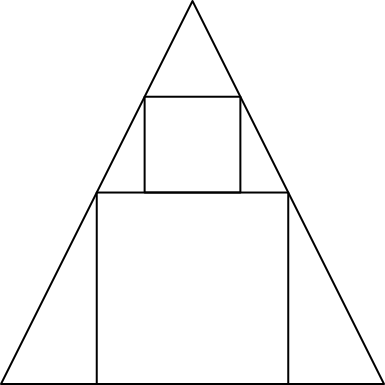
A square with side length is inscribed in an isosceles triangle with one side of the square along the base of the triangle. A square with side length has two vertices on the other square and the other two on sides of the triangle, as shown. What is the area of the triangle?
Pista pequeña:
Usa triángulos semejantes para relacionar los anchos a diferentes alturas.
Use similar triangles to relate widths at different heights
Pista grande:
Los anchos del triángulo son y a alturas separadas por .
The triangle widths are and at heights separated by
Solución:
Sea la altura del triángulo isósceles y su base. Por semejanza, los anchos horizontales del triángulo son proporcionales a la distancia al vértice superior.
El lado superior del cuadrado más grande tiene ancho y está a unidades del vértice superior. El lado superior del cuadrado más pequeño tiene ancho y está a unidades del vértice superior. Por lo tanto
Al resolver se obtiene Además así que El área es
Por lo tanto, la respuesta es B.
Let the isosceles triangle have height and base By similarity, horizontal widths in the triangle are proportional to distance from the top vertex.
The top side of the larger square has width and is units from the top. The top side of the smaller square has width and is units from the top. Hence
Solving gives Also so The area is
Thus, the answer is B .
14.
Una lanza dados estándar de caras simultáneamente y calcula el producto de los números obtenidos. ¿Cuál es la probabilidad de que el producto sea divisible entre ?
Una rolls standard -sided dice simultaneously and calculates the product of the numbers obtained. What is the probability that the product is divisible by
Pista pequeña:
Cuenta el complemento: el producto no divisible entre .
Count the complement: product not divisible by
Pista grande:
El complemento no tiene ningún factor o tiene exactamente un factor .
The complement has either no factor of or exactly one factor of
Solución:
Contamos el complemento, en el que el producto no es divisible entre Esto ocurre si el producto no tiene ningún factor o exactamente un factor
Que todos los dados sean impares tiene probabilidad Exactamente un factor significa que exactamente un dado muestra o y los otros cinco dados son impares. Esto tiene probabilidad
El complemento tiene probabilidad así que la probabilidad buscada es
Por lo tanto, la respuesta es C.
Count the complement, where the product is not divisible by This happens if the product has no factor of or exactly one factor of
All dice odd has probability Exactly one factor of means exactly one die is or and the other five dice are odd. This has probability
The complement has probability so the desired probability is
Thus, the answer is C .
15.
En el cuadrado los puntos y están sobre y respectivamente. Los segmentos y se cortan en ángulo recto en con y ¿Cuál es el área del cuadrado?
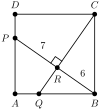
In square points and lie on and respectively. Segments and intersect at right angles at with and What is the area of the square?
Pista pequeña:
por el triángulo .
by the triangle
Pista grande:
Usa el teorema de la altura en el triángulo rectángulo .
Use the altitude theorem in right triangle
Solución:
Como y tenemos Al seguir los ángulos rectos y los ángulos del cuadrado se obtiene así que
Como el punto es el pie de la altura desde hasta la hipotenusa del triángulo rectángulo Por lo tanto, y
Así, y son y Como está en tenemos La congruencia da mientras que las fórmulas de proyección para triángulos rectángulos dan y Por consiguiente, de modo que y Entonces,
El área del cuadrado es
Así, la respuesta es D.
Since and we have The right-angle and square-angle chasing gives so
Because point is the foot of the altitude from to the hypotenuse of right triangle Thus and
So and are and Because lies on we have Congruence gives while the right-triangle projection formulas give and Hence so and Therefore,
The area of the square is
Thus, the answer is D .
16.
Cinco bolas están dispuestas alrededor de un círculo. Chris elige dos bolas adyacentes al azar y las intercambia. Luego Silva hace lo mismo, y su elección de bolas adyacentes a intercambiar es independiente de la de Chris. ¿Cuál es el número esperado de bolas que ocupan sus posiciones originales después de estas dos transposiciones sucesivas?
Five balls are arranged around a circle. Chris chooses two adjacent balls at random and interchanges them. Then Silva does the same, with her choice of adjacent balls to interchange being independent of Chris’s. What is the expected number of balls that occupy their original positions after these two successive transpositions?
Pista pequeña:
Considera casos según cómo el intercambio de Silva se superpone con el de Chris.
Case on how Silva’s swap overlaps Chris’s swap
Pista grande:
Los tamaños de superposición tienen probabilidades .
The overlap sizes have probabilities
Solución:
Después de que Chris elige un par adyacente, Silva tiene pares adyacentes igualmente probables para elegir.
Si Silva elige el mismo par, las bolas regresan a sus posiciones originales. Esto tiene probabilidad
Si Silva elige un par que comparte exactamente una bola con el par de Chris, entonces bolas están en sus posiciones originales. Hay pares de este tipo, así que esto tiene probabilidad
Si Silva elige un par adyacente disjunto, entonces bola está en su posición original. Esto también tiene probabilidad
El número esperado es
Por lo tanto, la respuesta es D.
After Chris chooses an adjacent pair, Silva has equally likely adjacent pairs to choose.
If Silva chooses the same pair, all balls return to their original positions. This has probability
If Silva chooses a pair sharing exactly one ball with Chris’s pair, then balls are in their original positions. There are such pairs, so this has probability
If Silva chooses a disjoint adjacent pair, then ball is in its original position. This also has probability
The expected number is
Thus, the answer is D .
17.
Las rectas distintas y están en el plano . Se cortan en el origen. El punto se refleja sobre la recta al punto y luego se refleja sobre la recta al punto La ecuación de la recta es y las coordenadas de son ¿Cuál es la ecuación de la recta ?
Distinct lines and lie in the -plane. They intersect at the origin. Point is reflected about line to point and then is reflected about line to point The equation of line is and the coordinates of are What is the equation of line
Pista pequeña:
Dos reflexiones a través de rectas que se cortan equivalen a una rotación.
Two reflections through intersecting lines equal a rotation
Pista grande:
Compara el cambio de ángulo de a .
Compare the angle change from to
Solución:
Dos reflexiones sobre rectas que pasan por el origen equivalen a una rotación por el doble del ángulo que va de la primera recta de reflexión a la segunda.
El punto se envía a lo cual es una rotación de en sentido horario. Por lo tanto, la recta está en sentido horario respecto a la recta
La pendiente de es Si entonces
Así, la recta es o
Por lo tanto, la respuesta es D.
Two reflections across lines through the origin are equivalent to a rotation by twice the angle from the first reflecting line to the second.
The point is sent to which is a clockwise rotation. Therefore line is clockwise from line
The slope of is If then
Thus line is or
Thus, the answer is D .
18.
Tres hojas de papel cuadradas idénticas, cada una de lado , se apilan una sobre otra. La hoja del medio se gira en sentido horario alrededor de su centro y la hoja superior se gira en sentido horario alrededor de su centro, lo que da como resultado el polígono de lados que se muestra en la figura de abajo.
El área de este polígono se puede expresar en la forma donde y son enteros positivos, y no es divisible por el cuadrado de ningún primo. ¿Cuánto vale ?
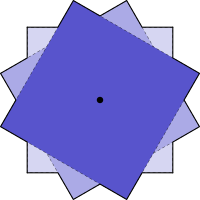
Three identical square sheets of paper each with side length are stacked on top of each other. The middle sheet is rotated clockwise about its center and the top sheet is rotated clockwise about its center, resulting in the -sided polygon shown in the figure below.
The area of this polygon can be expressed in the form where and are positive integers, and is not divisible by the square of any prime. What is
Pista pequeña:
Divide el polígono en triángulos congruentes.
Split the polygon into congruent triangles
Pista grande:
Cada triángulo pequeño tiene ángulos .
Each small triangle has angles
Solución:
La frontera se puede dividir en triángulos congruentes. Cada uno tiene ángulos , y .
Para uno de esos triángulos, traza la altura en la dirección hacia el lado central. La altura es , la mitad del lado de un cuadrado. El triángulo rectángulo adyacente tiene un ángulo de , así que la parte recortada de una base de longitud es .
Así, cada triángulo pequeño tiene base y altura , lo que da área .
El área total es Por lo tanto .
Por lo tanto, la respuesta es E.
The boundary can be split into congruent triangles. Each has angles and
For one such triangle, draw the altitude from the center-side direction. The altitude is half the side length of a square. The adjacent right triangle has a angle, so the part cut off from a length base is
Thus each small triangle has base and height giving area
The total area is Hence
Thus, the answer is E .
19.
Sea el entero positivo un número de dígitos donde cada dígito es un Sea el dígito inicial de la raíz -ésima de ¿Cuánto vale
Let be the positive integer a -digit number where each digit is a Let be the leading digit of the th root of What is
Pista pequeña:
Acota entre y .
Bound between and
Pista grande:
Para cada raíz, factoriza la mayor potencia de .
For each root, factor out the largest power of
Solución:
El número satisface Multiplicar o dividir por una potencia de solo desplaza el punto decimal, así que solo necesitamos el factor inicial que queda después de extraer la mayor potencia conveniente de .
Para , tiene factor inicial entre y , así que .
Para , el factor inicial está entre y , así que . Para , el factor inicial está entre y , así que .
Para , como , el factor inicial está entre y . Como , .
Para , el factor inicial está entre y , así que . La suma es .
Por lo tanto, la respuesta es A.
The number satisfies Multiplying or dividing by a power of only shifts the decimal point, so we only need the leading factor left after taking out the largest convenient power of
For has leading factor between and so
For the leading factor is between and so For the leading factor is between and so
For since the leading factor is between and Since
For the leading factor is between and so The sum is
Thus, the answer is A .
20.
En cierto juego, cada uno de los jugadores lanza un dado estándar de caras. El ganador es el jugador que saca el número más alto. Si hay un empate en el lanzamiento más alto, los involucrados en el empate vuelven a lanzar y este proceso continúa hasta que un jugador gana. Hugo es uno de los jugadores en este juego. ¿Cuál es la probabilidad de que el primer lanzamiento de Hugo haya sido un dado que ganó el juego?
In a particular game, each of players rolls a standard -sided die. The winner is the player who rolls the highest number. If there is a tie for the highest roll, those involved in the tie will roll again and this process will continue until one player wins. Hugo is one of the players in this game. What is the probability that Hugo’s first roll was a given that he won the game?
Pista pequeña:
Usa la probabilidad condicional .
Use
Pista grande:
Considera casos según cuántos otros jugadores también sacaron .
Case on how many other players also rolled
Solución:
Por simetría, Por lo tanto, la probabilidad condicional pedida es cuatro veces la probabilidad de que Hugo saque un en su primer lanzamiento y termine ganando.
Si Hugo saca entonces ningún otro jugador puede sacar Consideramos casos según cuántos de los otros tres jugadores también sacan Si otros jugadores empatan con Hugo, entonces Hugo gana el desempate final con probabilidad
Así
Al multiplicar por se obtiene
Por lo tanto, la respuesta es C.
By symmetry, Therefore, the requested conditional probability is four times the probability that Hugo first rolls and eventually wins.
If Hugo rolls then no other player can roll Case on how many of the other three players also roll If other players tie Hugo, then Hugo wins the eventual tiebreaker with probability
Thus
Multiplying by gives
Thus, the answer is C .
21.
Polígonos regulares de y lados están inscritos en el mismo círculo. Ningún par de los polígonos comparte un vértice, y ningún trío de sus lados se corta en un punto común. ¿En cuántos puntos dentro del círculo se cortan dos de sus lados?
Regular polygons with and sides are inscribed in the same circle. No two of the polygons share a vertex, and no three of their sides intersect at a common point. At how many points inside the circle do two of their sides intersect?
Pista pequeña:
Cuenta las intersecciones por separado para cada par de polígonos.
Count intersections separately for each pair of polygons
Pista grande:
Un -ágono y un polígono regular más grande se cortan en puntos de frontera.
A -gon and larger regular polygon intersect in boundary points
Solución:
Para un -ágono regular y un -ágono regular inscritos en el mismo círculo con y sin vértices compartidos, sus fronteras se cortan en puntos. Cada lado del polígono más pequeño es cruzado dos veces por la frontera del polígono más grande.
Por lo tanto, sumamos sobre todos los pares de polígonos. El -ágono contribuye intersecciones con cada uno de los -, - y -ágonos. El -ágono contribuye intersecciones con cada uno de los - y -ágonos. El -ágono contribuye con el -ágono.
El total es
Por lo tanto, la respuesta es E.
For a regular -gon and a regular -gon inscribed in the same circle with and no shared vertices, their boundaries intersect in points. Each side of the smaller polygon is crossed twice by the boundary of the larger polygon.
Therefore, sum over all pairs of polygons. The -gon contributes intersections with each of the -, -, and -gons. The -gon contributes intersections with each of the - and -gons. The -gon contributes with the -gon.
The total is
Thus, the answer is E .
22.
Para cada entero sea la suma de todos los productos donde y son enteros y ¿Cuál es la suma de los menores valores de para los cuales es divisible entre ?
For each integer let be the sum of all products where and are integers and What is the sum of the least values of such that is divisible by
Pista pequeña:
Halla cómo cambia cuando se agregan los términos con .
Find how changes when terms with are added
Pista grande:
Solo cambia el valor módulo .
Only changes the value modulo
Solución:
Al pasar de a los nuevos términos son para
Módulo este incremento es cuando o y es cuando
Como la sucesión se vuelve divisible entre tras la tercera aparición de un número congruente con es decir en Entonces permanece divisible entre para y el mismo patrón se repite cada en
Los diez menores valores son Su suma es
Por lo tanto, la respuesta es B.
When passing from to the new terms are for Their sum is
Modulo this increment is when or and is when
Since the sequence becomes divisible by after the third occurrence of a number congruent to namely at Then stays divisible by for and the same pattern repeats every in
The ten least values are Their sum is
Thus, the answer is B .
23.
Cada uno de los lados y las diagonales de un pentágono regular se colorean al azar e independientemente de rojo o azul con igual probabilidad. ¿Cuál es la probabilidad de que exista un triángulo cuyos vértices estén entre los vértices del pentágono tal que todos sus lados tengan el mismo color?
Each of the sides and the diagonals of a regular pentagon are randomly and independently colored red or blue with equal probability. What is the probability that there will be a triangle whose vertices are among the vertices of the pentagon such that all of its sides have the same color?
Pista pequeña:
Cuenta las coloraciones sin ningún triángulo monocromático.
Count the colorings with no monochromatic triangle
Pista grande:
En cada vértice, cada color debe aparecer en exactamente aristas incidentes.
At each vertex, each color must appear on exactly incident edges
Solución:
Contamos el complemento: las coloraciones de las aristas de sin ningún triángulo monocromático.
En cualquier vértice, si aristas incidentes tuvieran el mismo color, entonces las aristas entre sus otros extremos tendrían que ser todas del otro color, formando un triángulo monocromático. Así, cada vértice tiene exactamente aristas rojas y azules incidentes.
Entonces las aristas rojas forman un grafo -regular sobre vértices, que debe ser un -ciclo. El número de -ciclos etiquetados es
Hay coloraciones en total, así que la probabilidad buscada es
Por lo tanto, la respuesta es D.
Count the complement: colorings of the edges of with no monochromatic triangle.
At any vertex, if incident edges had the same color, then the edges among their other endpoints would all have to be the other color, making a monochromatic triangle. Thus each vertex has exactly red and blue incident edges.
So the red edges form a -regular graph on vertices, which must be a -cycle. The number of labeled -cycles is
There are total colorings, so the desired probability is
Thus, the answer is D .
24.
Un cubo se construye con cubos unitarios blancos y cubos unitarios azules. ¿De cuántas maneras diferentes se puede construir el cubo usando estos cubos más pequeños? (Dos construcciones se consideran iguales si una se puede rotar para coincidir con la otra.)
A cube is constructed from white unit cubes and blue unit cubes. How many different ways are there to construct the cube using these smaller cubes? (Two constructions are considered the same if one can be rotated to match the other.)
Pista pequeña:
Este es el número de subconjuntos de vértices de un cubo salvo rotación.
This is the number of -vertex subsets of a cube up to rotation
Pista grande:
Burnside sobre las rotaciones del cubo.
Burnside over the rotations of the cube
Solución:
Este es el número de maneras de elegir cuáles de los vértices del cubo son azules, salvo rotación del cubo. Usamos el lema de Burnside sobre las rotaciones del cubo.
La identidad fija coloraciones. Las rotaciones de un cuarto de vuelta sobre caras fijan cada una Las rotaciones de media vuelta sobre caras fijan cada una Las rotaciones alrededor de vértices opuestos fijan cada una Las rotaciones de media vuelta alrededor de aristas opuestas fijan cada una
Así, el número de construcciones no equivalentes es
Por lo tanto, la respuesta es A.
This is the number of ways to choose which of the cube vertices are blue, up to cube rotation. Use Burnside’s lemma on the rotations of the cube.
The identity fixes colorings. The quarter-turn face rotations each fix The half-turn face rotations each fix The rotations about opposite vertices each fix The half-turn rotations about opposite edges each fix
Thus the number of inequivalent constructions is
Thus, the answer is A .
25.
Un rectángulo de lados y un cuadrado de lado y un rectángulo están inscritos dentro de un cuadrado más grande como se muestra. La suma de todos los valores posibles del área de se puede escribir en la forma donde y son enteros positivos primos entre sí. ¿Cuánto vale ?
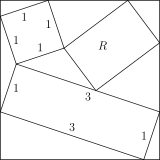
A rectangle with side lengths and a square with side length and a rectangle are inscribed inside a larger square as shown. The sum of all possible values for the area of can be written in the form where and are relatively prime positive integers. What is
Pista pequeña:
Usa la pendiente del rectángulo para plantear .
Use the slope of the rectangle to set
Pista grande:
La ecuación de triángulos semejantes se factoriza como .
The similar-triangle equation factors as
Solución:
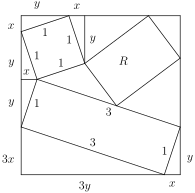
Usamos triángulos semejantes como se muestra en el diagrama. El lado izquierdo del cuadrado grande tiene longitud , y el lado inferior tiene longitud . Como son iguales, , así que . Por lo tanto, el lado del cuadrado grande es .
En la parte superior de la figura, sea el segmento horizontal marcado. Los dos triángulos rectángulos formados por los lados del rectángulo tienen lados correspondientes paralelos e hipotenusas iguales, así que son congruentes. Esto da las longitudes que se muestran a continuación.
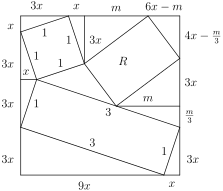
Los triángulos semejantes dan Por lo tanto , así que
Si , el rectángulo tiene lado en ambas direcciones, así que su área es . Si , sus lados son y , así que su área es .
Las dos áreas posibles suman . Como el rectángulo da , tenemos . La suma de las áreas posibles es
Así , y la respuesta es E.
Use similar triangles as shown in the diagram. The left side of the large square has length and the bottom side has length Since these are equal, so The side length of the large square is therefore
In the upper part of the figure, let the marked horizontal segment be The two right triangles formed by the sides of rectangle have parallel corresponding sides and equal hypotenuses, so they are congruent. This gives the lengths shown below.
Similar triangles give Hence so
If rectangle has side length in both directions, so its area is If its side lengths are and so its area is
The two possible areas sum to Since the rectangle gives we have The sum of the possible areas is
Thus and the answer is E .