
Soluciones del 2018 AMC 10A
Desplázate hacia abajo para ver las soluciones preparadas profesionalmente de LIVE by Po-Shen Loh, imprime las soluciones en PDF, consulta la clave de respuestas, o haz el examen cronometrado completo.
Todos los problemas se usan con el permiso legal oficial de la Mathematical Association of America (MAA).
1.
¿Cuál es el valor de
What is the value of
Pista pequeña:
Trabaja desde el recíproco más interno hacia afuera.
Work from the innermost reciprocal outward
Pista grande:
Después de cada paso con recíproco, simplifica antes de sumar el siguiente .
After each reciprocal step, simplify before adding the next
Solución:
Podemos simplificar de la siguiente manera:
Por lo tanto, B es la respuesta correcta.
We can simplify this as follows.
Thus, B is the correct answer.
2.
Liliane tiene más refresco que Jacqueline, y Alice tiene más refresco que Jacqueline. ¿Cuál es la relación entre las cantidades de refresco que tienen Liliane y Alice?
Liliane has more soda than Jacqueline, and Alice has more soda than Jacqueline. What is the relationship between the amounts of soda that Liliane and Alice have?
Liliane tiene más refresco que Alice.
Liliane has more soda than Alice.
Liliane tiene más refresco que Alice.
Liliane has more soda than Alice.
Liliane tiene más refresco que Alice.
Liliane has more soda than Alice.
Liliane tiene más refresco que Alice.
Liliane has more soda than Alice.
Liliane tiene más refresco que Alice.
Liliane has more soda than Alice.
Pista pequeña:
Usa la cantidad de Jacqueline como variable base.
Use Jacqueline’s amount as the base variable
Pista grande:
Compara la cantidad de Liliane directamente con la de Alice.
Compare Liliane’s amount directly to Alice’s amount
Solución:
Sea el número de galones de refresco que tiene Jacqueline. Entonces Alice tiene galones y Liliane tiene galones.
Por lo tanto, la relación se obtiene dividiendo las cantidades de refresco de cada una: lo que significa que Liliane tiene más refresco que Alice.
Por lo tanto, A es la respuesta correcta.
Let be the number of gallons of soda that Jacqueline has. Then Alice has gallons, and Liliane has gallons.
Therefore, the relationship can be found by dividing the amount of soda that each has to yield which means Liliane has more soda than Alice.
Thus, A is the correct answer.
3.
Una unidad de sangre caduca después de segundos. Yasin dona una unidad de sangre al mediodía del de enero. ¿En qué día caduca su unidad de sangre?
A unit of blood expires after seconds. Yasin donates a unit of blood at noon on January On what day does his unit of blood expire?
de enero
January
de enero
January
de enero
January
de febrero
February
de febrero
February
Pista pequeña:
Convierte segundos en días.
Convert seconds into days
Pista grande:
Usa segundos por día.
Use seconds per day
Solución:
Podemos dividir entre y para obtener el número de días que tarda una unidad de sangre en caducar.
La primera división cancela un y un La segunda división cancela y La última división cancela y convierte el en un
Quedan y cuyo producto es Enero tiene días, así que para el de febrero, a la sangre solo le quedan días.
días después del de febrero, la sangre caducará el de febrero.
Por lo tanto, E es la respuesta correcta.
We can divide by and to get the number of days that it takes for a unit of blood to expire.
The first division cancels a and The second division cancels and The final division cancels and turns the into a
This leaves and a which multiply to There are days in January, so by February the blood only has days left.
days from February would make the blood expire on February
Thus, E is the correct answer.
4.
¿De cuántas maneras puede un estudiante programar cursos de matemáticas, álgebra, geometría y teoría de números, en un día de periodos si no puede haber dos cursos de matemáticas en periodos consecutivos?
(Los cursos que el estudiante tome durante los otros periodos no importan aquí.)
How many ways can a student schedule mathematics courses — algebra, geometry, and number theory — in a -period day if no two mathematics courses can be taken in consecutive periods?
(What courses the student takes during the other periods is of no concern here.)
Pista pequeña:
Primero elige los tres periodos no consecutivos.
First choose the three nonconsecutive periods
Pista grande:
Una vez elegidos los periodos, ordena los tres cursos indicados.
After the periods are chosen, arrange the three named courses
Solución:
Las clases pueden ocupar los siguientes periodos:
Esto significa que hay maneras de elegir en qué periodos ocurren los cursos de matemáticas.
Para cada configuración, hay maneras de determinar el orden de los cursos, para un total de horarios.
Por lo tanto, E es la respuesta correcta.
The classes can occupy the following periods:
This means that there are ways to choose which periods the mathematics courses occur.
For each configuration, there are ways to determine the order of the courses, for a total of schedules.
Thus, E is the correct answer.
5.
Alice, Bob y Charlie estaban de excursión y se preguntaban qué tan lejos estaba el pueblo más cercano. Cuando Alice dijo: “Estamos al menos a millas”, Bob respondió: “Estamos a lo más a millas”. Charlie luego comentó: “En realidad el pueblo más cercano está a lo más a millas”. Resultó que ninguna de las tres afirmaciones era verdadera. Sea la distancia en millas al pueblo más cercano. ¿Cuál de los siguientes intervalos es el conjunto de todos los valores posibles de ?
Alice, Bob, and Charlie were on a hike and were wondering how far away the nearest town was. When Alice said, “We are at least miles away,” Bob replied, “We are at most miles away.” Charlie then remarked, “Actually the nearest town is at most miles away.” It turned out that none of the three statements was true. Let be the distance in miles to the nearest town. Which of the following intervals is the set of all possible values of
Pista pequeña:
Niega la afirmación de cada persona.
Negate each person’s statement
Pista grande:
Interseca las tres desigualdades resultantes para .
Intersect the three resulting inequalities for
Solución:
La afirmación de Alice nos dice que La afirmación de Bob nos dice que La afirmación de Charlie nos dice que
Combinando todo esto obtenemos que y lo que significa que está en el intervalo
Por lo tanto, D es la respuesta correcta.
Alice’s statement tells us that Bob’s statement tells us that Charlie’s statement tells us that
Combining all of these tells us that and which means is in the interval
Thus, D is the correct answer.
6.
Sangho subió un video a un sitio web donde los espectadores pueden votar si les gusta o no un video. Cada video comienza con una puntuación de y la puntuación aumenta en por cada voto positivo y disminuye en por cada voto negativo.
En cierto momento, Sangho vio que su video tenía una puntuación de y que de los votos emitidos en su video eran positivos. ¿Cuántos votos se habían emitido en el video de Sangho en ese momento?
Sangho uploaded a video to a website where viewers can vote that they like or dislike a video. Each video begins with a score of and the score increases by for each like vote and decreases by for each dislike vote.
At one point Sangho saw that his video had a score of and that of the votes cast on his video were like votes. How many votes had been cast on Sangho’s video at that point?
Pista pequeña:
Sea el número total de votos.
Let be the total number of votes
Pista grande:
La puntuación es el número de votos positivos menos el de negativos.
The score is likes minus dislikes
Solución:
Si de los votos fueron positivos, entonces de los votos son negativos. Así, la puntuación de Sangho es del número total de votos.
Sabemos que la puntuación de Sangho es así que el número total de votos es
Por lo tanto, B es la respuesta correcta.
If of votes were like votes, then of votes are dislike votes. Then Sangho’s score is the total number of votes.
We know that Sangho’s score is so the total number of votes is
Thus, B is the correct answer.
7.
¿Para cuántos valores enteros de (no necesariamente positivos) la siguiente expresión es un entero?
For how many (not necessarily positive) integer values of is the following value an integer?
Pista pequeña:
Escribe como .
Write as
Pista grande:
Los exponentes de y deben ser ambos no negativos.
The exponents of and must both be nonnegative
Solución:
Podemos reescribir la expresión como
Para que sea un entero, los exponentes deben ser no negativos, es decir
Esto nos da valores para
Por lo tanto, E es la respuesta correcta.
We can rewrite the expression as
For this to be an integer, both exponents must be nonnegative. This means that
This gives us values for
Thus, E is the correct answer.
8.
Joe tiene una colección de monedas, formada por monedas de centavos, monedas de centavos y monedas de centavos. Tiene monedas de centavos más que de centavos, y el valor total de su colección es centavos. ¿Cuántas monedas de centavos más que de centavos tiene Joe?
Joe has a collection of coins, consisting of -cent coins, -cent coins, and -cent coins. He has more -cent coins than -cent coins, and the total value of his collection is cents. How many more -cent coins does Joe have than -cent coins?
Pista pequeña:
Sea el número de monedas de centavos.
Let the number of -cent coins be
Pista grande:
Usa tanto la ecuación del número total de monedas como la del valor total.
Use both the total number of coins and total value equations
Solución:
Sea el número de monedas de centavos que tiene Joe. Entonces el número de monedas de centavos que tiene es
Por lo tanto, Joe tiene monedas de centavos.
El valor total de todas estas monedas es
Sabemos que
Esto significa que Joe tiene monedas de centavos. Por lo tanto, tiene monedas de centavos más que de centavos.
Por lo tanto, C es la respuesta correcta.
Let be the number of -cent coins that Joe has. Then the number of -cent coins he has is
Therefore, Joe has -cent coins.
The total value of all these coins is
We know that
This means that Joe has -cent coins. Therefore, he has more -cent coins than -cent coins.
Thus, C is the correct answer.
9.
Todos los triángulos del diagrama de abajo son semejantes al triángulo isósceles en el que Cada uno de los triángulos más pequeños tiene área y tiene área ¿Cuál es el área del trapecio ?
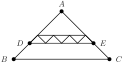
All of the triangles in the diagram below are similar to isosceles triangle in which Each of the smallest triangles has area and has area What is the area of trapezoid
Pista pequeña:
En triángulos semejantes, el área escala como el cuadrado de la longitud de los lados.
Area scales as the square of side length for similar triangles
Pista grande:
Encuentra el área del triángulo superior y réstala de .
Find the area of the top triangle and subtract from
Solución:
Por la semejanza de triángulos, sabemos que la longitud del lado de los triángulos más pequeños es veces la del triángulo más grande.
Entonces la longitud del lado de es veces la del lado del triángulo más grande.
Esto hace que la razón de las áreas sea
Por lo tanto, el área de es El área del trapecio es entonces
Por lo tanto, E es la respuesta correcta.
We know that the side length of the smaller triangles is times the length of the larger triangle from similar triangles.
Then the side length of is times the length of the side length of the larger triangle.
This makes the ratio of the areas
Therefore, the area of is The area of the trapezoid is then
Thus, E is the correct answer.
10.
Supongamos que el número real satisface ¿Cuál es el valor de
Suppose that real number satisfies What is the value of
Pista pequeña:
Trata los dos radicales como cantidades tipo conjugado.
Treat the two radicals as conjugate-like quantities
Pista grande:
Multiplica la diferencia dada por la suma buscada.
Multiply the given difference by the desired sum
Solución:
Nota que el lado izquierdo de la ecuación y la expresión buscada son conjugados. Al multiplicarlos se eliminan las raíces cuadradas.
Al multiplicarlos se obtiene
Esto significa que el producto de los valores de las expresiones es igual a Por lo tanto, el valor buscado es
Por lo tanto, A es la respuesta correcta.
Note that the left hand side of the equation and the desired expression are conjugates. Multiplying them would remove the square roots.
Multiplying them yields
This means that the product of the values of the expressions is equal to The desired value is therefore
Thus, A is the correct answer.
11.
Cuando se lanzan dados justos estándar de caras, la probabilidad de que la suma de los números en las caras superiores sea puede escribirse como donde es un entero positivo. ¿Cuál es ?
When fair standard -sided dice are thrown, the probability that the sum of the numbers on the top faces is can be written as where is a positive integer. What is
Pista pequeña:
Enumera las formas no ordenadas en que siete resultados positivos de dados pueden sumar .
List the unordered ways seven positive die rolls can sum to
Pista grande:
Cuenta los ordenamientos de cada patrón enumerado.
Count the orderings for each listed pattern
Solución:
Podemos usar estrellas y barras para hallar Es lo mismo que contar el número de formas de poner bolas en cajas, donde cada caja tiene al menos una bola.
La fórmula para este caso es donde es el número de bolas y es el número de cajas.
Ningún dado puede pasar de en una suma de con siete lanzamientos positivos, así que la cota superior de no impone ninguna restricción adicional. Por lo tanto, la respuesta buscada es
Por lo tanto, E es la respuesta correcta.
We can use stars and bars to find It is the same as finding the number of ways to put balls into boxes, where each box has at least one ball.
The formula for such a scenario is where is the number of balls and is the number of boxes.
No die can exceed in a sum of from seven positive rolls, so the upper bound of creates no additional restriction. The desired answer is therefore
Thus, E is the correct answer.
12.
¿Cuántos pares ordenados de números reales satisfacen el siguiente sistema de ecuaciones?
How many ordered pairs of real numbers satisfy the following system of equations?
Pista pequeña:
Reemplaza la ecuación con valor absoluto por cuatro casos lineales.
Replace the absolute-value equation by four linear cases
Pista grande:
Soluciones distintas pueden repetirse entre casos, así que cuenta los pares ordenados únicos.
Distinct solutions can repeat across cases, so count unique ordered pairs
Solución:
La segunda ecuación dice que o , así que basta con revisar las cuatro posibilidades lineales y .
Combinándolas con se obtiene , , de nuevo , y .
Estos son tres pares ordenados distintos, y cada uno satisface la ecuación original con valor absoluto. Por lo tanto, C es la respuesta correcta.
The second equation says or , so it is enough to check the four linear possibilities and .
Combining these with gives , , again, and .
These are three distinct ordered pairs, and each satisfies the original absolute-value equation. Thus, C is the correct answer.
13.
Un triángulo de papel con lados de longitudes y pulgadas, como se muestra, se dobla de modo que el punto cae sobre el punto ¿Cuál es la longitud en pulgadas del pliegue?

A paper triangle with sides of lengths and inches, as shown, is folded so that point falls on point What is the length in inches of the crease?
Pista pequeña:
El pliegue es la mediatriz de .
The crease is the perpendicular bisector of
Pista grande:
Usa la semejanza con el triángulo original --.
Use similarity with the original -- triangle
Solución:

Nota que el pliegue será la mediatriz de Sea el pliegue.
Por semejanza , sabemos que Por lo tanto, Sustituyendo las longitudes de los lados se obtiene así que
Por lo tanto, D es la respuesta correcta.
The crease is the perpendicular bisector of Let be the crease.
By similarity, Therefore, Plugging in the side lengths gives so
Thus, D is the correct answer.
14.
¿Cuál es el mayor entero menor o igual que
What is the greatest integer less than or equal to
Pista pequeña:
Primero compara esta expresión con .
Compare the expression to first
Pista grande:
Luego demuestra que sigue siendo mayor que .
Then prove it is still greater than
Solución:
Sea y . La expresión es , así que es menor que .
Para demostrar que el mayor entero es , también necesitamos que la expresión sea mayor que . Esto equivale a , es decir .
Como tenemos Por consiguiente la expresión es mayor que y menor que Por lo tanto, A es la respuesta correcta.
Let and . The expression is , so it is less than .
To show the floor is , we also need the expression to be greater than . This is equivalent to , or .
Because we have Hence the expression is greater than and less than Thus, A is the correct answer.
15.
Dos círculos de radio son tangentes externamente entre sí y tangentes internamente a un círculo de radio en los puntos y como se muestra en el diagrama. La distancia puede escribirse en la forma donde y son enteros positivos primos entre sí. ¿Cuál es ?
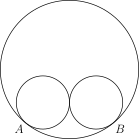
Two circles of radius are externally tangent to each other and are internally tangent to a circle of radius at points and as shown in the diagram. The distance can be written in the form where and are relatively prime positive integers. What is
Pista pequeña:
Une los centros de los tres círculos.
Join the three circle centers
Pista grande:
El triángulo que pasa por los puntos de tangencia es semejante al triángulo que pasa por los centros.
The triangle through tangent points is similar to the triangle through centers
Solución:
Sea el centro del círculo grande y sean los centros de los dos círculos más pequeños. Entonces y .
Los radios a los puntos de tangencia hacen que sea colineal con y colineal con , así que . Por lo tanto .
Entonces , de modo que . Por lo tanto, D es la respuesta correcta.
Let be the center of the large circle and let be the centers of the two smaller circles. Then and .
The radii to tangent points make collinear with and collinear with , so . Thus .
Hence , so . Thus, D is the correct answer.
16.
El triángulo rectángulo tiene catetos de longitudes y Incluyendo y ¿cuántos segmentos de longitud entera pueden trazarse desde el vértice hasta un punto de la hipotenusa ?
Right triangle has leg lengths and Including and how many line segments with integer length can be drawn from vertex to a point on hypotenuse
Pista pequeña:
Encuentra la altura desde hasta la hipotenusa.
Find the altitude from to the hypotenuse
Pista grande:
Los segmentos de longitud entera aparecen en pares simétricos alrededor de la altura.
Integer-length segments occur in symmetric pairs around the altitude
Solución:
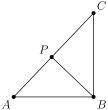
Sea el pie de la altura desde hasta El teorema de Pitágoras da Al calcular el área de dos maneras, obtenemos así que que está entre y
Cuando el extremo se mueve de a su distancia a disminuye continuamente de a Por tanto, hay un segmento de cada longitud entera Cuando el extremo se mueve de a la distancia aumenta continuamente de a lo que da un segmento de cada longitud entera Estos son segmentos distintos.
Por lo tanto, D es la respuesta correcta.
Let be the foot of the altitude from to The Pythagorean Theorem gives Computing the area in two ways gives so which lies between and
As the endpoint moves from to its distance from decreases continuously from to Thus there is one segment of each integer length As the endpoint moves from to the distance increases continuously from to giving one segment of each integer length These are distinct segments.
Thus, D is the correct answer.
17.
Sea un conjunto de enteros tomados de con la propiedad de que si y son elementos de con entonces no es múltiplo de ¿Cuál es el menor valor posible de un elemento de ?
Let be a set of integers taken from with the property that if and are elements of with then is not a multiple of What is the least possible value of an element in
Pista pequeña:
Agrupa los números de modo que a lo más se pueda elegir uno de cada grupo.
Group numbers so at most one from each group can be chosen
Pista grande:
Intenta forzar seis elecciones a partir de las cadenas de divisores.
Try forcing six choices from the divisor chains
Solución:
Procedemos por casos según el posible menor elemento de
no puede ser el menor elemento, pues eso significaría que ningún otro número puede estar en el conjunto.
no puede ser el menor elemento, pues tendríamos que incluir todos los números impares excepto Esto haría que y violaran la regla.
Sea el menor elemento. Entonces podemos incluir y Finalmente podemos incluir u y o
En cualquier caso, el número máximo de elementos que podemos incluir es así que no puede ser el menor elemento.
Empezando con podemos incluir y Finalmente, podemos añadir o formando un conjunto de elementos.
Por lo tanto, C es la respuesta correcta.
We proceed by casing on possible values for
cannot be the smallest element since that would mean that no other number can be in the set.
cannot be the smallest element since we would have to include every odd number except This would make and violate the rule.
Let be the smallest element. Then we can include and We can finally include either or and or
Either way, the maximum number of elements that we can include is so cannot be the smallest element.
Starting with we can include and Finally, we can add either or creating a -element set.
Thus, C is the correct answer.
18.
¿Cuántos enteros no negativos pueden escribirse en la forma donde para ?
How many nonnegative integers can be written in the form where for
Pista pequeña:
Piensa en la expresión como una representación ternaria balanceada.
Think of the expression as balanced ternary
Pista grande:
Los valores positivos y negativos se emparejan simétricamente alrededor de .
Positive and negative values pair off symmetrically around
Solución:
Nota que todo número formado por esta suma es positivo, negativo o cero.
El número de valores positivos es igual al de negativos por simetría (cambia los a y los a ).
La única manera de que la suma sea es que todos los coeficientes sean
El número total de valores es Como cada potencia de es mayor que la suma de todas las potencias anteriores de tres, cada combinación de coeficientes produce un valor distinto. Más explícitamente, en la posición más alta donde dos combinaciones difieren, la diferencia tiene magnitud al menos mientras que todas las posiciones inferiores juntas pueden cancelar a lo sumo
Por lo tanto, hay enteros no negativos distintos.
Por lo tanto, D es la respuesta correcta.
Note that every number formed by this sum is either positive, negative, or zero.
The number of positive numbers equals the number of negative numbers due to symmetry (flip the s to s and s to s).
The only way for the sum to be is if all the coefficients are
The total number of numbers is Because each power of is larger than the sum of all previous powers of three, each combination of coefficients yields a different value. More explicitly, at the highest place where two combinations differ, the difference has magnitude at least while all lower places together can cancel at most
Therefore, there are distinct nonnegative integers.
Thus, D is the correct answer.
19.
Se selecciona al azar un número del conjunto y se selecciona al azar un número de ¿Cuál es la probabilidad de que tenga dígito de las unidades igual a ?
A number is randomly selected from the set and a number is randomly selected from What is the probability that has a units digit of
Pista pequeña:
Solo importan los ciclos del dígito de las unidades.
Only units-digit cycles matter
Pista grande:
Promedia los conteos de éxito para las bases que terminan en .
Average the success counts for bases ending in
Solución:
Solo importa el dígito de las unidades de . Entre los exponentes consecutivos posibles, cada residuo módulo aparece veces, y exponentes son pares. Una base que termina en funciona para los exponentes; las bases que terminan en o funcionan para los exponentes divisibles por una base que termina en nunca funciona; y una base que termina en funciona para los exponentes pares.
Así, de los pares igualmente probables funcionan, y la probabilidad es
Por lo tanto, E es la respuesta correcta.
Only the units digit of matters. Among the consecutive possible exponents, each residue modulo occurs times, and exponents are even. A base ending in succeeds for all exponents; bases ending in or succeed for the exponents divisible by a base ending in never succeeds; and a base ending in succeeds for the even exponents.
Thus of the equally likely pairs work, and the probability is
Thus, E is the correct answer.
20.
Un código de escaneo consiste en una cuadrícula de cuadrados, con algunos de sus cuadrados coloreados de negro y el resto de blanco. Debe haber al menos un cuadrado de cada color en esta cuadrícula de cuadrados.
Un código de escaneo se llama simétrico si su apariencia no cambia cuando el cuadrado completo se rota un múltiplo de en sentido antihorario alrededor de su centro, ni cuando se refleja a través de una recta que une esquinas opuestas o una recta que une los puntos medios de lados opuestos.
¿Cuál es el número total de códigos de escaneo simétricos posibles?
A scanning code consists of a grid of squares, with some of its squares colored black and the rest colored white. There must be at least one square of each color in this grid of squares.
A scanning code is called symmetric if its look does not change when the entire square is rotated by a multiple of counterclockwise around its center, nor when it is reflected across a line joining opposite corners or a line joining midpoints of opposite sides.
What is the total number of possible symmetric scanning codes?
Pista pequeña:
Clasifica los cuadrados de la cuadrícula según las órbitas de simetría.
Classify grid squares by symmetry orbits
Pista grande:
Elige un color por órbita, excluyendo las dos coloraciones constantes.
Choose one color per orbit, excluding the two constant colorings
Solución:
Numeremos las filas y las columnas de a con el centro en Las rotaciones y las reflexiones pueden cambiar los signos e intercambiar las coordenadas, así que la órbita de queda determinada por el par ordenado que se obtiene al ordenar Estos pares son los con de los cuales hay
Una vez que se colorea un cuadrado de cada órbita, la simetría determina los colores de todos los demás cuadrados de esa órbita.
Por lo tanto, hay coloraciones simétricas antes de aplicar la condición de usar ambos colores. Las coloraciones todo negro y todo blanco no están permitidas.
El número total de códigos de escaneo simétricos válidos es . Por lo tanto, B es la respuesta correcta.
Number rows and columns from through with the center at Rotations and reflections can change signs and exchange coordinates, so the orbit of is determined by the ordered pair obtained by sorting These pairs are with of which there are
Once one square in each orbit is colored, symmetry forces the colors of all other squares in that orbit.
There are therefore symmetric colorings before the condition about using both colors. The all-black and all-white colorings are not allowed.
The total number of valid symmetric scanning codes is . Thus, B is the correct answer.
21.
¿Cuál de las siguientes opciones describe el conjunto de valores de para los cuales las curvas y en el plano real se intersecan en exactamente puntos?
Which of the following describes the set of values of for which the curves and in the real -plane intersect at exactly points?
Pista pequeña:
Sustituye la ecuación de la parábola en la ecuación del círculo.
Substitute the parabola equation into the circle equation
Pista grande:
Las raíces no nulas aparecen solo cuando es positivo.
The nonzero roots appear only when is positive
Solución:
Sustituye en , lo que da , así que .
El factor siempre da el único punto . El otro factor da dos puntos reales adicionales exactamente cuando .
Hay exactamente tres puntos de intersección cuando . Por lo tanto, E es la respuesta correcta.
Substitute into . This gives , so .
The factor always gives the single point . The other factor gives two additional real points exactly when .
There are exactly three intersection points when . Thus, E is the correct answer.
22.
Sean y enteros positivos tales que y ¿Cuál de las siguientes opciones debe ser un divisor de ?
Let and be positive integers such that and Which of the following must be a divisor of
Pista pequeña:
Rastrea las potencias forzadas de y en los máximos comunes divisores.
Track the forced powers of and in the gcds
Pista grande:
El factor restante de debe estar entre y .
The remaining factor of must lie between and
Solución:
De y , el número es divisible por pero no por .
De y , el número es divisible por pero no por . Por lo tanto , donde no tiene factor ni .
Como el entero cumple El único valor en ese rango sin factor ni es así que debe dividir a Por lo tanto, D es la respuesta correcta.
From and , the number is divisible by but not by .
From and , the number is divisible by but not by . Therefore , where has no factor or .
Since the integer satisfies The only value in this range with no factor or is so must divide Thus, D is the correct answer.
23.
El granjero Pythagoras tiene un campo con forma de triángulo rectángulo. Los catetos del triángulo rectángulo tienen longitudes y unidades. En la esquina donde esos lados se encuentran en ángulo recto, deja un pequeño cuadrado sin sembrar de modo que desde el aire parece el símbolo de ángulo recto. El resto del campo está sembrado. La distancia más corta de a la hipotenusa es unidades. ¿Qué fracción del campo está sembrada?
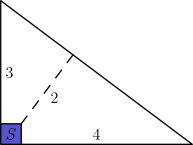
Farmer Pythagoras has a field in the shape of a right triangle. The right triangle’s legs have lengths and units. In the corner where those sides meet at a right angle, he leaves a small unplanted square so that from the air it looks like the right angle symbol. The rest of the field is planted. The shortest distance from to the hypotenuse is units. What fraction of the field is planted?
Pista pequeña:
Sea la longitud del lado del cuadrado sin sembrar.
Let be the side length of the unplanted square
Pista grande:
Descompón el triángulo en el cuadrado, dos triángulos rectángulos y un triángulo de altura .
Decompose the triangle into the square, two right triangles, and a triangle of height
Solución:
Sea la longitud del lado de Entonces podemos dividir el campo en las siguientes figuras.
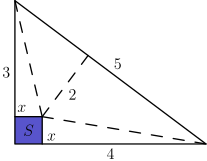
Podemos expresar el área del campo de dos maneras:
Al simplificar se obtiene
La fracción buscada es
Por lo tanto, D es la respuesta correcta.
Let be the side length of Then we can split the field up into the following shapes.
We can express the area of the field in two ways:
Simplifying yields
The desired fraction is
Thus, D is the correct answer.
24.
El triángulo con y tiene área Sea el punto medio de y sea el punto medio de La bisectriz del interseca a y en y respectivamente. ¿Cuál es el área del cuadrilátero ?
Triangle with and has area Let be the midpoint of and let be the midpoint of The angle bisector of intersects and at and respectively. What is the area of quadrilateral
Pista pequeña:
Usa el teorema de la bisectriz para localizar .
Use the angle bisector theorem to locate
Pista grande:
El segmento medio forma un trapecio semejante de media altura.
The midsegment makes a similar half-height trapezoid
Solución:
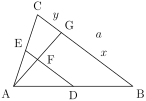
Sea y sea la longitud de la altura que pasa por
Por el teorema de la bisectriz, así que Como es un segmento medio, Al aplicar el mismo teorema en , obtenemos de modo que
La altura del trapecio es y La longitud media de sus bases es Por tanto, su área es Así, D es la respuesta correcta.
Let and be the length of the altitude through
By the Angle Bisector Theorem, so Because is a midsegment, Applying the same theorem in gives so
The trapezoid’s height is and Its average base length is Therefore, its area is Thus, D is the correct answer.
25.
Para un entero positivo y dígitos no nulos y sea el entero de dígitos cada uno de cuyos dígitos es igual a ; sea el entero de dígitos cada uno de cuyos dígitos es igual a ; y sea el entero de dígitos (no de dígitos) cada uno de cuyos dígitos es igual a ¿Cuál es el mayor valor posible de para el cual hay al menos dos valores de tales que
For a positive integer and nonzero digits and let be the -digit integer each of whose digits is equal to ; let be the -digit integer each of whose digits is equal to ; and let be the -digit (not -digit) integer each of whose digits is equal to What is the greatest possible value of for which there are at least two values of such that
Pista pequeña:
Escribe los números de dígitos repetidos como sumas geométricas.
Write the repeated-digit numbers as geometric sums
Pista grande:
Tener dos valores distintos de obliga a que la ecuación lineal en sea idénticamente verdadera.
Having two different values forces the linear equation in to be identically true
Solución:
Los números de dígitos repetidos pueden escribirse como
Al sustituir estas expresiones en y dividir entre , obtenemos
Al reorganizar, resulta Si esto se cumple para dos valores diferentes de al restar las ecuaciones vemos que La ecuación mostrada también obliga a que
Entonces y Como son dígitos no nulos, los candidatos son y La última terna no es válida porque no es un dígito. La mayor suma válida es Por lo tanto, D es la respuesta correcta.
The repeated-digit numbers can be written as
Substituting these expressions into and dividing by gives
Rearranging yields If this holds for two different values of subtracting the two equations shows that The displayed equation then also forces
Hence and Because are nonzero digits, the candidates are and The last triple is invalid because is not a digit. The greatest valid sum is Thus, D is the correct answer.