
2016 AMC 10A 真题
计时
1:15:00
1.
2.
求使下式成立的 值:
For what value of does
答案:C
小提示:
把所有数都写成 的幂。
Write everything as a power of
大提示:
左边会化为 。
The left side becomes
解答:
把所有底数写成 的幂: 同时
因此 ,所以 。
所以正确答案是 C。
Rewrite all bases as powers of : and
Therefore , so .
Thus, the correct answer is C.
3.
Ben 每花一美元买贝果,David 就少花 美分。Ben 比 David 多付 。他们两人在贝果店一共花了多少钱?
For every dollar Ben spent on bagels, David spent cents less. Ben paid more than David. How much did they spend in the bagel store together?
小提示:
Ben 每花一美元,David 花 美分。
David spends cents for each dollar Ben spends
大提示:
两人的差额是 Ben 花费的四分之一。
The difference is one quarter of Ben’s spending
解答:
Ben 每花一美元,David 花 美分,所以两人的差额是 美分。总差额为 ,也就是 Ben 花费的四分之一。
Ben 花了 美元,David 花了 美元。两人共花 美元。
所以正确答案是 C。
For each dollar Ben spent, David spent cents, so the difference was cents. The total difference is therefore one quarter of Ben’s spending.
Ben spent dollars, and David spent dollars. Together they spent dollars.
Thus, the correct answer is C.
4.
对所有实数 和满足 的实数 ,余数函数定义为 其中 表示小于或等于 的最大整数。求 的值。
The remainder function can be defined for all real numbers and with by where denotes the greatest integer less than or equal to What is the value of
5.
一个长方体的整数边长之比为 。下列哪个数可能是这个长方体的体积?
A rectangular box has integer side lengths in the ratio Which of the following could be the volume of the box?
小提示:
若边长为 ,体积为 。
If the sides are , the volume is
大提示:
检查哪个选项是 乘以一个立方数。
Test which choice is times a cube
解答:
设最短边长为 ,则另外两边为 和 。
体积为 测试 的取值可知,当 时,,这是一个选项。
所以正确答案是 D。
Let be the side length of the smallest side. Then the other two sides are and
The volume is therefore Testing out values of we see that if then which is an answer choice.
Thus, the correct answer is D .
6.
Ximena 把整数 到 各列出一次。Emilio 抄写 Ximena 的数,但把每次出现的数字 都替换成数字 。Ximena 把她的数相加,Emilio 把他的数相加。Ximena 的和比 Emilio 的和大多少?
Ximena lists the whole numbers through once. Emilio copies Ximena’s numbers, replacing each occurrence of the digit by the digit Ximena adds her numbers and Emilio adds his numbers. How much larger is Ximena’s sum than Emilio’s?
小提示:
把个位数字 改为 会少 。
Changing a units digit to loses
大提示:
把十位数字 改为 会少 。
Changing a tens digit to loses
解答:
个位数字 被改成 时,数少 。这发生在 ,总共少 。
十位数字 被改成 时,数少 。这发生在 ,总共少 。
因此 Emilio 的和比 Ximena 的和少 ,所以 Ximena 的和大 。
所以正确答案是 D。
When Emilio changes a units digit to , his copied number is smaller by . This happens in , for a loss of .
When he changes a tens digit to , his copied number is smaller by . This happens for , for a loss of .
Thus Emilio’s sum is less than Ximena’s sum, so Ximena’s sum is larger.
Thus, the correct answer is D.
7.
个数据值 的平均数、中位数和众数都等于 。求 的值。
The mean, median, and mode of the data values are all equal to What is the value of
小提示:
先使用平均数条件。
Use the mean condition first
大提示:
求出 后,再检查中位数和众数也等于 。
After finding , check that median and mode also equal
解答:
七个数的和为 。如果平均数等于 ,则 所以 ,。
当 时,排序后的数据为 。其中位数是 ,众数也是 ,所以符合条件。
所以正确答案是 D。
The sum of the seven data values is . If the mean equals , then so and .
With , the ordered data set is . Its median is , and its mode is also , so the value works.
Thus, the correct answer is D.
8.
Trickster Rabbit 同意每次 Foolish Fox 经过 Rabbit 家旁边的桥时,都把 Fox 的钱翻倍,但 Fox 每次过桥后必须向 Rabbit 支付 枚硬币的过路费。付款在翻倍之后进行。Fox 起初很高兴,但他发现自己过桥三次后钱全没了。Fox 一开始有多少枚硬币?
Trickster Rabbit agrees with Foolish Fox to double Fox’s money every time Fox crosses the bridge by Rabbit’s house, as long as Fox pays coins in toll to Rabbit after each crossing. The payment is made after the doubling. Fox is excited about his good fortune until he discovers that all his money is gone after crossing the bridge three times. How many coins did Fox have at the beginning?
答案:C
小提示:
从第三次付完过路费后一枚硬币也不剩开始倒推。
Work backward from zero coins after the third toll
大提示:
每次倒推时,先加回 ,再除以二。
Undo each crossing by adding , then halving
解答:
最后 Fox 有 枚硬币,所以第三次付过路费之前有 枚。
因此第三次翻倍前有 枚;第二次付过路费之前有 枚。
第二次翻倍前有 枚;第一次付过路费之前有 枚。
最后,第一次翻倍前 Fox 有 枚硬币。
所以正确答案是 C。
We know that Fox has coins at the end. Then before paying the final toll, Fox had coins.
Then he had coins before the doubling. Then before paying the toll for the second crossing, he had coins.
Before the doubling on the second crossing, he had coins. On the first crossing before the toll, Fox had coins.
Finally, before the first doubling, Fox had coins.
Thus, the correct answer is C .
9.
一个由 枚硬币组成的三角形阵列,第一行有 枚硬币,第二行有 枚,第三行有 枚,依此类推,第 行有 枚。求 的各位数字之和。
A triangular array of coins has coin in the first row, coins in the second row, coins in the third row, and so on up to coins in the th row. What is the sum of the digits of
小提示:
解方程 。
Solve
大提示:
寻找乘积为 的连续整数。
Look for consecutive factors of
解答:
回忆前 个整数之和为 。
我们要找 ,使得 交叉相乘并化简,得到 因式分解得 取正值,。各位数字和为 。
所以正确答案是 D。
Recall that the sum of the first numbers is
We want to find such that Cross-multiplying and simplifying gives us Factoring gives us We want the positive value so Adding together the digits gives us
Thus, the correct answer is D .
10.
一块地毯由如图所示的三种不同颜色组成。三种不同颜色区域的面积构成一个等差数列。最内层长方形宽为一英尺,外面的两个区域在四周各宽 英尺。最内层长方形的长度是多少英尺?
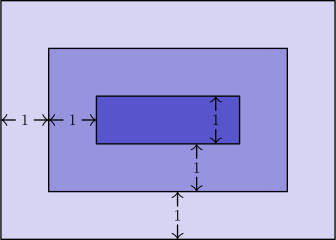
A rug is made with three different colors as shown. The areas of the three differently colored regions form an arithmetic progression. The inner rectangle is one foot wide, and each of the two shaded regions is foot wide on all four sides. What is the length in feet of the inner rectangle?
小提示:
设内层长方形长度为 。
Let the inner rectangle have length
大提示:
三个区域面积分别为 。
The three region areas are
解答:
设内层长方形长度为 ,则内层面积为 。
中间区域面积为 外层区域面积为
这 个面积构成等差数列,所以
所以正确答案是 B。
Let be the length of the inner rectangle. Then the area of the inner rectangle is
The area of the middle region is going to be The area of the outer region is
We know that these values form an arithmetic sequence. That means that
Thus, the correct answer is B .
11.
给定的 长方形中,阴影区域的面积是多少?

What is the area of the shaded region of the given rectangle?
小提示:
把阴影区域分成四个三角形。
Split the shaded region into four triangles
大提示:
使用长度为 的底,以及高度 和 。
Use bases of length with heights and
解答:
可将阴影区域分成 个底为 的三角形。

四个三角形的底都是 。其中两个的高为 ,另外两个的高为 。
面积总和为
所以正确答案是 D。
We can split the region into triangles with bases of
All four triangles have base Two have height and the other two have height
The sum of the areas of the triangles is
Thus, the correct answer is D .
12.
从 到 之间随机选取三个不同的整数。下列哪一句正确描述了这三个整数乘积为奇数的概率 ?
Three distinct integers are selected at random between and inclusive. Which of the following is a correct statement about the probability that the product of the three integers is odd?
小提示:
乘积为奇数,当且仅当三个选出的整数全为奇数。
The product is odd only if all three selected integers are odd
大提示:
不放回抽取使概率略小于 。
Sampling without replacement makes the probability slightly less than
解答:
乘积为奇数,当且仅当选出的三个整数全是奇数。从 到 中有 个奇数和 个偶数。
因为是不放回抽取, 第一个因子为 ,后两个因子都略小于 ,所以 。
所以正确答案是 A。
The product is odd exactly when all three selected integers are odd. There are odd and even integers from to .
Because the integers are selected without replacement, The first factor is , and each of the next two factors is slightly less than . Therefore .
Thus, the correct answer is A.
13.
五位朋友坐在电影院一排 个座位中,从左到右编号为 到 。(“左”和“右”是从坐在座位上的人的视角看。)
电影期间 Ada 去大厅买爆米花。她回来时发现 Bea 向右移动了两个座位,Ceci 向左移动了一个座位,Dee 和 Edie 交换了座位,并且给 Ada 留下了一个端点座位。Ada 起身前坐在哪个座位?
Five friends sat in a movie theater in a row containing seats, numbered to from left to right. (The directions “left” and “right” are from the point of view of the people as they sit in the seats.)
During the movie Ada went to the lobby to get some popcorn. When she returned, she found that Bea had moved two seats to the right, Ceci had moved one seat to the left, and Dee and Edie had switched seats, leaving an end seat for Ada. In which seat had Ada been sitting before she got up?
小提示:
跟踪已占座位的总位移。
Track net displacement of the occupied seats
大提示:
Bea 向右移动两个座位,Ceci 向左移动一个座位。
Bea moves two right and Ceci moves one left
解答:
移动前后,被占用座位编号之和都是 。Dee 和 Edie 只是交换座位,所以两人的合位移为 。Bea 的位移为 ,Ceci 的位移为 。因此 Ada 的位移必须为 ,才能使总位移为 。
Ada 回到了一个端点座位。因为她向左移动了一个座位,所以她必定是从 号座位移到 号座位。
所以正确答案是 B。
The sum of the occupied seat numbers is both before and after the moves. Dee and Edie merely switch seats, so their combined displacement is Bea’s displacement is and Ceci’s is Therefore Ada’s displacement must be so that the total displacement is
Ada returns to an end seat. Since she moves one seat left, she must move from seat to seat
Thus, the correct answer is B .
14.
有多少种方法把 写成若干个二和若干个三的和,且不考虑顺序?例如, 和 是其中两种。
How many ways are there to write as the sum of twos and threes, ignoring order? (For example, and are two such ways.)
小提示:
写成方程 。
Write
大提示:
必须是从 到 的偶数。
must be even from through
解答:
题目可以写成方程 ,其中 是二的个数, 是三的个数。
目标就是数出有多少个 的倍数,能从 中减去后仍得到偶数。
这对应于从 到 的所有有序对,其中 每次增加 。
这样就有 组 和 的解。
所以正确答案是 C。
The problem can be rewritten as an equation where is the number of twos and is the number of threes.
The goal is to find the number of multiples of that can be subtracted from to result in an even number.
This can be achieved by the pairs of up to with being incremented by
This gives us solutions for and
Thus, the correct answer is C .
15.
如图,从一块圆形饼干面团中切出七块半径为 英寸的饼干。相邻饼干相切,除中心饼干外,其他饼干都与面团边缘相切。剩下的边角料被重新塑造成另一块同样厚度的饼干。边角料饼干的半径是多少英寸?

Seven cookies of radius inch are cut from a circle of cookie dough, as shown. Neighboring cookies are tangent, and all except the center cookie are tangent to the edge of the dough. The leftover scrap is reshaped to form another cookie of the same thickness. What is the radius in inches of the scrap cookie?
小提示:
大圆半径为 。
The large circle has radius
大提示:
从大圆面积中减去七个单位圆饼干的总面积。
Subtract the total area of the seven unit cookies
解答:
圆形面团半径为 英寸,因为从中心到边缘经过一个饼干直径再加一个饼干半径。
面团面积为 ,七块饼干的总面积为 。
剩余边角料的面积为 ,所以它的半径为 。
所以正确答案是 A。
The circle of cookie dough has a radius of inches since it is the same as the diameter plus the radius of a cookie.
The area of the cookie dough is and the cookies have an area of
The area of the leftover scrap is therefore This means that its radius is
Thus, the correct answer is A .
16.
顶点为 ,,和 的三角形先关于 轴反射,得到的像 再绕原点逆时针旋转 ,得到 。下列哪个变换能把 变回 ?
A triangle with vertices and is reflected about the -axis, then the image is rotated counterclockwise about the origin by to produce Which of the following transformations will return to
绕原点逆时针旋转
counterclockwise rotation about the origin by
绕原点顺时针旋转
clockwise rotation about the origin by
关于 轴反射
reflection about the -axis
关于直线 反射
reflection about the line
关于 轴反射
reflection about the -axis
小提示:
跟踪一般点 经过两个变换后的结果。
Follow a generic point through the two transformations
大提示:
像点为 。
The image point is
解答:
为判断如何逆转这些变换,可以跟踪一个任意点。
设该点为 。关于 轴反射后,它变为 。
再逆时针旋转后得到 。要把它变回 ,唯一的方法是关于 反射。
所以正确答案是 D。
To figure out how to reverse the transformations, we can analyze a single point and see what happens to it.
Let be the point. After being reflected about the -axis, the point would go to
Rotating this counterclockwise would put it at The only transformation that puts this back at is reflection about
Thus, the correct answer is D .
17.
设 是 的正倍数。将一个红球和 个绿球随机排成一行。令 为至少有 的绿球在红球同一侧的概率。注意 ,且当 变大时 趋近于 。使 的最小 的各位数字之和是多少?
Let be a positive multiple of One red ball and green balls are arranged in a line in random order. Let be the probability that at least of the green balls are on the same side of the red ball. Observe that and that approaches as grows large. What is the sum of the digits of the least value of such that
小提示:
把红球放进绿球之间的 个空隙之一。
Place the red ball in one of the gaps among the green balls
大提示:
不满足条件的空隙,其左侧的绿球数介于 与 之间。
The bad gaps have between and green balls on the left
解答:
先排好 个绿球,再把红球放入 个空隙之一。若红球左侧有 个绿球,则右侧有 个。
至少有 个绿球在一侧,等价于 或 。因此不满足条件的空隙为 共 个。
所以 解不等式 得 。最小的 的正倍数是 ,其各位数字之和为 。
所以正确答案是 A。
Think of first arranging the green balls, then placing the red ball in one of the gaps. If green balls are to the left of the red ball, then are to its right.
At least green balls are on one side exactly when or . Thus the bad gaps are a total of gaps.
Therefore Solving gives . The least positive multiple of is , whose digit sum is .
Thus, the correct answer is A.
18.
一个立方体的每个顶点要标上从 到 的一个整数,每个整数用一次,使得每个面的四个顶点上的数之和都相同。通过立方体旋转可以互相得到的标法视为相同。有多少种不同标法?
Each vertex of a cube is to be labeled with an integer through with each integer being used once, in such a way that the sum of the four numbers on the vertices of a face is the same for each face. Arrangements that can be obtained from each other through rotations of the cube are considered to be the same. How many different arrangements are possible?
小提示:
相对的两个面各自的和都必须是 的一半。
Opposite faces must each sum to half of
大提示:
选定与 相邻的三个数后,其余相对顶点被迫确定。
Choose the three neighbors of and force the opposite vertices
解答:
相对两个面包含全部八个标号,总和为 ,所以每个面的和必须为 。
把标号 放在一个顶点,设与它相邻的三个标号为 。与这三个顶点隔面相邻的另外三个顶点于是被迫为 而对顶点为 。
假设三个相邻标号按递增顺序排列。把 中的三元组代入上面四个被迫的表达式,恰好得到 对每个相邻标号集合,绕过该顶点的对角线作 旋转,会把顶点周围的六种排列分成两组各三种。因此每个集合给出两种不能通过旋转互相得到的标法,共有 种标法。
所以正确答案是 C。
Opposite faces together use all eight labels, whose sum is , so every face must have sum .
Put label at one vertex, and let the three adjacent labels be . The three vertices adjacent to those across faces are then forced to be and the opposite vertex is .
Assume the three neighbor labels are listed in increasing order. Substituting triples from into the four forced expressions above gives exactly For each neighbor set, the six orders around the vertex fall into two groups of three under the rotations about the diagonal through that vertex. Thus each set gives two non-rotationally equivalent arrangements, for arrangements in all.
Thus, the correct answer is C.
19.
在长方形 中,,。点 在 与 之间,点 在 与 之间,且 。线段 和 分别与 相交于 和 。
比值 可写成 ,其中 , 和 的最大公因数为 。求 。
In rectangle and Point between and and point between and are such that Segments and intersect at and respectively.
The ratio can be written as where the greatest common factor of and is What is
20.
对某个特定的 ,展开 并合并同类项后,所得表达式中恰好有 项同时包含四个变量 、、 和 ,且每个变量的指数都为正。求 。
For some particular value of when is expanded and like terms are combined, the resulting expression contains exactly terms that include all four variables and each to some positive power. What is
小提示:
数同时包含四个变量的项对应的指数选择。
Count exponent choices for terms containing all four variables
大提示:
插板法给出 。
Stars and bars gives
解答:
同时包含四个变量的项形如 ,其中 ,此外还要乘以 的某个幂。若这个幂是 ,则
从 各减去 后,得到 个非负整数,其和为 。因此这样的项数为
由于 ,所以 。
所以正确答案是 B。
A term that includes all four variables has form , with , multiplied by some power of . If that power is , then
After subtracting from each of , this becomes a nonnegative stars-and-bars count with variables summing to . The number of such terms is
Since , we get .
Thus, the correct answer is B.
21.
圆心为 , 和 、半径分别为 , 和 的三个圆位于直线 的同侧,并分别在 , 和 处与 相切,其中 在 和 之间。圆心为 的圆与另外两个圆都外切。求 的面积。
Circles with centers and having radii and respectively, lie on the same side of line and are tangent to at and respectively, with between and The circle with center is externally tangent to each of the other two circles. What is the area of
小提示:
使用切点之间的水平距离。
Use horizontal distances between tangent points
大提示:
把这些水平距离代入坐标面积公式。
Use those horizontal distances in a coordinate-area formula
解答:
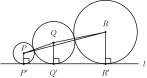
把这条公切线取作 轴,并令 。因为 ,而两个圆心的高度相差 ,所以 到 的水平距离为 同理,,这两个圆心的高度也相差 ,因此它们的水平距离为 。
于是可以取 再由坐标面积公式得到
所以正确答案是 D。
Put the tangent line on the -axis and take Because and the centers differ in height by the horizontal distance from to is Similarly, and its centers also differ in height by so their horizontal distance is
Thus we may use The coordinate-area formula gives
Thus, the correct answer is D .
22.
对某个正整数 ,数 有 个正整数因数,包括 和 本身。数 有多少个正整数因数?
For some positive integer the number has positive integer divisors, including and the number How many positive integer divisors does the number have?
小提示:
因数个数 迫使指数为 。
The divisor count forces exponents
大提示:
这些指数都等于 ,所以能来自 。
Those exponents are all , so they can come from
解答:
质因数分解为 。若 有 个因数,则它恰有三个素因子,指数为 的某种排列。
对于素数 ,它们在 中的指数都是 加上 的倍数。指数 都满足这个形式,所以它们在 中对应为 的某种排列。
在 中,来自 的指数为 的某种排列,另外素数 上还有指数 。因数个数为
所以正确答案是 D。
The prime factorization is . If has divisors, then it has exactly three prime factors, with exponents in some order.
For each of the primes , its exponent in is more than a multiple of . The exponents all have this form, so the corresponding exponents in are in some order.
In , the exponents from are therefore , in some order, along with the exponent on prime . Hence the divisor count is
Thus, the correct answer is D.
23.
二元运算 满足 以及 ,对所有非零实数 , 和 都成立。(这里的点号 表示通常的乘法运算。)方程 的解可写成 ,其中 和 为互质正整数。求 的值。
A binary operation has the properties that and that for all nonzero real numbers and (Here the dot represents the usual multiplication operation.) The solution to the equation can be written as where and are relatively prime positive integers. What is
24.
一个四边形内接于半径为 的圆。该四边形的三条边长为 。第四条边长是多少?
A quadrilateral is inscribed in a circle of radius Three of the sides of this quadrilateral have length What is the length of the fourth side?
答案:E
小提示:
等长弦对应相等圆心角。
Equal chords give equal central angles
大提示:
若一条长为 的弦所对的圆心角为 ,就使用弦长公式和 。
If a -unit chord subtends angle , use the chord formula and
解答:
把这个四边形记作 ,其中 。设这三条等长弦各自所对的圆心角都是 。由弦长公式得 所以 。特别地,,因此 所对的较小圆心角是 。
于是再用一次弦长公式,得到 再利用 ,我们求得
因此
所以正确答案是 E。
Label the quadrilateral , with . Let each of these equal chords subtend central angle . The chord formula gives so . In particular, , so the smaller central angle subtended by is .
Therefore another use of the chord formula gives Using , we obtain
Hence
Thus, the correct answer is E.
25.
有多少个正整数有序三元组 同时满足 以及
How many ordered triples of positive integers satisfy and
小提示:
分别独立处理每个素数的指数。
Treat each prime exponent independently
大提示:
和 的幂各自留下一个小的最大值条件计数。
The powers of and each leave a small max-condition count
解答:
先分解给定的最小公倍数: 因为 没有因子 ,所以 和 都没有因子 ,而 必须含 。
写 ,,。 中 的指数迫使 , 中 的指数迫使 。
剩余独立条件为 和 。前者有 个有序选择,后者有 个有序选择,所以共有 个三元组。
所以正确答案是 A。
Factor the given least common multiples: Since has no factor of , neither nor has a factor of , and must contain .
Write , , and . The power of in forces , and the power of in forces .
The remaining independent conditions are and . These have and ordered choices, respectively, so there are triples.
Thus, the correct answer is A.