2024 AMC 8 Exam Problems
Scroll down and press Start to try the exam! Or, go to the printable PDF, answer key, or professional video solutions and written solutions curated by LIVE by Po-Shen Loh.
All of the real AMC 8 and AMC 10 problems in our complete solution collection are used with official permission of the Mathematical Association of America (MAA).
Want to learn professionally through interactive video classes?
Time Left:
40:00
40:00
1.
What is the ones digit of
Answer: B
Video solution:
Click to load, then click again to play
Written solution:

We only need to consider the ones digits of each number (except for the first one so we avoid getting a negative answer): which has a ones digit of .
Thus, B is the correct answer.
2.
What is the value of this expression in decimal form?
Answer: C
Video solution:
Click to load, then click again to play
Written solution:
We can simplify the fractions by taking out the common factor : simplifies to , simplifies to , and simplifies to . Therefore, we have
Thus, C is the correct answer.
3.
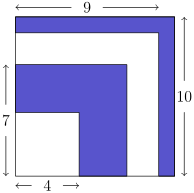
Four squares of side length and units are arranged in increasing size order so that their left edges and bottom edges align. The squares alternate shaded and unshaded, as shown in the figure. What is the area of the visible shaded region in square units?
Answer: E
Video solution:
Click to load, then click again to play
Written solution:
The visible shaded region is the part inside the by square but outside the by square, together with the part inside the by square but outside the by square. Its area is
Thus, E is the correct answer.
4.
When Yunji added all the integers from to she mistakenly left out a number. Her incorrect sum turned out to be a square number. Which number did Yunji leave out?
Answer: E
Video solution:
Click to load, then click again to play
Written solution:
To find the number that Yunji left out, we need to find the sum of the integers from to and find its difference with the largest perfect square below the sum. We can calculate the sum of the integers from to as follows: The largest perfect square less than would be and .
Thus, E is the correct answer.
5.
Aaliyah rolls two standard 6-sided dice. She notices that the product of the two numbers rolled is a multiple of 6. Which of the following integers cannot be the sum of the two numbers?
Answer: B
Video solution:
Click to load, then click again to play
Written solution:
For the product to be a multiple of , the two dice together must supply a factor of and a factor of . The possible sums among the answer choices can occur as follows: There is no way to get sum while also having a product divisible by : the pairs with sum are , and none have product divisible by .
Thus, B is the correct answer.
6.
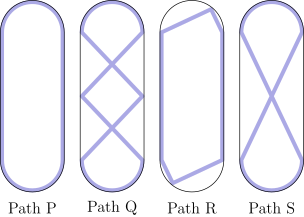
Sergei skated around an ice rink, gliding along different paths. The marked lines in the figures below show four of the paths labeled P, Q, R, and S. What is the sorted order of the four paths from shortest to longest?
P, Q, R, S
P, R, S, Q
Q, S, P, R
R, P, S, Q
R, S, P, Q
Answer: D
Video solution:
Click to load, then click again to play
Written solution:
Path R is shortest because it replaces curved arc portions with straight-line chords. Path Q is longest because it includes the most interior crossing distance while still using the curved ends.
It remains to compare paths P and S. The relevant straight piece in path S is a diagonal across the rink, while the corresponding straight piece in path P is a side of the same right triangle. A diagonal is longer than a side, so path S is longer than path P.
The order from shortest to longest is R, P, S, Q.
Thus, D is the correct answer.
7.
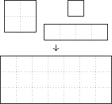
A rectangle is covered without overlap by shapes of tiles: and shown below. What is the minimum possible number of tiles used?
Answer: E
Video solution:
Click to load, then click again to play
Written solution:
The and tiles each have area . Since the rectangle has area , the number of tiles must be congruent to . Among the choices, only and are possible by area.
It is impossible to use just one tile. If the larger tiles covered the other cells, then two rows would have all cells covered by larger tiles. But each tile covers cells in any row it meets, and each tile covers cells in one row, so each row would have an even number of cells covered by larger tiles. A row cannot have such cells.
The following tiling shows that unit tiles are possible.
Thus, E is the correct answer.
8.
On Monday Taye has Every day, he either gains or doubles the amount of money he had on the previous day. How many different dollar amounts could Taye have on Thursday, days later?
Answer: D
Video solution:
Click to load, then click again to play
Written solution:
After Tuesday, Taye could have or dollars. After Wednesday, the possible amounts are so the distinct amounts are .
After Thursday, these can become These are distinct dollar amounts.
Thus, D is the correct answer.
9.
All of the marbles in Maria's collection are red, green, or blue. Maria has half as many red marbles as green marbles and twice as many blue marbles as green marbles. Which of the following could be the total number of marbles in Maria's collection?
Answer: E
Video solution:
Click to load, then click again to play
Written solution:
We can let be the number of red marbles that Maria has. Since Maria has half as many red marbles as green, then we know that she has green marbles. Moreover, since she has twice as many blue marbles as green, then she will have blue marbles. Adding these together gives us and so the answer must be a multiple of Among the answer choices, only is a multiple of
Thus, E is the correct answer.
10.
In January 1980 the Mauna Loa Observatory recorded carbon dioxide CO2 levels of ppm (parts per million). Over the years the average CO2 reading has increased by about ppm each year. What is the expected CO2 level in ppm in January 2030? Round your answer to the nearest integer.
Answer: B
Video solution:
Click to load, then click again to play
Written solution:
There are years between and , so we can expect the CO2 reading to increase by ppm by . Since the CO2 reading in was ppm, then we will have ppm by .
Thus, B is the correct answer.
11.
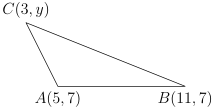
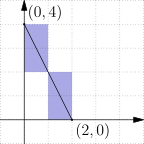
The coordinates of are and with The area of is What is the value of
Answer: D
Video solution:
Click to load, then click again to play
Written solution:
Consider the base of the triangle to be which has length . Given that the area of the triangle is , its height must be of length . Since , then must be .
Thus, D is the correct answer.
12.
Rohan keeps a total of 90 guppies in 4 fish tanks.
• There is 1 more guppy in the 2nd tank than in the 1st tank.
• There are 2 more guppies in the 3rd tank than in the 2nd tank.
• There are 3 more guppies in the 4th tank than in the 3rd tank.
How many guppies are in the 4th tank?
Answer: E
Video solution:
Click to load, then click again to play
Written solution:
Let be the number of guppies in the 1st tank. Hence, there are guppies in the 2nd tank, guppies in the 3rd tank, and guppies in the 4th tank. We then use the fact that there are a total of 90 guppies in the 4 tanks to find :
Note that we are not yet done since we are asked for the number of guppies in the 4th tank and not the 1st. There are guppies in the 4th tank.
Thus, E is the correct answer.
13.
Buzz Bunny is hopping up and down a set of stairs, one step at a time. In how many ways can Buzz start on the ground, make a sequence of 6 hops, and end up back on the ground? (For example, one sequence of hops is up-up-down-down-up-down.)
Answer: B
Video solution:
Click to load, then click again to play
Written solution:
We can deduce from the choices that it is possible to exhaust all possible cases for this problem. Note that all sequences must start with up and end with down , and that it should not be possible to go down more times than Buzz has gone up so far. Keeping this in mind, we can arrive at the following possible cases: which is a total of five possible sequences.
Thus, B is the correct answer.
14.
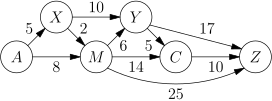
The one-way routes connecting towns and are shown in the figure below (not drawn to scale). The distances in kilometers along each route are marked. Traveling along these routes, what is the shortest distance from to in kilometers?
Answer: A
Video solution:
Click to load, then click again to play
Written solution:
A systematic way of tracking the shortest overall distance to is to consider the shortest distance to get to each town from . For instance, the shortest distance to get to town from is km, trivially.
Then, for town , going to town first will be shorter compared to going directly from , so the shortest path to town has a length of km.
For town , it will take us km if we come from town and only km coming from so km is the length of shortest path to from .
Doing the same for town will give us km as the shortest distance by coming from town .
Finally, for town , we can either come from town or . The total distance if we come from each three towns respectively would be and . Hence, km is the shortest distance from to .
Thus, A is the correct answer.
15.
Let the letters represent distinct digits. Suppose is the greatest number that satisfies the equation What is the value of
Answer: C
Video solution:
Click to load, then click again to play
Written solution:
Firstly, note that and, similarly, so the equation can be simplified to
For to remain three digits, must be Moreover, must also be less than to avoid carrying over to the hundreds digit and making the product digits. Since we need to be the greatest number, must be
To identify the possible values for we note that so far we have , so we must avoid carrying to the tens digit to keep the resulting product three digits. Hence, . We can try and verify that the resulting product has unique digits that haven't been used yet: , which does not have unique digits. Trying we get , which satisfies our criteria.
Hence,
Thus, C is the correct answer.
16.
Minh enters the numbers through into the cells of a grid in some order. She calculates the product of the numbers in each row and column. What is the least number of rows and columns that could have a product divisible by
Answer: D
Video solution:
Click to load, then click again to play
Written solution:
There are multiples of from through . A row or column has product divisible by exactly when it contains at least one of these multiples.
Suppose rows and columns have products divisible by . Every multiple of must lie in one of those rows and also in one of those columns, or else it would create another marked row or column. Thus the multiples must fit in the intersection cells. If , then , which is too small. So at least rows and columns are needed.
This can be done by placing multiples of in a block, then placing the remaining multiples in a sixth column within two of those same rows. Then exactly rows and columns are marked, for a total of .
Thus, D is the correct answer.
17.
A chess king is said to attack all the squares one step away from it, horizontally, vertically, or diagonally. For instance, a king on the center square of a grid attacks all other squares, as shown below. Suppose a white king and a black king are placed on different squares of a grid so that they do not attack each other. In how many ways can this be done?
Answer: E
Solution:
Count ordered placements by first choosing the square for the white king. If the white king is in the center, it attacks every other square, so there are choices for the black king.
If the white king is in a corner, it attacks squares, so the black king has safe squares. There are corner choices, giving placements.
If the white king is on an edge but not a corner, it attacks squares, so the black king has safe squares. There are such edge choices, giving placements.
The total number of placements is .
Thus, E is the correct answer.
18.
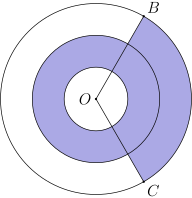
Three concentric circles centered at have radii of and Points and lie on the largest circle. The region between the two smaller circles is shaded, as is the portion of the region between the two larger circles bounded by central angle as shown in the figure below. Suppose the shaded and unshaded regions are equal in area. What is the measure of in degrees?
Answer: A
Solution:
Let be the measure of
One component of the shaded region is the area of the circle with radius minus the area of the circle with radius This part has area The remaining area is a sector of the biggest circle minus the area of the circle with radius . This has area Hence, the total area of the shaded region is
Next, we note that the unshaded region is composed of the smallest circle and the unshaded portion of the outer ring. This will have a total area of
Lastly, we equate the area of both regions and solve for
Thus, A is the correct answer.
19.
Jordan owns pairs of sneakers. Three fifths of the pairs are red and the rest are white. Two thirds of the pairs are high-top and the rest are low-top. The red high-top sneakers make up a fraction of the collection. What is the least possible value of this fraction?
Answer: C
Solution:
Jordan has pairs of red sneakers and pairs of white sneakers. Moreover, are high-top and are low-top. If we want to minimize the number of red high-top sneakers, then we can set all white sneakers to be high-top, leaving red sneakers as high-top. Hence, the fraction of red high-top sneakers would be .
Thus, C is the correct answer.
20.
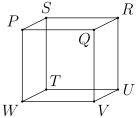
Any three vertices of the cube shown in the figure below, can be connected to form a triangle. (For example, vertices and can be connected to form isosceles ) How many of these triangles are equilateral and contain as a vertex?
Answer: D
Solution:
We first note that we can only form equilateral triangles if we go through the diagonals of the square faces, otherwise at least one angle of the triangle will be different. Afterwards, it is easy to exhaust all possible equilateral triangles that can be formed: and
Thus, D is the correct answer.
21.
A group of frogs (called an army) is living in a tree. A frog turns green when in the shade and turns yellow when in the sun. Initially, the ratio of green to yellow frogs was Then green frogs moved to the sunny side and yellow frogs moved to the shady side. Now the ratio is What is the difference between the number of green frogs and yellow frogs now?
Answer: E
Video solution:
Click to load, then click again to play
Written solution:
We can let be the number of green frogs and be the number of yellow frogs. Initially, we have . Then, after some frogs moved, we have the following proportion:
Substituting for will allow us to determine the number of yellow frogs originally ():
Hence, there were yellow frogs and green frogs initially. After some frogs moved, we now have yellow frogs and green frogs, giving us a difference of between the number of green and yellow frogs.
Thus, E is the correct answer.
22.
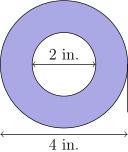
A roll of tape is inches in diameter and is wrapped around a ring that is inches in diameter. A cross section of the tape is shown in the figure below. The tape is inches thick. If the tape is completely unrolled, approximately how long would it be? Round your answer to the nearest inches.
Answer: B
Video solution:
Click to load, then click again to play
Written solution:
We have a huge margin of error for this problem so we can freely estimate values. Firstly, we note that the entire roll of tape is 1-inch thick, and given that a single tape is inches thick, then there are layers of tape in the entire roll.
Then, we must identify an estimate for the circumference of one layer of tape. Near the center, one layer of tape will have a circumference of while the layers near the outer section will have a circumference of about . A good estimate would be to take the average circumference which is . With this, we can estimate the total length for the entire roll:
Thus, B is the correct answer.
23.
Rodrigo has a very large piece of graph paper. First he draws a line segment connecting point to point and colors the cells whose interiors intersect the segment, as shown below. Next, Rodrigo draws a line segment connecting point to point Again he colors the cells whose interiors intersect the segment. How many cells will he color this time?
Answer: C
Video solution:
Click to load, then click again to play
Written solution:
For a segment whose endpoint differences are horizontally and vertically, the segment crosses vertical grid lines and horizontal grid lines, but crossings at lattice points are counted twice. Therefore the number of cells whose interiors are intersected is
Here the endpoint differences are and , and . Thus the number of cells colored is
Thus, C is the correct answer.
24.
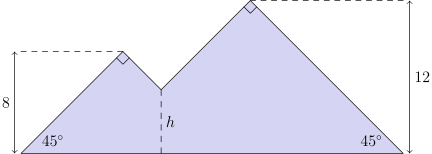
Jean made a piece of stained glass art in the shape of two mountains, as shown in the figure below. One mountain peak is feet high and the other peak is feet high. Each peak forms a angle, and the straight sides of the mountains form angles with the ground. The artwork has an area of square feet. The sides of the mountains meet at an intersection point near the center of the artwork, feet above the ground. What is the value of
Answer: B
Video solution:
Click to load, then click again to play
Written solution:
Each mountain is a triangle. A right isosceles triangle with height has area , since its two perpendicular sides each have length .
The two large mountains have areas and . Their overlap is also a triangle with height , so its area is . Thus so , and .
Thus, B is the correct answer.
25.
A small airplane has rows of seats with seats in each row. Eight passengers have boarded the plane and are distributed randomly among the seats. A married couple is next to board. What is the probability there will be adjacent seats in the same row for the couple?
Answer: C
Video solution:
Click to load, then click again to play
Written solution:
After the first passengers sit, there are empty seats among the seats, so there are equally likely sets of empty seats.
Count the complement, where no row has two adjacent empty seats. In a row of three seats, the possible empty-seat patterns with no adjacent empty seats have sizes , with choices respectively. So we need the coefficient of in This coefficient is
Therefore the probability that at least one row has adjacent empty seats is
Thus, C is the correct answer.