
2006 AMC 8 Problems
Scroll down and press Start to try the exam! Or, go to the printable PDF, answer key, or professional solutions curated by LIVE by Po-Shen Loh.
All problems are used with official legal permission of the Mathematical Association of America (MAA).
Or jump straight to a single problem with its solution: 1 · 2 · 3 · 4 · 5 · 6 · 7 · 8 · 9 · 10 · 11 · 12 · 13 · 14 · 15 · 16 · 17 · 18 · 19 · 20 · 21 · 22 · 23 · 24 · 25
Want to learn professionally through interactive video classes?
Timed
40:00
1.
Mindy made three purchases for , , and . What was her total, to the nearest dollar?
Answer: D
Small Hint:
Round each price to the nearest dollar before adding.
Big Hint:
The exact cents are not needed because the question asks for the nearest dollar.
Solution:
Since all the values are already close to a whole number, we can just add the sums of the rounded numbers.
These prices round to and which add to
Thus, D is the correct answer.
2.
On the AMC contest Billy answers questions correctly, answers questions incorrectly and doesn’t answer the last What is his score?
Answer: C
Small Hint:
On the AMC only correct answers add to the score.
Big Hint:
Incorrect and blank answers do not change the number of correct answers.
Solution:
Since the AMC only awards point for each correct question, Billy will get points.
Thus, C is the correct answer.
3.
Elisa swims laps in the pool. When she first started, she completed laps in minutes. Now, she can finish laps in minutes. By how many minutes has she improved her lap time?
Answer: A
Small Hint:
Find Elisa’s minutes per lap before and after the improvement.
Big Hint:
Compare minutes per lap with minutes per lap.
Solution:
Initially, Elisa swam one lap in minutes. Now she swims one lap in minutes.
Therefore, she improved her lap time by minute.
Thus, A is the correct answer.
4.
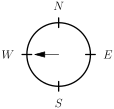
Initially, a spinner points west. Chenille moves it clockwise revolutions and then counterclockwise revolutions. In what direction does the spinner point after the two moves?
North
East
South
West
Northwest
Answer: B
Small Hint:
Whole revolutions do not change the final direction.
Big Hint:
After removing whole turns, compare a clockwise quarter-turn with a counterclockwise three-quarter-turn.
Solution:
If the spinner goes revolutions clockwise and revolutions counterclockwise, it goes revolutions counterclockwise.
This means that the spinner will be pointing east.
Thus, B is the correct answer.
5.
Points and are midpoints of the sides of the larger square. If the larger square has area what is the area of the smaller square?

Answer: D
Small Hint:
The four corner triangles around the smaller square are congruent.
Big Hint:
Those four outside triangles can be rearranged to cover the smaller square.
Solution:
Note that we can fold all the triangles in to perfectly cover the smaller square. This means that area of the smaller square is half the area of the larger square.
This makes the area of the smaller square
Thus, D is the correct answer.
6.
The letter T is formed by placing two inch rectangles next to each other, as shown. What is the perimeter of the T, in inches?

Small Hint:
Start with the perimeters of the two rectangles separately.
Big Hint:
The shared interior segments are counted in the separate perimeters but not in the outside perimeter.
Solution:
If we found the total perimeter of the two rectangles separately, we would have gotten
In the letter T, we can see that their intersection removes a piece of length from each of the rectangles. Therefore, the perimeter of the T is
Thus, C is the correct answer.
7.
Circle has a radius of Circle has a circumference of Circle has an area of List the circles in order from smallest to largest radius.
Answer: B
Small Hint:
Convert all three pieces of information into radii.
Big Hint:
Use for circle and for circle .
Solution:
Recall that and Using these formulas we get that the radius of is We also get that the radius of is As is greater than and less than the correct order is
Thus, the answer is B .
8.
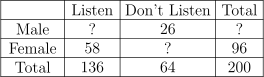
The table shows some of the results of a survey by radio station KAMC. What percentage of the males surveyed listen to the station?
Answer: E
Small Hint:
Use the totals to fill in the number of males surveyed.
Big Hint:
Find the male listeners by subtracting the male non-listeners from the male total.
Solution:
The total number of males surveyed is the total number surveyed minus the number of females surveyed: .
Of those males, do not listen, so males listen. The desired percentage is .
Thus, E is the correct answer.
9.
What is the product of
Answer: C
Small Hint:
Most adjacent numerators and denominators cancel.
Big Hint:
After cancellation, only the first denominator and the last numerator remain.
Solution:
Note that the numerator of every fraction cancels with the denominator of the following fraction. This leaves two numbers:
Thus, C is the correct answer.
10.
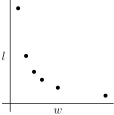
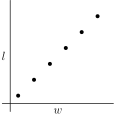
Jorge’s teacher asks him to plot all the ordered pairs of positive integers for which is the width and is the length of a rectangle with area What should his graph look like?
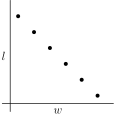
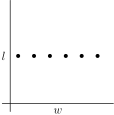
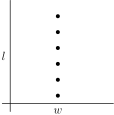
Answer: A
Small Hint:
List the positive integer factor pairs of .
Big Hint:
Remember that and are different plotted points when the factors differ.
Solution:
The positive integer factor pairs with are and .
These points form a decreasing set of six points, and only graph A matches them.
Thus, A is the correct answer.
11.
How many two-digit numbers have digits whose sum is a perfect square?
Answer: C
Small Hint:
The largest possible digit sum is .
Big Hint:
Count the two-digit numbers whose digit sums are and .
Solution:
There is number whose digit sum is :
There are numbers whose digit sum is : and
There are numbers whose digit sum is : and
There are numbers whose digit sum is : and
Therefore, there are numbers that satisfy the problem statement.
Thus, C is the correct answer.
12.
Antonette gets on a -problem test, on a -problem test and on a -problem test. If the three tests are combined into one -problem test, which percent is closest to her overall score?
Answer: D
Small Hint:
Convert each test percentage into a number of correct answers.
Big Hint:
This is a weighted average by number of problems, not a plain average of the three percentages.
Solution:
Antonette got questions right on the first test. Similarly, she got and problems right on her second and third tests.
Adding these up yields correct questions. Her score on the combined test would have been , closest to .
Thus, D is the correct answer.
13.
Cassie leaves Escanaba at AM heading for Marquette on her bike. She bikes at a uniform rate of miles per hour. Brian leaves Marquette at AM heading for Escanaba on his bike. He bikes at a uniform rate of miles per hour. They both bike on the same -mile route between Escanaba and Marquette. At what time in the morning do they meet?
Answer: D
Small Hint:
First account for Cassie’s half-hour head start.
Big Hint:
After Brian starts, the distance between them closes at the sum of their speeds.
Solution:
By the time Brian starts biking, Cassie has already traveled miles. This means that Cassie and Brian are then miles apart.
Together, they close the distance at miles per hour. This means that they meet hours after AM.
This means that they meet at AM.
Thus, D is the correct answer.
14.
Problems and involve Mrs. Reed’s English assignment.
A Novel Assignment
The students in Mrs. Reed’s English class are reading the same -page novel. Three friends, Alice, Bob and Chandra, are in the class. Alice reads a page in seconds, Bob reads a page in seconds and Chandra reads a page in seconds.
If Bob and Chandra both read the whole book, Bob will spend how many more seconds reading than Chandra?
Answer: B
Small Hint:
Compare Bob and Chandra by seconds per page.
Big Hint:
Bob takes the same extra number of seconds on each of the pages.
Solution:
Bob will take seconds to read the book, and Chandra will take seconds.
The difference between the time they spent reading is seconds.
Thus, B is the correct answer.
15.
Chandra and Bob, who each have a copy of the book, decide that they can save time by “team reading” the novel. In this scheme, Chandra will read from page to a certain page and Bob will read from the next page through page finishing the book. When they are through they will tell each other about the part they read. What is the last page that Chandra should read so that she and Bob spend the same amount of time reading the novel?
Answer: C
Small Hint:
Let be the number of pages Chandra reads.
Big Hint:
Set Chandra’s time for pages equal to Bob’s time for the remaining pages.
Solution:
Let be the number of pages that Chandra will read. Then Bob will read pages.
For them to read for the same amount of time,
Thus, C is the correct answer.
16.
Before Chandra and Bob start reading, Alice says she would like to team read with them. If they divide the book into three sections so that each reads for the same length of time, how many seconds will each have to read?
Answer: E
Small Hint:
Compare how many pages each person reads in the same amount of time.
Big Hint:
A common time such as seconds makes all three page counts whole numbers.
Solution:
If all individuals read the same amount of time, then the number of pages Bob, Chandra, and Alice will read will be in the ratio respectively.
This means that they will read and pages respectively. Since they all read for the same amount of time, we can just calculate how long it takes for Bob to read his portion.
Bob will take seconds to read his portion.
Thus, E is the correct answer.
17.
Jeff rotates spinners and and adds the resulting numbers. What is the probability that his sum is an odd number?
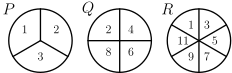
Answer: B
Small Hint:
Track only odd and even values, not the exact sums.
Big Hint:
Spinner always gives an even number, and spinner always gives an odd number.
Solution:
Spinner always lands on an even number, so it does not change the parity of the total. Spinner always lands on an odd number.
For the full sum to be odd, the number from spinner must be even. Only one of the three equal sectors of spinner contains an even number.
Therefore the probability is .
Thus, B is the correct answer.
18.
A cube with -inch edges is made using cubes with -inch edges. Nineteen of the smaller cubes are white and eight are black. If the eight black cubes are placed at the corners of the larger cube, what fraction of the surface area of the larger cube is white?
Answer: D
Small Hint:
Look at one face of the large cube.
Big Hint:
Each face has four corner unit squares from black corner cubes and five other unit squares.
Solution:
Since each face has the same black and white surface area, we can analyze what fraction of one side is white.
On one side, there are unit squares. of them are black. This means that of each face is white.
Thus, D is the correct answer.
19.
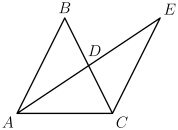
Triangle is an isosceles triangle with Point is the midpoint of both and and is units long. Triangle is congruent to triangle What is the length of
Answer: D
Small Hint:
Use the congruent triangles to relate and .
Big Hint:
Then use and the fact that is the midpoint of .
Solution:
By the congruency condition, we know that
Also from the isosceles condition, we know that
Since is the midpoint of we know that
Thus, D is the correct answer.
20.
A singles tournament had six players. Each player played every other player only once, with no ties. If Helen won games, Ines won games, Janet won games, Kendra won games and Lara won games, how many games did Monica win?
Answer: C
Small Hint:
Count how many games are played in a six-player round robin.
Big Hint:
Every game has exactly one winner, so total wins equal total games.
Solution:
In every match, there was exactly one winner. There are games and therefore wins.
There are already wins accounted for, so Monica won games.
Thus, C is the correct answer.
21.
An aquarium has a rectangular base that measures cm by cm and has a height of cm. The aquarium is filled with water to a depth of cm. A rock with volume is then placed in the aquarium and completely submerged. By how many centimeters does the water level rise?
Answer: A
Small Hint:
A submerged object raises the water by its own volume.
Big Hint:
Divide the rock’s volume by the base area of the aquarium.
Solution:
The base area of the aquarium is .
The submerged rock displaces of water, so the water level rises by cm.
Thus, A is the correct answer.
22.
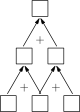
Three different one-digit positive integers are placed in the bottom row of cells. Numbers in adjacent cells are added and the sum is placed in the cell above them. In the second row, continue the same process to obtain a number in the top cell. What is the difference between the largest and smallest numbers possible in the top cell?
Answer: D
Small Hint:
Write the three bottom entries as and .
Big Hint:
The middle bottom entry is counted twice in the top number.
Solution:
If the lower cells contain and the middle row will have and .
This means that the top row will have . To minimize this, put in the middle and and in the outer cells. This yields a top number of .
To maximize it, put in the middle and and in the outer cells. This yields a top number of . The desired difference is .
Thus, D is the correct answer.
23.
A box contains gold coins. If the coins are equally divided among six people, four coins are left over. If the coins are equally divided among five people, three coins are left over. If the box holds the smallest number of coins that meets these two conditions, how many coins are left when equally divided among seven people?
Answer: A
Small Hint:
List small numbers that leave remainder when divided by .
Big Hint:
Equivalently, adding two coins would make the number divisible by both and .
Solution:
The positive integers that leave a remainder of when divided by are The positive integers that leave a remainder of when divided by are
From this, we can see that the smallest number of coins that work is This leaves a remainder of when divided by
Thus, A is the correct answer.
24.
In the multiplication problem below are different digits. What is
Answer: A
Small Hint:
Write as .
Big Hint:
Since is nonzero, divide the equation by the two-digit number .
Solution:
Note that This forces Then and
Thus, A is the correct answer.
25.
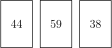
Barry wrote different numbers, one on each side of cards, and laid the cards on a table, as shown. The sums of the two numbers on each of the three cards are equal. The three numbers on the hidden sides are prime numbers. What is the average of the hidden prime numbers?
Small Hint:
The common card sum must have the same parity for all three visible numbers.
Big Hint:
Use the fact that is the only even prime.
Solution:
The common sum must be odd. If the common sum were even, then the hidden numbers behind and would both have to be even primes, but there is only one even prime.
So the prime hidden behind the odd visible number must be , making the common sum .
The other two hidden primes are and .
The average of the hidden primes is .
Thus, B is the correct answer.