
2004 AMC 8 Solutions
Scroll down to view professionally curated solutions from LIVE by Po-Shen Loh, print PDF solutions, view answer key, or take the full timed exam.
All problems are used with official legal permission of the Mathematical Association of America (MAA).
1.
On a map, a -centimeter length represents kilometers. How many kilometers does a -centimeter length represent?
Small Hint:
Find how many kilometers centimeter represents.
Big Hint:
Multiply that scale by
Solution:
Note that cm represents kilometers. This means that cm represents kilometers.
Thus, B is the correct answer.
2.
How many different four-digit numbers can be formed by rearranging the four digits in
Small Hint:
A four-digit number cannot start with
Big Hint:
Choose which nonzero digit comes first, then place the other nonzero digit.
Solution:
Note that there are non-zero digits that could be the thousands digit.
After choosing that, we need to arrange the other digits. There are spots for the other non-zero digit.
This gives us possible numbers.
Thus, B is the correct answer.
3.
Twelve friends met for dinner at Oscar’s Overstuffed Oyster House, and each ordered one meal. The portions were so large, there was enough food for people. If they shared, how many meals should they have ordered to have just enough food for the of them?
Small Hint:
The meals made enough food for people.
Big Hint:
Find how many meals are needed per person, then scale to people.
Solution:
Note that meals feed people. This means that one meal feeds people.
This means that they need meals for people.
Thus, A is the correct answer.
4.
Ms. Hamilton’s eighth-grade class wants to participate in the annual three-person-team basketball tournament. Lance, Sally, Joy, and Fred are chosen for the team. In how many ways can the three starters be chosen?
Small Hint:
Choosing the three starters is the same as choosing who sits out.
Big Hint:
There are possible players who could be the alternate.
Solution:
If there are starters, then one person must not be starting. Choosing the person who doesn’t start determines the starters.
There are choices for the person who doesn’t start.
Thus, B is the correct answer.
5.
Ms. Hamilton’s eighth-grade class wants to participate in the annual three-person-team basketball tournament. The losing team of each game is eliminated from the tournament. If sixteen teams compete, how many games will be played to determine the winner?
Small Hint:
Each game eliminates exactly one team.
Big Hint:
The tournament ends when all but one team have been eliminated.
Solution:
Note that after every game, one team gets eliminated. For there to be one team remaining, teams must have been eliminated.
This means that games had to have been played.
Thus, D is the correct answer.
6.
After Sally takes shots, she has made of her shots. After she takes more shots, she raises her percentage to How many of the last shots did she make?
Small Hint:
Find how many shots Sally had made after shots.
Big Hint:
Find how many total made shots she had after shots.
Solution:
Sally made of her first shots. Then we get that which tells us that and
Thus, C is the correct answer.
7.
An athlete’s target heart rate, in beats per minute, is of the theoretical maximum heart rate. The maximum heart rate is found by subtracting the athlete’s age, in years, from To the nearest whole number, what is the target heart rate of an athlete who is years old?
Small Hint:
First compute
Big Hint:
Take of that maximum heart rate and round.
Solution:
The maximum heart rate for this athlete would be Then the target heart rate would be
Thus, B is the correct answer.
8.
Find the number of two-digit positive integers whose digits total
Small Hint:
The tens digit cannot be
Big Hint:
Once the tens digit is chosen, the ones digit is forced.
Solution:
Note that the tens digit can range from to and this digit determines the units digit.
Therefore, there are numbers.
Thus, B is the correct answer.
9.
The average of the five numbers in a list is The average of the first two numbers is What is the average of the last three numbers?
Small Hint:
Turn each average into a sum.
Big Hint:
Subtract the sum of the first two numbers from the sum of all five.
Solution:
The sum of all numbers is The sum of the first numbers is
The sum of the last numbers is The average is therefore
Thus, D is the correct answer.
10.
Handy Aaron helped a neighbor hours on Monday, minutes on Tuesday, from to on Wednesday morning, and a half-hour on Friday. He is paid per hour. How much did he earn for the week?
Small Hint:
Convert all the work times to minutes.
Big Hint:
After finding total minutes, convert to hours before multiplying by
Solution:
Aaron worked minutes on Monday, minutes on Tuesday, minutes on Wednesday, and minutes on Friday.
The total is minutes, or hours.
At per hour, he earned dollars.
Thus, E is the correct answer.
11.
The numbers and are rearranged according to these rules:
The largest isn’t first, but it is in one of the first three places.
The smallest isn’t last, but it is in one of the last three places.
The median isn’t first or last.
What is the average of the first and last numbers?
Small Hint:
Use the rules to locate the largest, smallest, and median numbers.
Big Hint:
The first and last positions are filled by the two remaining numbers.
Solution:
Note that the largest, smallest, and median numbers cannot be the first or last number.
This means that the first and last numbers are and in some order. Their average is
Thus, C is the correct answer.
12.
Niki usually leaves her cell phone on. If her cell phone is on but she is not actually using it, the battery will last for hours. If she is using it constantly, the battery will last for only hours. Since the last recharge, her phone has been on hours, and during that time she has used it for minutes. If she doesn’t talk any more but leaves the phone on, how many more hours will the battery last?
Small Hint:
One hour of talking uses as much battery as several idle hours.
Big Hint:
The phone was idle for hours and used for hour.
Solution:
When not in use, her cell phone uses up of its battery per hour. When it is in use, it uses up of its battery per hour.
Niki’s phone has been on for hours, with of those hours being idle and hour being used to talk on the phone.
This means that the phone has used up of its battery. In order to drain the remaining of the battery, the phone can last for more hours without being used.
Thus, B is the correct answer.
13.
Amy, Bill and Celine are friends with different ages. Exactly one of the following statements is true.
Bill is the oldest.
Amy is not the oldest.
Celine is not the youngest.
Rank the friends from the oldest to youngest.
Bill, Amy, Celine
Amy, Bill, Celine
Celine, Amy, Bill
Celine, Bill, Amy
Amy, Celine, Bill
Small Hint:
If Bill were oldest, check how many statements would be true.
Big Hint:
After ruling out the oldest person, use the fact that exactly one statement is true.
Solution:
If Bill were oldest, then statements and would both be true, so Bill is not oldest.
If Celine were oldest, then statements and would both be true, so Celine is not oldest.
Therefore Amy is oldest. Statements and are false, so statement must be the single true statement. Thus Celine is not youngest, leaving Bill youngest.
The order is Amy, Celine, Bill.
Thus, E is the correct answer.
14.
What is the area enclosed by the geoboard quadrilateral below?
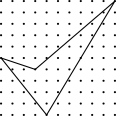
Small Hint:
Put the quadrilateral inside an easy surrounding square.
Big Hint:
Subtract the outside rectangles and right triangles from the surrounding square.
Solution:
Place the quadrilateral inside the surrounding square, whose area is
The five outside pieces have areas and
The outside area is so the quadrilateral area is
Thus, C is the correct answer.
15.
Thirteen shaded and six unshaded hexagonal tiles were used to create the figure below. If a new figure is created by attaching a border of unshaded tiles with the same size and shape as the others, what will be the difference between the total number of unshaded tiles and the total number of shaded tiles in the new figure?

Small Hint:
The original figure has one center tile, a ring of and a ring of
Big Hint:
The next hexagonal border has tiles.
Solution:
The original figure has shaded tiles and unshaded tiles.
The new border is the next hexagonal ring around the figure, which has unshaded tiles.
The new figure has unshaded tiles and shaded tiles, so the difference is
Thus, C is the correct answer.
16.
Two mL pitchers contain orange juice. One pitcher is full and the other pitcher is full. Water is added to fill each pitcher completely, then both pitchers are poured into one large container. What fraction of the mixture in the large container is orange juice?
Small Hint:
Compute the orange juice in each pitcher before water is added.
Big Hint:
After filling both pitchers, the total mixture volume is mL.
Solution:
The first pitcher contains mL of orange juice. The second one has mL.
The large container then has mL of orange juice. The total amount of mixture is mL.
Then the fraction of orange juice is
Thus, C is the correct answer.
17.
Three friends have a total of identical pencils, and each one has at least one pencil. In how many ways can this happen?
Small Hint:
Give each friend one pencil first.
Big Hint:
Count the ways to distribute the remaining pencils among the friends.
Solution:
First give each friend one pencil. Then pencils remain to distribute among the friends.
If one friend gets all remaining pencils, there are ways. If the remaining pencils split as and there are ways. If each friend gets one more, there is way.
The total number of ways is
Thus, D is the correct answer.
18.
Five friends compete in a dart-throwing contest. Each one has two darts to throw at the same circular target, and each individual’s score is the sum of the scores in the target regions that are hit. The scores for the target regions are the whole numbers through Each throw hits the target in a region with a different value. The scores are: Alice points, Ben points, Cindy points, Dave points, and Ellen points. Who hits the region worth points?
Alice
Ben
Cindy
Dave
Ellen
Small Hint:
Ben’s score of has only one possible pair of distinct positive scores.
Big Hint:
Use each forced pair to eliminate numbers from the remaining scores.
Solution:
The only way to get Ben’s score of is with a and since he can’t hit twice.
Cindy can achieve her score with Ben already hit and so Cindy must have hit and
Similarly, Dave must have hit and Finally, since is already used, Alice is forced to have hit and with Ellen hitting and
Thus, A is the correct answer.
19.
A whole number larger than leaves a remainder of when divided by each of the numbers and The smallest such number lies between which two numbers?
and
and
and
and
and
Small Hint:
If the number leaves remainder subtract
Big Hint:
The result must be divisible by and
Solution:
Let be the number. Then is divisible by and
The least common multiple of these numbers is which makes
Thus, B is the correct answer.
20.
Two-thirds of the people in a room are seated in three-fourths of the chairs. The rest of the people are standing. If there are empty chairs, how many people are in the room?
Small Hint:
The empty chairs are the remaining one-fourth of the chairs.
Big Hint:
The seated people are two-thirds of all the people.
Solution:
Since of the chairs are occupied, the empty chairs are of all the chairs. Thus there are chairs.
The number of seated people is of which is
Those seated people are of all the people, so the total number of people is
Thus, D is the correct answer.
21.
Spinners and are spun. On each spinner, the arrow is equally likely to land on each number. What is the probability that the product of the two spinners’ numbers is even?
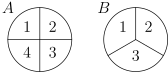
Small Hint:
It is easier to count the complement: an odd product.
Big Hint:
An odd product requires both spinner results to be odd.
Solution:
For the product to be even, at least one of the spinners must land on an even number.
We can use complementary counting and calculate the probability of both spinners landing on odds.
This happens with a probability of
Then the probability of landing on at least one even is
Thus, D is the correct answer.
22.
At a party there are only single women and married men with their wives. The probability that a randomly selected woman is single is What fraction of the people in the room are married men?
Small Hint:
Use a convenient number of women matching the ratio
Big Hint:
Married women and married men come in equal numbers.
Solution:
For a convenient ratio model, let there be women in the room. Then there are single women.
This means that there are married women, which is also the number of married men.
There are a total of people in the room. The fraction of married men is
Thus, B is the correct answer.
23.
Tess runs counterclockwise around rectangular block She lives at corner Which graph could represent her straight-line distance from home?

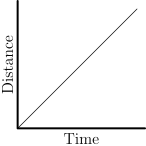
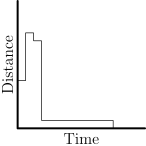
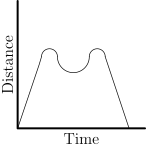
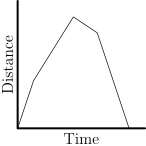
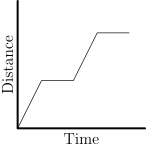
Small Hint:
Track the distance from corner at each side of the rectangle.
Big Hint:
The distance is greatest at the opposite corner
Solution:
As Tess runs from to her distance from home increases.
From to her distance continues to increase, but with a different shape, reaching its maximum at the opposite corner
From to and then from back to her distance decreases back to again changing behavior at
Graph is the only graph with this increase, changed-rate increase, changed-rate decrease, and final decrease to
Thus, D is the correct answer.
24.
In the figure, is a rectangle and is a parallelogram. Using the measurements given in the figure, what is the length of the segment that is perpendicular to and
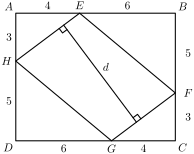
Small Hint:
Find the area of the rectangle and subtract the four corner triangles.
Big Hint:
Use the Pythagorean theorem to get the parallelogram base
Solution:
The rectangle has side lengths and so its area is
The four corner triangles have total area Thus parallelogram has area
Segment has length by the right triangle. Since the parallelogram area is we have so
Thus, C is the correct answer.
25.
Two squares intersect at right angles, bisecting their intersecting sides, as shown. The circle’s diameter is the segment between the two points of intersection. What is the area of the shaded region created by removing the circle from the squares?

Small Hint:
Find the area covered by the union of the two squares.
Big Hint:
The circle diameter is the diagonal of the overlap square.
Solution:
The two squares have total area but their overlap is a square with area Thus the area covered by the union of the two squares is
The circle’s diameter is the diagonal of that overlap square, so the diameter is and the radius is
The circle area is so the shaded area is
Thus, D is the correct answer.