
2002 AMC 8 Problems
Scroll down and press Start to try the exam! Or, go to the printable PDF, answer key, or professional solutions curated by LIVE by Po-Shen Loh.
All problems are used with official legal permission of the Mathematical Association of America (MAA).
Or jump straight to a single problem with its solution: 1 · 2 · 3 · 4 · 5 · 6 · 7 · 8 · 9 · 10 · 11 · 12 · 13 · 14 · 15 · 16 · 17 · 18 · 19 · 20 · 21 · 22 · 23 · 24 · 25
Want to learn professionally through interactive video classes?
Timed
40:00
1.
A circle and two distinct lines are drawn on a sheet of paper. What is the largest possible number of points of intersection of these figures?
Answer: D
Small Hint:
Count each type of pair of figures separately.
Big Hint:
Each line can meet the circle at most twice, and the two lines can meet once.
Solution:
A line and a circle can intersect at no more than two points, and two distinct lines can intersect at no more than one point.
Arrange the two lines so each meets the circle twice and the two lines meet at a different point. This gives
Thus, D is the correct answer.
2.
How many different combinations of bills and bills can be used to make a total of Order does not matter in this problem.
Answer: A
Small Hint:
Because is odd, the number of bills must be odd.
Big Hint:
Try the possible odd numbers of bills before the total goes over
Solution:
Since the total is odd, the number of bills must be odd.
One bill leaves which is six bills. Three bills leave which is one bill. Five bills is too much.
Therefore, there are combinations.
Thus, A is the correct answer.
3.
What is the smallest possible average of four distinct positive even integers?
Answer: C
Small Hint:
To make the average as small as possible, choose the smallest possible integers.
Big Hint:
Use the four smallest distinct positive even integers.
Solution:
To get the smallest possible average, we want to use the smallest positive even integers.
This can be achieved as follows:
Thus, C is the correct answer.
4.
The year is a palindrome (a number that reads the same from left to right as it does from right to left). What is the product of the digits of the next year after that is a palindrome?
Answer: B
Small Hint:
The next palindrome after still starts and ends with
Big Hint:
The middle two digits must increase to the smallest matching pair.
Solution:
We don’t want to increase the thousands digit, so we can keep that as
This means that we have to increase the tens and hundreds digits to to yield the next palindrome of The product of its digits is
Thus, B is the correct answer.
5.
Carlos Montado was born on Saturday, November On what day of the week will Carlos be days old?
Monday
Wednesday
Friday
Saturday
Sunday
Answer: C
Small Hint:
Reduce modulo
Big Hint:
days is an exact number of weeks.
Solution:
The days of the week cycle every days. After days, the day of the week will still be Saturday.
After more days, the day of the week will be Friday.
Thus, C is the correct answer.
6.
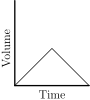
A birdbath is designed to overflow so that it will be self-cleaning. Water flows in at the rate of milliliters per minute and drains at the rate of milliliters per minute. One of these graphs shows the volume of water in the birdbath during the filling time and continuing into the overflow time. Which one is it?
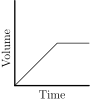
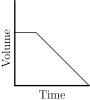
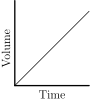
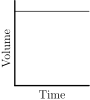
Answer: A
Small Hint:
Before overflow, the volume rises at a constant positive rate.
Big Hint:
After the birdbath is full, extra water overflows so the volume stays constant.
Solution:
Before the birdbath overflows, it gains milliliters of water per minute, so its volume increases steadily.
Once the birdbath is full, the incoming extra water overflows, so the volume remains constant. Only graph A shows an increasing line followed by a horizontal line.
Thus, A is the correct answer.
7.
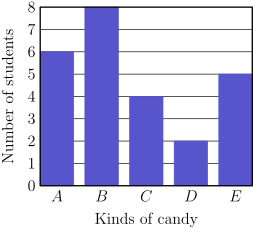
The students in Mrs. Sawyer’s class were asked to do a taste test of five kinds of candy. Each student chose one kind of candy. A bar graph of their preferences is shown. What percent of her class chose candy
Answer: E
Small Hint:
Add the heights of all five bars to get the class size.
Big Hint:
Compare the height of bar with the total number of students.
Solution:
There are a total of students in the class. The percent that chose is
Thus, E is the correct answer.
8.
Problems and use the data found in the accompanying paragraph and table.
Juan’s Old Stamping Grounds
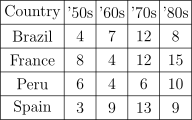
Juan organizes the stamps in his collection by country and by the decade in which they were issued. The prices he paid for them at a stamp shop were: Brazil and France, ¢ each, Peru ¢ each, and Spain ¢ each. (Brazil and Peru are South American countries and France and Spain are in Europe.)
Number of Stamps by Decade
How many of his European stamps were issued in the ‘s?
Answer: D
Small Hint:
European means France and Spain in the table.
Big Hint:
Use only the entries in the ‘s column.
Solution:
Note that France and Spain are the European countries. The number of ‘s stamps from these countries respectively is and for a total of stamps.
Thus, D is the correct answer.
9.
His South American stamps issued before the ‘s cost him
Answer: B
Small Hint:
South American means Brazil and Peru.
Big Hint:
Before the ‘s means the ‘s and ‘s columns.
Solution:
Brazil and Peru are the South American countries.
Brazil has stamps before the ‘s, costing cents. Peru has such stamps, costing cents.
The total cost is cents, or
Thus, B is the correct answer.
10.
The average price of his ‘s stamps is closest to
¢
¢
¢
¢
¢
Answer: E
Small Hint:
Compute the total cost of all ‘s stamps.
Big Hint:
Divide the total cost by the number of ‘s stamps, then choose the closest option.
Solution:
The ‘s stamps cost cents.
There are stamps, so the average cost is a little more than cents and closest to cents.
Thus, E is the correct answer.
11.
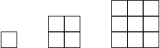
A sequence of squares is made of identical square tiles. The edge of each square is one tile length longer than the edge of the previous square. The first three squares are shown. How many more tiles does the seventh square require than the sixth?
Answer: C
Small Hint:
The sixth and seventh squares have side lengths and
Big Hint:
Compare and
Solution:
The sixth and seventh squares have side lengths and tile lengths.
They use and tiles, respectively, so the seventh square requires more tiles.
Thus, C is the correct answer.
12.
A board game spinner is divided into three regions labeled and The probability of the arrow stopping on region is and on region is The probability of the arrow stopping on region is
Answer: B
Small Hint:
The probabilities of and add to
Big Hint:
Subtract the probabilities for and from
Solution:
The total probability is We need to subtract the probability of the spinner landing on and to get which is
Thus, B is the correct answer.
13.
For his birthday, Bert gets a box that holds jellybeans when filled to capacity. A few weeks later, Carrie gets a larger box full of jellybeans. Her box is twice as high, twice as wide and twice as long as Bert’s. Approximately, how many jellybeans did Carrie get?
Answer: E
Small Hint:
Doubling length, width, and height multiplies volume by
Big Hint:
Scale the number of jellybeans by the volume factor.
Solution:
The larger box will have approximately jellybeans.
Thus, E is the correct answer.
14.
A merchant offers a large group of items at off. Later, the merchant takes off these sale prices and claims that the final price of these items is off the original price. The total discount is
Answer: B
Small Hint:
After a discount, of the original price remains.
Big Hint:
The second discount is off the sale price, not the original price.
Solution:
Let the original price be After the discount, the price is
Taking another off that sale price leaves
The customer pays of the original price, so the total discount is
Thus, B is the correct answer.
15.
Which of the following polygons has the largest area?
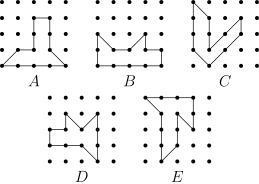
Answer: E
Small Hint:
Break each polygon into unit squares and half-unit triangles.
Big Hint:
Compare the five areas by counting full squares plus half-squares.
Solution:
The number of boxes enclosed by each polygon can be obtained by dividing the polygon into unit squares and right triangles with sidelength and adding up their values.
The unit squares count as and the triangles count as
has a total area of has has has and has
Thus, E is the correct answer.
16.
Right isosceles triangles are constructed on the sides of a right triangle, as shown. A capital letter represents the area of each triangle. Which one of the following is true?
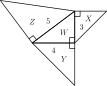
Answer: E
Small Hint:
Each right isosceles triangle has area half the square of the side it is built on.
Big Hint:
Compute the areas on the sides and
Solution:
For a right isosceles triangle built on a side of length the two legs have length so its area is
These values satisfy and the other listed equations do not.
Thus, E is the correct answer.
17.
In a mathematics contest with ten problems, a student gains points for a correct answer and loses points for an incorrect answer. If Olivia answered every problem and her score was how many correct answers did she have?
Answer: C
Small Hint:
Let be the number of correct answers.
Big Hint:
Then the number of incorrect answers is
Solution:
Let be the number of correct answers. Then she answered questions incorrectly.
This gives her a total score of
We know that this equals and solving yields
Thus, C is the correct answer.
18.
Gage skated hr min each day for days and hr min each day for days. How long would he have to skate the ninth day in order to average minutes of skating each day for the entire time?
hr
hr min
hr min
hr min
hr
Answer: E
Small Hint:
Convert all skating times to minutes.
Big Hint:
Find the total minutes needed for a -day average of
Solution:
Gage has skated a total of minutes.
For an average of minutes over days, Gage must have skated a total of minutes.
This means that Gage must skate minutes on the last day. Note that minutes is the same as hours.
Thus, E is the correct answer.
19.
How many whole numbers between and contain exactly one
Small Hint:
The number is a three-digit number.
Big Hint:
The single can be in the tens place or the ones place, but not the hundreds place.
Solution:
Note that the digit can either be the tens or the units digit. This gives us options for this.
There are options for each of the other digits for a total of numbers.
Thus, D is the correct answer.
20.
The area of triangle is square inches. Points and are midpoints of congruent segments and Altitude bisects The area (in square inches) of the shaded region is
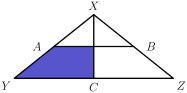
Answer: D
Small Hint:
The altitude splits the isosceles triangle into two equal halves.
Big Hint:
The segment through the midpoints creates a similar triangle with half the side lengths.
Solution:
Since and bisects altitude splits into two congruent triangles. The left half has area
In point is the midpoint of The horizontal segment through meets halfway up, so the small top triangle is similar to with scale factor Its area is therefore of or
The shaded region is the rest of the left half, so its area is
Thus, D is the correct answer.
21.
Harold tosses a nickel four times. The probability that he gets at least as many heads as tails is
Answer: E
Small Hint:
At least as many heads as tails means or heads.
Big Hint:
Count outcomes by choosing which tosses are heads.
Solution:
There are equally likely outcomes for four coin tosses.
At least as many heads as tails means getting or heads. The number of such outcomes is
Thus the probability is
Thus, E is the correct answer.
22.
Six cubes, each an inch on an edge, are fastened together, as shown. Find the total surface area in square inches. Include the top, bottom, and sides.

Answer: C
Small Hint:
Start with separate cubes, each with exposed faces.
Big Hint:
Each glued pair of faces removes two exposed faces.
Solution:
We can count the number of unexposed faces to find how many faces contribute to the surface area.
Three cubes have face unexposed, two cubes have faces unexposed, and one cube has faces unexposed.
This gives us a total of unexposed faces, which gives us exposed faces.
Each exposed face contributes to the surface area, for a total surface area of
Thus, C is the correct answer.
23.
A corner of a tiled floor is shown. If the entire floor is tiled in this way and each of the four corners looks like this one, then what fraction of the tiled floor is made of darker tiles?
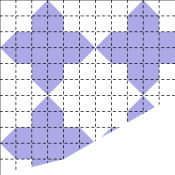
Answer: B
Small Hint:
Look for a repeating block.
Big Hint:
In one block, combine pairs of half dark squares into whole dark squares.
Solution:
Notice that there are repeating regions with the same pattern (they might be rotated differently).

In this region, there are three dark unit squares and two dark triangles that combine to form another unit square.
This makes the area of the darker region and the whole region The desired fraction is then
Thus, B is the correct answer.
24.
Miki has a dozen oranges of the same size and a dozen pears of the same size. Miki uses her juicer to extract ounces of pear juice from pears and ounces of orange juice from oranges. She makes a pear-orange juice blend from an equal number of pears and oranges. What percent of the blend is pear juice?
Answer: B
Small Hint:
Use an equal convenient number of pears and oranges.
Big Hint:
Six pears and six oranges make both juice amounts easy to compute.
Solution:
Use pears and oranges, which is an equal number of each fruit.
Since pears make ounces, pears make ounces. Since oranges make ounces, oranges make ounces.
The blend has ounces total, of which ounces is pear juice. The pear-juice percent is
Thus, B is the correct answer.
25.
Loki, Moe, Nick and Ott are good friends. Ott had no money, but the others did. Moe gave Ott one-fifth of his money, Loki gave Ott one-fourth of his money and Nick gave Ott one-third of his money. Each gave Ott the same amount of money. What fractional part of the group’s money does Ott now have?
Answer: B
Small Hint:
Assume each friend gives Ott the same convenient amount.
Big Hint:
If each gives Ott work backward to each friend’s original amount.
Solution:
Because only the fractions matter, suppose each person gave Ott This means that Moe had Loki had and Nick had originally.
The transfers do not change the group’s total amount of money, which is Ott now has
This means that Ott has of the group’s money.
Thus, B is the correct answer.