
2018 AMC 12B Problems
25 problems · 75 minutes
Scroll down and press Start to try the exam! Or, go to the printable PDF, answer key, or professional solutions curated by LIVE by Po-Shen Loh.
Or jump straight to a single problem with its solution: 1 · 2 · 3 · 4 · 5 · 6 · 7 · 8 · 9 · 10 · 11 · 12 · 13 · 14 · 15 · 16 · 17 · 18 · 19 · 20 · 21 · 22 · 23 · 24 · 25
All problems are used with official legal permission of the Mathematical Association of America (MAA).
Want to learn professionally through interactive video classes?
Learn LIVETimed
1:15:00
1.
Kate bakes a -inch by -inch pan of cornbread. The cornbread is cut into pieces that measure inches by inches. How many pieces of cornbread does the pan contain?
Small hint:
The pan and each piece are rectangles; compare their areas
Big hint:
Divide the total area by the area of one piece
Solution:
The whole pan has area square inches. Each piece is square inches. So the number of pieces is Thus, the correct answer is A.
2.
Sam drove miles in minutes. His average speed during the first minutes was mph (miles per hour), and his average speed during the second minutes was mph. What was his average speed, in mph, during the last minutes?
Answer: D
Concepts:distance rate and time
Small hint:
Distance = rate time, and each -minute leg is half an hour
Big hint:
Subtract the distance covered in the first hour from to get the last leg’s distance
Solution:
Each leg is half an hour. In the first, Sam drove miles; in the second, miles. That’s miles so far. That leaves miles for the last half hour, which is a speed of mph. Therefore, the answer is D.
3.
A line with slope intersects a line with slope at the point What is the distance between the -intercepts of these two lines?
Answer: B
Small hint:
Write each line in point-slope form through
Big hint:
Set in each equation to find its -intercept
Solution:
The line of slope is setting gives The line of slope is setting gives
The distance between the intercepts is
Thus, the correct answer is B.
4.
A circle has a chord of length and the distance from the center of the circle to the chord is What is the area of the circle?
Answer: B
Small hint:
The radius, half the chord, and the distance to the chord form a right triangle
Big hint:
With legs and the radius satisfies
Solution:
Dropping a perpendicular from the center to the chord bisects it, forming a right triangle with legs (half the chord) and (the distance), and hypotenuse
Then so the area is
Thus, the correct answer is B.
5.
How many subsets of contain at least one prime number?
Answer: D
Small hint:
Count the subsets with no prime and subtract from the total number of subsets
Big hint:
The non-prime elements are any subset of just those contains no prime
Solution:
Count the complement. The set has subsets total. A subset avoids every prime exactly when it sticks to the non-primes and there are of those. So subsets contain at least one prime. Thus, the correct answer is D.
6.
Suppose cans of soda can be purchased from a vending machine for quarters. Which of the following expressions describes the number of cans of soda that can be purchased for dollars, where dollar is worth quarters?
Answer: B
Small hint:
One can costs quarters
Big hint:
Convert dollars to quarters, then divide by the price per can
Solution:
One can costs quarters, which is dollars. The number of cans that dollars can buy is
Thus, the correct answer is B.
7.
What is the value of
Answer: C
Small hint:
Apply the change-of-base formula
Big hint:
Separate into two telescoping chains: bases and bases
Solution:
The factors split into two telescoping chains. The odd-position factors form and the even-position factors form
The product is
Thus, the correct answer is C.
8.
Line segment is a diameter of a circle with Point not equal to or lies on the circle. As point moves around the circle, the centroid (center of mass) of traces out a closed curve missing two points. To the nearest positive integer, what is the area of the region bounded by this curve?
Answer: C
Small hint:
The centroid of is and is twice the center
Big hint:
As moves on a circle of radius the centroid moves on a circle of one third the radius
Solution:
Put the center at the origin, so and while runs over the circle of radius Then so the centroid is As circles, traces a circle of radius (minus the two points where or ). Its area is Therefore, the answer is C.
9.
What is
Answer: E
Small hint:
Split the sum into
Big hint:
The sum of the first positive integers is
Solution:
Splitting the sum,
Since this equals
Thus, the correct answer is E.
10.
A list of positive integers has a unique mode, which occurs exactly times. What is the least number of distinct values that can occur in the list?
Answer: D
Small hint:
The non-mode entries can each appear at most times
Big hint:
Find the fewest distinct non-mode values needed, then add for the mode
Solution:
The mode uses of the entries, leaving Because the mode is unique, every other value appears at most times, so at least distinct non-mode values are needed.
Adding the mode gives This is achievable: use copies each of through ten copies of and one copy of
Thus, the correct answer is D.
11.
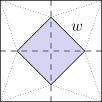
A closed box with a square base is to be wrapped with a square sheet of wrapping paper. The box is centered on the wrapping paper with the vertices of the base lying on the midlines of the square sheet of paper, as shown in the figure on the left. The four corners of the wrapping paper are to be folded up over the sides and brought together to meet at the center of the top of the box, point in the figure on the right. The box has base length and height What is the area of the sheet of wrapping paper?
Answer: A
Small hint:
If the sheet has side its center-to-corner distance is
Big hint:
Folding a corner to the top center covers, in a straight line, half the base, then the side of height then the other half of the top
Solution:
Let the sheet have side The base sits as a square of side turned so the center is from each base edge. A corner of the sheet lies from the center. Folding that corner up to the top center traces a straight line: out to the base edge, then up the side, then across the top. So Then and the area is Thus, the correct answer is A.
12.
Side of has length The bisector of angle meets at and The set of all possible values of is an open interval What is
Answer: C
Small hint:
By the angle bisector theorem,
Big hint:
Let so then apply the three triangle inequalities
Solution:
Let and The angle bisector theorem gives so
Applying the triangle inequalities to sides and and substituting yields and (the third inequality holds automatically). Together these force
So and
Thus, the correct answer is C.
13.
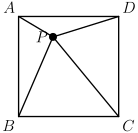
Square has side length Point lies inside the square so that and The centroids of and are the vertices of a convex quadrilateral. What is the area of that quadrilateral?
Answer: C
Small hint:
Place the square in coordinates and write
Big hint:
Each centroid averages three vertices; the four centroids form a square whose diagonals have length
Solution:
Place and Averaging the vertices, the four centroids are
These form a square whose diagonals, one horizontal and one vertical, each have length Its area is independent of where lies.
Thus, the correct answer is C.
14.
Joey and Chloe and their daughter Zoe all have the same birthday. Joey is year older than Chloe, and Zoe is exactly year old today. Today is the first of the birthdays on which Chloe’s age will be an integral multiple of Zoe’s age. What will be the sum of the two digits of Joey’s age the next time his age is a multiple of Zoe’s age?
Answer: E
Small hint:
Let Chloe be today; years from now her age is a multiple of Zoe’s exactly when divides
Big hint:
So must have exactly divisors; find the only two-digit such value
Solution:
Let Chloe be today, so she is years older than Zoe. In years Chloe’s age is a multiple of Zoe’s age exactly when divides Having such birthdays means has exactly divisors.
A number with exactly divisors has the form for distinct primes or Because Joey’s age at the requested future birthday has two digits, the only possibility is So Chloe is and Joey is
Joey’s age is a multiple of exactly when divides The next time is making Joey with digit sum
Thus, the correct answer is E.
15.
How many -digit positive odd multiples of do not include the digit
Answer: A
Small hint:
Choose the hundreds digit (not or ) and the units digit (odd, not ) first
Big hint:
For each such pair, the allowed tens digits split evenly into three residue classes mod
Solution:
Write the number as The hundreds digit has choices (), and the units digit has choices ().
The tens digit may be any of These split into three residue classes mod of equal size so exactly choices of make divisible by
The count is
Thus, the correct answer is A.
16.
The solutions to the equation are connected in the complex plane to form a convex regular polygon, three of whose vertices are labeled and What is the least possible area of
Answer: B
Small hint:
Shifting by does not change the shape; the roots of form a regular octagon
Big hint:
The circumradius is and the smallest triangle uses three consecutive vertices
Solution:
Translating by the solutions of are eight points on a circle of radius forming a regular octagon. The minimum-area triangle uses three consecutive vertices.
Take and Then and the height is so the area is
Thus, the correct answer is B.
17.
Let and be positive integers such that and is as small as possible. What is
Answer: A
Small hint:
Since and with integer sides, and
Big hint:
Add these after writing to bound
Solution:
From we get and from we get Now
Hence With the fraction lies strictly between and so and
Thus, the correct answer is A.
18.
A function is defined recursively by and
for all integers What is
Answer: B
Small hint:
Look for a particular solution of the form subtracting it leaves
Big hint:
That homogeneous recursion is periodic with period reduce modulo
Solution:
Notice solves the recurrence on its own, so write Then satisfies the homogeneous version With and it cycles with period : Since we get so Therefore, the answer is B.
19.
Mary chose an even -digit number She wrote down all the divisors of in increasing order from left to right: At some moment Mary wrote as a divisor of What is the smallest possible value of the next divisor written to the right of
Answer: C
Small hint:
Factor
Big hint:
If the next divisor were coprime to then so shares a prime with
Solution:
Let be the next divisor after If then divides forcing impossible for a -digit number. So shares a prime factor with
Then so Indeed occurs for which is even and -digit.
Thus, the correct answer is C.
20.
Let be a regular hexagon with side length Denote by and the midpoints of sides and respectively. What is the area of the convex hexagon whose interior is the intersection of the interiors of and
Answer: C
Small hint:
Put the regular hexagon on the unit circle and write coordinates for and the three midpoints
Big hint:
Intersect the side lines of the two equilateral triangles to find the six vertices, then use shoelace
Solution:
Place the regular hexagon on the unit circle with and The three specified midpoints are and
Intersecting the side lines of and gives the six vertices of their common interior, in cyclic order: The shoelace formula applied to these vertices gives area
Thus, the correct answer is C.
21.
In with side lengths and let and denote the circumcenter and incenter, respectively. A circle with center is tangent to the legs and and to the circumcircle of What is the area of
Answer: E
Small hint:
The triangle is right-angled at put at the origin with the legs on the axes
Big hint:
is the midpoint of the hypotenuse and the circle at is tangent to the circumcircle
Solution:
Since the triangle is right-angled at Set and Then is the midpoint of namely with circumradius The inradius is so
Because ’s circle is tangent to both legs, Internal tangency to the circumcircle gives Setting this equal to and solving gives so
The shoelace formula on gives area
Thus, the correct answer is E.
22.
Consider polynomials of degree at most each of whose coefficients is an element of How many such polynomials satisfy
Answer: D
Small hint:
Write then
Big hint:
Substitute and to turn it into with each variable in
Solution:
Write with each of in The condition is
Let and both in Then By stars and bars the number of nonnegative solutions is and each automatically satisfies the upper bounds since the sum is
Thus, the correct answer is D.
23.
Ajay is standing at point near Pontianak, Indonesia, latitude and E longitude. Billy is standing at point near Big Baldy Mountain, Idaho, USA, N latitude and W longitude. Assume that Earth is a perfect sphere with center What is the degree measure of
Answer: C
Small hint:
The longitude difference is
Big hint:
Put both points on a unit sphere and take the dot product of their position vectors
Solution:
The longitudes differ by and is at latitude N. Place on the unit sphere.
Then The dot product is so and
Thus, the correct answer is C.
24.
Let denote the greatest integer less than or equal to How many real numbers satisfy the equation
Answer: C
Small hint:
Writing the equation is so
Big hint:
On each interval there is a solution exactly when
Solution:
Let The equation reads and since this forces so On each interval the quantity increases from and approaches, but does not reach, It hits exactly once precisely when That holds for the integers which is solutions. Thus, the correct answer is C.
25.
Circles and each have radius and are placed in the plane so that each circle is externally tangent to the other two. Points and lie on and respectively, so that and line is tangent to for each where See the figure below. The area of can be written in the form where and are positive integers. What is

Answer: D
Small hint:
Since is tangent to at the radius is perpendicular to
Big hint:
Let with apply the Law of Cosines in
Solution:
Let be the center of and let be the intersection of lines and Because triangle is a -- triangle. With we get and
The Law of Cosines in (with ) gives which simplifies to so
Then and the area is
So
Thus, the correct answer is D.