
2003 AMC 12A Problems
Scroll down and press Start to try the exam! Or, go to the printable PDF, answer key, or professional solutions curated by LIVE by Po-Shen Loh.
All problems are used with official legal permission of the Mathematical Association of America (MAA).
Or jump straight to a single problem with its solution: 1 · 2 · 3 · 4 · 5 · 6 · 7 · 8 · 9 · 10 · 11 · 12 · 13 · 14 · 15 · 16 · 17 · 18 · 19 · 20 · 21 · 22 · 23 · 24 · 25
Want to learn professionally through interactive video classes?
Timed
1:15:00
1.
What is the difference between the sum of the first even counting numbers and the sum of the first odd counting numbers?
Answer: D
Small Hint:
Pair each even number with the odd number just below it
Big Hint:
Each of the pairs differs by
Solution:
The th even counting number is and the th odd counting number is which differ by
Summing this difference over all pairs gives
Thus, the correct answer is D.
2.
Members of the Rockham Soccer League buy socks and T-shirts. Socks cost per pair and each T-shirt costs more than a pair of socks. Each member needs one pair of socks and a shirt for home games and another pair of socks and a shirt for away games. If the total cost is how many members are in the League?
Answer: B
Small Hint:
A T-shirt costs
Big Hint:
Each member buys two pairs of socks and two shirts
Solution:
A T-shirt costs dollars.
Each member needs two pairs of socks and two shirts, costing dollars.
The number of members is
Thus, the correct answer is B.
3.
A solid box is cm by cm by cm. A new solid is formed by removing a cube cm on a side from each corner of this box. What percent of the original volume is removed?
Answer: D
Small Hint:
The box has corners
Big Hint:
Each removed cube has volume
Solution:
The original volume is
Eight corner cubes are removed, each of volume totaling
The fraction removed is which is
Thus, the correct answer is D.
4.
It takes Mary minutes to walk uphill km from her home to school, but it takes her only minutes to walk from school to home along the same route. What is her average speed, in km/hr, for the round trip?
Answer: A
Small Hint:
Average speed is total distance divided by total time
Big Hint:
The total time is minutes hour
Solution:
Mary walks a total of km in minutes, which is hour.
Her average speed is km/hr.
Thus, the correct answer is A.
5.
The sum of the two -digit numbers and is What is
Answer: E
Small Hint:
Big Hint:
The two numbers share the same leading three digits
Solution:
Write and
Their sum is so
Then
Thus, the correct answer is E.
6.
Define to be for all real numbers and Which of the following statements is not true?
for all and
for all and
for all
for all
if
Answer: C
Small Hint:
Big Hint:
Test a negative value of
Solution:
Since statement (C) claims for all which fails when For example,
Every other statement follows directly from properties of the absolute value.
Thus, the correct answer is C.
7.
How many non-congruent triangles with perimeter have integer side lengths?
Answer: B
Small Hint:
The longest side must be less than half the perimeter
Big Hint:
The longest side is at most
Solution:
Let the sides be with The triangle inequality requires so forcing
Then with giving the triangles and
Thus, the correct answer is B.
8.
What is the probability that a randomly drawn positive factor of is less than
Answer: E
Small Hint:
has factors
Big Hint:
Count the factors from through
Solution:
The number has positive factors:
Six of them are less than namely so the probability is
Thus, the correct answer is E.
9.
A set of points in the -plane is symmetric about the origin, both coordinate axes, and the line If is in what is the smallest number of points in
Answer: D
Small Hint:
Reflecting over gives
Big Hint:
The symmetries produce every sign choice and coordinate swap
Solution:
Reflecting across gives and reflecting across the axes gives all points and
There are such points, and this set is already symmetric about the origin, both axes, and
Thus, the correct answer is D.
10.
Al, Bert, and Carl are the winners of a school drawing for a pile of Halloween candy, which they are to divide in a ratio of respectively. Due to some confusion they come at different times to claim their prizes, and each assumes he is the first to arrive. If each takes what he believes to be his correct share of candy, what fraction of the candy goes unclaimed?
Answer: D
Small Hint:
The three shares are of the whole
Big Hint:
Each person leaves a fixed fraction of whatever candy is present, so the order does not matter
Solution:
The shares are of the pile.
Each person assumes he is first, so Al leaves Bert leaves and Carl leaves of the candy present when he arrives.
The unclaimed fraction is regardless of the order.
Thus, the correct answer is D.
11.
A square and an equilateral triangle have the same perimeter. Let be the area of the circle circumscribed about the square and be the area of the circle circumscribed about the triangle. Find
Answer: C
Small Hint:
Choose a convenient common perimeter, such as
Big Hint:
A square’s circumradius is half its diagonal; an equilateral triangle’s is
Solution:
Let the common perimeter be so the square has side and the triangle has side
The square’s circumradius is so
The triangle’s circumradius is so
Then
Thus, the correct answer is C.
12.
Sally has five red cards numbered through and four blue cards numbered through She stacks the cards so that the colors alternate and so that the number on each red card divides evenly into the number on each neighboring blue card. What is the sum of the numbers on the middle three cards?
Answer: E
Small Hint:
Among the blue numbers the red divides only and the red divides only
Big Hint:
Work inward from the forced ends and
Solution:
Since divides only and divides only among the two ends must be
Because divides only and the next card is and since divides only and the full stack is
The middle three cards are which sum to
Thus, the correct answer is E.
13.
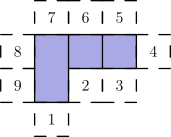
The polygon enclosed by the solid lines in the figure consists of congruent squares joined edge-to-edge. One more congruent square is attached to an edge at one of the nine positions indicated. How many of the nine resulting polygons can be folded to form a cube with one face missing?
Answer: E
Small Hint:
A cube with one face missing needs squares
Big Hint:
Fold the four-square piece partway around a cube, then check which attached square lands on a still-open face
Solution:
A cube missing one face has faces, so the fifth square must fold onto a face not already occupied by the four-square piece. Tracing the face reached by each attachment, positions and fold onto a face already occupied and overlap it. Each of positions and folds onto an unoccupied face. Therefore of the nine positions work.
Thus, the correct answer is E.
14.
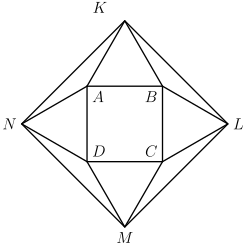
Points and lie in the plane of the square so that and are equilateral triangles. If has an area of find the area of
Answer: D
Small Hint:
is a square by the rotational symmetry of the figure
Big Hint:
Its diagonal equals the square’s side plus twice the triangle height
Solution:
The square has side By the rotational symmetry, is also a square.
Each equilateral triangle on a side of length has height so the diagonal
A square with diagonal has area so
Thus, the correct answer is D.
15.
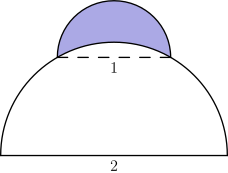
A semicircle of diameter sits at the top of a semicircle of diameter as shown. The shaded area inside the smaller semicircle and outside the larger semicircle is called a lune. Determine the area of this lune.
Answer: C
Small Hint:
The small diameter is a chord of length in the large radius- circle, spanning a arc
Big Hint:
Lune (equilateral triangle small semicircle) the sector of the large circle
Solution:
The small semicircle’s diameter is a chord of length in the large circle of radius so it subtends a angle at the center.
The region bounded by that chord and the small arc is an equilateral triangle of area topped by the small semicircle of area
Subtracting the sector of the large circle, gives the lune area
Thus, the correct answer is C.
16.
A point is chosen at random in the interior of equilateral triangle What is the probability that has a greater area than each of and
Answer: C
Small Hint:
The three triangles share equal bases, so their areas depend only on ’s distances to the sides
Big Hint:
By the threefold symmetry each side yields the largest triangle equally often
Solution:
The triangles and have equal bases (the sides of the equilateral triangle), so their areas are proportional to the distances from to those sides.
By the threefold symmetry of the equilateral triangle, is the largest with the same probability as each of the other two, so that probability is
Thus, the correct answer is C.
17.
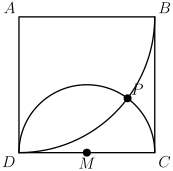
Square has sides of length and is the midpoint of A circle with radius and center intersects a circle with radius and center at points and What is the distance from to
Answer: B
Small Hint:
Put at the origin with on the -axis and on the -axis
Big Hint:
The distance from to is the -coordinate of
Solution:
Place and The circle centered at is and the circle centered at is
Solving these equations gives the intersection
Since lies on the -axis, the distance from to is its -coordinate,
Thus, the correct answer is B.
18.
Let be a -digit number, and let and be the quotient and remainder, respectively, when is divided by For how many values of is divisible by
Answer: B
Small Hint:
Big Hint:
Since is a multiple of
Solution:
Since and is divisible by we have
So is a multiple of exactly when is a multiple of
Among the -digit numbers, the count of multiples of is
Thus, the correct answer is B.
19.
A parabola with equation is reflected about the -axis. The parabola and its reflection are translated horizontally five units in opposite directions to become the graphs of and respectively. Which of the following describes the graph of
a parabola tangent to the -axis
a parabola not tangent to the -axis
a horizontal line
a non-horizontal line
the graph of a cubic function
Answer: D
Small Hint:
Write the parabola as its reflection is
Big Hint:
After the opposite shifts, add and and watch the squared terms cancel
Solution:
Write the parabola in vertex form Its reflection about the -axis is
Shifting in opposite directions gives and
Adding, the squared terms cancel and which is a non-horizontal line since
Thus, the correct answer is D.
20.
How many -letter arrangements of A’s, B’s, and C’s have no A’s in the first letters, no B’s in the next letters, and no C’s in the last letters?
Answer: A
Small Hint:
In the first block (no A’s), suppose there are B’s and C’s
Big Hint:
Fixing determines the letter counts in all three blocks, each chosen with placements
Solution:
Suppose the first block holds B’s and C’s. The remaining C’s must go in the second block (since the third has no C’s), forcing A’s there.
Then the third block contains the remaining A’s and B’s.
For each the B’s in the first block, C’s in the second, and A’s in the third can be placed in ways, so the total is
Thus, the correct answer is A.
21.
The graph of the polynomial
has five distinct -intercepts, one of which is at Which of the following coefficients cannot be zero?
Answer: D
Small Hint:
forces
Big Hint:
Factor out the constant term of the remaining quartic is the product of the four nonzero roots
Solution:
Since is an intercept, so
The four remaining intercepts are nonzero and distinct, and equals their product, which is therefore nonzero.
Any of can be zero for suitable choices of those roots, but
Thus, the correct answer is D.
22.
Objects and move simultaneously in the coordinate plane via a sequence of steps, each of length one. Object starts at and each of its steps is either right or up, both equally likely. Object starts at and each of its steps is either left or down, both equally likely. Which of the following is closest to the probability that the objects meet?
Answer: C
Small Hint:
They can meet only after each has taken steps, along the line
Big Hint:
The number of meeting path-pairs equals out of total pairs
Solution:
The objects are steps apart, so they can only meet after each takes steps, on the anti-diagonal
Pairing ’s six-step path with ’s reversed six-step path matches meeting pairs one-to-one with the monotone walks from to
The probability is which is closest to
Thus, the correct answer is C.
23.
How many perfect squares are divisors of the product
Answer: B
Small Hint:
Combine the factorials into
Big Hint:
A square divisor uses an even exponent of each prime
Solution:
The product is
A perfect-square divisor has the form with and
The number of choices is
Thus, the correct answer is B.
24.
If what is the largest possible value of
Answer: B
Small Hint:
Simplify to
Big Hint:
With use
Solution:
Expand:
Let Since by AM-GM, the expression is at most
Equality holds when that is, when so the largest value is
Thus, the correct answer is B.
25.
Let For how many real values of is there at least one positive value of for which the domain of and the range of are the same set?
infinitely many
Small Hint:
If both the domain and range equal for every
Big Hint:
For the domain is and the maximum of is
Solution:
If then has domain and range both so works.
If the domain is while the range is so no such exists.
If the domain is and the range is Equating the right endpoints gives so giving
Thus there are values of and the correct answer is C.