
1994 AMC 12 Problems
Scroll down and press Start to try the exam! Or, go to the printable PDF, answer key, or professional solutions curated by LIVE by Po-Shen Loh.
All problems are used with official legal permission of the Mathematical Association of America (MAA).
Or jump straight to a single problem with its solution: 1 · 2 · 3 · 4 · 5 · 6 · 7 · 8 · 9 · 10 · 11 · 12 · 13 · 14 · 15 · 16 · 17 · 18 · 19 · 20 · 21 · 22 · 23 · 24 · 25 · 26 · 27 · 28 · 29 · 30
Want to learn professionally through interactive video classes?
Timed
1:15:00
1.
Answer: C
Small Hint:
Group the powers of and the powers of
Big Hint:
Both bases have total exponent
Solution:
Combining like bases and then pairing them, Thus the correct answer is C.
2.
A large rectangle is partitioned into four rectangles by two segments parallel to its sides. The areas of three of the resulting rectangles are shown. What is the area of the fourth rectangle?
?
Answer: B
Small Hint:
Represent the two column widths and two row heights by variables
Big Hint:
Products of diagonally opposite areas are equal
Solution:
Let the column widths be and the row heights be The displayed areas give and Therefore the missing area is Thus the correct answer is B.
3.
How many of the following are equal to for all
Answer: B
Small Hint:
First combine the two identical terms
Big Hint:
Test whether changing the base or exponent preserves for every
Solution:
The given sum is so expression I is always equal to it. Expression II fails at where its value is instead of Expression III fails at where its value is instead of Expression IV fails at where its value is instead of Hence only one expression works. Thus the correct answer is B.
4.
In the -plane, the segment with endpoints and is the diameter of a circle. If the point is on the circle, then
Answer: A
Small Hint:
Find the center and radius from the diameter endpoints
Big Hint:
The point’s vertical distance from the center already equals the radius
Solution:
The center is and the radius is Thus so Thus the correct answer is A.
5.
Pat intended to multiply a number by but instead divided by Pat then meant to add but instead subtracted After these mistakes, the result was If the correct operations had been used, the value produced would have been
less than
between and
between and
between and
greater than
Answer: E
Small Hint:
Undo the mistaken subtraction and division to recover the starting number
Big Hint:
Apply to that starting number
Solution:
If the starting number is the mistaken calculation gives so The intended calculation would produce which is greater than Thus the correct answer is E.
6.
In the sequence each term is the sum of the two terms to its left. Find
Answer: A
Small Hint:
Work backward by subtracting the preceding known term
Big Hint:
Determine in that order before finding
Solution:
Working backward, gives then gives and gives Finally so Thus the correct answer is A.
7.
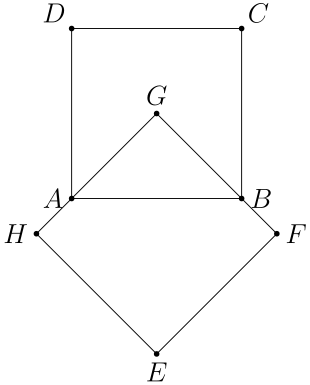
Squares and are congruent, and is the center of square The area of the region in the plane covered by these squares is
Answer: E
Small Hint:
The overlap is triangle
Big Hint:
The distance from the center to side is
Solution:
Each square has area Their overlap is whose base is and whose altitude from the center to is Its area is Hence the union has area Thus the correct answer is E.
8.
In the polygon shown, each side is perpendicular to its adjacent sides, and all of the sides are congruent. The perimeter of the polygon is The area of the region bounded by the polygon is

Answer: C
Small Hint:
Each side has length
Big Hint:
In units of one side length, split the shape into horizontal strips of widths
Solution:
Each side has length Measured in side-length units, the seven horizontal strips have widths totaling unit squares. Each such square has area so the polygon’s area is Thus the correct answer is C.
9.
If is four times and the complement of is four times the complement of then
Answer: D
Small Hint:
Let and write
Big Hint:
Translate the second condition as
Solution:
Let so The complement condition gives Hence and Thus the correct answer is D.
10.
For distinct real numbers and let be the larger of and and let be the smaller of and If then
Answer: B
Small Hint:
Evaluate the innermost expressions first
Big Hint:
The two arguments of the outermost reduce to and
Solution:
From the ordering, so Also hence The outer expression is therefore Thus the correct answer is B.
11.
Three cubes of volume and are glued together at their faces. The smallest possible surface area of the resulting configuration is
Answer: D
Small Hint:
The cube side lengths are and
Big Hint:
Minimize exposed area by maximizing the total areas of glued face portions
Solution:
Before gluing, the total surface area is The side- cube can share area with the side- cube, while the side- cube is placed at their common edge so that it shares area with each larger cube. Thus the total contact area is Each glued area removes two exposed copies, giving No pair can share more than the smaller face, so this is maximal contact and minimal surface area. Thus the correct answer is D.
12.
If then
Answer: D
Small Hint:
Use
Big Hint:
After simplifying the parentheses, rationalize
Solution:
Because Thus the correct answer is D.
13.
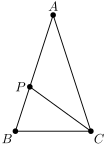
In triangle If there is a point strictly between and such that then
Answer: B
Small Hint:
Let and use in
Big Hint:
Use to relate to a base angle of
Solution:
Let Since triangle has Since each base angle of is Also so the base angles of at and are equal; the one at is Hence At giving and Thus the correct answer is B.
14.
Find the sum of the arithmetic series
Answer: B
Small Hint:
The common difference is
Big Hint:
Find the number of terms, then multiply by the average of the endpoints
Solution:
The number of terms is Their average is so the sum is Thus the correct answer is B.
15.
For how many in is the tens digit of odd?
Answer: B
Small Hint:
The parity of the tens digit of depends only on the units digit of
Big Hint:
Check the squares of the ten possible units digits
Solution:
Write Modulo The term changes the tens digit by an even amount, so only the tens digit of matters. Among it is odd only for and Each units digit occurs times from through giving Thus the correct answer is B.
16.
Some marbles in a bag are red and the rest are blue. If one red marble is removed, then one-seventh of the remaining marbles are red. If two blue marbles are removed instead of one red, then one-fifth of the remaining marbles are red. How many marbles were in the bag originally?
Answer: B
Small Hint:
Let be the red count and the total count
Big Hint:
Translate the two experiments into and
Solution:
The two conditions give and Thus and Hence and Thus the correct answer is B.
17.
An by rectangle has the same center as a circle of radius The area of the region common to both the rectangle and the circle is
Answer: D
Small Hint:
The rectangle removes two congruent caps from the circle
Big Hint:
The cap chord is at distance from the center, so its half central angle is
Solution:
The rectangle is wider than the circle, so the common region is the circle with the top and bottom caps beyond distance from the center removed. One cap has area Therefore the common area is Thus the correct answer is D.
18.
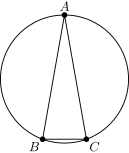
Triangle is inscribed in a circle, and If and are adjacent vertices of a regular polygon of sides inscribed in this circle, then
Answer: C
Small Hint:
Use the triangle angle sum to find
Big Hint:
The central angle subtending is twice
Solution:
The angle sum gives so The central angle subtending chord is therefore Adjacent vertices of a regular -gon subtend so and Thus the correct answer is C.
19.
Label one disk “,” two disks “,” three disks “,” fifty disks “.” Put these labeled disks in a box. Disks are then drawn from the box at random without replacement. The minimum number of disks that must be drawn to guarantee drawing at least ten disks with the same label is
Answer: C
Small Hint:
Count the most disks that can be drawn while taking at most nine of each label
Big Hint:
All disks labeled through may be drawn, but only nine of each label through
Solution:
To avoid ten equal labels, one may draw all disks with labels below and at most from each of the labels through Thus disks can be drawn without forcing ten alike, and the next draw guarantees them. The minimum is Thus the correct answer is C.
20.
Suppose is a geometric sequence with common ratio and If is an arithmetic sequence, then is
Answer: B
Small Hint:
Write and
Big Hint:
The arithmetic-sequence condition is
Solution:
Because and the arithmetic-sequence condition gives Here so yielding or The condition excludes leaving Thus the correct answer is B.
21.
Find the number of counterexamples to the statement:
“If is an odd positive integer the sum of whose digits is and none of whose digits is then is prime.”
Answer: C
Small Hint:
A number satisfying the digit conditions has at most four digits
Big Hint:
List the odd possibilities by composing into positive digits
Solution:
The odd possibilities are and The numbers and are prime, while and Thus there are counterexamples. Thus the correct answer is C.
22.
Nine chairs in a row are to be occupied by six students and Professors Alpha, Beta and Gamma. These three professors arrive before the six students and decide to choose their chairs so that each professor will be between two students. In how many ways can Professors Alpha, Beta and Gamma choose their chairs?
Answer: C
Small Hint:
Professor chairs cannot be endpoints or adjacent to one another
Big Hint:
First choose three nonconsecutive positions from chairs through , then assign the professors
Solution:
The professors must occupy three nonconsecutive positions among chairs The number of such -subsets of consecutive positions is The three distinct professors can be assigned to the selected chairs in ways, for Thus the correct answer is C.
23.
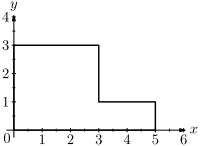
In the -plane, consider the L-shaped region bounded by horizontal and vertical segments with vertices at and The slope of the line through the origin that divides the area of this region exactly in half is
Answer: E
Small Hint:
The L-shaped region has total area
Big Hint:
For the desired slope the area below the line is the -unit extension plus a triangle of base
Solution:
The region has area so each half has area If the line is the part below it consists of the entire -unit rectangle from to together with a triangle of base and height Therefore This gives which indeed lies in the assumed range. Thus the correct answer is E.
24.
A sample consisting of five observations has an arithmetic mean of and a median of The smallest value that the range (largest observation minus smallest) can assume for such a sample is
Answer: C
Small Hint:
Order the observations as
Big Hint:
Use the total sum , then test whether a range below is possible
Solution:
The sample has sum median and range so range is possible. Suppose the range were at most If the largest value were at most then the top three values would all be leaving the bottom two with sum yet each would be at least a contradiction. If the largest value exceeded then the smallest would exceed making the total exceed Thus no smaller range works. The correct answer is C.
25.
If and are non-zero real numbers such that
and
then the integer nearest to is
Answer: A
Small Hint:
Consider the signs of separately
Big Hint:
For put and combine with
Solution:
If the second equation gives while the first gives these would require which has no real root. Hence Put Then the equations become and so Therefore already an integer. Thus the correct answer is A.
26.
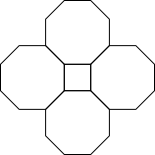
A regular polygon of sides is exactly enclosed (no overlaps, no gaps) by regular polygons of sides each. (Shown here for ) If what is the value of
Answer: A
Small Hint:
At each vertex of the inner polygon, one -gon angle and two -gon angles fill
Big Hint:
Use the regular -gon interior angle
Solution:
At a vertex of the inner polygon, its interior angle and two angles from the surrounding polygons total Thus This simplifies to With we get so Thus the correct answer is A.
27.
A bag of popping corn contains white kernels and yellow kernels. Only of the white kernels will pop, whereas of the yellow ones will pop. A kernel is selected at random from the bag, and pops when placed in the popper. What is the probability that the kernel selected was white?
Answer: D
Small Hint:
Compute the probabilities of selecting-and-popping for each color
Big Hint:
Condition the white-and-popped probability on the total probability of popping
Solution:
The probabilities of selecting a kernel that pops are Hence and Thus the correct answer is D.
28.
In the -plane, how many lines whose -intercept is a positive prime number and whose -intercept is a positive integer pass through the point
Answer: C
Small Hint:
Let the intercepts be and , and use
Big Hint:
Rearrange to
Solution:
Let the -intercept be the prime and the -intercept be the positive integer Intercept form gives Thus is a positive divisor of Testing gives prime only for and Therefore there are lines. Thus the correct answer is C.
29.
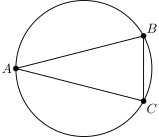
Points and on a circle of radius are situated so that and the length of minor arc is If angles are measured in radians, then
Answer: A
Small Hint:
The minor arc subtends a central angle of radian
Big Hint:
Use the chord formula for both and
Solution:
The central angle subtending minor arc is so Since and point is the midpoint of the major arc The minor central angle from to is so Therefore Thus the correct answer is A.
30.
When standard -sided dice are rolled, the probability of obtaining a sum of is greater than zero and is the same as the probability of obtaining a sum of The smallest possible value of is
Answer: C
Small Hint:
A sum of is possible only when
Big Hint:
Replacing every die value by pairs sums and
Solution:
The smallest feasible number of dice is Replacing every die result by is a bijection between outcomes of sum and outcomes of sum Thus for the sum paired with is Dice-sum counts increase strictly from the minimum sum up to the mean, so for any feasible no sum below can match the count at Thus the smallest value is and the correct answer is C.