
1987 AMC 12 Problems
Scroll down and press Start to try the exam! Or, go to the printable PDF, answer key, or professional solutions curated by LIVE by Po-Shen Loh.
All problems are used with official legal permission of the Mathematical Association of America (MAA).
Or jump straight to a single problem with its solution: 1 · 2 · 3 · 4 · 5 · 6 · 7 · 8 · 9 · 10 · 11 · 12 · 13 · 14 · 15 · 16 · 17 · 18 · 19 · 20 · 21 · 22 · 23 · 24 · 25 · 26 · 27 · 28 · 29 · 30
Want to learn professionally through interactive video classes?
Timed
1:15:00
1.
equals
Answer: D
Small Hint:
Distribute each term of the first binomial across the second
Big Hint:
The product contributes the highest-degree term
Solution:
Expanding gives
Thus the correct answer is D.
2.
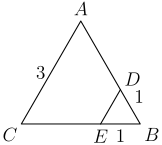
As shown in the figure, a triangular corner with side lengths is cut from equilateral triangle of side length The perimeter of the remaining quadrilateral is
Answer: E
Small Hint:
Determine the angle between and
Big Hint:
Start from the original perimeter, remove and and add
Solution:
Since and triangle is equilateral, so The original perimeter is Cutting off the corner removes two unit segments and adds one:
Thus the correct answer is E.
3.
How many primes less than have as the ones digit? (Assume the usual base representation.)
Answer: C
Small Hint:
List every positive integer below whose ones digit is
Big Hint:
For numbers below trial division only requires primes through their square roots
Solution:
The primes are The other candidates are composite: and Hence there are such primes.
Thus the correct answer is C.
4.
equals
Answer: B
Small Hint:
Rewrite every negative power of as a reciprocal
Big Hint:
Compare corresponding numerator and denominator terms by a common factor
Solution:
The numerator is while the denominator is Their quotient is
Thus the correct answer is B.
5.
A student recorded the exact percentage frequency distribution for a set of measurements, as shown below. However, the student neglected to indicate the total number of measurements. What is the smallest possible value of
measured value percent frequency
Answer: B
Small Hint:
Express each nonzero percentage as a reduced fraction of the total
Big Hint:
Every resulting frequency must be a whole number
Solution:
Since the total must be divisible by Taking gives frequencies all whole numbers. Thus the smallest possible total is
Therefore the correct answer is B.
6.
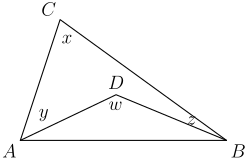
In the shown, is some interior point, and are the measures of angles in degrees. Solve for in terms of and
Answer: A
Small Hint:
Name the two unlabelled angles at and inside triangle
Big Hint:
Subtract the angle sum of from that of
Solution:
Let the unlabelled angles of triangle at and be and Then The angle sum of triangle gives Subtracting yields so
Thus the correct answer is A.
7.
If which of the four quantities is the largest?
no one is always largest
Answer: C
Small Hint:
Set all four expressions equal to one common value
Big Hint:
Solve each variable as the common value plus or minus a constant
Solution:
If the common value is then Therefore is always the largest.
Thus the correct answer is C.
8.
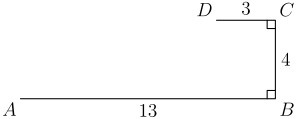
In the figure the sum of the distances and is
between and
between and
between and
Answer: C
Small Hint:
Use the -- right triangle to find
Big Hint:
The horizontal and vertical displacements from to are and
Solution:
Triangle is a -- right triangle, so From to the horizontal displacement is and the vertical displacement is hence Since the sum is between and
Thus the correct answer is C.
9.
The first four terms of an arithmetic sequence are The ratio of to is
Answer: B
Small Hint:
Write all four terms using and a common difference
Big Hint:
Use the equation relating the second term to the fourth term
Solution:
Let the common difference be Then and Thus so and Therefore
Thus the correct answer is B.
10.
How many ordered triples of nonzero real numbers have the property that each number is the product of the other two?
Answer: D
Small Hint:
Translate the condition into
Big Hint:
Multiply the equations and use the nonzero condition to determine the possible magnitudes
Solution:
Multiplying gives Since none of the variables is zero, Also so each variable is or Product allows either no negative signs or exactly two, giving ordered triples.
Thus the correct answer is D.
11.
Let be a constant. The simultaneous equations have a solution inside Quadrant I if and only if
Answer: E
Small Hint:
Solve the two equations for and in terms of
Big Hint:
Quadrant I requires both coordinates to be strictly positive
Solution:
Solving the system gives The condition requires With this positive denominator, is equivalent to Hence
Thus the correct answer is E.
12.
In an office, at various times during the day the boss gives the secretary a letter to type, each time putting the letter on top of the pile in the secretary’s in-box. When there is time, the secretary takes the top letter off the pile and types it. If there are five letters in all, and the boss delivers them in the order which of the following could not be the order in which the secretary types them?
Answer: D
Small Hint:
Letters still in the pile always remain in increasing order from bottom to top
Big Hint:
After letter is typed, examine which smaller letter must be on top before can be typed
Solution:
To type first in choice D, letters must all have been delivered, leaving on top after is removed. Letter can then be delivered and typed, but is still above so cannot be typed next. Thus is impossible. Each other listed order can be produced by interleaving deliveries and typings.
Therefore the correct answer is D.
13.
A long piece of paper cm wide is made into a roll for cash registers by wrapping it times around a cardboard tube of diameter cm, forming a roll cm in diameter. Approximate the length of the paper in meters. (Pretend the paper forms concentric circles with diameters evenly spaced from cm to cm.)
Answer: A
Small Hint:
The diameters form an arithmetic sequence
Big Hint:
Use the average diameter to find the sum of all circumferences
Solution:
The average of the first and last diameters is Hence the total length is approximately cm, or meters.
Thus the correct answer is A.
14.
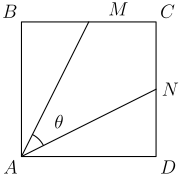
is a square and and are the midpoints of and respectively. Then
none of these
Answer: B
Small Hint:
Assign coordinates to the square and write vectors and
Big Hint:
Use the determinant formula for the sine of the angle between two vectors
Solution:
Take the square to have side with and Then
Thus the correct answer is B.
15.
If is a solution to the system find
Answer: D
Small Hint:
Factor the second equation using
Big Hint:
Use
Solution:
The second equation becomes Since we get Therefore
Thus the correct answer is D.
16.
A cryptographer devises the following method for encoding positive integers. First, the integer is expressed in base Second, a -to- correspondence is established between the digits that appear in the expressions in base and the elements of the set Using this correspondence, the cryptographer finds that three consecutive integers in increasing order are coded as respectively. What is the base- expression for the integer coded as
Answer: D
Small Hint:
Compare the final digits of and
Big Hint:
The change from to forces a base- carry
Solution:
Because is one more than the digit for is one more than the digit for The next increment changes to so and The carry changes to leaving Thus
Thus the correct answer is D.
17.
In a mathematics competition, the sum of the scores of Bill and Dick equalled the sum of the scores of Ann and Carol. If the scores of Bill and Carol had been interchanged, then the sum of the scores of Ann and Carol would have exceeded the sum of the scores of the other two. Also, Dick’s score exceeded the sum of the scores of Bill and Carol. Determine the order in which the four contestants finished, from highest to lowest. Assume all scores were nonnegative.
Dick, Ann, Carol, Bill
Dick, Ann, Bill, Carol
Dick, Carol, Bill, Ann
Ann, Dick, Carol, Bill
Ann, Dick, Bill, Carol
Answer: E
Small Hint:
Represent the four scores by in name order
Big Hint:
Add and subtract the equality and the inequality
Solution:
Let be the scores of Ann, Bill, Carol, and Dick. The conditions are Adding the first two comparisons gives Subtracting the equality from the inequality gives Finally, Hence
Thus the correct answer is E.
18.
It takes algebra books (all the same thickness) and geometry books (all the same thickness, which is greater than that of an algebra book) to completely fill a certain shelf. Also, of the algebra books and of the geometry books would fill the same shelf. Finally, of the algebra books alone would fill this shelf. Given that are distinct positive integers, it follows that is
Answer: D
Small Hint:
Let and be the two book thicknesses and normalize the shelf length to
Big Hint:
Eliminate the geometry-book thickness from and
Solution:
Let the shelf length be and let be the algebra- and geometry-book thicknesses. Then Multiplying the first equation by the second by and subtracting gives Hence
Thus the correct answer is D.
19.
Which of the following is closest to
Answer: B
Small Hint:
Rationalize the difference of the two square roots
Big Hint:
Compare with to decide which side of the result lies on
Solution:
Rationalizing gives The denominator is less than because its square is Thus the value is greater than Also each radical exceeds so the value is less than It is therefore closer to than to any other choice.
Thus the correct answer is B.
20.
Evaluate
none of these
Answer: A
Small Hint:
Pair the term at angle with the term at angle
Big Hint:
Use before combining logarithms
Solution:
For each Thus each paired sum of logarithms is The remaining middle term is Hence the whole sum is
Thus the correct answer is A.
21.
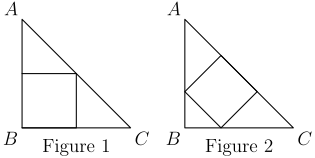
There are two natural ways to inscribe a square in a given isosceles right triangle. If it is done as in Figure below, then one finds that the area of the square is What is the area (in ) of the square inscribed in the same as shown in Figure below?
Answer: B
Small Hint:
Use Figure to determine the leg length of the isosceles right triangle
Big Hint:
In Figure compare the side of the tilted square with the two equal leg segments cut off by its opposite side
Solution:
The first square has side so the triangle’s legs have length Let be the side of the tilted square. Its side on the hypotenuse is parallel to the opposite side joining the legs. That opposite side has endpoints and so The distance between the parallel lines and is also giving Hence and its area is
Thus the correct answer is B.
22.
A ball was floating in a lake when the lake froze. The ball was removed (without breaking the ice), leaving a hole cm across at the top and cm deep. What was the radius of the ball (in centimeters)?
Answer: C
Small Hint:
Take a vertical cross-section through the center of the circular hole
Big Hint:
The half-chord is while the center-to-ice distance is
Solution:
In a vertical cross-section, half the -cm hole is a chord segment of length If the sphere radius is the distance from its center to the ice plane is The resulting right triangle gives Solving yields so
Thus the correct answer is C.
23.
If is a prime and both roots of are integers, then
Answer: D
Small Hint:
For an integer root rewrite the equation as
Big Hint:
Since is prime, write and factor
Solution:
An integer root satisfies Thus is divisible by so write Substitution gives The consecutive product condition works only with for which or The roots are and so
Thus the correct answer is D.
24.
How many polynomial functions of degree satisfy
finitely many but more than
infinitely many
Answer: B
Small Hint:
Compare the degrees and leading coefficients of the three polynomials
Big Hint:
After proving is a monic quadratic, compare coefficients in
Solution:
Let have degree and leading coefficient The three expressions have degrees so and therefore Comparing leading coefficients in gives hence
Write Then The cubic coefficient forces and then the quadratic coefficient forces Thus the only candidate is which indeed satisfies all three expressions. There is exactly one function.
Thus the correct answer is B.
25.
is a triangle: and both the coordinates of are integers. What is the minimum area can have?
there is no minimum
Answer: C
Small Hint:
Write and use the determinant formula for triangle area
Big Hint:
Find the smallest positive value of using
Solution:
For the area is Since the smallest possible positive value of the determinant is at least It is attained, for example, by since Therefore the minimum area is
Thus the correct answer is C.
26.
The amount is split into two nonnegative real numbers uniformly at random, for instance, into and or into and Then each number is rounded to its nearest integer, for instance, and in the first case above, and in the second. What is the probability that the two integers sum to
Answer: B
Small Hint:
Let the first number be uniformly distributed on
Big Hint:
Find the intervals on which and round to integers whose sum is
Solution:
Let the first part be so the second is Ignoring endpoints of probability zero, the rounded values sum to exactly when These intervals have total length out of a sample interval of length The probability is therefore
Thus the correct answer is B.
27.
A cube of cheese is cut along the planes and How many pieces are there? (No cheese is moved until all three cuts are made.)
Answer: B
Small Hint:
Within one piece, the relative order of cannot change
Big Hint:
Count the strict orderings of three distinct coordinates
Solution:
The three planes are precisely the boundaries where two coordinates are equal. Away from them, each piece is determined by a strict ordering of such as Every one of the orderings occurs inside the cube, so there are pieces.
Thus the correct answer is B.
28.
Let be real numbers. Suppose that all the roots of are complex numbers lying on a circle in the complex plane centered at and having radius The sum of the reciprocals of the roots is necessarily
Answer: D
Small Hint:
For a complex number on the unit circle, compare with
Big Hint:
Real polynomial coefficients make the sum of the roots real
Solution:
If then Therefore the sum of the reciprocals is the conjugate of the sum of the roots. By Vieta’s formulas, the sum of the roots is which is real. Its conjugate is still
Thus the correct answer is D.
29.
Consider the sequence of numbers defined recursively by and for by when is even and by when is odd. Given that the sum of the digits of is
Answer: A
Small Hint:
Values greater than come from even indices; values between and come from odd indices
Big Hint:
Reverse the recursion by subtracting from values above and taking reciprocals of values below
Solution:
Let be the index at which the value occurs. Reversing the recursion gives for and for
Starting with repeated use gives and Continuing gives and
Next, and Finally, and Thus whose digit sum is
Therefore the correct answer is A.
30.
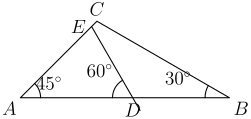
In the figure, has and A line with on and divides into two pieces of equal area. (Note: the figure may not be accurate; perhaps is on instead of ) The ratio is
Answer: E
Small Hint:
Scale so and place
Big Hint:
Find the height of and the height of in terms of , then equate half the total area to the area of
Solution:
Set and Since side lies on The line through making angle with meets it at height Let The ray has slope so its intersection with has height Equal areas require Therefore Hence
Thus the correct answer is E.