
1978 AMC 12 Problems
Scroll down and press Start to try the exam! Or, go to the printable PDF, answer key, or professional solutions curated by LIVE by Po-Shen Loh.
All problems are used with official legal permission of the Mathematical Association of America (MAA).
Or jump straight to a single problem with its solution: 1 · 2 · 3 · 4 · 5 · 6 · 7 · 8 · 9 · 10 · 11 · 12 · 13 · 14 · 15 · 16 · 17 · 18 · 19 · 20 · 21 · 22 · 23 · 24 · 25 · 26 · 27 · 28 · 29 · 30
Want to learn professionally through interactive video classes?
Timed
1:15:00
1.
If then equals
or
or
Answer: B
Small Hint:
Let
Big Hint:
The resulting quadratic is a perfect square
Solution:
With the equation becomes or Therefore
Therefore, the correct answer is B.
2.
If four times the reciprocal of the circumference of a circle equals the diameter of the circle, then the area of the circle is
Answer: C
Small Hint:
Write the circumference and diameter in terms of the radius
Big Hint:
The condition directly determines the product
Solution:
The condition is Multiplying by gives so the area equals
Therefore, the correct answer is C.
3.
For all nonzero numbers and such that equals
Answer: D
Small Hint:
Use the reciprocal relation to replace and
Big Hint:
The two factors become and
Solution:
Since we also have Thus the product is
Therefore, the correct answer is D.
4.
If and then is equal to
Answer: B
Small Hint:
Count how many times each variable appears with each sign
Big Hint:
The entire sum simplifies to twice
Solution:
Each variable appears positively three times and negatively once, so the expression is
Therefore, the correct answer is B.
5.
Four boys bought a boat for The first boy paid one half of the sum of the amounts paid by the other boys; the second boy paid one third of the sum of the amounts paid by the other boys; and the third boy paid one fourth of the sum of the amounts paid by the other boys. How much did the fourth boy pay?
Answer: C
Small Hint:
Replace each “sum paid by the other boys” by minus that boy’s payment
Big Hint:
Solve separately for the first three payments, then subtract their sum from
Solution:
Let the first three payments be and Then Hence The fourth payment is dollars.
Therefore, the correct answer is C.
6.
The number of distinct pairs of real numbers satisfying both of the following equations: is
Answer: E
Small Hint:
Factor the second equation as
Big Hint:
Handle and as separate cases
Solution:
If the first equation gives so or If the second equation gives The first then gives producing and There are four pairs.
Therefore, the correct answer is E.
7.
Opposite sides of a regular hexagon are inches apart. The length of each side, in inches, is
Answer: E
Small Hint:
The distance between opposite sides is twice the apothem
Big Hint:
A regular hexagon of side has apothem
Solution:
The distance between opposite sides is twice the apothem, hence Therefore so
Therefore, the correct answer is E.
8.
If and the sequences and each are in arithmetic progression, then equals
Answer: D
Small Hint:
Count the equal steps from to in each sequence
Big Hint:
The two common differences are and
Solution:
The first common difference is and the second is Since their ratio is
Therefore, the correct answer is D.
9.
If then equals
Answer: B
Small Hint:
Use
Big Hint:
When determine the signs of and
Solution:
Because Therefore since
Therefore, the correct answer is B.
10.
If is a point on circle with center then the set of all points in the plane of circle such that the distance between and is less than or equal to the distance between and any other point on circle is
the line segment from to
the ray beginning at and passing through
a ray beginning at
a circle whose center is
a circle whose center is
Answer: B
Small Hint:
For the nearest point of the circle lies on the ray from through
Big Hint:
Require that this radial nearest point be the fixed point
Solution:
For any the closest point of the circle to is where the ray from through meets the circle. This point is exactly when lies on the ray from through The center also qualifies because every point on the circle is equally distant from it. Thus the locus is that ray.
Therefore, the correct answer is B.
11.
If is positive and the line whose equation is is tangent to the circle whose equation is then equals
Answer: C
Small Hint:
The circle has center at the origin and radius
Big Hint:
Set the distance from the origin to the line equal to the circle’s radius
Solution:
The distance from the origin to is Tangency requires this to equal the radius so Since squaring and dividing by gives
Therefore, the correct answer is C.
12.
In points and lie on sides and respectively, and points are distinct. If lengths and are all equal, then the measure of is
Answer: E
Small Hint:
Name and use the successive isosceles triangles
Big Hint:
Express the other base angles in terms of then use the angle sum in
Solution:
Let and The exterior-angle theorem applied successively gives The angles of are and so Hence
Therefore, the correct answer is E.
13.
If and are nonzero numbers such that and are the solutions of and and are the solutions of then equals
Answer: B
Small Hint:
Apply Vieta’s formulas to both quadratics
Big Hint:
The two sum equations imply ; then use the product equations and nonzero condition
Solution:
Vieta’s formulas give The two sum equations imply Since the product equations give Then gives and therefore
Therefore, the correct answer is B.
14.
If an integer greater than is a solution of the equation and the representation of in the base numeration system is then the base representation of is
Answer: C
Small Hint:
Translate the base- numeral into
Big Hint:
Use the sum and product of the two roots
Solution:
In ordinary notation, Since one root is the other root must be Their product is whose base- representation is
Therefore, the correct answer is C.
15.
If and then is
not completely determined by the given information
Answer: A
Small Hint:
Square the given equation to determine
Big Hint:
Treat and as roots of a quadratic, then use
Solution:
Squaring gives so Thus and are the roots of namely and Because on the given interval, and Hence
Therefore, the correct answer is A.
16.
In a room containing people, at least one person has not shaken hands with everyone else in the room. What is the maximum number of people in the room that could have shaken hands with everyone else?
none of these
Answer: E
Small Hint:
A missed handshake always involves two people
Big Hint:
Find an upper bound, then realize it by omitting just one handshake
Solution:
If one person has missed a handshake, the other person in that missed pair also has not shaken hands with everyone. Thus at most people can have shaken hands with everyone. This is attainable when exactly two people fail to shake hands with each other and every other handshake occurs. Since is not listed, the answer is “none of these.”
Therefore, the correct answer is E.
17.
If is a positive number and is a function such that, for every positive number then, for every positive number is equal to
Answer: D
Small Hint:
Choose so that
Big Hint:
Compare with after making the substitution
Solution:
Set which is positive. Then Therefore the requested expression is
Therefore, the correct answer is D.
18.
What is the smallest positive integer such that
There is no such integer.
Answer: C
Small Hint:
Rationalize
Big Hint:
Compare the resulting denominator with near
Solution:
Rationalizing gives For the denominator is so the difference exceeds For the denominator is so the difference is less than The denominator increases with making the least such integer.
Therefore, the correct answer is C.
19.
A positive integer not exceeding is chosen in such a way that if then the probability of choosing is and if then the probability of choosing is The probability that a perfect square is chosen is
Answer: C
Small Hint:
First use the total probability to determine
Big Hint:
Count the perfect squares at most and those from through separately
Solution:
The total probability is so There are seven perfect squares at most and three more, above Hence the desired probability is
Therefore, the correct answer is C.
20.
If are nonzero real numbers such that and and then equals
Answer: A
Small Hint:
Set the three equal fractions to and compare pairs of the resulting equations
Big Hint:
The comparison forces either or ; use the sign of
Solution:
Let the common value be The first two resulting equations imply and cyclic comparisons give the analogous relations. Thus either which gives or In the latter case and so The condition selects the latter value.
Therefore, the correct answer is A.
21.
For all positive numbers distinct from equals
Answer: A
Small Hint:
Use the reciprocal identity
Big Hint:
Combine the resulting sum with the product rule for logarithms
Solution:
Let denote the given sum. Changing bases and combining logarithms gives
Therefore, the correct answer is A.
22.
The following four statements, and only these, are found on a card:
On this card exactly one statement is false.
On this card exactly two statements are false.
On this card exactly three statements are false.
On this card exactly four statements are false.
(Assume each statement on the card is either true or false.) Among them the number of false statements is exactly
Answer: D
Small Hint:
Assume the actual number of false statements is
Big Hint:
For each possible count how many of the four displayed statements would then be true
Solution:
If the actual number of false statements is one of exactly one displayed statement—the one naming —is true. Therefore exactly three statements are false, forcing This is consistent: the third statement is true and the other three are false.
Therefore, the correct answer is D.
23.
Vertex of equilateral triangle is in the interior of square and is the point of intersection of diagonal and line segment If length is then the area of is
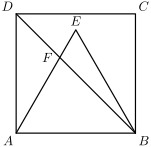
Answer: C
Small Hint:
Place and where
Big Hint:
Find the intersection of and
Solution:
Let and where The two lines containing have equations Hence the altitude of above is Therefore
Therefore, the correct answer is C.
24.
If the distinct nonzero numbers form a geometric progression with common ratio then satisfies the equation
Answer: A
Small Hint:
Add the three given expressions
Big Hint:
Write the three nonzero terms as
Solution:
The three expressions have sum Writing the nonzero geometric progression as gives Since
Therefore, the correct answer is A.
25.
Let be a positive number. Consider the set of all points whose rectangular coordinates satisfy all of the following conditions: The boundary of set is a polygon with
sides
sides
sides
sides
sides
Answer: D
Small Hint:
Begin with the square described by conditions and
Big Hint:
Determine which condition is redundant and which two cut off opposite corners
Solution:
The first two conditions form the square Within this square, is automatic. The last two conditions are equivalent to their boundary lines cut off the corners and Cutting two opposite corners from a square produces a hexagon, so the boundary has six sides.
Therefore, the correct answer is D.
26.
In and Circle is the circle with smallest radius which passes through and is tangent to Let and be the points of intersection, distinct from of circle with sides and respectively. The length of segment is
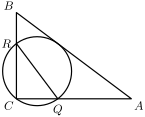
Answer: B
Small Hint:
The -- triangle is right at ; let be the foot from to
Big Hint:
The smallest circle has as a diameter, and
Solution:
Let be the foot of the altitude from to Among circles through tangent to the least radius occurs when the tangency point is so is a diameter. The area of the right triangle gives Also so is a diameter of circle Therefore
Therefore, the correct answer is B.
27.
There is more than one integer greater than which, when divided by any integer such that has a remainder of What is the difference between the two smallest such integers?
none of these
Answer: C
Small Hint:
Each desired integer is more than a common multiple of every integer from through
Big Hint:
The difference of consecutive such integers is the least common multiple of those divisors
Solution:
A qualifying integer is congruent to modulo every integer from through hence modulo The two smallest qualifying integers greater than are and whose difference is
Therefore, the correct answer is C.
28.
If is equilateral and is the midpoint of line segment for all positive integers then the measure of equals
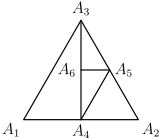
Small Hint:
Let and derive a recurrence for these vectors
Big Hint:
Show that reducing the requested angle to one among the first few points
Solution:
Let The midpoint rule gives and also Consequently, Thus and are the same positive scalar multiple of and respectively, so Since and are the midpoints of and The equilateral-triangle angles then give
Therefore, the correct answer is E.
29.
Sides and respectively, of convex quadrilateral are extended past and to points and Also, and and the area of is The area of is
Answer: D
Small Hint:
In vector notation, and similarly for the other two vertices
Big Hint:
Substitute these expressions into the cross-product area formula for a polygon
Solution:
Using position vectors, the equal extensions give Substitution into the oriented polygon-area sum shows that the diagonal cross terms cancel: Hence the outer area is five times the original area, or
Therefore, the correct answer is D.
30.
In a tennis tournament, women and men play, and each player plays exactly one match with every other player. If there are no ties and the ratio of the number of matches won by women to the number of matches won by men is then equals
none of these
Answer: E
Small Hint:
Let be the number of mixed matches won by women and count all wins by women
Big Hint:
Use together with the required share of all match wins
Solution:
There are matches, so women must win matches. If women win of the mixed matches, then giving The bound forces For this formula is not an integer, while gives which is possible. Thus which is not among the listed numerical choices.
Therefore, the correct answer is E.