
1969 AMC 12 Problems
Scroll down and press Start to try the exam! Or, go to the printable PDF, answer key, or professional solutions curated by LIVE by Po-Shen Loh.
All problems are used with official legal permission of the Mathematical Association of America (MAA).
Or jump straight to a single problem with its solution: 1 · 2 · 3 · 4 · 5 · 6 · 7 · 8 · 9 · 10 · 11 · 12 · 13 · 14 · 15 · 16 · 17 · 18 · 19 · 20 · 21 · 22 · 23 · 24 · 25 · 26 · 27 · 28 · 29 · 30 · 31 · 32 · 33 · 34 · 35
Want to learn professionally through interactive video classes?
Timed
1:15:00
1.
When is added to both the numerator and the denominator of the fraction the value of the fraction is changed to Then equals:
Answer: B
Small Hint:
Translate the change into
Big Hint:
Cross-multiply and collect the terms containing
Solution:
From we obtain Hence so
Therefore, the correct answer is B.
2.
If an item is sold for dollars, there is a loss of based on the cost. If, however, the same item is sold for dollars, there is a profit of based on the cost. The ratio is:
dependent upon the cost
none of these
Answer: A
Small Hint:
Let the cost be
Big Hint:
Write and then form the ratio
Solution:
If the cost is then and Therefore
Therefore, the correct answer is A.
3.
If written in base is the integer immediately preceding written in base is:
Answer: E
Small Hint:
Subtract from the binary number
Big Hint:
Borrow through the three trailing zeros
Solution:
Subtracting from requires borrowing through the three trailing zeros. Thus
Therefore, the correct answer is E.
4.
Let a binary operation on ordered pairs of integers be defined by Then, if and represent identical pairs, equals:
Answer: E
Small Hint:
Evaluate each ordered-pair operation directly
Big Hint:
Equate the first coordinates and
Solution:
The first pair is The second is Equality of the first coordinates gives so
Therefore, the correct answer is E.
5.
If a number diminished by four times its reciprocal, equals a given real constant then, for this given the sum of all such possible values of is:
Answer: B
Small Hint:
Rewrite as a quadratic in
Big Hint:
Use the sum of the roots of that quadratic
Solution:
Multiplying by gives The sum of its two roots is by Vieta’s formulas. Both roots are nonzero because their product is
Therefore, the correct answer is B.
6.
The area of the ring between two concentric circles is square inches. The length of a chord of the larger circle tangent to the smaller circle, in inches, is:
Answer: C
Small Hint:
If the radii are and the area gives
Big Hint:
Half the tangent chord, the smaller radius, and the larger radius form a right triangle
Solution:
Let the radii be and The ring area gives The radius to the tangent point bisects the chord. If its length is then Thus so
Therefore, the correct answer is C.
7.
If the points and lie on the graph of and then equals:
Answer: A
Small Hint:
Substitute and
Big Hint:
Subtract the two resulting values; the and terms cancel
Solution:
We have and Therefore so
Therefore, the correct answer is A.
8.
Triangle is inscribed in a circle. The measures of the non-overlapping minor arcs and are, respectively, Then one interior angle of the triangle, in degrees, is:
Answer: D
Small Hint:
The three non-overlapping arcs sum to
Big Hint:
Each inscribed angle is half the measure of its intercepted arc
Solution:
The arc sum gives The arcs then measure and The angle intercepting the arc measures
Therefore, the correct answer is D.
9.
The arithmetic mean (ordinary average) of the fifty-two successive positive integers beginning with is:
Answer: C
Small Hint:
Find the fifty-second integer in the list
Big Hint:
The mean of an arithmetic sequence is the average of its first and last terms
Solution:
The integers run from through Their mean is the average of the first and last:
Therefore, the correct answer is C.
10.
The number of points equidistant from a circle and two parallel tangents to the circle is:
infinite
Answer: C
Small Hint:
Points equidistant from the two parallel tangents lie on their midway parallel line
Big Hint:
On that line, compare distance to either tangent with distance to the circle
Solution:
Let the circle have center and radius A point equidistant from the two parallel tangents must lie on their midline, which passes through If its distance from is its distance from either tangent is while its distance from the circle is Thus giving or There is one point with and two with for a total of
Therefore, the correct answer is C.
11.
Given points and in the -plane, point is taken so that is a minimum. Then equals:
either or
Answer: B
Small Hint:
The triangle inequality is sharp when and are collinear
Big Hint:
Find the point on line whose -coordinate is
Solution:
By the triangle inequality, with equality when lies on segment The slope of is Moving from to raises the -coordinate by so
Therefore, the correct answer is B.
12.
Let be the square of an expression which is linear in Then has a particular value between:
and
and
and
and
and
Answer: A
Small Hint:
Rewrite
Big Hint:
Match the constant term to the square of half the linear coefficient
Solution:
We have For this to be a square, it must equal whose constant term is Hence so which lies between and
Therefore, the correct answer is A.
13.
A circle with radius is contained within the region bounded by a circle with radius The area bounded by the larger circle is times the area of the region outside the smaller circle and inside the larger circle. Then equals:
Answer: B
Small Hint:
Write
Big Hint:
Solve for the ratio before taking square roots
Solution:
The area condition is Thus so Therefore and
Therefore, the correct answer is B.
14.
The complete set of -values satisfying the inequality is the set of all such that:
or or
or
or
or
is any real number except or
Answer: A
Small Hint:
The sign can change only at and
Big Hint:
Test one point in each interval and exclude zeros and undefined points
Solution:
Factor the expression as A sign chart at and shows it is positive on The endpoints give zero and are undefined.
Therefore, the correct answer is A.
15.
In a circle with center at and radius chord is drawn with length equal to units. From a perpendicular to meets at From a perpendicular to meets at In terms of the area of triangle in appropriate square units, is:
Answer: D
Small Hint:
Because triangle is equilateral
Big Hint:
Use the two -- triangles to find and
Solution:
Triangle is equilateral. Since is the midpoint of so and In right triangle the hypotenuse is giving Hence
Therefore, the correct answer is D.
16.
When is expanded by the binomial theorem, it is found that, when where is a positive integer, the sum of the second and third terms is zero. Then equals:
Answer: E
Small Hint:
The second and third terms are and
Big Hint:
Substitute and cancel the common nonzero factor
Solution:
The sum of the second and third terms is Substituting and dividing by the nonzero quantity gives Therefore
Therefore, the correct answer is E.
17.
The equation is satisfied by:
none of these
Answer: D
Small Hint:
Let and solve a quadratic in
Big Hint:
One root is ; take logarithms base
Solution:
Set Then The root gives (The equation is also satisfied by which is not a listed choice.)
Therefore, the correct answer is D.
18.
The number of points common to the graphs of
and
is:
infinite
Answer: B
Small Hint:
Each factored equation represents a pair of lines
Big Hint:
Intersect each line from the first pair with each line from the second pair and check distinctness
Solution:
The first graph is the pair and and the second is and Each line in the first pair meets each line in the second pair. Solving the four pairings gives four distinct points: Thus there are common points.
Therefore, the correct answer is B.
19.
The number of distinct ordered pairs where and have positive integral values satisfying the equation is:
infinite
Answer: B
Small Hint:
Treat as one variable
Big Hint:
After factoring, translate the possible values into conditions on the positive integer product
Solution:
Let Then Since and are positive integers, this means or The pairs are and for a total of
Therefore, the correct answer is B.
20.
Let equal the product of and The number of digits in is:
Answer: C
Small Hint:
Bound the factors between and and between and
Big Hint:
Show the product lies between and
Solution:
The factors satisfy Hence so Therefore has digits.
Therefore, the correct answer is C.
21.
If the graph of is tangent to that of then:
must equal
must equal
must equal
must equal
may be any nonnegative real number
Answer: E
Small Hint:
The circle has center the origin and radius
Big Hint:
Find the distance from the origin to
Solution:
The circle has radius The distance from the origin to the line is Thus the line is tangent for every (with the case degenerate at the origin).
Therefore, the correct answer is E.
22.
Let be the measure of the area bounded by the -axis, the line and the curve defined by
Then is:
less than but arbitrarily close to it
Answer: C
Small Hint:
Split the region at
Big Hint:
Use a triangle from to and a trapezoid from to
Solution:
From to the region is a triangle of area From to the endpoint heights are and so the trapezoid has area Thus
Therefore, the correct answer is C.
23.
For any integer greater than the number of prime numbers greater than and less than is:
Here
for even, for odd
Answer: A
Small Hint:
Every integer strictly between the endpoints has the form with
Big Hint:
Use the fact that divides both and
Solution:
Every integer in the interval has the form for some Because is divisible by so is and Thus every such integer is composite. (For the interval is empty.) Hence there are no primes in the interval.
Therefore, the correct answer is A.
24.
When the natural numbers and with are divided by the natural number the remainders are and respectively. When and are divided by the remainders are and respectively. Then:
always
always
sometimes, and sometimes
sometimes, and sometimes
always
Answer: E
Small Hint:
Write and
Big Hint:
Multiply the two congruences
Solution:
By definition of the remainders, Multiplying gives Since each has a unique remainder between and their remainders must be equal:
Therefore, the correct answer is E.
25.
If it is known that then the least value that can be taken on by is:
none of these
Answer: D
Small Hint:
Combine the logarithms to bound
Big Hint:
Apply
Solution:
The logarithm condition gives so By AM-GM, Equality is attained at
Therefore, the correct answer is D.
26.
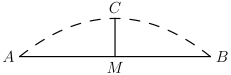
A parabolic arch has a height of inches and a span of inches. The height, in inches, of the arch at a point inches from the center is:
Answer: B
Small Hint:
Place the center at the origin and write the parabola as
Big Hint:
Use the endpoint to find , then substitute
Solution:
Place at the origin with the span on the -axis. The arch has equation Since lies on it, so At
Therefore, the correct answer is B.
27.
A particle moves so that its speed for the second and subsequent miles varies inversely as the integral number of miles already traveled. For each subsequent mile the speed is constant. If the second mile is traversed in hours, then the time, in hours, needed to traverse the th mile is:
Answer: E
Small Hint:
During the th mile, the number of miles already traveled is
Big Hint:
Time for a fixed one-mile distance varies directly as
Solution:
For the th mile, Since the distance is one mile, the time is The condition gives Therefore
Therefore, the correct answer is E.
28.
Let be the number of points interior to the region bounded by a circle with radius such that the sum of the squares of the distances from to the endpoints of a given diameter is Then is:
infinite
Answer: E
Small Hint:
Place the circle at the origin with diameter endpoints and
Big Hint:
Simplify the sum of the two squared distances
Solution:
Let and take the diameter endpoints as and The condition becomes Thus This is an entire circle of radius lying inside the given unit circle. It contains infinitely many points.
Therefore, the correct answer is E.
29.
If and a relation between and is:
none of these
Answer: C
Small Hint:
Divide by to express in terms of and
Big Hint:
Also observe that , then eliminate
Solution:
Dividing the definitions gives Also, Substituting gives Raising both sides to the power yields
Therefore, the correct answer is C.
30.
Let be a point of hypotenuse (or its extension) of isosceles right triangle Let Then:
for a finite number of positions of
for an infinite number of positions of
only if is the midpoint of or an endpoint of
always
if is a trisection point of
Answer: D
Small Hint:
Put the midpoint of at the origin and on the -axis
Big Hint:
Use and
Solution:
Take and This describes every point on the hypotenuse line. Then Thus for every position of
Therefore, the correct answer is D.
31.
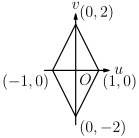
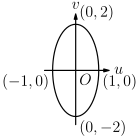
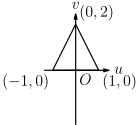
Let be a unit square in the -plane with and Let and define a transformation of the -plane into the -plane. The transform (or image) of the square is:
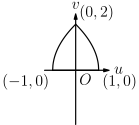
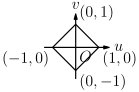
Answer: D
Small Hint:
Map the four vertices and then transform each side separately
Big Hint:
The horizontal sides and vertical sides become two line segments and two parabolic arcs
Solution:
The vertices map as Side maps to the segment from to and maps to the segment from to On so on so These are the two upper parabolic arcs joining to
Therefore, the correct answer is D.
32.
Let a sequence be defined by and the relation If is expressed as a polynomial in the algebraic sum of its coefficients is:
Answer: C
Small Hint:
The sum of a polynomial’s coefficients is its value at
Big Hint:
The problem already gives
Solution:
For any polynomial the sum of its coefficients is Here the polynomial represents and the initial condition gives Therefore the coefficient sum is
Therefore, the correct answer is C.
33.
Let and be the respective sums of the first terms of two arithmetic series. If for all the ratio of the eleventh term of the first series to the eleventh term of the second series is:
undetermined
Answer: A
Small Hint:
In an arithmetic sequence, the middle term of the first terms equals their average
Big Hint:
Express each eleventh term as its corresponding -term sum divided by
Solution:
For an arithmetic sequence, the eleventh term is the average of the first terms. Thus the respective eleventh terms are and Their ratio is
Therefore, the correct answer is A.
34.
The remainder obtained by dividing by is a polynomial of degree less than Then may be written as:
Answer: B
Small Hint:
Write and use
Big Hint:
Evaluate the division identity at and
Solution:
Write Since the divisor is evaluating the division identity at its roots gives Therefore
Therefore, the correct answer is B.
35.
Let be the -coordinate of the left endpoint of the intersection of the graphs of and where Let Then, as is made arbitrarily close to zero, the value of is:
arbitrarily close to zero
arbitrarily close to
arbitrarily close to
arbitrarily large
undetermined
Answer: B
Small Hint:
The left intersection coordinate is
Big Hint:
Substitute into and rationalize the numerator
Solution:
The left intersection satisfies Hence As approaches this approaches
Therefore, the correct answer is B.