
1967 AMC 12 Problems
Scroll down and press Start to try the exam! Or, go to the printable PDF, answer key, or professional solutions curated by LIVE by Po-Shen Loh.
All problems are used with official legal permission of the Mathematical Association of America (MAA).
Or jump straight to a single problem with its solution: 1 · 2 · 3 · 4 · 5 · 6 · 7 · 8 · 9 · 10 · 11 · 12 · 13 · 14 · 15 · 16 · 17 · 18 · 19 · 20 · 21 · 22 · 23 · 24 · 25 · 26 · 27 · 28 · 29 · 30 · 31 · 32 · 33 · 34 · 35 · 36 · 37 · 38 · 39 · 40
Want to learn professionally through interactive video classes?
Timed
1:15:00
1.
The three-digit number is added to the number to give the three-digit number If is divisible by then equals:
Answer: C
Small Hint:
Use the digit sum of
Big Hint:
After finding compare the tens digits in the addition
Solution:
Divisibility by requires to be a multiple of Since is a digit, this gives The addition is then so Hence
Therefore, the correct answer is C.
2.
An equivalent of the expression
is:
Answer: D
Small Hint:
Expand each product into four terms
Big Hint:
Look for cancellation of the and terms
Solution:
The first product is while the second is Adding gives
Therefore, the correct answer is D.
3.
The side of an equilateral triangle is A circle is inscribed in the triangle and a square is inscribed in the circle. The area of the square is:
Answer: B
Small Hint:
The inradius of an equilateral triangle of side is
Big Hint:
The square’s diagonal is the circle’s diameter
Solution:
The inradius is The inscribed square has diagonal so its area is half the square of that diagonal:
Therefore, the correct answer is B.
4.
Given all logarithms to the same base and If then is:
Answer: C
Small Hint:
Rewrite the logarithmic equalities as and
Big Hint:
Substitute those powers into
Solution:
The given equalities imply and Therefore Since this is and we have
Therefore, the correct answer is C.
5.
A triangle is circumscribed about a circle of radius inches. If the perimeter of the triangle is inches and the area is square inches, then is:
independent of the value of
Answer: D
Small Hint:
Split the triangle into three smaller triangles with altitude
Big Hint:
Express using the semiperimeter
Solution:
The three radii to the points of tangency split the triangle into smaller triangles whose total area is Hence
Therefore, the correct answer is D.
6.
7.
If where are real numbers and then:
must be negative
must be positive
must not be zero
can be negative or zero, but not positive
can be positive, negative, or zero
Answer: E
Small Hint:
The signs of are unrestricted except that
Big Hint:
Try and choose so that the right side is positive
Solution:
Take and The inequality becomes which is satisfied by positive, zero, and negative values of Thus none of the three possible signs is forced.
Therefore, the correct answer is E.
8.
To ounces of an solution of acid, ounces of water are added to yield an solution. If then is:
not determined by the given information
Answer: A
Small Hint:
The amount of acid remains ounces
Big Hint:
Set that equal to times the final volume
Solution:
Conservation of acid gives Hence so and
Therefore, the correct answer is A.
9.
Let in square units, be the area of a trapezoid such that the shorter base, the altitude, and the longer base, in that order, are in arithmetic progression. Then:
must be an integer
must be a rational fraction
must be an irrational number
must be an integer or a rational fraction
taken alone neither nor nor nor is true
Answer: E
Small Hint:
Write the three lengths as and
Big Hint:
The resulting area is but the problem does not restrict the kind of number is
Solution:
Let the shorter base, altitude, and longer base be and Then Depending on this can be an integer, a nonintegral rational number, or an irrational number. No one of choices (A) through (D) must hold.
Therefore, the correct answer is E.
10.
If
is an identity for positive rational values of then the value of is:
Answer: A
Small Hint:
Multiply by
Big Hint:
Compare the coefficient of and the constant term
Solution:
Clearing denominators gives Therefore and Solving gives so
Therefore, the correct answer is A.
11.
If the perimeter of rectangle is inches, the least value of diagonal in inches, is:
none of these
Answer: B
Small Hint:
If adjacent sides are and square the diagonal
Big Hint:
Complete the square in
Solution:
Let adjacent sides be and Then This is minimized at giving
Therefore, the correct answer is B.
12.
If the (convex) area bounded by the -axis and the lines and is then equals:
none of these
Answer: B
Small Hint:
The parallel vertical sides have lengths and
Big Hint:
Their separation is , so use the trapezoid-area formula
Solution:
The bounded region is a trapezoid with parallel sides and separated by Thus Hence so The endpoint heights are positive, as required for the stated convex region.
Therefore, the correct answer is B.
13.
A triangle is to be constructed given side (opposite angle ), angle and the altitude from If is the number of noncongruent solutions, then
is
is
must be zero
must be infinite
must be zero or infinite
Answer: E
Small Hint:
Fix and draw the ray from making the given angle
Big Hint:
The distance from to that ray is fixed, regardless of where lies on it
Solution:
Fix and draw the ray from that makes the prescribed angle Its distance from is fixed. If that distance is not there is no solution. If it is then may be chosen at infinitely many positions on the ray, producing infinitely many noncongruent triangles. Thus must be zero or infinite.
Therefore, the correct answer is E.
14.
Let If then can be expressed as:
Answer: C
Small Hint:
Solve for
Big Hint:
Compare with
Solution:
From we obtain so Since this is
Therefore, the correct answer is C.
15.
The difference in the areas of two similar triangles is square feet, and the ratio of the larger area to the smaller is the square of an integer. The area of the smaller triangle, in square feet, is an integer, and one of its sides is feet. The corresponding side of the larger triangle, in feet, is:
Answer: D
Small Hint:
Let the integer side-scale factor be
Big Hint:
If the smaller area is then
Solution:
Let the side-scale factor be the integer and the smaller area be the integer Then Thus is a positive divisor of The only resulting square is so The corresponding side is
Therefore, the correct answer is D.
16.
Let the product each factor written in base equal in base Let each term expressed in base Then in base is:
Answer: B
Small Hint:
Translate the three factors and into polynomials in
Big Hint:
The resulting cubic has the valid base
Solution:
The product equation is It simplifies to Thus the valid base is The required sum is which is
Therefore, the correct answer is B.
17.
If and are the distinct real roots of then it must follow that:
or
and
and
Answer: A
Small Hint:
Distinct real roots require the discriminant to be positive
Big Hint:
Use
Solution:
The discriminant condition is so By Vieta’s formulas, and therefore
Therefore, the correct answer is A.
18.
If and then
can take any real value
Answer: B
Small Hint:
Factor to locate
Big Hint:
Check how varies on that interval
Solution:
The inequality gives On this interval is increasing, with endpoint values and The endpoints are excluded, so
Therefore, the correct answer is B.
19.
The area of a rectangle remains unchanged when it is made inches longer and inch narrower, or when it is made inches shorter and inch wider. Its area, in square inches, is:
Answer: E
Small Hint:
Let the original length and width be and
Big Hint:
Expand both equal-area equations; the terms cancel
Solution:
The two conditions are After expanding, these give and Hence and
Therefore, the correct answer is E.
20.
A circle is inscribed in a square of side then a square is inscribed in that circle, then a circle is inscribed in the latter square, and so on. If is the sum of the areas of the first circles so inscribed, then, as grows beyond all bounds, approaches:
Answer: A
Small Hint:
The first circle has area
Big Hint:
Each successive circle has half the preceding circle’s area
Solution:
The first circle has area Each inscribed square reduces the next circle’s squared radius, and hence its area, by a factor of Thus the limiting sum is
Therefore, the correct answer is A.
21.
In right triangle the hypotenuse and leg The bisector of angle meets the opposite side in A second right triangle is then constructed with hypotenuse and leg If the bisector of angle meets the opposite side in the length of is:
Answer: B
Small Hint:
Use the angle-bisector theorem in the -- triangle
Big Hint:
The second triangle is a half-scale copy of the first
Solution:
Since the angle-bisector theorem gives Hence and so triangle is a half-scale copy of
For the angle bisector from in the original triangle, so Therefore is half of this, or
Thus, the correct answer is B.
22.
For natural numbers, when is divided by the quotient is and the remainder is When is divided by the quotient is and the remainder is Then, when is divided by the remainder is:
Answer: A
Small Hint:
Write and
Big Hint:
Substitute the second equation into the first and isolate the multiple of
Solution:
Substitution gives The remainder bounds imply so this is indeed the remainder.
Therefore, the correct answer is A.
23.
If is real and positive and grows beyond all bounds, then approaches:
no finite number
Answer: B
Small Hint:
Combine the logarithms into one logarithm
Big Hint:
Find the limit of
Solution:
The difference is The fraction approaches so the expression approaches
Therefore, the correct answer is B.
24.
The number of solution-pairs in positive integers of the equation is:
none of these
Answer: A
Small Hint:
Reduce the equation modulo to find the form of
Big Hint:
Count the positive values that leave
Solution:
Modulo the equation gives so Write Then Positivity requires giving pairs.
Therefore, the correct answer is A.
25.
For every odd number we have:
is divisible by
is divisible by
is divisible by
is divisible by
is divisible by
Answer: A
Small Hint:
Work modulo for choice (A)
Big Hint:
Since every positive power has the same residue
Solution:
Because is odd, is a positive integer. Modulo we have Therefore Thus choice (A) always holds.
Therefore, the correct answer is A.
26.
If one uses only the tabular information then the strongest statement one can make for is that it lies between:
and
and
and
and
and
Answer: C
Small Hint:
Compare with for a lower bound
Big Hint:
Compare with for an upper bound
Solution:
From we get so From we get so This is the narrowest listed interval justified by the table.
Therefore, the correct answer is C.
27.
Two candles of the same length are made of different materials so that one burns out completely at a uniform rate in hours and the other in hours. At what time P.M. should the candles be lighted so that, at P.M., one stub is twice the length of the other?
Answer: C
Small Hint:
Let be the number of hours the candles burn before P.M.
Big Hint:
Their remaining fractions are and
Solution:
After hours, the faster and slower candles have fractions and remaining. The slower stub must be twice the faster: Thus hours minutes. Counting back from P.M. gives P.M.
Therefore, the correct answer is C.
28.
Given the two hypotheses: I Some Mems are not Ens and II No Ens are Vees. If “some” means “at least one,” we can conclude that:
Some Mems are not Vees
Some Vees are not Mems
No Mem is a Vee
Some Mems are Vees
Neither nor nor nor is deducible from the given statements
Answer: E
Small Hint:
Translate the three kinds of objects into sets
Big Hint:
Test both and while keeping the two hypotheses true
Solution:
The hypotheses say only that some element of lies outside and that A model with makes (A), (B), and (C) false while satisfying the hypotheses. A model with makes (D) false. Hence none of choices (A) through (D) is forced.
Therefore, the correct answer is E.
29.
is a diameter of a circle. Tangents and are drawn so that and intersect in a point on the circle. If and the diameter of the circle is:
Answer: C
Small Hint:
Let the intersection point on the circle be ; then
Big Hint:
Use the parallel tangents to compare right triangles and
Solution:
Let be the diameter. Since the intersection of and lies on the circle, those two lines are perpendicular by Thales’ theorem. Also the tangents and are parallel. The resulting right triangles and are similar, so Hence and
Therefore, the correct answer is C.
30.
A dealer bought radios for dollars, a positive integer. He contributed two radios to a community bazaar at half their cost. The rest he sold at a profit of on each radio sold. If the overall profit was then the least possible value of for the given information is:
Answer: D
Small Hint:
Each radio costs dollars
Big Hint:
Write the total intake from profitable sales and two half-cost sales
Solution:
The regular sales bring while the two bazaar radios bring together. Since the total intake is This reduces to Positivity requires and gives the positive integer
Therefore, the correct answer is D.
31.
Let where are consecutive integers and Then is:
always an even integer
sometimes an odd integer, sometimes not
always an odd integer
sometimes rational, sometimes not
always irrational
Answer: C
Small Hint:
Set and expand
Big Hint:
Try to recognize as the square of
Solution:
With and Thus Since is even, this integer is always odd.
Therefore, the correct answer is C.
32.
In quadrilateral with diagonals and intersecting at and The length of is:
Answer: E
Small Hint:
Use triangle to find
Big Hint:
Angles and are supplementary
Solution:
In triangle Therefore Applying the law of cosines in triangle gives Hence
Therefore, the correct answer is E.
33.
In this diagram semi-circles are constructed on diameters and so that they are mutually tangent. If then the ratio of the shaded area to the area of a circle with as radius is:
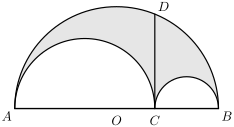
Answer: D
Small Hint:
Subtract the two small semicircle areas from the large one
Big Hint:
In right triangle the altitude theorem gives
Solution:
Let and The shaded area is the large semicircle minus the two smaller ones: Since lies on the semicircle with diameter triangle is right, and its altitude satisfies A circle of radius therefore has area The required ratio is
Therefore, the correct answer is D.
34.
Points are taken respectively on sides and of triangle so that and The ratio of the area of triangle to that of triangle is:
Answer: A
Small Hint:
Subtract the three corner triangles from triangle
Big Hint:
Each corner triangle has area ratio
Solution:
At each vertex, the two adjacent side fractions used by the corner triangle are and Thus each corner triangle has area times Therefore
Therefore, the correct answer is A.
35.
The roots of are in arithmetic progression. The difference between the largest and smallest roots is:
Answer: B
Small Hint:
Write the roots as and
Big Hint:
Use their sum to find then use their product to find
Solution:
Let the roots be and Their sum is so Their product is Substituting gives so the difference between the extreme roots is
Therefore, the correct answer is B.
36.
Given a geometric progression of five terms, each a positive integer less than The sum of the five terms is If is the sum of those terms in the progression which are squares of integers, then is:
Answer: C
Small Hint:
Write the rational common ratio in lowest terms as
Big Hint:
Integrality forces the middle term to be a multiple of ; use that is prime
Solution:
Let the common ratio be in lowest terms and the middle term be Since all five terms are integers, is divisible by so write The sum is then divisible by Thus is or But the middle term is less than so
Thus The bound gives If either is the possible sums are or not Coprimality therefore leaves and equal to and in either order. The progression is Its square terms sum to
Therefore, the correct answer is C.
37.
Segments are drawn from the vertices of triangle each perpendicular to a straight line not intersecting the triangle. Points are the intersection points of with the perpendiculars. If is the length of the perpendicular segment drawn to from the intersection point of the medians of the triangle, then is:
undetermined
Small Hint:
Signed distance from a point to a fixed line is an affine function
Big Hint:
The centroid is the average of the three vertices
Solution:
Because does not intersect the triangle, the three perpendicular distances have the same sign. Signed distance to a fixed line is affine, and the centroid is the average of the vertices. Therefore its distance is the average
Therefore, the correct answer is A.
38.
Given a set consisting of two undefined elements “pib” and “maa,” and the four postulates:
Every pib is a collection of maas.
Any two distinct pibs have one and only one maa in common.
Every maa belongs to two and only two pibs.
There are exactly four pibs.
Consider the three theorems:
There are exactly six maas.
There are exactly three maas in each pib.
For each maa there is exactly one other maa not in the same pib with it.
The theorems which are deducible from the postulates are:
only
and only
and only
and only
all
Answer: E
Small Hint:
Label the four pibs and
Big Hint:
Each maa corresponds to an unordered pair of pibs
Solution:
Label the four pibs and By and every maa is exactly the common maa of one unordered pair of pibs. Thus there are maas, proving
A fixed pib contains the three maas with proving For maa the unique maa sharing neither pib is the one belonging to the complementary pair of pibs, proving All three follow.
Therefore, the correct answer is E.
39.
Given the sets of consecutive integers where each set contains one more element than the preceding one, and where the first element of each succeeding set is one more than the last element of the preceding set. Let be the sum of the elements in the th set. Then equals:
none of these
Answer: B
Small Hint:
The last number in the th set is
Big Hint:
Sum the consecutive integers ending at that number
Solution:
The th set ends at and contains consecutive integers. Its sum is Thus
Therefore, the correct answer is B.
40.
Located inside equilateral triangle is a point such that and To the nearest integer the area of triangle is:
Answer: D
Small Hint:
Rotate by about so that maps to
Big Hint:
The resulting -- triangle determines
Solution:
Rotate by about to Since this rotation sends to we have and Thus triangle is right. Also triangle is equilateral, so
If the equilateral triangle has side the law of cosines in triangle gives Its area is whose nearest integer is
Therefore, the correct answer is D.