
1957 AMC 12 Problems
Scroll down and press Start to try the exam! Or, go to the printable PDF, answer key, or professional solutions curated by LIVE by Po-Shen Loh.
All problems are used with official legal permission of the Mathematical Association of America (MAA).
Or jump straight to a single problem with its solution: 1 · 2 · 3 · 4 · 5 · 6 · 7 · 8 · 9 · 10 · 11 · 12 · 13 · 14 · 15 · 16 · 17 · 18 · 19 · 20 · 21 · 22 · 23 · 24 · 25 · 26 · 27 · 28 · 29 · 30 · 31 · 32 · 33 · 34 · 35 · 36 · 37 · 38 · 39 · 40 · 41 · 42 · 43 · 44 · 45 · 46 · 47 · 48 · 49 · 50
Want to learn professionally through interactive video classes?
Timed
1:15:00
1.
The number of distinct lines representing the altitudes, medians, and interior angle bisectors of a triangle that is isosceles, but not equilateral, is:
Answer: B
Small Hint:
Separate the line from the apex from the lines drawn from the two base vertices
Big Hint:
At the apex, the altitude, median, and angle bisector coincide; at either base vertex they do not
Solution:
The altitude, median, and angle bisector from the apex are the same line. At each of the two base vertices, those three lines are distinct. Thus there are distinct lines.
Therefore, the correct answer is B.
2.
In the equation the sum of the roots is and the product of the roots is Then and have the values, respectively:
and
and
and
and
and
Answer: E
Small Hint:
Apply Vieta’s formulas without first solving the quadratic
Big Hint:
The sum is and the product is
Solution:
By Vieta’s formulas, the sum and product of the roots are Hence and
Therefore, the correct answer is E.
3.
The simplest form of is:
if
if
with no restriction on
if
Answer: E
Small Hint:
Combine before taking its reciprocal
Big Hint:
Retain every restriction imposed by the original denominator
Solution:
The original expression requires For such Therefore the expression is The restriction remains.
Thus, the correct answer is E.
4.
The first step in finding the product by use of the distributive property in the form is:
Answer: C
Small Hint:
Match the second factor with in the stated form
Big Hint:
Take and
Solution:
Using the property in precisely the stated form, set and Then
Thus, the correct answer is C.
5.
Through the use of theorems on logarithms, can be reduced to:
Answer: B
Small Hint:
Combine the first three logarithms by multiplying their arguments
Big Hint:
The product telescopes to
Solution:
Combining the logarithms gives
Therefore, the correct answer is B.
6.
An open box is constructed by starting with a rectangular sheet of metal in. by in. and cutting a square of side inches from each corner. The resulting projections are folded up and the seams welded. The volume of the resulting box is:
none of these
Answer: A
Small Hint:
After folding, the height is and each base dimension loses
Big Hint:
Write the volume as
Solution:
The box has height and base dimensions and Hence
Thus, the correct answer is A.
7.
The area of a circle inscribed in an equilateral triangle is The perimeter of this triangle is:
Answer: E
Small Hint:
Use to find the inradius
Big Hint:
For an equilateral triangle of side the inradius is
Solution:
The inradius satisfies so If is the side length, then which gives The perimeter is
Thus, the correct answer is E.
8.
The numbers are proportional to The sum of and is The number is given by the equation Then is:
Answer: A
Small Hint:
Write as
Big Hint:
Their sum determines , after which substitute and into the given equation
Solution:
Let and Since we get so and Thus and
Therefore, the correct answer is A.
9.
The value of when and is:
Answer: B
Small Hint:
Evaluate the exponent before the power
Big Hint:
The powered term is , not
Solution:
Here Therefore
Thus, the correct answer is B.
10.
The graph of has its:
lowest point at
lowest point at
lowest point at
highest point at
highest point at
Answer: C
Small Hint:
Complete the square in
Big Hint:
Because the coefficient of the square is positive, the vertex is a minimum
Solution:
Completing the square, The squared term is nonnegative, so the graph has its lowest point at
Thus, the correct answer is C.
11.
The angle formed by the hands of a clock at is:
none of these
Answer: E
Small Hint:
At the minute hand is at from twelve
Big Hint:
The hour hand has advanced one quarter of the interval from two to three
Solution:
The minute hand is clockwise from twelve. The hour hand is from twelve. Their smaller angle is which is not listed.
Therefore, the correct answer is E.
12.
Comparing the numbers and we may say:
the first exceeds the second by
the first exceeds the second by
the first exceeds the second by
the second is five times the first
the first exceeds the second by
Answer: C
Small Hint:
Express both numbers with the same power of ten
Big Hint:
Rewrite as
Solution:
Using a common power of ten,
Thus, the correct answer is C.
13.
A rational number between and is:
Answer: C
Small Hint:
Compare the decimal choices with and
Big Hint:
The radical expressions in the first two choices are irrational
Solution:
Since the rational number lies between the two radicals.
Therefore, the correct answer is C.
14.
If then is:
none of these
Answer: D
Small Hint:
Factor each radicand as a perfect square
Big Hint:
For real
Solution:
The two radicands are and Hence
Thus, the correct answer is D.
15.
The table below shows the distance in feet a ball rolls down an inclined plane in seconds.
The distance for is:
Answer: B
Small Hint:
Compare each listed -value with the square of its -value
Big Hint:
The table follows
Solution:
The entries follow Thus, at
Therefore, the correct answer is B.
16.
Goldfish are sold at cents each. The rectangular coordinate graph showing the cost of to goldfish is:
a straight line segment
a set of horizontal parallel line segments
a set of vertical parallel line segments
a finite set of distinct points
a straight line
Answer: D
Small Hint:
Decide whether the number of fish varies continuously or only through whole numbers
Big Hint:
There is one cost point for each integer count from through
Solution:
The rule is linear, but the number of goldfish can only be one of the twelve integers The graph therefore consists of twelve distinct points, not an entire line or segment.
Thus, the correct answer is D.
17.
A cube is made by soldering twelve -inch lengths of wire properly at the vertices of the cube. If a fly alights at one of the vertices and then walks along the edges, the greatest distance it could travel before coming to any vertex a second time, without retracing any distance, is:
in.
in.
in.
in.
in.
Answer: A
Small Hint:
A path that never returns to a vertex can visit at most all eight cube vertices
Big Hint:
Exhibit a path through all eight vertices, which uses seven edges before the next step returns to the starting vertex
Solution:
The cube has eight vertices. A path can visit all eight once, using seven edges, and then traverse the edge from its last vertex back to its starting vertex; the return is the first repeated vertex. Thus the greatest permitted walk uses eight edges. Its length is inches.
Therefore, the correct answer is A.
18.
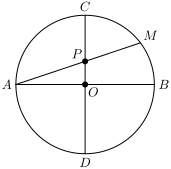
Circle has diameters and perpendicular to each other. is any chord intersecting at Then is equal to:
Answer: B
Small Hint:
Because is a diameter, angle is a right angle
Big Hint:
Compare right triangles and
Solution:
Angles and are both right angles, and the two triangles share angle Therefore triangles and are similar. Corresponding sides give Hence
Thus, the correct answer is B.
19.
The base of the decimal number system is ten, meaning, for example, that In the binary system, which has base two, the first five positive integers are The numeral in the binary system would then be written in the decimal system as:
Answer: A
Small Hint:
Assign powers to the five binary places
Big Hint:
Only the first, fourth, and fifth digits are nonzero
Solution:
Expanding by binary place value,
Therefore, the correct answer is A.
20.
A man makes a trip by automobile at an average speed of mph. He returns over the same route at an average speed of mph. His average speed for the entire trip is:
mph
mph
mph
mph
none of these
Answer: A
Small Hint:
Use a convenient one-way distance and divide total distance by total time
Big Hint:
For equal distances the arithmetic mean of the two speeds is not the average speed
Solution:
Let each leg have distance The average speed, in miles per hour, is
Thus, the correct answer is A.
21.
Start with the theorem “If two angles of a triangle are equal, the triangle is isosceles,” and the following four statements:
If two angles of a triangle are not equal, the triangle is not isosceles.
The base angles of an isosceles triangle are equal.
If a triangle is not isosceles, then two of its angles are not equal.
A necessary condition that two angles of a triangle be equal is that the triangle be isosceles.
Which combination of statements contains only those which are logically equivalent to the given theorem?
Answer: E
Small Hint:
Write the theorem as and compare each statement with its inverse, converse, or contrapositive
Big Hint:
A statement is always equivalent to its contrapositive, but not generally to its converse or inverse
Solution:
Let mean that two angles are equal and that the triangle is isosceles. Statement is the contrapositive so it is equivalent to Statement says that is necessary for which is another wording of Statements and are the inverse and converse.
Thus only statements and are equivalent, so the correct answer is E.
22.
If then equals:
no real value
Answer: A
Small Hint:
Rearrange to
Big Hint:
After squaring once, isolate
Solution:
Rearrange and square: Thus so and This value satisfies the original equation. Therefore
Thus, the correct answer is A.
23.
The graph of and the graph of meet in two points. The distance between these two points is:
less than
more than
Answer: C
Small Hint:
Set the two expressions for equal
Big Hint:
The resulting equation is
Solution:
At an intersection, so or The points are and Their distance is
Therefore, the correct answer is C.
24.
If the square of a number of two digits is decreased by the square of the number formed by reversing the digits, then the result is not always divisible by:
the product of the digits
the sum of the digits
the difference of the digits
Answer: B
Small Hint:
Represent the number as and its reversal as
Big Hint:
Factor the difference of their squares completely
Solution:
If the digits are then This is always divisible by the digit sum, and the digit difference. It need not be divisible by the digit product; for example, is not divisible by
Thus, the correct answer is B.
25.
The vertices of triangle have coordinates as follows: where and are positive. The origin and point lie on opposite sides of The area of triangle may be found from the expression:
Answer: B
Small Hint:
Use the determinant formula for the area of a triangle from its coordinates
Big Hint:
The opposite-side condition determines the sign inside the absolute value
Solution:
The signed doubled area is The line has equation Since the origin gives a value below and is on the opposite side, Thus the area is
Therefore, the correct answer is B.
26.
From a point within a triangle, line segments are drawn to the vertices. A necessary and sufficient condition that the three triangles thus formed have equal areas is that the point be:
the center of the inscribed circle
the center of the circumscribed circle
such that the three angles formed at the point each be
the intersection of the altitudes of the triangle
the intersection of the medians of the triangle
Answer: E
Small Hint:
Recall how the medians partition a triangle’s area
Big Hint:
The intersection of the medians divides the triangle into six small triangles paired into three equal-area regions
Solution:
The three medians meet at the centroid and divide the triangle into six small triangles of equal area. Each of the three triangles having the centroid and one side of the original triangle consists of two of those small triangles, so their areas are equal. Conversely, equal areas give equal barycentric coordinates, which uniquely locate the centroid.
Thus, the necessary and sufficient point is the intersection of the medians, and the correct answer is E.
27.
The sum of the reciprocals of the roots of the equation is:
Answer: A
Small Hint:
Call the roots and , and combine
Big Hint:
Use and
Solution:
If the roots are then Vieta’s formulas give and Therefore
Thus, the correct answer is A.
28.
If and are positive and then the value of is:
dependent upon
dependent upon
dependent upon and
zero
one
Small Hint:
Use the inverse relationship between a base- logarithm and exponentiation by
Big Hint:
If then
Solution:
By the definition of a logarithm, Thus the value depends on not on the choice of admissible base
Therefore, the correct answer is B.
29.
The relation is true only for:
Here means that can take on all values greater than and the value equal to while has a corresponding meaning with “less than.”
Answer: D
Small Hint:
The factor is positive except at
Big Hint:
Away from zero, the sign is controlled by
Solution:
At the product is zero. For the factor is positive, so the product is nonnegative exactly when or or Including the isolated value gives the set in choice D.
Thus, the correct answer is D.
30.
The sum of the squares of the first positive integers is given by the expression if and are, respectively:
and
and
and
and
and
Answer: D
Small Hint:
Compare the expression with the standard sum-of-squares formula
Big Hint:
Alternatively, substitute and to obtain two equations
Solution:
The standard formula is Therefore and
Thus, the correct answer is D.
31.
A regular octagon is to be formed by cutting equal isosceles right triangles from the corners of a square. If the square has sides of one unit, the leg of each of the triangles has length:
Answer: B
Small Hint:
If each cut-off leg is an uncut horizontal octagon side has length
Big Hint:
A slanted octagon side is the hypotenuse , and regularity makes these equal
Solution:
Let be a leg of each corner triangle. The horizontal and vertical octagon sides have length while the four slanted sides have length Thus so
Therefore, the correct answer is B.
32.
The largest of the following integers which divides each of the numbers of the sequence is:
Answer: E
Small Hint:
Show is always divisible by and
Big Hint:
Use consecutive factors for and and residues modulo for the remaining factor
Solution:
Factor Among three consecutive integers, one is divisible by and at least one is even, so the expression is divisible by Also for every integer so it is divisible by Hence every term is divisible by Taking gives so no larger listed integer can divide every term.
Thus, the correct answer is E.
33.
If then the value of is:
Answer: E
Small Hint:
Rewrite as
Big Hint:
After collecting like terms, express as a power of
Solution:
Factoring so and Since we have
Therefore, the correct answer is E.
34.
The points that satisfy the system where the symbol “” means “less than,” constitute the following set:
only two points
an arc of a circle
a straight line segment not including the end-points
a straight line segment including the end-points
a single point
Answer: C
Small Hint:
Interpret as the interior of a circle
Big Hint:
Intersect that open disk with the line
Solution:
The inequality describes the open disk inside the circle of radius centered at the origin. The line crosses the circle in two points. Its portion inside the disk is the segment between those points, but the strict inequality excludes the endpoints.
Thus, the correct answer is C.
35.
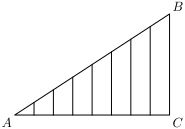
Side of right triangle is divided into equal parts. Seven line segments parallel to are drawn to from the points of division. If then the sum of the lengths of the seven line segments:
cannot be found from the given information
is
is
is
is
Answer: D
Small Hint:
Each small triangle with vertex is similar to triangle
Big Hint:
The seven parallel lengths are
Solution:
By similarity, the segment at the th division point has length for Their sum is
Therefore, the correct answer is D.
36.
If then the largest value of is:
an irrational number about
Answer: D
Small Hint:
Substitute into the product
Big Hint:
Complete the square in
Solution:
We have The squared term is nonnegative, so the largest possible product is
Thus, the correct answer is D.
37.
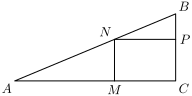
In right triangle and is on If one-half the perimeter of rectangle then:
Answer: C
Small Hint:
Triangles and are similar
Big Hint:
Use and
Solution:
By similarity, Also Hence
Therefore, the correct answer is C.
38.
From a two-digit number we subtract the number with the digits reversed and find that the result is a positive perfect cube. Then:
cannot end in
can end in any digit other than
does not exist
there are exactly values for
there are exactly values for
Answer: D
Small Hint:
If the digits are the difference from the reversal is
Big Hint:
The difference is at most so test the positive cubes no larger than
Solution:
Writing the positive difference is It is at most Among and only is divisible by so The digit pairs are giving exactly seven values of
Thus, the correct answer is D.
39.
Two men set out at the same time to walk towards each other from and miles apart. The first man walks at the rate of mph. The second man walks miles the first hour, miles the second hour, miles the third hour, and so on in arithmetic progression. Then the men will meet:
in hours
in hours
nearer than
nearer than
midway between and
Answer: E
Small Hint:
After whole hours, sum the second man’s hourly distances as an arithmetic progression
Big Hint:
Set that sum plus equal to
Solution:
In hours, the second man’s hourly distances form an arithmetic progression with first term and last term His distance is Together the men cover or The positive root is The first man then walks miles, exactly half the original distance.
Therefore, the correct answer is E.
40.
If the parabola has its vertex on the -axis, then must be:
a positive integer
a positive or a negative rational number
a positive rational number
a positive or a negative irrational number
a negative irrational number
Small Hint:
A parabola whose vertex lies on the -axis has a repeated root
Big Hint:
Set the discriminant of equal to zero
Solution:
The vertex lies on the -axis exactly when the quadratic has one repeated root. Its discriminant must satisfy Hence a positive or negative irrational number.
Thus, the correct answer is D.
41.
Given the system of equations
For which one of the following values of is there no solution for and
Answer: D
Small Hint:
A system can fail to have a unique solution when its coefficient determinant is zero
Big Hint:
Compute
Solution:
The coefficient determinant is It vanishes when For either value, the two coefficient rows are proportional but the two right sides are not in the same ratio, so the system is inconsistent.
Thus, the correct answer is D.
42.
If where and is an integer, then the total number of possible distinct values for is:
more than
Answer: C
Small Hint:
Powers of repeat with period four
Big Hint:
Check one representative of each residue class of modulo
Solution:
If is even, is or and equals its reciprocal, so or If is odd, the two terms are and in some order, so Thus the distinct values are three values.
Therefore, the correct answer is C.
43.
We define a lattice point as a point whose coordinates are integers, zero admitted. Then the number of lattice points on the boundary and inside the region bounded by the -axis, the line and the parabola is:
not finite
Answer: B
Small Hint:
Only the integer -coordinates and occur
Big Hint:
For a fixed integer count the integer -values from through
Solution:
For each among and there are integer values from through Therefore the number of lattice points is
Thus, the correct answer is B.
44.
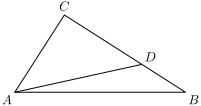
In triangle and Then is:
Answer: E
Small Hint:
Because triangle is isosceles
Big Hint:
Express using and
Solution:
Let and Since lies on as an exterior angle of triangle Because triangle is isosceles, so But Hence so and
Thus, the correct answer is E.
45.
If two real numbers and satisfy the equation then:
or where means that can take any value greater than or equal to
can equal
both and must be irrational
and cannot both be integers
both and must be rational
Answer: A
Small Hint:
Clear the denominator and regard the result as a quadratic equation in
Big Hint:
Real requires the discriminant to be nonnegative
Solution:
Since multiplying by gives or For a real value of its discriminant must satisfy Thus or
Therefore, the correct answer is A.
46.
Two perpendicular chords intersect in a circle. The segments of one chord are and the segments of the other are and Then the diameter of the circle is:
Answer: E
Small Hint:
Place the chord intersection at the origin and the perpendicular chords on the coordinate axes
Big Hint:
The circle’s center lies on both chord perpendicular bisectors
Solution:
Place the intersection at with endpoints and The perpendicular bisectors of the chords are and so the center is Using the endpoint Therefore the diameter is
Thus, the correct answer is E.
47.
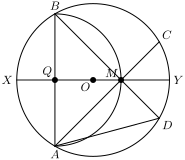
In circle the midpoint of radius is at The semicircle with as diameter intersects in Line intersects circle in and line intersects circle in Line is drawn. Then, if the radius of circle is is:
not a side of an inscribed regular polygon
Answer: A
Small Hint:
Since perpendicularly bisects compare and
Big Hint:
Use the semicircle to find then use that and are collinear
Solution:
Line is the perpendicular bisector of so Since lies on the semicircle with diameter Thus triangle is an isosceles right triangle and Because are collinear, the inscribed angle so its intercepted arc measures Therefore chord is a side of an inscribed square and has length
Thus, the correct answer is A.
48.
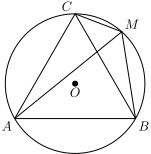
Let be an equilateral triangle inscribed in circle is a point on arc Lines and are drawn. Then is:
equal to
less than
greater than
equal to, less than, or greater than depending upon the position of
none of these
Answer: A
Small Hint:
Apply Ptolemy’s theorem to cyclic quadrilateral
Big Hint:
Use to cancel the common side length
Solution:
In cyclic quadrilateral Ptolemy’s theorem gives Since is equilateral, Dividing by this common length yields
Therefore, the correct answer is A.
49.
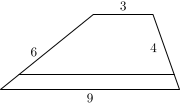
The parallel sides of a trapezoid are and The non-parallel sides are and A line parallel to the bases divides the trapezoid into two trapezoids of equal perimeters. The ratio in which each of the non-parallel sides is divided is:
Answer: C
Small Hint:
A segment parallel to the bases divides both legs in the same fraction
Big Hint:
Let the upper leg segments be and ; the common dividing segment cancels when the two perimeters are equated
Solution:
Let the upper pieces of the legs of lengths and be and respectively. The dividing segment appears once in each perimeter and cancels. Equal perimeters therefore give Hence so Each leg is divided in the ratio
Thus, the correct answer is C.
50.
In circle is a moving point on diameter is drawn perpendicular to and equal to is drawn perpendicular to on the same side of diameter as and equal to Let be the midpoint of Then, as moves from to point
moves on a straight line parallel to
remains stationary
moves on a straight line perpendicular to
moves in a small circle intersecting the given circle
follows a path which is neither a circle nor a straight line
Answer: B
Small Hint:
Place and
Big Hint:
Write coordinates for and , then average them
Solution:
Let and The perpendicular constructions on the same side give Their midpoint is independent of Thus remains stationary.
Therefore, the correct answer is B.