
2020 AMC 10B Solutions
Scroll down to view professional video solutions and written solutions from LIVE by Po-Shen Loh, print PDF solutions, view answer key, or take the full timed exam.
All problems are used with official legal permission of the Mathematical Association of America (MAA).
1.
What is the value of
Small Hint:
Turn subtraction of a negative into addition before combining terms
Big Hint:
Pair the positive and negative terms so the arithmetic stays small
Solution:
Subtracting a negative is the same as adding the corresponding positive number, so Now combine the terms:
Thus, D is the correct answer.
2.
Carl has cubes each having side length and Kate has cubes each having side length What is the total volume of these cubes?
Small Hint:
A cube with side length has volume
Big Hint:
Find the volume from Carl’s cubes and Kate’s cubes separately
Solution:
A cube with side length has volume Carl’s five cubes have total volume and Kate’s five cubes have total volume
The total volume is
Thus, the correct answer is E .
3.
The ratio of to is the ratio of to is and the ratio of to is What is the ratio of to
Small Hint:
Rewrite each ratio as a fraction involving the same variables
Big Hint:
Express as
Solution:
The ratios give Then Therefore
Thus, E is the correct answer.
4.
The acute angles of a right triangle are and where and both and are prime numbers. What is the least possible value of
Small Hint:
The two acute angles in a right triangle add to
Big Hint:
To make small, try the largest possible prime value of
Solution:
The acute angles satisfy Testing primes from least to greatest, would give none of which is prime. For however, is prime and is greater than
Therefore the least possible value of is Thus, D is the correct answer.
5.
How many distinguishable arrangements are there of brown tile, purple tile, green tiles, and yellow tiles in a row from left to right? (Tiles of the same color are indistinguishable.)
Small Hint:
First arrange the seven tiles as if they were all different
Big Hint:
Divide by the orders of the identical green and yellow tiles
Solution:
There are total tiles. If all seven tiles were distinct, there would be arrangements. The two green tiles are indistinguishable, and the three yellow tiles are indistinguishable, so we divide by and
Thus the number of arrangements is
Thus, B is the correct answer.
6.
Driving along a highway, Megan noticed that her odometer showed (miles). This number is a palindrome—it reads the same forward and backward. Then hours later, the odometer displayed the next higher palindrome. What was her average speed, in miles per hour, during this -hour period?
Small Hint:
Find the next palindrome after before computing the speed
Big Hint:
Increasing the middle digit forces a carry to the next palindrome
Solution:
A five-digit palindrome is determined by its first three digits. The first half of is ; increasing this to and reflecting the first two digits gives the next palindrome,
Megan traveled miles in hours, so her average speed was miles per hour. Thus, B is the correct answer.
7.
How many positive even multiples of less than are perfect squares?
Small Hint:
A square that is an even multiple of has a square root divisible by
Big Hint:
Count positive multiples of whose squares are less than
Solution:
A number that is both even and a multiple of is a multiple of If such a number is also a perfect square, its square root must be divisible by both and hence by Therefore the numbers counted are exactly for positive integers
Since and we have for a total of numbers.
Thus, A is the correct answer.
8.
Points and lie in a plane with How many locations for point in this plane are there such that the triangle with vertices and is a right triangle with area square units?
Small Hint:
The area condition fixes the distance from to line
Big Hint:
Separate the cases where the right angle is at or
Solution:
Place and Since the area is and the distance from to line is so
If the right angle is at then giving points. If it is at then giving more points.
If the right angle is at then is the hypotenuse, so Thus giving another points.
The total is
Thus, the correct answer is D .
9.
How many ordered pairs of integers satisfy the equation
infinitely many
Small Hint:
Complete the square in
Big Hint:
The equation forces so only a few integer -values are possible
Solution:
Move all terms to one side and complete the square: Because we must have Since is an integer,
If then so If then so or This gives ordered pairs.
Thus, D is the correct answer.
10.
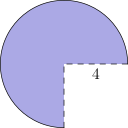
A three-quarter sector of a circle of radius inches together with its interior can be rolled up to form the lateral surface of a right circular cone by taping together along the two radii shown. What is the volume of the cone in cubic inches?
Small Hint:
The sector arc becomes the circumference of the cone base
Big Hint:
The sector radius becomes the slant height of the cone
Solution:
The sector’s arc becomes the base circumference, so if the base radius is then giving The sector radius becomes the cone’s slant height, so the cone’s height is
Hence the volume is Thus, C is the correct answer.
11.
Ms. Carr asks her students to read any of the books on a reading list. Harold randomly selects books from this list, and Betty does the same. What is the probability that there are exactly books that they both select?
Small Hint:
Fix Harold’s five books and count Betty’s choices
Big Hint:
Betty must choose exactly two from Harold’s books and three from the other five
Solution:
Assume that Harold has already picked his books. Of these five books, there are ways that Betty can have picked exactly two of the same books as Harold, and ways that Betty can choose her other three books from the books not on Harold’s list.
Thus there are favorable choices for Betty out of equally likely choices. The probability is Thus, D is the correct answer.
12.
The decimal representation of consists of a string of zeros after the decimal point, followed by a and then several more digits. How many zeros are in that initial string of zeros after the decimal point?
Small Hint:
Rewrite as
Big Hint:
Find how many digits has to know how many leading zeros appear
Solution:
We can write Now which has digits and begins with Dividing by places this -digit number after the decimal point with zeros before the first digit.
Thus, the correct answer is D .
13.
Andy the Ant lives on a coordinate plane and is currently at facing east (that is, in the positive -direction). Andy moves unit and then turns left. From there, Andy moves units (north) and then turns left. He then moves units (west) and again turns left. Andy continues this process, increasing his distance each time by unit and always turning left. What is the location of the point at which Andy makes the left turn?
Small Hint:
Track the net displacement over four moves
Big Hint:
There are exactly complete four-move cycles in moves
Solution:
In the first four moves, Andy goes east, north, west, and south. The net change is and he is again facing east.
Since Andy completes such cycles. Starting from his final position is
Thus, B is the correct answer.
14.
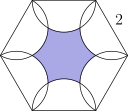
As shown in the figure below, six semicircles lie in the interior of a regular hexagon with side length so that the diameters of the semicircles coincide with the sides of the hexagon. What is the area of the shaded region—inside the hexagon but outside all of the semicircles?
Small Hint:
Use the symmetry of the regular hexagon to split the shaded region into six equal pieces
Big Hint:
Each piece is two equilateral triangles minus a sector of radius
Solution:
By symmetry, the shaded region is made of six congruent pieces. One such piece is the union of two equilateral triangles with side length minus a sector of a circle of radius
The two equilateral triangles have total area The sector has area Thus one shaded piece has area and the total shaded area is
Thus, D is the correct answer.
15.
Steve wrote the digits and in order repeatedly from left to right, forming a list of digits, beginning He then erased every third digit from his list (that is, the rd, th, th, digits from the left), then erased every fourth digit from the resulting list (that is, the th, th, th, digits from the left in what remained), and then erased every fifth digit from what remained at that point. What is the sum of the three digits that were then in positions and
Small Hint:
After each deletion step, find the new repeating block
Big Hint:
Use the final period to reduce positions and modulo the period length
Solution:
Start with the repeating block Deleting every third digit repeats over original positions: so the new period has length
Deleting every fourth digit from this period repeats over positions: so the new period has length
Deleting every fifth digit from this period gives which has period Since the digits in positions and are the rd, th, and th digits of this period: Their sum is
Thus, the correct answer is D .
16.
Bela and Jenn play the following game on the closed interval of the real number line, where is a fixed integer greater than They take turns playing, with Bela going first. At his first turn, Bela chooses any real number in the interval Thereafter, the player whose turn it is chooses a real number that is more than one unit away from all numbers previously chosen by either player. A player unable to choose such a number loses. Using optimal strategy, which player will win the game?
Bela will always win.
Jenn will always win.
Bela will win if and only if is odd.
Jenn will win if and only if is odd.
Jenn will win if and only if n>8.
Small Hint:
Look for a first move that leaves the interval symmetric
Big Hint:
After Jenn moves to Bela can respond at
Solution:
Bela can first choose the midpoint After that, whenever Jenn chooses a number Bela chooses the reflected number
This reflected number is legal whenever Jenn’s move is legal: distances from previously chosen numbers are preserved by the reflection about and Jenn cannot choose because it was Bela’s first move. Therefore every Jenn move has a matching Bela response, so Jenn is the first player who can run out of legal moves.
Thus, A is the correct answer.
17.
There are people standing equally spaced around a circle. Each person knows exactly of the other people: the people standing next to her or him, as well as the person directly across the circle. How many ways are there for the people to split up into pairs so that the members of each pair know each other?
Small Hint:
Classify pairings by how many opposite pairs are used
Big Hint:
Once the opposite pairs are chosen, the remaining people must be matched along arcs of the circle
Solution:
Label the people around the circle. Count by the number of pairs of opposite people.
With no opposite pairs, everyone must be paired with a neighbor around the -cycle. There are exactly alternating neighbor matchings.
With one opposite pair, choose that pair in ways. The remaining people form two paths of four vertices, and each path has only one perfect matching by neighbor pairs, so this gives matchings.
With two or four opposite pairs, the remaining neighbor-pairing paths have odd length somewhere, so no perfect matching is possible.
With three opposite pairs, the two opposite pairs not chosen must be adjacent around the five opposite-pair positions; otherwise the remaining people cannot be matched by neighbor pairs. There are adjacent choices for the two unchosen opposite pairs, so there are matchings.
With all five opposite pairs, there is matching. The total is
Thus, the correct answer is C .
18.
An urn contains one red ball and one blue ball. A box of extra red and blue balls lies nearby. George performs the following operation four times: he draws a ball from the urn at random and then takes a ball of the same color from the box and returns those two matching balls to the urn. After the four iterations the urn contains six balls. What is the probability that the urn contains three balls of each color?
Small Hint:
The final urn has three of each color exactly when the four draws contain two red and two blue
Big Hint:
Each fixed color order with two red draws and two blue draws has the same probability
Solution:
The urn ends with three red and three blue balls exactly when the four draws contain two red draws and two blue draws. There are possible color orders of this type.
For any fixed order with two red draws and two blue draws, the probability is because the first and second draws of each color have numerators and while the total number of balls before the four draws is
Thus the desired probability is
Thus, the correct answer is B .
19.
In a certain card game, a player is dealt a hand of cards from a deck of distinct cards. The number of distinct (unordered) hands that can be dealt to the player can be written as What is the digit
Small Hint:
The number of hands is
Big Hint:
After factoring out a final only the units digit of the remaining product is needed
Video solution:

Click to load, then click again to play
Written solution:
After canceling factors in the binomial coefficient, Dividing by the final factor the units digit of the remaining product is
Working modulo Hence Thus, A is the correct answer.
20.
Let be a right rectangular prism (box) with edge lengths and together with its interior. For real let be the set of points in -dimensional space that lie within a distance of some point in The volume of can be expressed as where and are positive real numbers. What is
Small Hint:
Decompose the enlarged solid into the original box, face slabs, edge quarter-cylinders, and corner eighth-spheres
Big Hint:
The coefficient of comes from one quarter-cylinder along each edge
Video solution:
Click to load, then click again to play
Written solution:
Decompose by where the added volume lies relative to the box.
The original box has volume The face slabs contribute surface area times so
Along each edge is a quarter-cylinder of radius The sum of all edge lengths is so At the eight corners, the eighth-spheres combine to one full sphere, so
Therefore
Thus, the correct answer is B .
21.
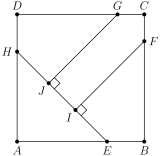
In square points and lie on and respectively, so that Points and lie on and respectively, and points and lie on so that and See the figure below. Triangle quadrilateral quadrilateral and pentagon each has area What is
Small Hint:
The four given regions fill the square, so the square’s side length is known
Big Hint:
Extend the perpendicular through to meet and compare the two resulting right isosceles triangles
Video solution:
Click to load, then click again to play
Written solution:
The four named regions fill the square and each has area so the square has area and side length Since triangle is right isosceles with area we have
Extend to meet at and set and Because has slope line has slope so If were on segment then region would lie inside triangle whose area would be at most a contradiction. Thus lies to the left of and
Triangle is right isosceles with area Triangle is right isosceles with hypotenuse so its area is Since their difference is region Therefore
Also, and so It follows that
Thus, the correct answer is B .
22.
What is the remainder when is divided by
Small Hint:
Try to factor the numerator using a difference of squares
Big Hint:
Write as a multiple of the divisor plus a small remainder
Video solution:
Click to load, then click again to play
Written solution:
Let We factor the numerator around this divisor: By the difference of squares, which is a multiple of Therefore
Thus, the correct answer is D .
23.
Square in the coordinate plane has vertices at the points and Consider the following four transformations:
• a rotation of counterclockwise around the origin;
• a rotation of clockwise around the origin;
• a reflection across the -axis; and
• a reflection across the -axis.
Each of these transformations maps the square onto itself, but the positions of the labeled vertices will change. For example, applying and then would send the vertex at to and would send the vertex at to itself. How many sequences of transformations chosen from will send all of the labeled vertices back to their original positions? (For example, is one sequence of transformations that will send the vertices back to their original positions.)
Small Hint:
After an odd number of allowed moves, a vertex always lies on the opposite parity of square corners
Big Hint:
For any first transformations, exactly one final transformation returns the square to its original labeling
Video solution:
Click to load, then click again to play
Written solution:
Each of moves every vertex to an adjacent corner of the square. Therefore after an odd number of transformations the labeling is in one of the four odd-parity states, and after an even number it is in one of the four even-parity states.
After any first transformations, the square is in an odd-parity state. From each odd-parity state, exactly one of sends the labeled vertices back to their original positions. Thus every sequence of the first transformations has exactly one valid final transformation.
There are choices for the first transformations, so there are valid sequences.
Thus, C is the correct answer.
24.
How many positive integers satisfy
(Recall that is the greatest integer not exceeding )
Small Hint:
Let so
Big Hint:
Use to bound the possible integers
Video solution:
Click to load, then click again to play
Written solution:
Let The equation gives Also, by the definition of the floor function, Substituting we get
The left inequality is so The right inequality is The roots of are which are approximately and Thus, together with the possible integer values are There are such values.
Thus, C is the correct answer.
25.
Let denote the number of ways of writing the positive integer as a product where the are integers strictly greater than and the order in which the factors are listed matters (that is, two representations that differ only in the order of the factors are counted as distinct). For example, the number can be written as and so What is
Small Hint:
Write
Big Hint:
For a product with factors, choose which factor contains the single and distribute the five factors of
Video solution:
Click to load, then click again to play
Written solution:
Write Suppose an ordered factorization has factors. Exactly one factor contains the single prime factor ; choose its position in ways.
The other factors must each contain at least one factor of while the factor containing may contain any number of factors of Distributing the five factors of under these conditions can be done in ways. Therefore the number of ordered factorizations with factors is where
Thus Letting this becomes
Thus, A is the correct answer.