
2016 AMC 10A Problems
Scroll down and press Start to try the exam! Or, go to the printable PDF, answer key, or professional solutions curated by LIVE by Po-Shen Loh.
All problems are used with official legal permission of the Mathematical Association of America (MAA).
Or jump straight to a single problem with its solution: 1 · 2 · 3 · 4 · 5 · 6 · 7 · 8 · 9 · 10 · 11 · 12 · 13 · 14 · 15 · 16 · 17 · 18 · 19 · 20 · 21 · 22 · 23 · 24 · 25
Want to learn professionally through interactive video classes?
Timed
1:15:00
1.
2.
For what value of does
Answer: C
Small Hint:
Write everything as a power of
Big Hint:
The left side becomes
Solution:
Rewrite all bases as powers of : and
Therefore , so .
Thus, the correct answer is C.
3.
For every dollar Ben spent on bagels, David spent cents less. Ben paid more than David. How much did they spend in the bagel store together?
Answer: C
Small Hint:
David spends cents for each dollar Ben spends
Big Hint:
The difference is one quarter of Ben’s spending
Solution:
For each dollar Ben spent, David spent cents, so the difference was cents. The total difference is therefore one quarter of Ben’s spending.
Ben spent dollars, and David spent dollars. Together they spent dollars.
Thus, the correct answer is C.
4.
The remainder function can be defined for all real numbers and with by where denotes the greatest integer less than or equal to What is the value of
Answer: B
Small Hint:
Compute before applying the floor function
Big Hint:
Solution:
Using the formula, we get Thus, the correct answer is B .
5.
A rectangular box has integer side lengths in the ratio Which of the following could be the volume of the box?
Answer: D
Small Hint:
If the sides are , the volume is
Big Hint:
Test which choice is times a cube
Solution:
Let be the side length of the smallest side. Then the other two sides are and
The volume is therefore Testing out values of we see that if then which is an answer choice.
Thus, the correct answer is D .
6.
Ximena lists the whole numbers through once. Emilio copies Ximena’s numbers, replacing each occurrence of the digit by the digit Ximena adds her numbers and Emilio adds his numbers. How much larger is Ximena’s sum than Emilio’s?
Answer: D
Small Hint:
Changing a units digit to loses
Big Hint:
Changing a tens digit to loses
Solution:
When Emilio changes a units digit to , his copied number is smaller by . This happens in , for a loss of .
When he changes a tens digit to , his copied number is smaller by . This happens for , for a loss of .
Thus Emilio’s sum is less than Ximena’s sum, so Ximena’s sum is larger.
Thus, the correct answer is D.
7.
The mean, median, and mode of the data values are all equal to What is the value of
Answer: D
Small Hint:
Use the mean condition first
Big Hint:
After finding , check that median and mode also equal
Solution:
The sum of the seven data values is . If the mean equals , then so and .
With , the ordered data set is . Its median is , and its mode is also , so the value works.
Thus, the correct answer is D.
8.
Trickster Rabbit agrees with Foolish Fox to double Fox’s money every time Fox crosses the bridge by Rabbit’s house, as long as Fox pays coins in toll to Rabbit after each crossing. The payment is made after the doubling. Fox is excited about his good fortune until he discovers that all his money is gone after crossing the bridge three times. How many coins did Fox have at the beginning?
Answer: C
Small Hint:
Work backward from zero coins after the third toll
Big Hint:
Undo each crossing by adding , then halving
Solution:
We know that Fox has coins at the end. Then before paying the final toll, Fox had coins.
Then he had coins before the doubling. Then before paying the toll for the second crossing, he had coins.
Before the doubling on the second crossing, he had coins. On the first crossing before the toll, Fox had coins.
Finally, before the first doubling, Fox had coins.
Thus, the correct answer is C .
9.
A triangular array of coins has coin in the first row, coins in the second row, coins in the third row, and so on up to coins in the th row. What is the sum of the digits of
Answer: D
Small Hint:
Solve
Big Hint:
Look for consecutive factors of
Solution:
Recall that the sum of the first numbers is
We want to find such that Cross-multiplying and simplifying gives us Factoring gives us We want the positive value so Adding together the digits gives us
Thus, the correct answer is D .
10.
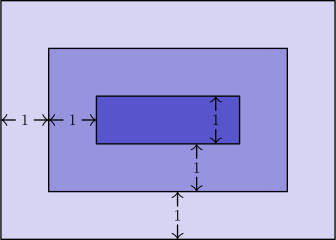
A rug is made with three different colors as shown. The areas of the three differently colored regions form an arithmetic progression. The inner rectangle is one foot wide, and each of the two shaded regions is foot wide on all four sides. What is the length in feet of the inner rectangle?
Answer: B
Small Hint:
Let the inner rectangle have length
Big Hint:
The three region areas are
Solution:
Let be the length of the inner rectangle. Then the area of the inner rectangle is
The area of the middle region is going to be The area of the outer region is
We know that these values form an arithmetic sequence. That means that
Thus, the correct answer is B .
11.
What is the area of the shaded region of the given rectangle?

Answer: D
Small Hint:
Split the shaded region into four triangles
Big Hint:
Use bases of length with heights and
Solution:
We can split the region into triangles with bases of

All four triangles have base Two have height and the other two have height
The sum of the areas of the triangles is
Thus, the correct answer is D .
12.
Three distinct integers are selected at random between and inclusive. Which of the following is a correct statement about the probability that the product of the three integers is odd?
Answer: A
Small Hint:
The product is odd only if all three selected integers are odd
Big Hint:
Sampling without replacement makes the probability slightly less than
Solution:
The product is odd exactly when all three selected integers are odd. There are odd and even integers from to .
Because the integers are selected without replacement, The first factor is , and each of the next two factors is slightly less than . Therefore .
Thus, the correct answer is A.
13.
Five friends sat in a movie theater in a row containing seats, numbered to from left to right. (The directions “left” and “right” are from the point of view of the people as they sit in the seats.)
During the movie Ada went to the lobby to get some popcorn. When she returned, she found that Bea had moved two seats to the right, Ceci had moved one seat to the left, and Dee and Edie had switched seats, leaving an end seat for Ada. In which seat had Ada been sitting before she got up?
Answer: B
Small Hint:
Track net displacement of the occupied seats
Big Hint:
Bea moves two right and Ceci moves one left
Solution:
The sum of the occupied seat numbers is both before and after the moves. Dee and Edie merely switch seats, so their combined displacement is Bea’s displacement is and Ceci’s is Therefore Ada’s displacement must be so that the total displacement is
Ada returns to an end seat. Since she moves one seat left, she must move from seat to seat
Thus, the correct answer is B .
14.
How many ways are there to write as the sum of twos and threes, ignoring order? (For example, and are two such ways.)
Answer: C
Small Hint:
Write
Big Hint:
must be even from through
Solution:
The problem can be rewritten as an equation where is the number of twos and is the number of threes.
The goal is to find the number of multiples of that can be subtracted from to result in an even number.
This can be achieved by the pairs of up to with being incremented by
This gives us solutions for and
Thus, the correct answer is C .
15.
Seven cookies of radius inch are cut from a circle of cookie dough, as shown. Neighboring cookies are tangent, and all except the center cookie are tangent to the edge of the dough. The leftover scrap is reshaped to form another cookie of the same thickness. What is the radius in inches of the scrap cookie?

Answer: A
Small Hint:
The large circle has radius
Big Hint:
Subtract the total area of the seven unit cookies
Solution:
The circle of cookie dough has a radius of inches since it is the same as the diameter plus the radius of a cookie.
The area of the cookie dough is and the cookies have an area of
The area of the leftover scrap is therefore This means that its radius is
Thus, the correct answer is A .
16.
A triangle with vertices and is reflected about the -axis, then the image is rotated counterclockwise about the origin by to produce Which of the following transformations will return to
counterclockwise rotation about the origin by
clockwise rotation about the origin by
reflection about the -axis
reflection about the line
reflection about the -axis
Answer: D
Small Hint:
Follow a generic point through the two transformations
Big Hint:
The image point is
Solution:
To figure out how to reverse the transformations, we can analyze a single point and see what happens to it.
Let be the point. After being reflected about the -axis, the point would go to
Rotating this counterclockwise would put it at The only transformation that puts this back at is reflection about
Thus, the correct answer is D .
17.
Let be a positive multiple of One red ball and green balls are arranged in a line in random order. Let be the probability that at least of the green balls are on the same side of the red ball. Observe that and that approaches as grows large. What is the sum of the digits of the least value of such that
Answer: A
Small Hint:
Place the red ball in one of the gaps among the green balls
Big Hint:
The bad gaps have between and green balls on the left
Solution:
Think of first arranging the green balls, then placing the red ball in one of the gaps. If green balls are to the left of the red ball, then are to its right.
At least green balls are on one side exactly when or . Thus the bad gaps are a total of gaps.
Therefore Solving gives . The least positive multiple of is , whose digit sum is .
Thus, the correct answer is A.
18.
Each vertex of a cube is to be labeled with an integer through with each integer being used once, in such a way that the sum of the four numbers on the vertices of a face is the same for each face. Arrangements that can be obtained from each other through rotations of the cube are considered to be the same. How many different arrangements are possible?
Answer: C
Small Hint:
Opposite faces must each sum to half of
Big Hint:
Choose the three neighbors of and force the opposite vertices
Solution:
Opposite faces together use all eight labels, whose sum is , so every face must have sum .
Put label at one vertex, and let the three adjacent labels be . The three vertices adjacent to those across faces are then forced to be and the opposite vertex is .
Assume the three neighbor labels are listed in increasing order. Substituting triples from into the four forced expressions above gives exactly For each neighbor set, the six orders around the vertex fall into two groups of three under the rotations about the diagonal through that vertex. Thus each set gives two non-rotationally equivalent arrangements, for arrangements in all.
Thus, the correct answer is C.
19.
In rectangle and Point between and and point between and are such that Segments and intersect at and respectively.
The ratio can be written as where the greatest common factor of and is What is
Answer: E
Small Hint:
Use similar triangles on the two cevians from
Big Hint:
Convert into fractions of
Solution:
Since and , we have and . Also .
From , From ,
Therefore , , and . Thus The sum is .
Thus, the correct answer is E.
20.
For some particular value of when is expanded and like terms are combined, the resulting expression contains exactly terms that include all four variables and each to some positive power. What is
Answer: B
Small Hint:
Count exponent choices for terms containing all four variables
Big Hint:
Stars and bars gives
Solution:
A term that includes all four variables has form , with , multiplied by some power of . If that power is , then
After subtracting from each of , this becomes a nonnegative stars-and-bars count with variables summing to . The number of such terms is
Since , we get .
Thus, the correct answer is B.
21.
Circles with centers and having radii and respectively, lie on the same side of line and are tangent to at and respectively, with between and The circle with center is externally tangent to each of the other two circles. What is the area of
Answer: D
Small Hint:
Use horizontal distances between tangent points
Big Hint:
Use those horizontal distances in a coordinate-area formula
Solution:
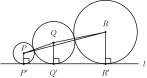
Put the tangent line on the -axis and take Because and the centers differ in height by the horizontal distance from to is Similarly, and its centers also differ in height by so their horizontal distance is
Thus we may use The coordinate-area formula gives
Thus, the correct answer is D .
22.
For some positive integer the number has positive integer divisors, including and the number How many positive integer divisors does the number have?
Answer: D
Small Hint:
The divisor count forces exponents
Big Hint:
Those exponents are all , so they can come from
Solution:
The prime factorization is . If has divisors, then it has exactly three prime factors, with exponents in some order.
For each of the primes , its exponent in is more than a multiple of . The exponents all have this form, so the corresponding exponents in are in some order.
In , the exponents from are therefore , in some order, along with the exponent on prime . Hence the divisor count is
Thus, the correct answer is D.
23.
A binary operation has the properties that and that for all nonzero real numbers and (Here the dot represents the usual multiplication operation.) The solution to the equation can be written as where and are relatively prime positive integers. What is
Answer: A
Small Hint:
First prove
Big Hint:
Then compute
Solution:
Since , substituting in gives . Also, using gives . Therefore .
The equation becomes Thus , so .
Thus, the correct answer is A.
24.
A quadrilateral is inscribed in a circle of radius Three of the sides of this quadrilateral have length What is the length of the fourth side?
Answer: E
Small Hint:
Equal chords give equal central angles
Big Hint:
If a -unit chord subtends angle , use the chord formula and
Solution:
Label the quadrilateral , with . Let each of these equal chords subtend central angle . The chord formula gives so . In particular, , so the smaller central angle subtended by is .
Therefore another use of the chord formula gives Using , we obtain
Hence
Thus, the correct answer is E.
25.
How many ordered triples of positive integers satisfy and
Answer: A
Small Hint:
Treat each prime exponent independently
Big Hint:
The powers of and each leave a small max-condition count
Solution:
Factor the given least common multiples: Since has no factor of , neither nor has a factor of , and must contain .
Write , , and . The power of in forces , and the power of in forces .
The remaining independent conditions are and . These have and ordered choices, respectively, so there are triples.
Thus, the correct answer is A.