
2010 AMC 10B Problems
25 problems · 75 minutes
Scroll down and press Start to try the exam! Or, go to the printable PDF, answer key, or professional solutions curated by LIVE by Po-Shen Loh.
Or jump straight to a single problem with its solution: 1 · 2 · 3 · 4 · 5 · 6 · 7 · 8 · 9 · 10 · 11 · 12 · 13 · 14 · 15 · 16 · 17 · 18 · 19 · 20 · 21 · 22 · 23 · 24 · 25
All problems are used with official legal permission of the Mathematical Association of America (MAA).
Want to learn professionally through interactive video classes?
Learn LIVETimed
1:15:00
1.
What is the value of the following expression?
Answer: C
Small hint:
Expand both terms before subtracting
Big hint:
Most of the terms cancel
Solution:
We have that and
As such, their difference is:
Thus, C is the correct answer.
2.
Makayla attended two meetings during her -hour work day. The first meeting took minutes and the second meeting took twice as long. What percent of her work day was spent attending meetings?
Answer: C
Small hint:
Convert the work day to minutes: hours is minutes
Big hint:
The two meetings together last minutes
Solution:
The two meetings lasted minutes, and the work day is minutes.
The fraction of the day spent in meetings is
Thus, the correct answer is C.
3.
A drawer contains red, green, blue, and white socks with at least of each color. What is the minimum number of socks that must be pulled from the drawer to guarantee a matching pair?
Answer: C
Concepts:pigeonhole principle
Small hint:
Use the worst case before a pair appears
Big hint:
You can draw one sock of each of the four colors first
Solution:
To maximize the number of socks, we want to grab as many single socks as possible before getting a pair.
There are colors, which means that we can draw one sock of each color before drawing a pair.
This means that it takes at least socks to be drawn before a pair is guaranteed.
Thus, C is the correct answer.
4.
For a real number define to be the average of and What is the value of the following expression?
Answer: C
Small hint:
Evaluate separately
Big hint:
Solution:
We have and
Then
Thus, C is the correct answer.
5.
A month with days has the same number of Mondays and Wednesdays. How many of the seven days of the week could be the first day of this month?
Answer: B
Small hint:
so exactly three weekdays occur five times
Big hint:
Those three days are the first three days of the month; check when Monday and Wednesday match
Solution:
Since the first three days of the month each occur five times, and the other four days occur four times.
Mondays and Wednesdays are equal in number exactly when both fall in the five-time group or both fall in the four-time group.
If the first day is Monday, the five-time days are Mon, Tue, Wed (both appear five times). If the first day is Thursday or Friday, the five-time days miss both Monday and Wednesday (both appear four times). Every other starting day includes exactly one of Monday or Wednesday.
So the first day can be Monday, Thursday, or Friday, giving possibilities.
Thus, the correct answer is B.
6.
A circle is centered at is a diameter and is a point on the circle with What is the degree measure of
Answer: B
Small hint:
Relate to
Big hint:
, so is isosceles
Solution:
Consider the following diagram:
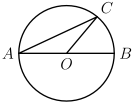
We have that
Since is isosceles, we have that
Since we have that
Thus, B is the correct answer.
7.
A triangle has side lengths and A rectangle has width and area equal to the area of the triangle. What is the perimeter of this rectangle?
Answer: D
Small hint:
Drop the altitude to the side of length
Big hint:
The altitude splits the triangle into two -- triangles
Solution:
To find the area of the triangle, we can drop the altitude to the side of length
Then we have a right triangle with one leg and hypotenuse
The other leg has length
The area of the triangle is then
The length of the rectangle is then Its perimeter is
Thus, D is the correct answer.
8.
A ticket to a school play costs dollars, where is a whole number. A group of th graders buys tickets costing a total of and a group of th graders buys tickets costing a total of How many values for are possible?
Answer: E
Small hint:
The ticket price must divide both totals
Big hint:
Count the positive divisors of
Solution:
Note that must divide both and which means that it must divide their greatest common divisor.
The greatest common divisor of and is which means divides
has factors, namely all the powers of up to
Thus, E is the correct answer.
9.
Lucky Larry’s teacher asked him to substitute numbers for and in the expression and evaluate the result. Larry ignored the parentheses but added and subtracted correctly and obtained the correct result by coincidence. The numbers Larry substituted for and were and respectively. What number did Larry substitute for
Answer: D
Small hint:
Compare Larry’s ignored-parentheses value to the correct value
Big hint:
Correctly evaluated, the expression is
Solution:
Ignoring the parentheses, Larry would get
Evaluating with the parentheses, one would get
Both of these values are the same, so
Thus, D is the correct answer.
10.
Shelby drives her scooter at a speed of miles per hour if it is not raining, and miles per hour if it is raining. Today she drove in the sun in the morning and in the rain in the evening, for a total of miles in minutes. How many minutes did she drive in the rain?
Answer: C
Small hint:
Let be the minutes in the rain; convert each speed to miles per minute
Big hint:
Rain distance plus sun distance equals
Solution:
Let be the number of minutes driven in the rain. She covers miles in the rain and miles in the sun.
Setting the total to gives so and
Thus, the correct answer is C.
11.
A shopper plans to purchase an item that has a listed price greater than and can use any one of the three coupons. Coupon A gives off the listed price, Coupon B gives off the listed price, and Coupon C gives off the amount by which the listed price exceeds
Let and be the smallest and largest prices, respectively, for which Coupon A saves at least as many dollars as Coupon B or C. What is
Answer: A
Small hint:
Write each coupon’s savings in terms of the listed price
Big hint:
Coupon A must beat both and
Solution:
Let be the price of the item. Then coupon A saves Coupon B saves
Coupon C will save
We must have that and
This shows that and Therefore
Thus, A is the correct answer.
12.
At the beginning of the school year, of all students in Mr. Wells’ math class answered “Yes” to the question “Do you love math”, and answered “No.” At the end of the school year, answered “Yes” and answered “No.” Altogether, of the students gave a different answer at the beginning and end of the school year. What is the difference between the maximum and the minimum possible values of
Answer: D
Small hint:
Assume students; the “Yes” count rises from to
Big hint:
At least must switch, and only end with “No,” bounding how many can switch
Solution:
Assume students. The number of “Yes” answers rises from to so at least students switched from “No” to “Yes”; thus
Since only students answer “No” at the end, at least of the original “Yes” students still answer “Yes,” so at most students switched; thus
Both extremes are achievable, so the difference is
Thus, the correct answer is D.
13.
What is the sum of all the solutions of the equation below?
Answer: C
Small hint:
Split cases based on the sign of
Big hint:
After resolving the inner absolute value, solve the resulting absolute-value equations
Solution:
We first take care of the outer absolute value. We have either or
These simplify to and
We have cases for each equation. For the first one, we have and
Solving both gives us and
For the other equation, we have and
Again solving both, we have and Note that cannot be negative since the right side of the original equation is nonnegative.
Adding up all the solutions gives us
Thus, C is the correct answer.
14.
The average of the numbers and is What is
Answer: B
Small hint:
Use the sum
Big hint:
Set
Solution:
Recall that the sum of the first integers is
Then, we have that which simplifies to by difference of squares. Dividing gives us
Thus, B is the correct answer.
15.
On a -question multiple choice math contest, students receive points for a correct answer, points for an answer left blank, and point for an incorrect answer. Jesse’s total score on the contest was What is the maximum number of questions that Jesse could have answered correctly?
Answer: C
Small hint:
Let be correct answers and wrong answers
Big hint:
Use and
Solution:
Let be the number of questions Jesse answered correctly and be the number he answered incorrectly.
Then and
We have that
Rearranging and simplifying tells us that Since is an integer, its maximum value is
Thus, C is the correct answer.
16.
A square of side length and a circle of radius share the same center. What is the area inside the circle, but outside the square?
Answer: B
Small hint:
Find where the circle cuts one side of the square
Big hint:
One side contributes a circular segment outside the square
Solution:
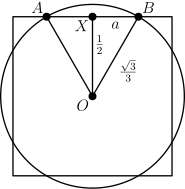
Drop the altitude from to at
Looking at the side lengths, we see that is a triangle.
This means that the area of sector is
We also have that the area of is
The area of the sector outside the square and inside the circle is then
There are of these regions, which gives us a total area of
Thus, B is the correct answer.
17.
Every high school in the city of Euclid sent a team of students to a math contest. Each participant in the contest received a different score. Andrea’s score was the median among all students, and hers was the highest score on her team. Andrea’s teammates Beth and Carla placed th and th, respectively. How many schools are in the city?
Answer: B
Small hint:
If there are schools, there are contestants
Big hint:
Andrea’s median place is
Solution:
Let there be schools. Then there are participants in the contest.
Because the median is one student’s score, is odd, so is odd. Carla’s th place requires and hence the odd integer is at least
Andrea’s median place is Because she had the highest score on her team, she finished ahead of Beth, so This gives and therefore the odd integer is at most
Thus there are schools.
Thus, B is the correct answer.
18.
Positive integers and are randomly and independently selected with replacement from the set
What is the probability that is divisible by
Answer: E
Small hint:
Factor the expression as
Big hint:
If is not divisible by , work modulo with
Solution:
Note that This means that if is divisible by the whole expression is as well.
Since is divisible by we have that is divisible by with probability
Now consider not divisible by For the expression to be divisible by we must have that is divisible by
This means that
The only possibility for this is that one of the factors is mod and the other is mod
For each of the two cases, there is a chance that each of the factors is the desired modulus, for a probability of
There are two cases, which means that this happens with a probability.
The total probability is then
Thus, E is the correct answer.
19.
A circle with center has area Triangle is equilateral, is a chord on the circle, and point is outside What is the side length of
Answer: B
Small hint:
Let be the side length and drop the altitude from
Big hint:
Use the circle radius and the equilateral triangle altitude
Solution:
Consider the following diagram:
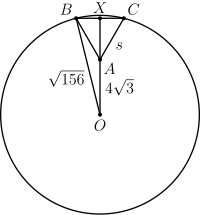
Using the formula for the area of a circle, we have that since it is a radius.
Extend to intersect at Let be the side length of
Then we have that and
We have that is right, which means that we can apply the Pythagorean Theorem. This gives us
Simplifying, we get
Since is positive, we must have that
Thus, B is the correct answer.
20.
Two circles lie outside regular hexagon The first is tangent to and the second is tangent to Both are tangent to lines and What is the ratio of the area of the second circle to that of the first circle?
Answer: D
Small hint:
Compare the two circle radii
Big hint:
The larger radius comes from a -- triangle
Solution:
Consider the following diagram:
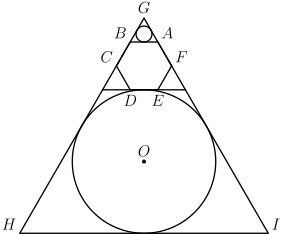
Assume the regular hexagon has side length The smaller circle is inscribed in an equilateral triangle of side length
The inradius of this equilateral triangle is The area of the circle is then
Let be the center of the larger circle. Drop the perpendicular from to at Draw
We have that is right. Since we also have that is a triangle.
Let Then We also have that is the sum of the height of the hexagon, equilateral triangle, and radius of the circle.
Then
Substituting in we get Simplifying gives us
The area of the larger circle is then
The desired ratio is then
Thus, D is the correct answer.
21.
A palindrome between and is chosen at random. What is the probability that it is divisible by
Answer: E
Small hint:
A four-digit palindrome equals
Big hint:
is divisible by but is not
Solution:
A four-digit palindrome has the form with and
Since is divisible by and is not, the number is divisible by exactly when is divisible by that is or
For each that is of the choices of a probability of
Thus, the correct answer is E.
22.
Seven distinct pieces of candy are to be distributed among three bags. The red bag and the blue bag must each receive at least one piece of candy; the white bag may remain empty. How many arrangements are possible?
Answer: C
Small hint:
Count all distributions first
Big hint:
Subtract cases with the red or blue bag empty, then add back the overlap
Solution:
We can count this with complementary counting. The total number of ways to distribute the candies with no restrictions is
To find the number of invalid arrangements, we have to count the number of ways where either the red or blue bag is empty.
For the case where the red bag is empty, each candy has options for the bag that goes into. There are then arrangements for this case. Similarly, there are arrangements for the case where the blue bag is empty.
There is an overlap of one case where both bags are empty. The final answer is then
Thus, C is the correct answer.
23.
The entries in a array include all the digits from through arranged so that the entries in every row and column are in increasing order. How many such arrays are there?
Answer: D
Small hint:
The top-left entry is forced to be and the bottom-right to be
Big hint:
Split into cases by the center entry, which must be or
Solution:
Write for the entry in row column The conditions force and
If then and split as complementary pairs filling the rest of the last row and column: splits times orders for gives arrays. By symmetry also gives
If then and are complementary subsets of subject to the ordering constraints. The first set can be any three-element subset except or giving arrays.
Altogether
Thus, the correct answer is D.
24.
A high school basketball game between the Raiders and Wildcats was tied at the end of the first quarter. The number of points scored by the Raiders in each of the four quarters formed an increasing geometric sequence, and the number of points scored by the Wildcats in each of the four quarters formed an increasing arithmetic sequence. At the end of the fourth quarter, the Raiders had won by one point. Neither team scored more than points. What was the total number of points scored by the two teams in the first half?
Answer: E
Small hint:
Let the Raiders score and the Wildcats tied at
Big hint:
The totals differ by and both stay under which forces small values
Solution:
Let the Raiders score (increasing geometric, ) and the Wildcats (increasing arithmetic), tied in the first quarter at
Write in lowest terms, with Since is an integer, is divisible by put The Raiders’ total is Since we have The pair already makes the parenthesized sum so the only possible coprime pairs are
The corresponding base values of are For and the bound forces but gives a nonintegral For it would give which is impossible modulo
For we have and so Thus and forces Then giving Raiders scores and Wildcats scores The Raiders win to
The first-half total is
Thus, the correct answer is E.
25.
Let and let be a polynomial with integer coefficients such that and What is the smallest possible value of
Answer: B
Small hint:
for some integer polynomial
Big hint:
Evaluate at to force to be divisible by
Solution:
Since are roots of write with having integer coefficients.
Evaluating at (where ) gives
So and all divide hence divides Since is odd, is divisible by so
To attain the bound, let This integer polynomial equals at At the pairs are and at they are Thus each time and Hence the bound is attainable.
Thus, the correct answer is B.