
2005 AMC 10B Problems
Scroll down and press Start to try the exam! Or, go to the printable PDF, answer key, or professional solutions curated by LIVE by Po-Shen Loh.
All problems are used with official legal permission of the Mathematical Association of America (MAA).
Or jump straight to a single problem with its solution: 1 · 2 · 3 · 4 · 5 · 6 · 7 · 8 · 9 · 10 · 11 · 12 · 13 · 14 · 15 · 16 · 17 · 18 · 19 · 20 · 21 · 22 · 23 · 24 · 25
Want to learn professionally through interactive video classes?
Timed
1:15:00
1.
A scout troop buys candy bars at a price of five for They sell all the candy bars at a price of two for What was their profit, in dollars?
Answer: A
Small Hint:
Find the total cost and the total revenue separately
Big Hint:
The bars come in groups of five and pairs
Solution:
The troop buys groups of five bars, costing dollars.
They sell pairs of bars, earning dollars.
The profit is
Thus, A is the correct answer.
2.
A positive number has the property that of is What is
Answer: D
Small Hint:
means
Big Hint:
Set up and solve for
Solution:
The statement translates to so
Since is positive,
Thus, D is the correct answer.
3.
A gallon of paint is used to paint a room. One third of the paint is used on the first day. On the second day, one third of the remaining paint is used. What fraction of the original amount of paint is available to use on the third day?
Answer: D
Small Hint:
After day one, of the paint remains
Big Hint:
On day two, of that is used
Solution:
After the first day, of the paint remains.
On the second day, of the original amount is used.
The fraction available on the third day is
Thus, D is the correct answer.
4.
For real numbers and define What is the value of
Answer: D
Small Hint:
Evaluate the two inner operations first
Big Hint:
Both and equal
Solution:
Each inner expression evaluates to and similarly
Then
Thus, D is the correct answer.
5.
Brianna is using part of the money she earned on her weekend job to buy several equally-priced CDs. She used one fifth of her money to buy one third of the CDs. What fraction of her money will she have left after she buys all the CDs?
Answer: C
Small Hint:
Buying all the CDs costs three times as much as buying one third of them
Big Hint:
All the CDs cost of her money
Solution:
Buying all the CDs costs three times as much as buying one third of them, namely of her money.
The fraction left over is
Thus, C is the correct answer.
6.
At the beginning of the school year, Lisa’s goal was to earn an A on at least of her quizzes for the year. She earned an A on of the first quizzes. If she is to achieve her goal, on at most how many of the remaining quizzes can she earn a grade lower than an A?
Answer: B
Small Hint:
Find how many A’s she needs in total
Big Hint:
She needs A’s, and quizzes remain
Solution:
Lisa needs an A on at least quizzes.
She already has so she needs A’s among the remaining quizzes.
That leaves at most quizzes with a grade lower than an A.
Thus, B is the correct answer.
7.
A circle is inscribed in a square, then a square is inscribed in this circle, and finally, a circle is inscribed in this square. What is the ratio of the area of the smaller circle to the area of the larger square?
Answer: B
Small Hint:
Let the smaller circle have radius and work outward
Big Hint:
The larger circle’s radius is half the diagonal of the smaller square,
Solution:
Let the smaller circle have radius so its area is
The smaller square, which circumscribes this circle, has side and its diagonal is the diameter of the larger circle. So the larger circle has radius
The larger square circumscribes the larger circle, so it has side and area
The desired ratio is
Thus, B is the correct answer.
8.
An -foot by -foot floor is tiled with square tiles of size foot by foot. Each tile has a pattern consisting of four white quarter circles of radius foot centered at each corner of the tile. The remaining portion of the tile is shaded. How many square feet of the floor are shaded?

Answer: A
Small Hint:
The four quarter circles on one tile combine into one full circle
Big Hint:
Each tile has shaded area and there are tiles
Solution:
The four quarter circles on a tile together make one full circle of radius with area
So each tile has shaded area square feet.
There are tiles, so the total shaded area is
Thus, A is the correct answer.
9.
One fair die has faces and another has faces The dice are rolled and the numbers on the top faces are added. What is the probability that the sum will be odd?
Answer: D
Small Hint:
A sum is odd exactly when one die is even and the other is odd
Big Hint:
The first die is odd with probability the second is odd with probability
Solution:
The first die is odd (a or ) with probability and even with probability The second die is odd (a ) with probability and even with probability
The sum is odd when the two parities differ:
Thus, D is the correct answer.
10.
In we have and Suppose that is a point on line such that lies between and and What is
Answer: A
Small Hint:
Drop the altitude from to line its foot is the midpoint of
Big Hint:
The altitude has length shared by right triangles and
Solution:
Let be the foot of the altitude from to line Since is the midpoint of so and
Applying the Pythagorean theorem in where gives so
Then so
Thus, A is the correct answer.
11.
The first term of a sequence is Each succeeding term is the sum of the cubes of the digits of the previous term. What is the th term of the sequence?
Answer: E
Small Hint:
Compute the first several terms until the values start repeating
Big Hint:
Once you find the repeating cycle, reduce the number of steps after the first term modulo its length
Solution:
The sequence begins so after the first term it repeats the cycle of length
Terms and are the first, second, and third entries of this cycle. Because leaves remainder upon division by the th term matches the third entry,
Thus, E is the correct answer.
12.
Twelve fair dice are rolled. What is the probability that the product of the numbers on the top faces is prime?
Answer: E
Small Hint:
A product of positive integers is prime only when one factor is a prime and the rest are
Big Hint:
Choose which die shows the prime, and which prime; the other dice must show
Solution:
The product is prime exactly when one die shows a prime ( or ) and the other eleven all show
The probability that any single die is the prime one is and each of the other eleven shows with probability Accounting for which of the twelve dice is prime, the probability is
Thus, E is the correct answer.
13.
How many numbers between and are integer multiples of or but not
Answer: C
Small Hint:
Count multiples of and of separately, noting that multiples of are the overlap
Big Hint:
From each of the -multiples and -multiples, remove the -multiples
Solution:
Between and there are multiples of multiples of and multiples of
Every multiple of is both a multiple of and of so removing them from each group gives numbers that are multiples of or but not
Thus, C is the correct answer.
14.
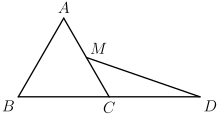
Equilateral has side length is the midpoint of and is the midpoint of What is the area of
Answer: C
Small Hint:
Take as the base; it has length
Big Hint:
The height from to line is half the height of
Solution:
Take as the base. Since is the midpoint of and we have
The height of is the distance from to line Because is the midpoint of this distance is half the height of which is
The area is
Thus, C is the correct answer.
15.
An envelope contains eight bills: ones, fives, tens, and twenties. Two bills are drawn at random without replacement. What is the probability that their sum is or more?
Answer: D
Small Hint:
There are equally likely pairs of bills
Big Hint:
A sum of or more needs both tens, both twenties, or a twenty with any other bill
Solution:
There are equally likely pairs.
A sum of at least comes from both twenties ( way), a twenty paired with any of the six smaller bills ( ways), or both tens ( way).
The probability is
Thus, D is the correct answer.
16.
The quadratic equation has roots that are twice those of and none of and is zero. What is the value of
Answer: D
Small Hint:
Let the roots of be and then use Vieta’s formulas on both equations
Big Hint:
Express and in terms of and
Solution:
Let and be the roots of so and
The roots of are and so and
Then and so Therefore
Thus, D is the correct answer.
17.
Suppose that and What is
Answer: B
Small Hint:
Raise successive equations to powers so the exponents multiply
Big Hint:
telescopes down to write as a power of
Solution:
Chaining the equations,
Since we conclude
Thus, B is the correct answer.
18.
All of David’s telephone numbers have the form where and are distinct digits and in increasing order, and none is either or How many different telephone numbers can David have?
Answer: D
Small Hint:
The seven digits come from and their order is forced
Big Hint:
Once the omitted digit is chosen, every digit’s position in the phone number is determined
Solution:
The seven digits are chosen from and once chosen they must be written in increasing order, so only the choice of digits matters.
Choosing seven of these eight digits is the same as choosing the one digit to leave out, which can be done in ways.
Thus, D is the correct answer.
19.
On a certain math exam, of the students got points, got points, got points, got points, and the rest got points. What is the difference between the mean and the median score on this exam?
Answer: B
Small Hint:
The remaining percentage scored find it first
Big Hint:
For the median, find which score the middle student earned using the cumulative percentages
Solution:
The percentage scoring is
The mean is
Since scored below and scored above the middle student scored so the median is
The difference is
Thus, B is the correct answer.
20.
What is the average (mean) of all -digit numbers that can be formed by using each of the digits and exactly once?
Answer: C
Small Hint:
By symmetry, each digit appears equally often in each place
Big Hint:
The average digit in each place is then multiply by
Solution:
By symmetry, each of the five digits appears equally often in each place, so the average digit in every place is
The average number is therefore
Thus, C is the correct answer.
21.
Forty slips are placed into a hat, each bearing a number or with each number entered on four slips. Four slips are drawn from the hat at random and without replacement. Let be the probability that all four slips bear the same number. Let be the probability that two of the slips bear a number and the other two bear a number What is the value of
Answer: A
Small Hint:
Both probabilities share the denominator so only the counts matter
Big Hint:
Count four-of-a-kind draws, then draws of the form two ’s and two ’s
Solution:
Both events draw from equally likely selections, so is the ratio of their favorable counts.
Exactly draws give four slips of the same number, one for each value.
For two ’s and two ’s, choose the two values in ways, then two of the four -slips and two of the four -slips:
Therefore
Thus, A is the correct answer.
22.
For how many positive integers less than or equal to is evenly divisible by
Answer: C
Small Hint:
Use and simplify
Big Hint:
The reduced fraction fails to be an integer exactly when is an odd prime
Solution:
Since divisibility is equivalent to being an integer.
Put If is composite and not a square, it has two distinct proper factors whose product is both occur in If with the factors and occur in that factorial, so it contains a multiple of The remaining composite case, also divides Thus the fraction is an integer whenever is composite. If is an odd prime, it divides neither nor so the fraction is not an integer. The even prime gives which works.
The odd primes at most are giving failing values of Hence values work.
Thus, C is the correct answer.
23.
In trapezoid we have parallel to as the midpoint of and as the midpoint of The area of is twice the area of What is
Answer: C
Small Hint:
The midsegment has length
Big Hint:
The two smaller trapezoids share a height, so their areas compare like the averages of their parallel sides
Solution:
Let and The midsegment has length and and have the same height.
Their areas are proportional to the averages of their parallel sides, so
Then so and
Thus, C is the correct answer.
24.
Let and be two-digit integers such that is obtained by reversing the digits of The integers and satisfy for some positive integer What is
Answer: E
Small Hint:
Write and then factor
Big Hint:
must be a perfect square, which forces
Solution:
Write and with Then
Since for to be a perfect square we need to be divisible by As this forces and then must itself be a perfect square.
With the only workable case is giving Then and so
Therefore
Thus, E is the correct answer.
25.
A subset of the set of integers from to inclusive, has the property that no two elements of sum to What is the maximum possible number of elements in
Answer: C
Small Hint:
Which integers can pair with another to sum to
Big Hint:
Separate the integers with no possible partner from the disjoint pairs whose members sum to
Solution:
The pairs summing to are which is pairs. From each pair, may contain at most one element.
The numbers through cannot pair with anything in range to sum to so all of them may be included.
Thus has at most elements, and the set achieves this.
Thus, C is the correct answer.