
2004 AMC 10B Problems
Scroll down and press Start to try the exam! Or, go to the printable PDF, answer key, or professional solutions curated by LIVE by Po-Shen Loh.
All problems are used with official legal permission of the Mathematical Association of America (MAA).
Or jump straight to a single problem with its solution: 1 · 2 · 3 · 4 · 5 · 6 · 7 · 8 · 9 · 10 · 11 · 12 · 13 · 14 · 15 · 16 · 17 · 18 · 19 · 20 · 21 · 22 · 23 · 24 · 25
Want to learn professionally through interactive video classes?
Timed
1:15:00
1.
Each row of the Misty Moon Amphitheater has seats. Rows through are reserved for a youth club. How many seats are reserved for this club?
Answer: C
Small Hint:
Count how many rows run from through inclusive
Big Hint:
Multiply the number of rows by
Solution:
Rows through inclusive make up rows.
Each row has seats, so the total is
Thus, the correct answer is C.
2.
How many two-digit positive integers have at least one as a digit?
Answer: B
Small Hint:
Count the numbers with in the tens place and those with in the units place separately
Big Hint:
The number belongs to both groups
Solution:
The numbers through give with a in the tens place.
The numbers give with a in the units place.
Since is counted twice, the total is
Thus, the correct answer is B.
3.
At each basketball practice last week, Jenny made twice as many free throws as she made at the previous practice. At her fifth practice she made free throws. How many free throws did she make at the first practice?
Answer: A
Small Hint:
Each practice count is twice the previous one, so work backward by halving
Big Hint:
Halve repeatedly to reach the first practice
Solution:
Working backward from the fifth practice, the counts are and at the fourth, third, second, and first practices.
Thus, the correct answer is A.
4.
A standard six-sided die is rolled, and is the product of the five numbers that are visible. What is the largest number that is certain to divide
Answer: B
Small Hint:
The product of all six faces is ; exactly one face is hidden
Big Hint:
For each prime, find how many copies must remain no matter which face is hidden
Solution:
Since the visible product uses only the primes and
Hiding leaves the fewest ’s, namely Hiding or leaves the fewest ’s, namely one. Hiding leaves no factor of
Therefore is always divisible by but not necessarily by any larger number.
Thus, the correct answer is B.
5.
In the expression the values of and are and although not necessarily in that order. What is the maximum possible value of the result?
Answer: D
Small Hint:
To maximize the result, make the subtracted value
Big Hint:
With remaining, compare for the sensible assignments
Solution:
Setting removes the subtraction, so we maximize using
Taking gives The alternative is smaller, and any assignment with forces a smaller power. The maximum is
Thus, the correct answer is D.
6.
Which of the following numbers is a perfect square?
Answer: C
Small Hint:
For write as
Big Hint:
The product is a perfect square exactly when is
Solution:
For equals which is a perfect square precisely when is a perfect square.
For the five choices this leftover factor is and Only is a perfect square.
Therefore is the perfect square.
Thus, the correct answer is C.
7.
On a trip from the United States to Canada, Isabella took U.S. dollars. At the border she exchanged them all, receiving Canadian dollars for every U.S. dollars. After spending Canadian dollars, she had Canadian dollars left. What is the sum of the digits of
Answer: A
Small Hint:
Exchanging U.S. dollars gives Canadian dollars
Big Hint:
Set and solve for
Solution:
Isabella received Canadian dollars and spent leaving So
Then so The sum of its digits is
Thus, the correct answer is A.
8.
Minneapolis-St. Paul International Airport is miles southwest of downtown St. Paul and miles southeast of downtown Minneapolis. Which of the following is closest to the number of miles between downtown St. Paul and downtown Minneapolis?
Answer: A
Small Hint:
Southwest and southeast are perpendicular directions
Big Hint:
The distance is ; estimate the nearest whole number
Solution:
The two given directions are perpendicular, so the airport sits at the right angle of a right triangle with legs and
The distance between the downtowns is which is closest to
Thus, the correct answer is A.
9.
A square has sides of length and a circle centered at one of its vertices has radius What is the area of the union of the regions enclosed by the square and the circle?
Answer: B
Small Hint:
Add the areas of the square and the circle, then subtract the overlap
Big Hint:
The overlap is the quarter of the circle that lies inside the square
Solution:
The square has area and the circle has area
Since the circle is centered at a vertex of the square, exactly one quarter of the circle, area lies inside the square.
The union has area
Thus, the correct answer is B.
10.
A grocer makes a display of cans in which the top row has one can and each lower row has two more cans than the row above it. If the display contains cans, how many rows does it contain?
Answer: D
Small Hint:
The rows contain cans
Big Hint:
The sum of the first odd numbers equals
Solution:
The rows hold cans, and the sum of the first odd numbers is
Setting gives
Thus, the correct answer is D.
11.
Two eight-sided dice each have faces numbered through When the dice are rolled, each face has an equal probability of appearing on the top. What is the probability that the product of the two top numbers is greater than their sum?
Answer: C
Small Hint:
The condition rearranges to
Big Hint:
Count the ordered pairs where instead
Solution:
There are ordered pairs. The inequality is equivalent to
This fails only when or which account for pairs.
The probability is
Thus, the correct answer is C.
12.
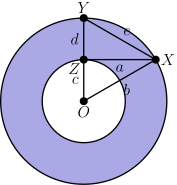
An annulus is the region between two concentric circles. The concentric circles in the figure have radii and with Let be a radius of the larger circle, let be tangent to the smaller circle at and let be the radius of the larger circle that contains Let and What is the area of the annulus?
Answer: A
Small Hint:
The annulus area is
Big Hint:
Since is tangent at triangle is right-angled, giving
Solution:
The annulus is the difference of the two circular areas,
Because is tangent to the small circle at it is perpendicular to the radius In right triangle with and we get
Therefore the area of the annulus is
Thus, the correct answer is A.
13.
In the United States, coins have the following thicknesses: penny, mm; nickel, mm; dime, mm; quarter, mm. If a stack of these coins is exactly mm high, how many coins are in the stack?
Answer: B
Small Hint:
Every coin thickness ends in a in the hundredths place, so consider the height’s last two decimal digits
Big Hint:
For the height to be a whole number of mm, the number of coins must be a multiple of
Solution:
Measure every thickness in hundredths of a millimeter. The four possible thicknesses are all congruent to If the stack has coins and an integer height, its total in hundredths is divisible by so is divisible by Therefore must be a multiple of
A stack of coins is at most mm, and a stack of coins is at least mm, so only coins can total mm.
Indeed, quarters give mm.
Thus, the correct answer is B.
14.
A bag initially contains red marbles and blue marbles only, with more blue than red. Red marbles are added to the bag until only of the marbles in the bag are blue. Then yellow marbles are added to the bag until only of the marbles in the bag are blue. Finally, the number of blue marbles in the bag is doubled. What fraction of the marbles now in the bag are blue?
Answer: C
Small Hint:
Let be the number of blue marbles and track the total at each stage
Big Hint:
Just before doubling there are blue out of total
Solution:
Let there be blue marbles. After adding red marbles the total is after adding yellow marbles the total is still with blue.
Doubling the blue marbles gives blue out of total, which is
Thus, the correct answer is C.
15.
Patty has coins consisting of nickels and dimes. If her nickels were dimes and her dimes were nickels, she would have cents more. How much are her coins worth?
Answer: A
Small Hint:
Swapping raises the value, so she has more nickels than dimes
Big Hint:
Each nickel-for-dime swap changes the total by cents
Solution:
Swapping increases the value, so Patty has more nickels than dimes. Each swapped coin changes the total by cents, so she has more nickels than dimes.
With and she has nickels and dimes.
Her coins are worth cents, or
Thus, the correct answer is A.
16.
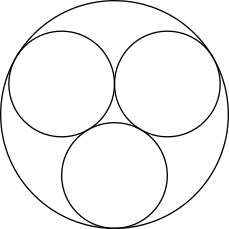
Three circles of radius are externally tangent to each other and internally tangent to a larger circle. What is the radius of the large circle?
Answer: D
Small Hint:
The three small centers form an equilateral triangle of side
Big Hint:
The large radius is plus the distance from that triangle’s center to a vertex
Solution:
The centers of the three unit circles form an equilateral triangle with side Its center is the center of the large circle.
For an equilateral triangle of side length the distance from its center to a vertex is
Adding the unit radius, the large radius is
Thus, the correct answer is D.
17.
The two digits in Jack’s age are the same as the digits in Bill’s age, but in reverse order. In five years Jack will be twice as old as Bill will be then. What is the difference in their current ages?
Answer: B
Small Hint:
Write Jack’s age as and Bill’s as
Big Hint:
The condition reduces to
Solution:
Let Jack’s age be and Bill’s be In five years which simplifies to
Since and are digits, the only solution is
So Jack is and Bill is a difference of
Thus, the correct answer is B.
18.
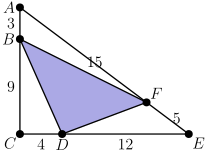
In right triangle we have and Points and are located on and respectively, so that and What is the ratio of the area of to that of
Answer: E
Small Hint:
The area of is
Big Hint:
Subtract the three corner triangles; each has a base and height that are known fractions of the big triangle’s
Solution:
The area of is
Each corner triangle and has a base and an altitude that are and of a corresponding base and altitude of So each has area of
Hence
Thus, the correct answer is E.
19.
In the sequence each term after the third is found by subtracting the previous term from the sum of the two terms that precede that term. For example, the fourth term is What is the th term in this sequence?
Answer: C
Small Hint:
Write out several terms:
Big Hint:
The even-position terms decrease by each time
Solution:
The recurrence gives The sequence begins
So the even-position terms form the arithmetic sequence with common difference The th term is its nd term,
Thus, the correct answer is C.
20.
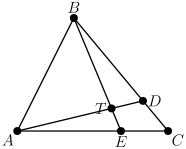
In points and lie on and respectively. If and intersect at so that and what is
Answer: D
Small Hint:
Draw the line through parallel to meeting at a point
Big Hint:
Two pairs of similar triangles give which converts to
Solution:
Let be on with and write
From so
From
Therefore
Thus, the correct answer is D.
21.
Let and be two arithmetic progressions. The set is the union of the first terms of each sequence. How many distinct numbers are in
Answer: A
Small Hint:
The first sequence has common difference and last term
Big Hint:
Common terms start at and are spaced by count the terms not exceeding
Solution:
The first sequence is with largest term and the second is with a much larger last term, so the binding limit is
A common value has the form (the first shared term is spaced by ). Requiring gives that is common numbers.
The number of distinct values is
Thus, the correct answer is A.
22.
A triangle with sides of and has both an inscribed and a circumscribed circle. What is the distance between the centers of those circles?
Answer: D
Small Hint:
Place the right triangle with vertices and
Big Hint:
The circumcenter is the midpoint of the hypotenuse; a right triangle’s inradius is
Solution:
Since the triangle is right. Place it at The circumcenter is the midpoint of the hypotenuse,
The inradius satisfies so and the incenter is
The distance is
Thus, the correct answer is D.
23.
Each face of a cube is painted either red or blue, each with probability The color of each face is determined independently. What is the probability that the painted cube can be placed on a horizontal surface so that the four vertical faces are all the same color?
Answer: B
Small Hint:
Fixing the cube’s orientation, there are equally likely colorings
Big Hint:
The working colorings are: all one color, exactly five one color, or four of one color with the opposite pair the other
Solution:
Fixing the orientation, there are colorings.
A coloring works if all six faces match ( ways), exactly five match ( ways), or four faces share a color with the remaining pair being opposite faces of the other color ( opposite pairs, colors, giving ways).
The total is so the probability is
Thus, the correct answer is B.
24.
In we have and Point is on the circumscribed circle of the triangle so that bisects What is the value of
Answer: B
Small Hint:
Let meet at inscribed angles give
Big Hint:
Triangles and are similar, so find from the Angle Bisector Theorem
Solution:
Let meet at Since and subtend the same arc, they are equal, and so
Hence
By the Angle Bisector Theorem, so
Therefore
Thus, the correct answer is B.
25.
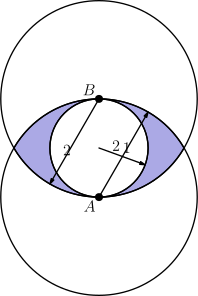
A circle of radius is internally tangent to two circles of radius at points and where is a diameter of the smaller circle. What is the area of the region, shaded in the figure, that is outside the smaller circle and inside each of the two larger circles?
Answer: B
Small Hint:
By symmetry the shaded region splits into four congruent pieces; compute one quarter
Big Hint:
One quarter is a sector of a large circle minus a right triangle minus a quarter of the small circle
Solution:
Let the large circles have centers and let be the center of the small circle, and let be a point where the two large circles meet.
Then is right with and so and its area is
One quarter of the shaded region equals the sector of the radius- circle (area ) minus (area ) minus a quarter of the small circle (area ), giving
Multiplying by the shaded area is
Thus, the correct answer is B.