
2004 AMC 10A Problem 23
Attempt Problem 23 of the 2004 AMC 10A below, then check your answer against the professionally curated solution from LIVE by Po-Shen Loh. You can also try the full timed exam, view all 2004 AMC 10A solutions, or check the answer key.
All problems are used with official legal permission of the Mathematical Association of America (MAA).
23.
Circles and are externally tangent to each other and internally tangent to circle Circles and are congruent. Circle has radius and passes through the center of What is the radius of circle
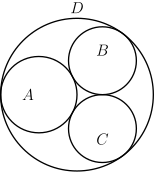
Answer: D
Small Hint:
Since passes through ’s center and is internally tangent, circle has radius
Big Hint:
Place the centers on coordinates; circle of radius has center at distance from and from
Solution:
Because circle passes through ’s center and is internally tangent to circle has radius Place ’s center at the origin and ’s center at
Let circle have radius and center using the symmetry of and about the horizontal axis. Tangency gives
Subtracting yields Substituting into the second equation gives so
Thus, the correct answer is D.
Problem 23 in Other Years
2000 AMC 10 · 2001 AMC 10 · 2002 AMC 10A · 2002 AMC 10B · 2003 AMC 10A · 2003 AMC 10B · 2004 AMC 10B · 2005 AMC 10A · 2005 AMC 10B · 2006 AMC 10A · 2006 AMC 10B · 2007 AMC 10A · 2007 AMC 10B · 2008 AMC 10A · 2008 AMC 10B · 2009 AMC 10A · 2009 AMC 10B · 2010 AMC 10A · 2010 AMC 10B · 2011 AMC 10A · 2011 AMC 10B · 2012 AMC 10A · 2012 AMC 10B · 2013 AMC 10A · 2013 AMC 10B · 2014 AMC 10A · 2014 AMC 10B · 2015 AMC 10A · 2015 AMC 10B · 2016 AMC 10A · 2016 AMC 10B · 2017 AMC 10A · 2017 AMC 10B · 2018 AMC 10A · 2018 AMC 10B · 2019 AMC 10A · 2019 AMC 10B · 2020 AMC 10A · 2020 AMC 10B · 2021 AMC 10A Spring · 2021 AMC 10B Spring · 2021 AMC 10A Fall · 2021 AMC 10B Fall · 2022 AMC 10A · 2022 AMC 10B · 2023 AMC 10A · 2023 AMC 10B · 2024 AMC 10A · 2024 AMC 10B · 2025 AMC 10A · 2025 AMC 10B