
2018 AIME I Problems
Scroll down and press Start to try the exam! Or, go to the printable PDF, answer key, or professional solutions curated by LIVE by Po-Shen Loh.
All problems are used with official legal permission of the Mathematical Association of America (MAA).
Or jump straight to a single problem with its solution: 1 · 2 · 3 · 4 · 5 · 6 · 7 · 8 · 9 · 10 · 11 · 12 · 13 · 14 · 15
Want to learn professionally through interactive video classes?
Timed
3:00:00
1.
Let be the number of ordered pairs of integers with and such that the polynomial can be factored into the product of two (not necessarily distinct) linear factors with integer coefficients. Find the remainder when is divided by
Answer: 600
Small Hint:
The quadratic factors over the integers exactly when the discriminant is a perfect square
Big Hint:
For each the valid come from with and count those and sum over
Solution:
The polynomial factors into integer linear factors exactly when its roots are integers, that is, when the discriminant equals for some integer Given such a exists exactly when for some with and and distinct such give distinct values
For odd the valid are which is choices; for even they are which is choices.
Summing over the odd contribute and the even contribute Thus and the remainder is
2.
The number can be written in base as can be written in base as and can be written in base as where Find the base- representation of
Answer: 925
Small Hint:
The three representations give
Big Hint:
Comparing the last two gives substituting into the first forces where and are base- digits
Solution:
Writing out the place values, where and are base- digits with and and
Equating the last two expressions gives Substituting into (which says ) yields so that is The digit bounds force and then which is a valid digit in bases and
Therefore Indeed confirming the base- form. The answer is
3.
Kathy has red cards and green cards. She shuffles the cards and lays out of the cards in a row in a random order. She will be happy if and only if all the red cards laid out are adjacent and all the green cards laid out are adjacent. For example, card orders RRGGG, GGGGR, or RRRRR will make Kathy happy, but RRRGR will not. The probability that Kathy will be happy is where and are relatively prime positive integers. Find
Answer: 157
Small Hint:
Only the color pattern matters: Kathy is happy exactly when the laid-out reds form one block and the laid-out greens form one block
Big Hint:
A pattern with reds occurs in of the equally likely ordered layouts
Solution:
There are equally likely ordered layouts of of the distinct cards. Kathy is happy exactly when the color pattern consists of one block of reds and one block of greens: the patterns are RRRRR, GGGGG, and the eight mixed patterns and for
A pattern using red and green positions can be filled in ways (ordered choices of which red cards and which green cards appear). For these counts are The happy layouts number
The probability is so
4.
In and Point lies strictly between and on and point lies strictly between and on so that Then can be expressed in the form where and are relatively prime positive integers. Find
Answer: 289
Small Hint:
Let so compute from triangle
Big Hint:
The law of cosines in triangle gives cancel a factor of
Solution:
By the law of cosines in
Let so The law of cosines in gives so Since we may divide by to get hence and
As the answer is
5.
For each ordered pair of real numbers satisfying there is a real number such that Find the product of all possible values of
Small Hint:
Since the first equation says
Big Hint:
That condition factors as substitute each case into the squared form of the second equation to find
Solution:
Because the first equation is equivalent to together with Expanding gives which factors as So or with
Similarly the second equation says that is If (taking so both logarithms are defined), then If (taking so and ), then so
Both cases occur, so the product of all possible values is
6.
Let be the number of complex numbers with the properties that and is a real number. Find the remainder when is divided by
Answer: 440
Small Hint:
Write the difference is real exactly when
Big Hint:
Equal sines mean the angles are equal or supplementary modulo count of each type and check the two families do not overlap
Solution:
Write with Then is real exactly when which happens when the angles are equal or supplementary modulo either giving or giving
The first family has values in and the second has They cannot coincide: would give equating an even number with an odd one.
Hence and the remainder is
7.
A right hexagonal prism has height The bases are regular hexagons with side length Any of the vertices determine a triangle. Find the number of these triangles that are isosceles (including equilateral triangles).
Answer: 52
Small Hint:
Count triangles with all vertices on one hexagon separately from those using both; each hexagon alone contributes isosceles triangles
Big Hint:
For two vertices on one base, the apex on the other base must lie above the perpendicular bisector of the pair, or a lateral side must equal the base chord
Solution:
The chords of a unit regular hexagon have lengths and Among the triangles in one hexagon, have sides and are equilateral with side the other with sides are scalene. So each base contributes isosceles triangles, for in all.
Otherwise two vertices lie on one base ( choices of that base) and one on the other. A vertex of the top base at horizontal distance from a bottom vertex is at distance from it. If the bottom pair is adjacent (chord ): the perpendicular bisector of a hexagon edge passes through no vertices, and no slant side can equal so there are no isosceles triangles. If the pair has one vertex between them (chord pairs): the top vertices above that middle vertex and above the opposite vertex are equidistant from the pair, giving If the pair is diametrically opposite (chord pairs): no vertex lies above the perpendicular bisector, but the top vertex directly above either endpoint gives a slant side equal to the chord, giving
The total is
8.
Let be an equiangular hexagon such that and Denote by the diameter of the largest circle that fits inside the hexagon. Find
Answer: 147
Small Hint:
In an equiangular hexagon and find and
Big Hint:
Opposite sides are parallel, at distance times the sum of the two sides connecting them; the narrowest of the three strips limits the circle
Solution:
All interior angles are so opposite sides are parallel. Attaching equilateral triangles to two opposite sides produces a parallelogram, which forces and Hence and
Walking from one side to the opposite side along the two connecting sides shows that the distance between a pair of opposite sides is times the sum of those two connecting sides: the strips have widths between and between and and between and Any circle inside the hexagon fits in the narrowest strip, so
A circle of diameter tangent to lines and can be centered so that it also touches exactly and has distances and from lines and all more than its radius so it fits inside the hexagon. Therefore and
9.
Find the number of four-element subsets of with the property that two distinct elements of the subset have a sum of and two distinct elements of the subset have a sum of For example, and are two such subsets.
Answer: 210
Small Hint:
There are pairs summing to and pairs summing to split by whether the two pairs can be chosen disjoint
Big Hint:
If the pairs must overlap, some element has both and in the subset plus a free fourth element; subtract the subsets that have two such centers
Solution:
The pairs of distinct elements summing to are (seven pairs), and those summing to are (eight pairs). First count subsets containing a -pair and a -pair that are disjoint. Of the combinations, the ones sharing an element require and all to be valid, which happens for the values other than and No four-element set arises from two different disjoint combinations (a second decomposition would force a -pair to coincide with a -pair), so this case gives subsets.
In the remaining subsets every -pair meets every -pair, so some center has both and in the subset. There are possible centers ( with ), and the fourth element can be any of the remaining numbers, giving center–subset counts. Exactly subsets admit two centers and are counted twice: and This case gives subsets, none of which contain disjoint pairs.
The total is
10.
The wheel shown below consists of two circles and five spokes, with a label at each point where a spoke meets a circle. A bug walks along the wheel, starting at point At every step of the process, the bug walks from one labeled point to an adjacent labeled point. Along the inner circle the bug only walks in a counterclockwise direction, and along the outer circle the bug only walks in a clockwise direction. For example, the bug could travel along the path which has steps. Let be the number of paths with steps that begin and end at point Find the remainder when is divided by
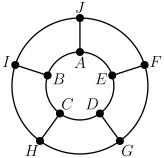
Answer: 4
Small Hint:
Every point offers exactly two moves; call a move if it goes counterclockwise or inward and if clockwise or outward, so paths correspond to -strings
Big Hint:
The bug is back at exactly when the last move is an and the number of s exceeds the number of s by a multiple of
Solution:
From any inner point the bug has exactly two moves, counterclockwise along the inner circle or outward along a spoke; from any outer point it has exactly two, clockwise along the outer circle or inward along a spoke. Call a move if it is counterclockwise or inward and if it is clockwise or outward. Then every string in describes exactly one -step path from
A step arrives on the inner circle exactly when it is an so the path ends on the inner circle exactly when its last move is an in that case the numbers of inward and outward moves are equal. Measuring angular position in fifths of a turn (counterclockwise clockwise spokes ), the path returns to exactly when it ends on the inner circle and the net rotation is a multiple of that is, when the last move is and With moves this means the number of s is or
Fixing the last move as the first moves contain or s, so and the remainder is
11.
Find the least positive integer such that when is written in base its two right-most digits in base are
Answer: 195
Small Hint:
The condition says work modulo and separately, noting
Big Hint:
Since the binomial theorem gives determine when this is then take an lcm
Solution:
The last two base- digits are exactly when and since this holds exactly when modulo both and
Modulo and since is prime and the order of is exactly Modulo the order of modulo is so the order modulo is a multiple of Writing and noting the binomial theorem gives which is exactly when is a multiple of So the order of modulo is
Therefore must be a common multiple of and and the least is
12.
For each subset of let be the sum of the elements of with defined to be If is chosen at random among all subsets of the probability that is divisible by is where and are relatively prime positive integers. Find
Answer: 683
Small Hint:
Each residue class modulo contains exactly six elements of and only the numbers of chosen elements and matter
Big Hint:
With chosen elements and elements you need evaluate using Vandermonde’s identity
Solution:
The set contains six elements in each residue class modulo If contains elements and elements then so is divisible by exactly when the six multiples of may be included freely, contributing a factor to both the favorable and total counts.
By Vandermonde’s identity, the number of ways to choose the s and s with is with it is and with it is The favorable choices number out of
The probability is which is in lowest terms since is odd. Thus
13.
Let have side lengths and Point lies in the interior of and points and are the incenters of and respectively. Find the minimum possible area of as varies along
Answer: 126
Small Hint:
for every position of so it suffices to minimize
Big Hint:
Using and the law of sines, the area is proportional to minimized when
Solution:
Since and bisect angles and a constant. Let The incenter angle formula gives so the law of sines in yields and similarly, since
Therefore which is minimized when that is, when is the foot of the altitude from
With and the half-angle formulas give so the minimum area is
14.
Let be a heptagon. A frog starts jumping at vertex From any vertex of the heptagon except the frog may jump to either of the two adjacent vertices. When it reaches vertex the frog stops and stays there. Find the number of distinct sequences of jumps of no more than jumps that end at
Answer: 351
Small Hint:
Group the vertices as each vertex has exactly one neighbor in each adjacent class, so only the class matters
Big Hint:
If count paths ending in the three classes, then and exactly paths reach on jump
Solution:
Group the vertices into classes and Each vertex of adjoins one vertex of and one of each vertex of adjoins one of and one of and each vertex of adjoins one of and the absorbing vertex Hence if count the -jump paths from that have not yet reached and end in each class, and exactly paths reach for the first time on jump
Starting from the values of for are
The number of sequences of at most jumps ending at is
15.
David found four sticks of different lengths that can be used to form three non-congruent convex cyclic quadrilaterals, and which can each be inscribed in a circle with radius Let denote the measure of the acute angle made by the diagonals of quadrilateral and define and similarly. Suppose that and All three quadrilaterals have the same area which can be written in the form where and are relatively prime positive integers. Find
Answer: 59
Small Hint:
All three quadrilaterals use the same four chords, so their sides cut the circle into the same four arcs, just in different cyclic orders
Big Hint:
In a unit circle a diagonal spanning two arcs has length of their half-sum, and that half-sum is the diagonal angle of one of the other two quadrilaterals
Solution:
The four sticks are chords of the unit circle subtending fixed arcs with The three quadrilaterals are the three distinct cyclic orders of the sides: say has arcs in order then (order ) and (order ) are the other two. The angle between the diagonals of a cyclic quadrilateral is half the sum of the arcs subtended by either pair of opposite sides, so and
In a circle of radius a chord spanning an arc has length The diagonals of span the arcs and so their lengths are and Hence a formula symmetric in the three quadrilaterals, which is why all three areas are equal.
Therefore and